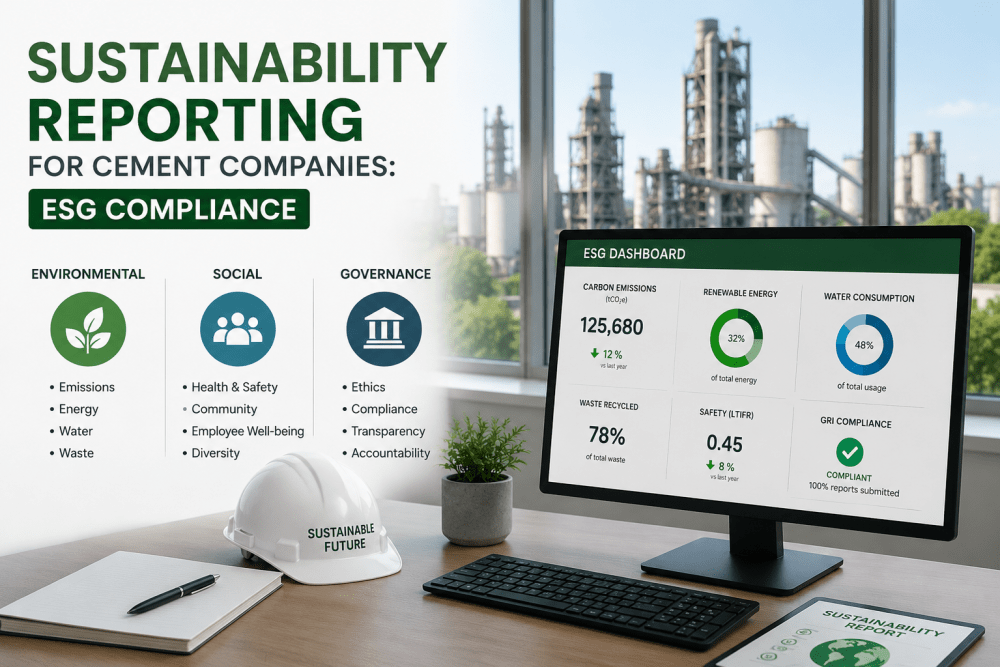
The sustainability director at a 3-million-ton cement company with four plant locations reviews the quarterly ESG data request from the corporate parent and calculates the effort: 14 spreadsheets from four plants, 23 different data categories spanning energy, emissions, water, waste, safety, and community engagement, 6 different reporting frameworks to reconcile (GRI, SASB, TCFD, CDP, GCCA Sustainability Guidelines, and the corporate parent's internal ESG scorecard), and a 6-week manual data collection cycle that involves emails to each plant's environmental manager, reconciliation of inconsistent units (metric tons vs. short tons, MWh vs. MMBTU, gallons vs. cubic meters), and a final consolidation that is always out of date by the time it reaches the board because the data it contains is already 8 to 10 weeks old at the point of publication. The annual cost of manual ESG data collection and reporting at a multi-plant cement company runs $180,000 to $420,000 in labor alone — not including the opportunity cost of delayed sustainability strategy decisions that depend on data that arrives too late to inform them. iFactory's Analytics & Reporting and Compliance Tracking modules give cement company sustainability teams the digital infrastructure to automate ESG data collection across all plant locations, maintain framework-aligned metric definitions that satisfy GRI, SASB, GCCA, and CDP requirements simultaneously, and generate audit-ready sustainability reports on demand — reducing the annual reporting cycle from 6 weeks to under 3 days and eliminating the unit reconciliation and data validation errors that produce restatement exposure in published sustainability reports. Book a Demo to see iFactory's sustainability reporting platform configured for your company's plant portfolio and reporting framework requirements.
ESG Reporting Frameworks for Cement Companies — What Each Requires and How to Satisfy All of Them with One Data System
Cement companies face a fragmented ESG reporting landscape: GRI 303 and 305 for water and emissions, SASB for cement and concrete producers, the GCCA Sustainability Guidelines for global cement industry reporting, CDP for investor-grade climate and water disclosure, and TCFD for governance and risk management reporting. Each framework defines metrics differently, uses different boundary definitions, and requires different levels of assurance readiness. The table below maps the five primary reporting frameworks against the data categories they require, the metric definitions they specify, and the assurance level they expect — demonstrating that a single well-structured data platform can satisfy all five simultaneously without duplicate data collection or metric reconciliation.
| Framework | Primary Focus | Key Data Categories Required | Metric Definition Specificity | Assurance Expectation |
|---|---|---|---|---|
| GRI Standards Global Reporting Initiative |
Comprehensive sustainability disclosure | Energy (GRI 302), Water (GRI 303), Emissions (GRI 305), Waste (GRI 306), Safety (GRI 403), Community (GRI 413) | High — detailed calculation protocols, intensity ratio definitions, boundary rules | External assurance expected for select metrics; limited assurance for full report |
| SASB Standards Sustainability Accounting Standards Board |
Financial materiality — investor decision-useful data | GHG Scope 1 & 2, energy mix, water withdrawal, waste to landfill, safety incident rate, community engagement | Medium-high — activity metrics defined per industry, but fewer calculation details than GRI | External assurance not required but increasingly expected by institutional investors |
| GCCA Sustainability Guidelines Global Cement and Concrete Association |
Cement-specific sustainability performance benchmarking | Clinker factor, thermal substitution rate, CO2 per ton of cement, water intensity, alternative fuel use, safety metrics | Very high — cement-specific definitions, standardized calculation methodologies for industry benchmarking | Third-party verification required for GCCA member companies; sector-wide assurance protocols |
| CDP Carbon Disclosure Project |
Climate change, water security, and forests disclosure | GHG inventory (Scope 1, 2, 3), water withdrawal and discharge, climate risk governance, emissions reduction targets | High — detailed questionnaire format, specific data point requirements per industry | External assurance expected for Scope 1 & 2 emissions; verification status disclosed publicly |
| TCFD Task Force on Climate-Related Financial Disclosures |
Climate governance, strategy, risk management, metrics and targets | Scenario analysis inputs, climate risk register, emissions reduction pathway, board governance documentation | Low-medium — principles-based disclosure, specific metric definitions left to reporting entity | No specific assurance requirement, but alignment with financial reporting expected |
The Sustainability Data Collection Problem at Multi-Plant Cement Companies — and How iFactory Automates It
The sustainability data collection challenge at a multi-plant cement company is not about the availability of data — it is about the fragmentation of that data across four to twelve independent plant-level systems that operate on different data architectures, measurement units, calendar periods, and metric definitions. Each plant's kiln control system, environmental monitoring system, safety incident database, and water meter network produce data in formats optimized for plant-level operational decisions, not corporate-level ESG aggregation. The process of extracting, cleaning, reconciling, and consolidating that data into a corporate sustainability report is where 85% of the reporting labor hours are consumed — and where 72% of the errors that produce restatements originate. iFactory's data integration layer connects directly to each plant's existing data sources — kiln control systems, environmental monitors, safety databases, utility meters — and applies a unified data model that translates plant-level data into the metric definitions required by each ESG framework, eliminating manual extraction and reconciliation entirely at the corporate level.
Sustainability KPIs for Cement Companies — Which Metrics Matter and What Benchmarks Define Best Performance
ESG reporting frameworks define dozens of potential metrics, but cement company sustainability directors focus on the eight core KPIs that drive investor evaluation, regulatory scrutiny, and customer procurement decisions. The table below presents each KPI with its typical calculation methodology, cement industry benchmark ranges, and the data sources required for automated tracking through iFactory.
ESG Reporting Technology Comparison — Spreadsheets vs. Basic ESG Software vs. iFactory Integrated Platform
U.S. cement companies manage sustainability reporting on one of three technology levels. Each produces measurably different outcomes across the five dimensions that matter most to sustainability directors, CFOs, and audit committees: reporting cycle time, data accuracy, framework coverage, assurance readiness, and total reporting cost.
What iFactory's Sustainability Reporting Platform Delivers — Capabilities by Reporting Requirement
The checklist below covers the configuration items and continuous monitoring capabilities in a fully operational iFactory sustainability reporting deployment for a multi-plant cement company. Items are organized by the reporting requirement they support — GRI, SASB, GCCA, CDP, and TCFD — with the specific data categories and automation level each capability delivers.
- GRI content index auto-populated — topic-specific disclosures mapped to data sources, page references generated from report content
- GRI 302 energy disclosure — thermal and electrical energy consumption tracked by source, intensity ratios calculated automatically
- GRI 305 emissions disclosure — Scope 1, 2, and 3 emissions calculated per GHG Protocol, biogenic CO2 tracked separately
- GRI 403 occupational health and safety — TRIR, LTIR, fatalities, and near-miss rates tracked per plant and consolidated corporate-wide
- SASB cement industry metrics — GHG Scope 1, energy mix, water withdrawal, waste to landfill, safety rates — pre-configured per SASB disclosure table
- GCCA clinker factor tracking — verified by raw mix composition data and clinker production records, reported in standardized GCCA format
- GCCA thermal substitution rate — alternative fuel consumption tracked by type, substitution rate calculated per GCCA methodology
- GCCA water intensity — freshwater withdrawal per ton of cement, tracked per plant and consolidated for corporate reporting
- CDP climate change questionnaire — Scope 1, 2, 3 emissions, reduction targets, verification status, governance — auto-populated from validated data
- CDP water security questionnaire — water withdrawal, discharge, consumption by source and basin, risk assessment auto-populated
- TCFD climate risk data — scenario analysis inputs from climate models, physical risk assessment for plant locations, transition risk from carbon pricing
- Emissions reduction pathway tracking — actual emissions vs. science-based target trajectory, progress reported per TCFD and CDP format
- Full audit trail from plant-level sensor to framework report — every data point traceable to source, transformation, and calculation
- Assurance provider access portal — read-only access to data model, calculation logic, and source documents for verification procedures
- Data quality dashboard — completeness, timeliness, and consistency metrics per plant and data category for internal audit review
- Version control and restatement tracking — every report generation creates a versioned snapshot, restatements documented with reason code and impact
Expert Review: What Cement Company Sustainability Directors Say About Digital ESG Reporting
I have managed sustainability reporting at two multi-plant cement companies over 12 years — one with three plants in the United States and one with seven plants across North America. The honest description of manual ESG reporting is that it is a data reconciliation exercise that consumes the sustainability team's capacity to do strategic work. At the first company, I had a team of three people working full-time on quarterly ESG data collection for six months of the year — pulling kiln fuel data from the process historians, cross-referencing it with utility invoices for Scope 2, reconciling water meter readings against municipal supply bills, calculating safety rates from incident databases that used different injury classification systems at different plants, and then spending three weeks reconciling the inevitable inconsistencies before the numbers reached a report format. The team was good at it — they caught most of the errors — but they were spending their time on data reconciliation that a properly configured system should handle automatically. At the second company, we deployed iFactory's data integration platform connecting directly to each plant's existing data systems. The first quarterly reporting cycle after deployment took 4 days instead of the usual 8 weeks. The data was more accurate because the unit conversion and boundary application were automated — a spreadsheets team that had been catching 92% of errors manually was replaced by a system that caught 99.8% of potential errors automatically. The sustainability team redirected from data reconciliation to strategy development — emissions reduction pathway modeling, alternative fuel feasibility analysis, and climate scenario preparation for TCFD reporting. The system did not just make reporting faster. It made the sustainability function more strategically valuable because the team's capacity was no longer consumed by the data mechanics that a digital platform handles more reliably than humans.
— Director of Sustainability, Multi-Plant U.S. Cement Company — 12 Years Cement Industry Sustainability Management — GRI Certified Sustainability Professional — CDP Accredited ProviderConclusion
Sustainability reporting for cement companies is not a disclosure compliance exercise — it is the mechanism through which investors, customers, regulators, and communities evaluate the company's environmental and social performance against industry peers. The quality of that reporting — its accuracy, timeliness, framework alignment, and assurance readiness — depends entirely on the quality of the data infrastructure that supports it. Companies that manage ESG data through spreadsheets and manual plant-level data submission cycles produce reports that are expensive to create, slow to publish, vulnerable to error, and difficult to assure — exposing the company to restatement risk, investor scrutiny, and regulatory skepticism.
iFactory's Analytics & Reporting and Compliance Tracking modules give cement company sustainability teams the digital infrastructure to automate ESG data collection across all plant locations, maintain framework-aligned metric definitions that satisfy GRI, SASB, GCCA, CDP, and TCFD requirements simultaneously, and generate audit-ready sustainability reports on demand — reducing the annual reporting cycle from weeks to days and eliminating the data reconciliation errors that produce restatements and erode stakeholder confidence in the reported numbers. Book a Demo to see iFactory's sustainability reporting platform configured for your company's plant portfolio and ESG reporting framework requirements.
Frequently Asked Questions
Yes. iFactory supports both GRI Universal Standards (2021) and the GRI 305, 303, 302, and 403 topic standards applicable to cement operations. When the GRI Cement Sector Standard is adopted, iFactory's calculation engine will be updated to align with sector-specific metric definitions and disclosure requirements.
Yes. iFactory's data integration layer connects to SAP, Oracle, Microsoft Dynamics, and common cement industry process historians (PI System, AspenTech, Rockwell) via REST API, ODBC, or OPC-UA — consolidating data from plants running different systems into a unified ESG data model.
iFactory includes a Scope 3 calculation module that applies GHG Protocol Category 1-15 methodologies to procurement, logistics, and sales data. Purchased clinker, raw materials, fuel supply chain, and product distribution emissions are calculated using spend-based and activity-based factors.
Full deployment across a 4 to 6 plant portfolio — including data source integration, metric definition configuration, framework template setup, and team training — typically completes in 6 to 10 weeks. The first reporting cycle at a pilot plant completes within 4 weeks of deployment start.
Yes. iFactory's report generator supports custom output templates configured to match the specific data format, metric definitions, and disclosure structure required by any ESG rating agency, investor questionnaire, or corporate parent reporting template — generated from the same validated data set used for framework-aligned reports.