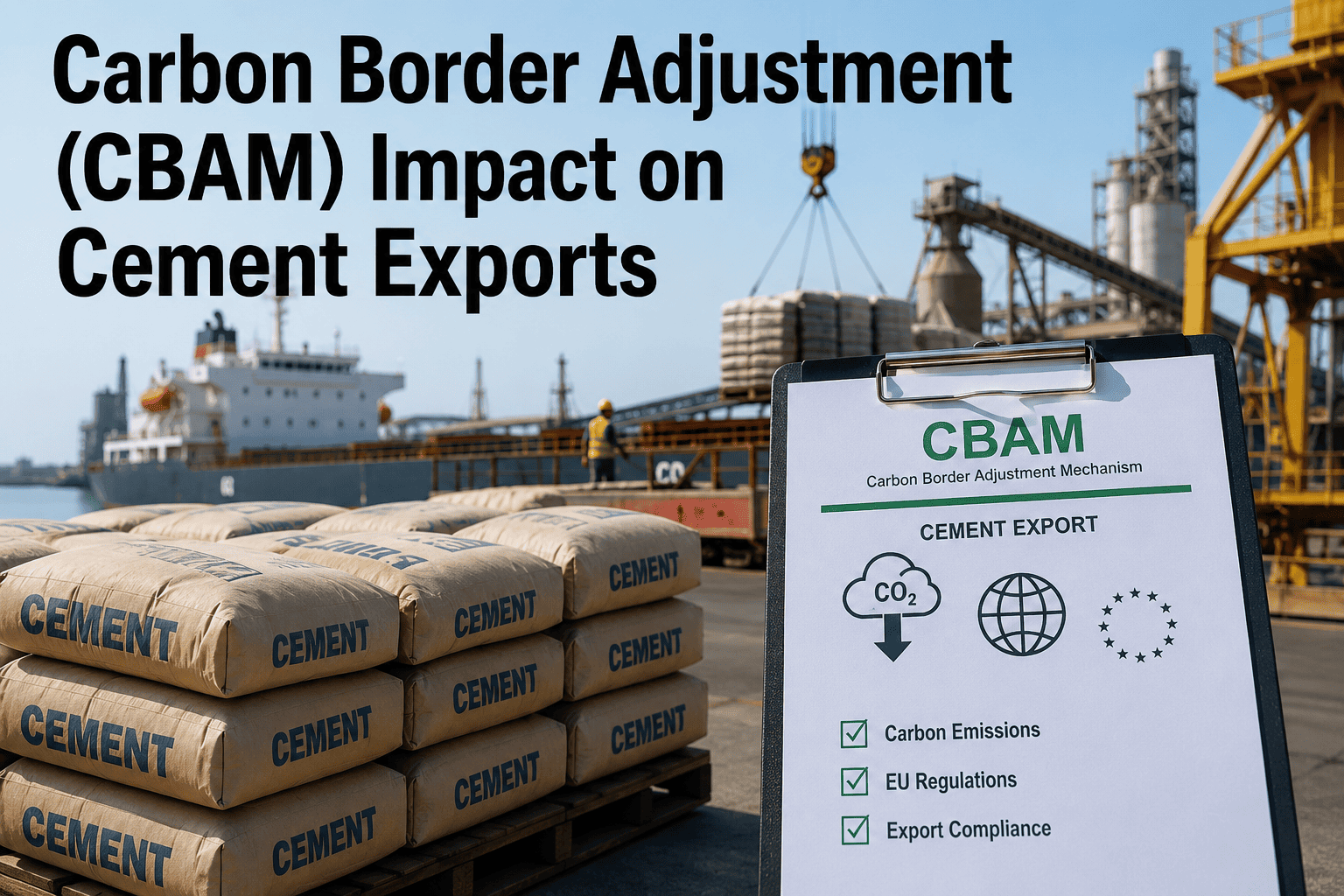
The regulatory landscape for European cement manufacturers is undergoing its most significant shift since the inception of the Emission Trading System (ETS). As free carbon allocations are progressively phased out and the Carbon Border Adjustment Mechanism (CBAM) enters its full implementation phase, the financial liability of every tonne of CO2 emitted is moving from a balance sheet footnote to a primary operational cost. Navigating this transition requires more than periodic reporting; it demands a real-time, auditable digital thread that connects kiln sensor data directly to regulatory compliance frameworks. For cement producers facing a 2026 deadline where carbon costs could represent up to 40% of total production expenses, adopting an AI-driven compliance tracking platform is the only way to ensure commercial viability. This guide explores how digital twin technology, MRV automation, and real-time carbon allowance modeling provide the foundation for regulatory resilience. Schedule a compliance audit to see your plant's exposure.
Automate Your EU Carbon Compliance Strategy
iFactory's compliance platform delivers real-time ETS tracking, CBAM certificate modeling, and automated MRV reports built for high-emissions cement production.
EU ETS Phase 4 and CBAM: A New Financial Reality for Cement
At the core of the new EU regulatory framework is the elimination of "Carbon Leakage" through the dual mechanism of ETS allocation reduction and CBAM implementation. When a plant's digital twin models its compliance roadmap, it isn't just counting tonnes—it is simulating the financial impact of the Linear Reduction Factor (LRF) against current market prices for carbon allowances (EUAs). This is the difference between simple emissions monitoring and genuine regulatory intelligence software. Manufacturers who book a demo with iFactory report that the ability to forecast carbon liability 12–36 months in advance is what allows their trading desks to hedge allowance purchases with precision.
EU ETS Phase 4 Alignment
Track emissions against the accelerating 2.2% annual linear reduction factor. Automate the Monitoring, Reporting, and Verification (MRV) process to ensure alignment with the latest EU Directive 2023/959.
CBAM Embedded Emissions
Calculate the specific "embedded emissions" of complex cement products (clinker, grey cement, white cement) required for CBAM quarterly reporting, ensuring accuracy for both exports and imports.
Carbon Allowance Modeling
Simulate the financial impact of the phase-out of free allocations (2026–2034). Predict precisely when your plant will cross the threshold from a surplus to a deficit of carbon allowances.
Audit-Ready MRV Automation
Maintain a persistent, time-stamped record of all process data, fuel chemistry, and calcination measurements. Provide verifiers with a single "Source of Truth" that reduces audit timelines by 70%.
Real-Time Operational Analytics: Bridging the Gap to Regulatory Filing
The complexity of EU ETS and CBAM compliance creates a significant administrative burden. A cement plant producing 1.2 million tonnes annually typically requires 350+ staff hours per year just for manual data consolidation and verification preparation. Digital twin platforms resolve this by automating the data pipeline from the kiln control system to the regulatory report. The platform identifies discrepancies in fuel-mix emission factors or calcination rates before they result in compliance penalties. This level of granularity is what ESG and Legal teams need to sign off on annual reports with confidence, and it is why compliance officers request a demo before each reporting cycle.
Compliance Framework: Traditional vs. Digital Twin Approach
The financial impact of compliance errors compounds quickly in the EU ETS. A reporting error that understates emissions by just 2% on a million-tonne kiln can result in €2 million in fines plus the cost of purchasing missing allowances at spot prices. iFactory’s digital twin approach eliminates this "Compliance Gap" by providing a continuous, real-time audit log that mirrors the plant's physical state. Cement manufacturers who have integrated this platform report that a demo conversation is typically the catalyst for moving away from spreadsheets into a validated regulatory intelligence environment.
| Compliance Area | Traditional Approach | Digital Twin Approach | Financial/Legal Impact |
|---|---|---|---|
| Emissions Tracking | Monthly spreadsheet manual entry | Continuous IoT-driven MRV feed | Zero reporting lag; 100% data integrity |
| CBAM Certification | Retrospective quarterly calculation | Predictive "Embedded Carbon" modeling | Optimized trade & export planning |
| Audit Readiness | 2–4 weeks of document retrieval | Instant access to time-stamped digital thread | Verification costs reduced by 60% |
| Allowance Hedging | Reactive market purchases | Predictive consumption forecasting | 8–12% saving on EUA procurement |
| Regulatory Updates | Manual internal legal review | Cloud-updated regulatory rule sets | Always compliant with latest EU Directives |
— Head of Sustainability, EU-Based Cement Group
Implementation Roadmap for EU Carbon Regulatory Readiness
Deploying a regulatory-grade compliance platform follows a structured three-phase architecture that ensures data sovereignty and validation. This roadmap is designed to move plants from reactive data gathering to proactive regulatory strategy.
Data Sovereignty & Sensor Audit
Map all regulatory data points (kiln feed, fuel calorific values, CEMS data) and establish a validated IoT historian. This phase ensures that the "Raw Data" layer is audit-proof and tamper-evident. Timeline: 8–12 weeks.
MRV Intelligence & ETS Reporting Setup
Commission the compliance models using EU ETS Phase 4 rules. Activate automated MRV reports and quarterly dashboarding. This phase eliminates manual reporting labor. Timeline: 6–8 weeks.
CBAM Strategy & Allowance Hedging
Integrate CBAM certificate modeling and predictive allowance forecasting. Move from compliance to "Strategic Carbon Management." Timeline: Ongoing.
Compliance Performance Across Key Regulatory KPIs
The performance gains from deploying a digital compliance platform span every regulatory dimension—from data accuracy to audit speed. The chart below benchmarks the average improvement achieved by cement plants within 12 months of full deployment, based on iFactory customer data across the EU and EFTA regions.
EU Carbon Compliance (ETS & CBAM) — Frequently Asked Questions
How does the phase-out of EU ETS free allocations affect cement manufacturers?
Starting in 2026, free carbon allowances will decrease linearly until reaching zero in 2034. For a standard cement plant, this means a shift from 100% free coverage to a 100% financial liability. iFactory models this phase-out curve to help you predict exactly when your compliance costs will spike.
What is the specific reporting requirement for CBAM "Embedded Emissions"?
CBAM requires reporting the "embedded" CO2 in cement products. This includes direct process emissions (calcination and fuel) and indirect emissions (electricity). The challenge is calculating these precisely per SKU—a task iFactory automates by tracking energy and material flows at the line level.
How long does it take to deploy a regulatory-grade MRV platform?
Full deployment typically requires 14–20 weeks. This includes the sensor audit, IoT historian commissioning, and validation of the calculation models against EU ETS Monitoring Plan requirements. iFactory’s pre-built EU compliance modules accelerate this timeline significantly.
Can the platform support independent third-party verification?
Yes. The platform provides a "Verifier Portal" where independent auditors can access time-stamped, unalterable data streams and calculation logs. This eliminates the need for 80% of on-site document review and significantly reduces verification costs.
Does the platform track both Scope 1 and Scope 2 emissions for EU compliance?
Yes. For EU ETS, we focus on Scope 1 (direct) emissions. For CBAM, we track both Scope 1 and Scope 2 (indirect) emissions, as both are required to determine the carbon footprint of imported or exported cement products under the new regulation.
What happens if our reporting data has gaps or errors?
EU regulations require the use of "conservative estimations" in the event of data gaps, which almost always results in higher carbon liability. iFactory’s redundant data historian ensures 99.9% data uptime, preventing the financial penalty of "gap-filling" estimations.
How does the platform handle changes in EU carbon regulations?
The iFactory compliance engine is cloud-updated. When the European Commission updates its Monitoring and Reporting Regulation (MRR) or CBAM implementing acts, the platform’s calculation libraries are updated automatically to ensure your plant remains compliant without manual software reconfiguration.
Deploy a Compliance Platform That Protects Your Bottom Line
iFactory's regulatory intelligence platform delivers real-time ETS tracking, CBAM embedded emissions reporting, and automated MRV — purpose-built for the European cement industry.