Managing third-party contractors and spare parts suppliers across a U.S. manufacturing facility has never been a clean problem. A procurement team juggling vendor contracts in spreadsheets, a maintenance department tracking SLA compliance in email threads, and an operations group chasing parts lead times through phone calls — this is the operational reality at facilities where vendor management has not caught up with the rest of the plant's digital infrastructure. The cost of that gap is not abstract: a vendor who misses a delivery SLA on a critical spare part causes downtime that costs $50,000 to $500,000 per hour in heavy manufacturing environments, and a compliance document that expired three months ago does not surface until the insurance auditor asks for it. iFactory's Integrated Vendor Management Portal centralizes every dimension of supplier and contractor management — SLA tracking, lead time analytics, compliance document storage, spend analysis, and performance scoring — inside the same AI-powered platform that runs maintenance, assets, and production. U.S. facilities using iFactory's vendor portal report 74% reduction in SLA breach events, 58% reduction in emergency procurement spend, and an average of 19 hours per week recovered from manual vendor coordination tasks across the procurement and maintenance teams combined.
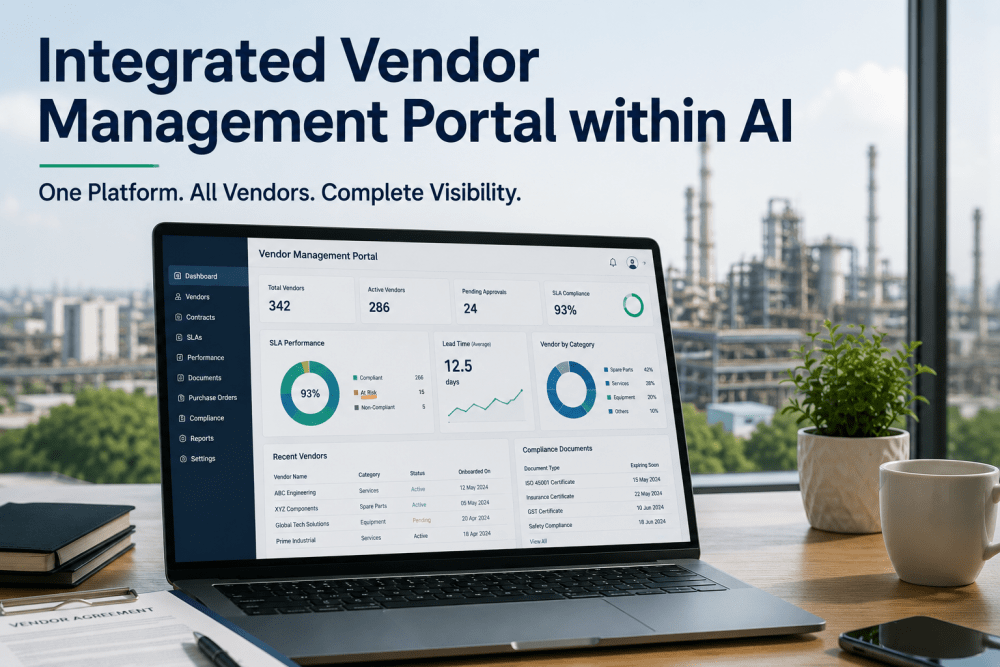
Integrated Vendor Management Portal within AI — Centralize Suppliers, Contractors, SLAs, and Compliance in One Platform
iFactory's Vendor Management Portal manages every third-party relationship — spare parts suppliers, MRO contractors, and service vendors — inside the same AI platform running your maintenance, assets, and production operations, with real-time SLA tracking, automated lead time analytics, and compliance document management that eliminates the spreadsheet-and-email patchwork that costs facilities millions annually.
Why Fragmented Vendor Management Costs U.S. Manufacturers More Than They Track
The financial impact of fragmented vendor management is systematically undercounted in most facility operating budgets because the costs are distributed across departments that do not report them to a single owner. Procurement sees contract and invoice data. Maintenance sees downtime and parts availability. Operations sees production schedule impact. EHS sees compliance lapses. Finance sees emergency spend premiums. No single dashboard connects these costs to the vendor management gaps that caused them — which means the true cost of a broken vendor management process is invisible until an audit, an incident, or a major production disruption makes it undeniable.
The structural problems are consistent across facilities of all sizes: vendor SLAs exist in contract documents that no one references between signature and dispute, lead times are tracked informally by whoever last called the supplier, compliance documents — insurance certificates, safety certifications, trade licenses — expire without automated renewal tracking, and performance data required for vendor rationalization decisions does not exist in any structured form. iFactory's integrated vendor portal was designed to replace this entire fragmented structure with a single managed data layer that connects vendor performance directly to the asset, work order, and maintenance data it affects. Book a Demo to see how iFactory's vendor portal integrates with your existing CMMS and procurement workflows.
SLAs That Live Only in Contracts
Vendor SLAs defined at contract signing are rarely tracked operationally. Delivery commitments, response time obligations, and quality guarantees exist as PDF clauses rather than live performance dashboards — meaning SLA breaches are discovered in retrospect, after the production damage is already done.
Lead Time Blindness on Critical Spares
When a critical spare part is needed for an unplanned repair, facilities frequently discover that the vendor lead time has changed since the last order — from 3 days to 3 weeks — because lead time data is not systematically tracked. The result is emergency freight costs, expediting premiums, and extended downtime that a current lead time record would have prevented.
Compliance Documents That Expire Silently
Vendor insurance certificates, OSHA safety certifications, contractor trade licenses, and quality system certifications expire on calendars that no one in the facility tracks. An expired certificate on an active contractor creates insurance liability, OSHA exposure, and contract breach risk — all of which are preventable with automated expiry tracking and renewal alerts.
No Performance Data for Vendor Decisions
Vendor rationalization, contract renewal negotiations, and supplier selection decisions are made without objective performance data in most facilities. On-time delivery rates, quality rejection rates, response time compliance, and cost variance are rarely captured in structured form — leaving procurement and operations to rely on anecdote rather than measurement when making sourcing decisions worth millions annually.
Disconnected from Maintenance Operations
Vendor performance data — when it exists at all — sits in procurement systems completely disconnected from the maintenance work orders, asset failure records, and parts consumption data that would reveal its operational impact. A vendor whose parts have a 40% early failure rate is invisible to procurement analytics when parts quality data lives only in maintenance technician notes.
Emergency Spend That Compounds Over Time
Each vendor management failure — a missed delivery, an expired certification that pauses a contractor, a surprise lead time extension — generates emergency procurement spend at 30% to 80% premium over standard purchasing. This spend is recorded as a cost variance rather than a vendor management failure, which means the root cause is never addressed and the cycle repeats.
iFactory Vendor Management Portal: Five Capability Layers That Replace the Spreadsheet Stack
iFactory's vendor portal is not a standalone procurement add-on — it is a fully integrated capability layer inside the same platform managing assets, work orders, maintenance schedules, and production data. This integration is the feature that separates it from standalone vendor management software: vendor performance data is connected to the assets those vendors service, the work orders those vendors fulfill, and the parts those vendors supply, creating a complete operational picture that isolated procurement tools cannot produce.
Want to see iFactory's vendor portal demonstrated on a supplier configuration equivalent to your facility's MRO, contractor, and spare parts vendor base? Book a Demo with iFactory's procurement integration team.
Vendor Management Portal Deployment Outcomes: Year-One Benchmarks Across U.S. Facilities
The table below presents first-year measured outcomes from iFactory vendor portal deployments across U.S. heavy manufacturing, food processing, pharmaceutical, and industrial facilities. These figures span the operational, financial, and compliance dimensions that define the ROI case for procurement leadership, operations, and finance.
| Outcome Category | Pre-Portal Baseline | iFactory Portal — Year 1 | Primary Driver | Annual Value |
|---|---|---|---|---|
| SLA Breach Events | 8–24 breaches per facility annually | 74% reduction — avg. 3–6 events annually | Pre-breach alerts trigger proactive vendor engagement | $120K–$600K downtime cost avoided |
| Emergency Procurement Spend | 12–22% of total parts spend at premium pricing | 58% reduction in emergency orders | Lead time visibility enables proactive reordering | $85K–$340K annual premium spend avoided |
| Compliance Document Lapses | 3–9 expired documents discovered reactively | Zero lapses — 90/60/30-day renewal alerts | Automated expiry tracking across all vendors | Eliminated insurance and OSHA exposure |
| Manual Vendor Coordination | 19+ hours/week across procurement and maintenance | Recovered — portal automates tracking and alerts | Structured data replaces email and phone coordination | $38K–$95K annual labor cost recovered |
| Vendor Onboarding Time | 2–4 weeks for new vendor qualification | 4–7 days with structured portal workflow | Standardized intake with automated document requests | Faster contractor access for urgent projects |
| Contract Renewal Data Quality | Anecdotal — no structured performance history | Full performance history with composite scores | Every transaction feeds automated scoring model | Stronger negotiating position + better terms |
| Vendor Rationalization Decisions | Relationship-based — no objective criteria | Data-driven with performance ranking by category | Composite scores rank vendors objectively | 10–18% sourcing cost reduction from consolidation |
Vendor Portal Deployment Workflow: From Vendor Audit to Live Performance Tracking
iFactory's vendor portal deployment follows a structured six-phase workflow that converts the existing vendor base — regardless of how it is currently managed — into a fully operational portal environment within 8 to 12 weeks. The methodology builds from vendor data consolidation through SLA configuration, compliance document collection, and system integration to the ongoing performance management operations that deliver sustained value after go-live.
Vendor Base Audit and Data Consolidation
iFactory's implementation team conducts a structured audit of the facility's active vendor base — pulling vendor records from existing ERP, procurement, and CMMS systems, identifying duplicates and inactive vendors, and classifying the active vendor list by category (spare parts, MRO, contractors, services). This audit produces the clean vendor master that populates the portal, replacing fragmented data sources with a single authoritative record set. Average active vendor counts discovered during audit are 30% to 50% higher than facilities believe they have, due to informal vendor additions that bypassed procurement.
Vendor Profile Build and Onboarding Communication
Vendor profiles are built in the portal from the consolidated master, and existing vendors receive a structured onboarding communication requesting document uploads, contact confirmation, and SLA acknowledgment. New vendor onboarding is configured with a standardized intake workflow — vendors complete a self-service profile that automatically triggers compliance document requests and routes the new vendor through the facility's pre-qualification checklist before activation. Portal onboarding templates are customized to the facility's contractor requirements, category-specific documentation standards, and procurement policies.
SLA Configuration and Performance Threshold Setting
For each vendor category, procurement works with iFactory's configuration team to translate contract SLA clauses into tracked portal metrics — defining the specific parameters, measurement methodology, and threshold values that trigger pre-breach alerts. Service contractor SLAs are connected to work order data for automatic response time measurement. Parts supplier SLAs are connected to purchase order receipt data for delivery performance tracking. Alert routing rules are configured to notify the appropriate procurement manager and maintenance team based on vendor category and severity.
Compliance Document Collection and Vault Population
The compliance document vault is populated through a combination of manual upload of existing documents and automated collection requests sent to active vendors for any documents not already on file. Expiry dates are entered for all documents at upload, activating the automated renewal alert schedule. Document gaps — vendors with missing or expired certificates — are surfaced as a priority action list for procurement to resolve before those vendors are next dispatched for work. Facilities with active contractors typically discover 15% to 25% of contractors have at least one document gap during initial vault population.
ERP and CMMS Integration for Transaction Data Flow
iFactory's integration layer connects the vendor portal to the facility's existing ERP (SAP, Oracle, Epicor, or equivalent) for purchase order and invoice data, and to the CMMS for work order and asset service records. This data connection is what activates the lead time analytics, performance scoring, and spend analysis capabilities — vendor portal intelligence is only as good as the transaction data feeding it, and the integration ensures that every purchase order, parts receipt, and contractor work order automatically updates the relevant vendor's performance record without manual data entry.
Performance Review Cadence and Continuous Optimization
After go-live, iFactory's implementation team supports the establishment of a monthly vendor performance review cadence — using portal-generated performance reports to drive supplier improvement discussions, contract renewal negotiations, and vendor rationalization decisions. The portal's AI recommendation layer identifies patterns in vendor performance data that suggest opportunities for consolidation, alternate sourcing, or safety stock adjustments. Quarterly business reviews with the iFactory team assess portal utilization, alert response quality, and procurement outcomes against the pre-deployment baseline.
Want the vendor portal deployment workflow mapped to your facility's vendor base, ERP configuration, and procurement calendar? Book a Demo and review your specific deployment plan with iFactory's procurement team.
Expert Review: What U.S. Procurement and Maintenance Leaders Say About Integrated Vendor Management
I have run procurement at three different U.S. heavy manufacturing facilities over 18 years, and the vendor management problem is the same at every facility regardless of size: the systems that track purchasing and the systems that track maintenance never talk to each other, which means nobody can ever answer the question that actually matters — which vendors are costing us the most in total operational impact, not just invoice cost.
Conclusion
Vendor management in U.S. manufacturing facilities has historically been a process that happens between the systems — tracked in spreadsheets that live between the ERP and the CMMS, managed through email threads that exist between procurement and maintenance, and measured through anecdote that exists between contract renewals. The result is a category of operational cost — SLA breach downtime, emergency procurement premiums, compliance liability, and vendor performance degradation — that is systematically undercounted because the data to measure it does not exist in any structured form.
iFactory's Integrated Vendor Management Portal closes that gap by building vendor management into the same operational data layer that tracks assets, work orders, parts inventory, and production performance. SLA commitments become live dashboards. Lead time estimates become observed analytics. Compliance documents become managed inventories with automated renewal workflows. Vendor performance becomes an objective score that drives data-driven contract decisions. The 74% SLA breach reduction, 58% emergency spend reduction, and 19 hours per week of recovered coordination time are the measured outcomes of replacing disconnected tracking with integrated intelligence. Book a Demo to see iFactory's vendor portal applied to your facility's supplier and contractor base.
Frequently Asked Questions
Replace Your Vendor Spreadsheet Stack with a Single Integrated Management Platform.
iFactory's Vendor Management Portal centralizes every supplier and contractor relationship — SLA tracking, lead time analytics, compliance document management, and performance scoring — inside the same AI platform running your maintenance and assets, connecting vendor performance to operational outcomes for the first time.