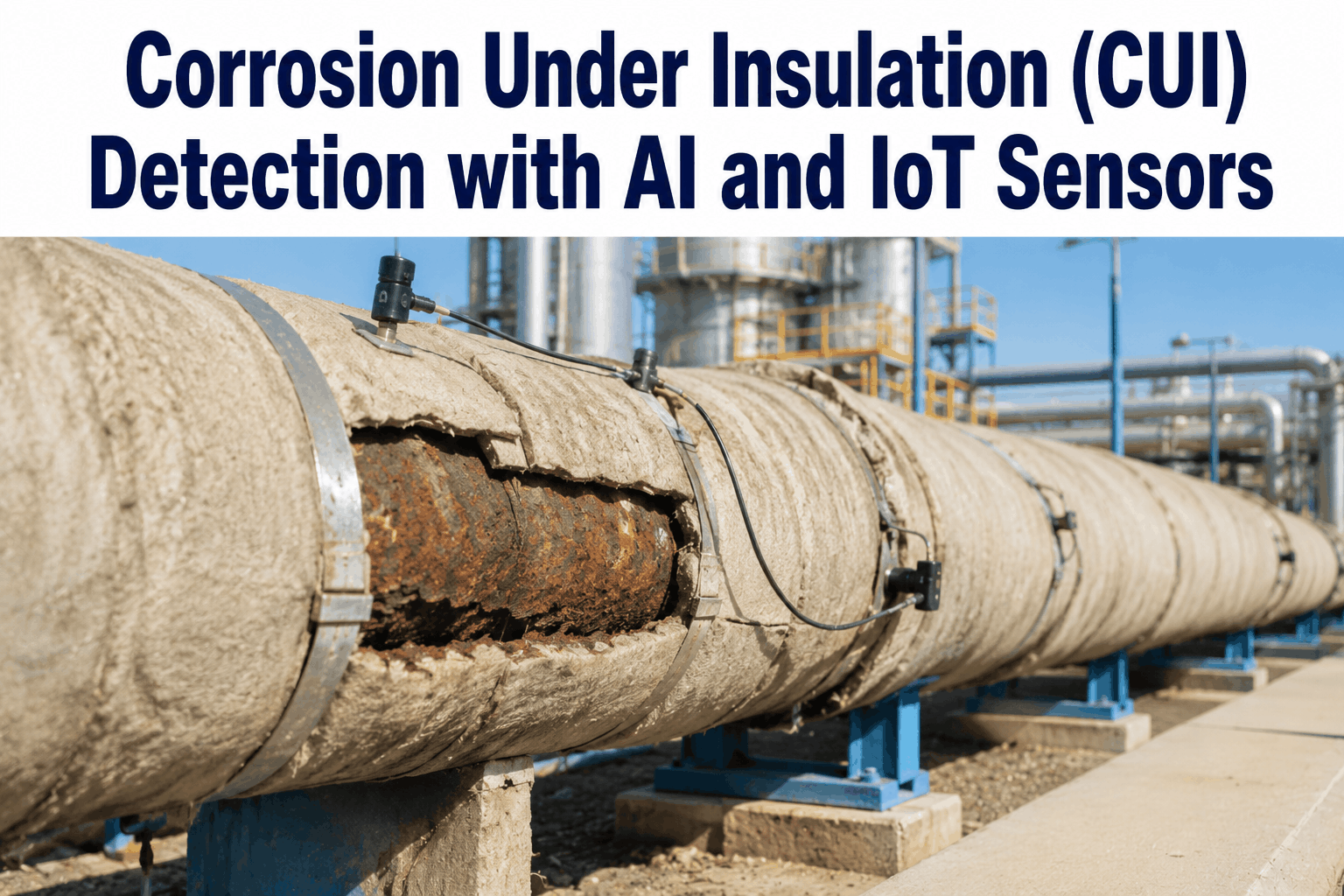
Corrosion under insulation is the refinery failure mode that hides in plain sight — invisible behind insulation jacketing, accumulating silently for years until a wall-loss measurement or, worse, a pipe rupture forces the issue. Industry data consistently places CUI as the cause of 40–60% of piping failures in process plants, yet most inspection programs still rely on intrusive strip-and-inspect methods that are expensive, time-consuming, and sample only a fraction of insulated piping. Get iFactory Support to deploy non-invasive CUI detection across your piping circuits today.
Detect Hidden Corrosion Under Insulation Without Stripping a Single Pipe
iFactory AI combines temperature profiling, neutron backscatter, and guided wave ultrasound data to identify CUI hotspots non-invasively — across your entire insulated piping network.
Why CUI Is the Hardest Corrosion Problem to Manage
CUI's invisibility is its primary danger. The combination of insulation that traps moisture, cyclic temperatures that drive wet-dry cycles, and the physical barrier that prevents routine visual inspection creates a failure mechanism that operates at its own pace, independent of the operator's awareness. API RP 583 identifies 14 specific susceptibility factors — understanding which of these apply to each circuit is the foundation of a risk-ranked CUI inspection strategy. Contact iFactory to build your CUI risk matrix from live sensor data.
Risk Factor 1
Temperature Cycling Zones
Piping operating between −4°C and 175°C (25°F–350°F) cycles through the moisture condensation range repeatedly. Each wet-dry cycle concentrates salts and accelerates corrosion. Carbon steel in this range is highly susceptible; austenitic stainless steel faces chloride stress corrosion cracking risk above 60°C.
Risk Factor 2
Insulation System Condition
Damaged, aged, or improperly sealed insulation jacketing allows water ingress at a rate that overwhelms coating protection. Areas with missing bands, punctured jacketing, failed caulking at penetrations, and degraded vapor barriers are primary CUI entry points that AI thermal imaging identifies before corrosion develops.
Risk Factor 3
Equipment Geometry
Water preferentially accumulates at low points in piping systems, at support clamps, under pipe shoes, at insulation terminations, and in deadleg configurations. AI risk models weight these geometric susceptibilities when ranking inspection priority across a piping network — directing inspection resources where water is most likely to be present.
Risk Factor 4
Coating and Primer Condition
External coatings beneath insulation provide the primary corrosion barrier when moisture is present. Coating condition at time of insulation installation — and degradation history — strongly influences CUI probability. AI risk models incorporate coating age, original specification, and known failure history from inspection records.
Risk Factor 5
Process Fluid Characteristics
Piping carrying fluids that are themselves corrosive (acids, chlorides, sour service) compounds CUI risk if internal corrosion creates localized thinning that overlaps with external CUI attack. AI correlating internal inspection data with external CUI risk scores identifies double-jeopardy locations requiring accelerated inspection intervals.
Risk Factor 6
Environmental Exposure
Coastal environments, cooling tower drift zones, and areas with industrial atmospheric contamination (chlorides, sulfur compounds) significantly accelerate CUI once moisture is present. Geographic and micro-environmental factors feed iFactory's risk scoring model — outdoor piping in marine environments receives higher baseline susceptibility ratings than equivalent indoor insulated piping.
The Three Non-Invasive Detection Technologies AI Combines
No single non-destructive evaluation technique covers all CUI scenarios economically. iFactory AI integrates outputs from the three most field-proven non-invasive CUI detection methods — temperature profiling, neutron backscatter, and guided wave ultrasound — applying each where it provides maximum coverage efficiency at minimum inspection cost. Book a demo to see the multi-technology integration in action.
Scroll for more →
| Technology | Detection Principle | Effective Pipe Range | AI Integration Role |
|---|---|---|---|
| Temperature Profiling (IRT) | Wet insulation conducts heat differently than dry — surface temperature anomalies identify moisture ingress zones | All sizes; best on cyclic-temperature lines | Anomaly location screening; directs targeted NDE |
| Neutron Backscatter | Neutron detector measures hydrogen density in insulation — elevated readings indicate moisture presence | All sizes; CUI susceptibility zones | Moisture mapping; confirms IRT anomalies without stripping |
| Guided Wave UT (GWUT) | Ultrasonic waves propagate along pipe wall — wall loss from corrosion reflects guided wave energy at damage location | 2″–48″; 50m+ linear screening range | Wall loss quantification; confirms active corrosion extent |
| Pulsed Eddy Current (PEC) | Electromagnetic pulses penetrate insulation and jacketing — induced current decay rate indicates remaining wall thickness | Up to 200mm insulation; all pipe sizes | Spot wall thickness measurement without insulation removal |
| Wireless Temperature Sensors | IoT sensors installed under insulation monitor local temperature patterns and detect condensation windows continuously | All sizes; permanent installation | Continuous CUI risk monitoring; real-time moisture event logging |
CUI Risk and Detection Performance Metrics
CUI Detection Coverage Rate
Multi-Tech AI: 94% Coverage
Traditional strip-and-inspect programs achieve 15–25% annual coverage of insulated piping due to cost and time constraints. AI-guided multi-technology screening increases effective coverage to 90–94% of susceptible piping annually without requiring insulation removal at most locations.
Inspection Cost Reduction
65–75% Lower Cost/Circuit
Targeted NDE guided by AI risk scoring and temperature profiling reduces the number of insulation removal locations required per inspection cycle by 70–80%. The cost reduction comes from eliminating unnecessary strip-inspect-reinstate cycles on low-risk sections while concentrating resources on confirmed high-risk locations.
CUI Detection Lead Time
2–5 Years Before Failure
Wireless under-insulation temperature monitoring detects the moisture condensation conditions that initiate CUI before measurable wall loss begins — providing 2–5 years of intervention lead time compared to 3–6 months lead time from annual visual/NDE inspection programs that detect CUI only after significant corrosion has occurred.
Risk Ranking Accuracy
AI Model: 89% Precision
iFactory AI risk ranking correctly identifies the highest-severity CUI locations 89% of the time when compared to subsequent strip-and-inspect findings — versus 54% accuracy from traditional risk-based inspection (RBI) models that rely on static data inputs without continuous sensor feedback.
How iFactory AI Processes Multi-Source CUI Data
Piping Circuit Risk Segmentation Starting Point
Every insulated piping circuit in scope is classified against API RP 583 susceptibility criteria: operating temperature range, insulation system type and age, coating history, process fluid characteristics, and environmental exposure. AI risk segmentation produces a ranked list of circuits requiring priority inspection — directing finite inspection resources to highest-consequence locations.
Thermal Imaging Anomaly Screening
Infrared thermography surveys of insulated piping identify surface temperature anomalies indicating moisture presence or heat loss from insulation damage. AI processes thermal images to classify anomalies by severity and distinguish CUI-related patterns from support contact points, steam tracing malfunctions, and ambient thermal gradients that produce false indications.
Neutron Backscatter Moisture Mapping
At IRT anomaly locations, neutron backscatter scanning confirms moisture presence without insulation removal. AI correlates neutron backscatter moisture maps with temperature anomaly locations to classify each zone as dry (no CUI risk), moist (monitor and rescan), or wet (immediate targeted NDE required). This triage eliminates unnecessary insulation removal at dry anomaly locations.
Guided Wave UT Wall Loss Screening
At confirmed wet locations, GWUT transducers clamp onto the pipe at accessible collar locations and screen up to 50 meters of pipe in both directions without removing insulation. AI processes guided wave data to identify reflection locations indicating wall loss, distinguishing CUI damage from weld reflections and geometric features that produce expected reflections in the pipe wall.
Continuous IoT Sensor Monitoring
Wireless temperature and humidity sensors installed under insulation at highest-risk locations provide continuous monitoring of the local micro-environment. AI models track the frequency and duration of condensation events (temperature below dew point) — each wet cycle representing a corrosion advance increment that accumulates into the wall loss prediction model.
Integrated Risk Score and Inspection Planning
All data sources — IRT, neutron backscatter, GWUT, PEC measurements, and IoT sensor history — feed into a unified CUI risk score per piping segment that drives inspection interval recommendations. iFactory generates API 510 / API 570 compliant inspection plan outputs with remaining life assessments for each circuit. Get iFactory Support to configure your inspection plan integration.
IoT Sensor Technology for Permanent CUI Monitoring
Sub-Insulation T+RH Sensors
Wireless sensors installed under jacketing monitor local temperature and relative humidity — detecting condensation events before corrosion initiates
Ultrasonic Wall Thickness Monitors
Permanently bonded UT sensors measure pipe wall thickness at fixed locations — trending wall loss over months and years without operator access
IoT Gateway and Mesh Network
Industrial-rated wireless gateways collect sensor data across the piping network and transmit to iFactory cloud analytics via encrypted mesh protocol
Real-Time Risk Dashboard
Live CUI risk scores per piping segment — updated continuously as sensor data arrives, with automatic alert escalation at configurable thresholds
CUI Program Implementation: From Risk Assessment to Continuous Monitoring
01
Piping Inventory and Circuit Definition
Compile complete insulated piping inventory from P&IDs and isometrics. Define inspection circuits as contiguous segments of similar material, temperature range, and insulation system. Circuit boundaries typically follow process unit limits, service changes, or material specification changes.
02
API RP 583 Susceptibility Assessment
Score each circuit against the 14 CUI susceptibility factors in API RP 583: operating temperature range, cyclic temperature service, insulation type, coating system, past inspection history, and environmental exposure. The resulting susceptibility scores drive the initial inspection priority ranking.
03
Baseline IRT and Neutron Survey
Conduct a baseline infrared and neutron backscatter survey across the highest-priority circuits. AI processes survey data to identify the initial set of confirmed moisture locations requiring targeted GWUT or PEC follow-up. This baseline establishes the starting condition for all subsequent monitoring comparison.
04
Targeted NDE at Confirmed Wet Locations
Deploy GWUT, PEC, or focused UT at locations confirmed as wet by the neutron backscatter survey. Quantify remaining wall thickness and map the extent of any active corrosion. iFactory integrates NDE measurement results directly into the circuit risk score and remaining life model.
05
IoT Sensor Deployment at High-Risk Locations
Install wireless under-insulation temperature and humidity sensors at the top 20% of circuits by susceptibility score. Sensors can be installed without taking the pipe out of service in most configurations. iFactory begins building the moisture event history that feeds long-term wall loss prediction immediately upon sensor activation.
06
Ongoing Monitoring and Interval Optimization
iFactory continuously updates circuit risk scores from IoT sensor data and schedules resurvey NDE at intervals driven by risk score rather than fixed time periods. High-risk circuits with active moisture events may resurvey annually; stable low-risk circuits extend to 5+ year intervals. Contact iFactory Support to design your interval optimization model.
Frequently Asked Questions
What temperature range is most susceptible to corrosion under insulation?
API RP 583 identifies −4°C to 175°C (25°F–350°F) as the primary CUI susceptibility range for carbon steel, because this range cycles through moisture condensation and evaporation temperatures under typical ambient conditions. Austenitic stainless steel faces additional chloride stress corrosion cracking risk in the 60°C–175°C (140°F–350°F) range when chlorides are present.
Can guided wave ultrasound detect CUI through the insulation without removing it?
Guided wave UT requires a clean pipe surface at the transducer collar location — typically a 150–300mm wide section of insulation is removed at the access point. From that one access point, the technique screens 50+ meters of pipe in both directions through intact insulation, making it far less intrusive than strip-inspect programs that require full insulation removal along the entire inspection length.
How long do wireless sensors installed under insulation typically last?
Battery-powered wireless temperature and humidity sensors designed for under-insulation installation typically provide 5–10 years of service life at 30-minute measurement intervals in ambient temperature environments. For high-temperature service (above 80°C), specialized high-temperature sensor variants with shorter battery life (2–5 years) or external power connections are required.
How does iFactory integrate with existing Risk-Based Inspection (RBI) programs?
iFactory ingests the static risk factors from existing RBI assessments as inputs to the AI risk model, then augments them with continuous IoT sensor data. The AI model updates circuit risk scores dynamically as sensor conditions change — converting static RBI snapshots into living risk assessments that evolve with actual operating conditions rather than remaining fixed between inspection intervals.
Is pulsed eddy current testing reliable through thick insulation?
PEC penetrates insulation and metallic jacketing effectively up to approximately 200mm total thickness, making it one of the few NDE methods that works through multi-layer insulation systems with metallic weather protection. Measurement accuracy decreases as insulation thickness increases, and the technique provides a single average wall thickness over the inspection footprint area (typically 50–150mm diameter) rather than a localized point measurement.
Find the Corrosion That's Hiding Behind Your Insulation
iFactory AI combines temperature profiling, neutron backscatter, and guided wave data to identify CUI hotspots non-invasively — giving your integrity team the risk intelligence to inspect where it matters most.