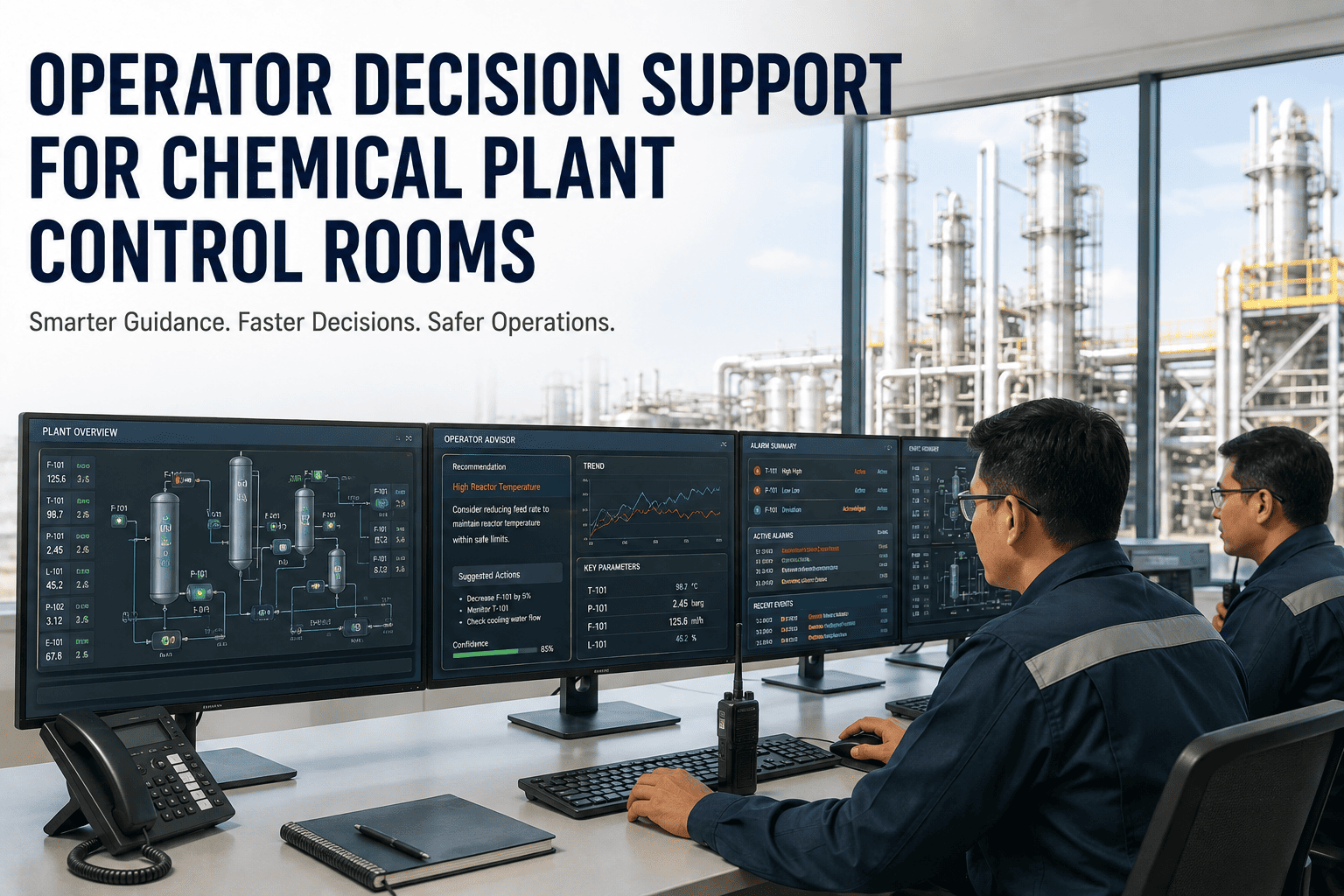
In a chemical control room, the process runs itself right up until the moment it doesn't. On a normal shift the panel operator supervises; on an abnormal one, they are suddenly detective, diagnostician, and decision-maker all at once — reading a flood of data, working out what is actually happening, and choosing the moves that either recover the situation or let it escalate. Industry studies consistently trace a large share of losses, trips, and incidents to exactly these abnormal situations, and to the gap between how the best operator handles them and how everyone else does. As a shift lead, that variability is your problem to own. iFactory's Operator Advisor Suite puts best-practice decision support in the control room — detecting abnormal situations early, diagnosing the likely cause, and guiding the operator through setpoint, recipe, and recovery decisions.
Operator Decision Support for Chemical Plants
Operator Decision Support for Chemical Plant Control Rooms
Advisory and closed-loop guidance for panel operators — early detection of abnormal situations, likely-cause diagnosis, and step-by-step recovery. On-premise, so every shift operates like your best one.
On-prem
in the control room
The Abnormal Situation Is Where It All Goes Wrong
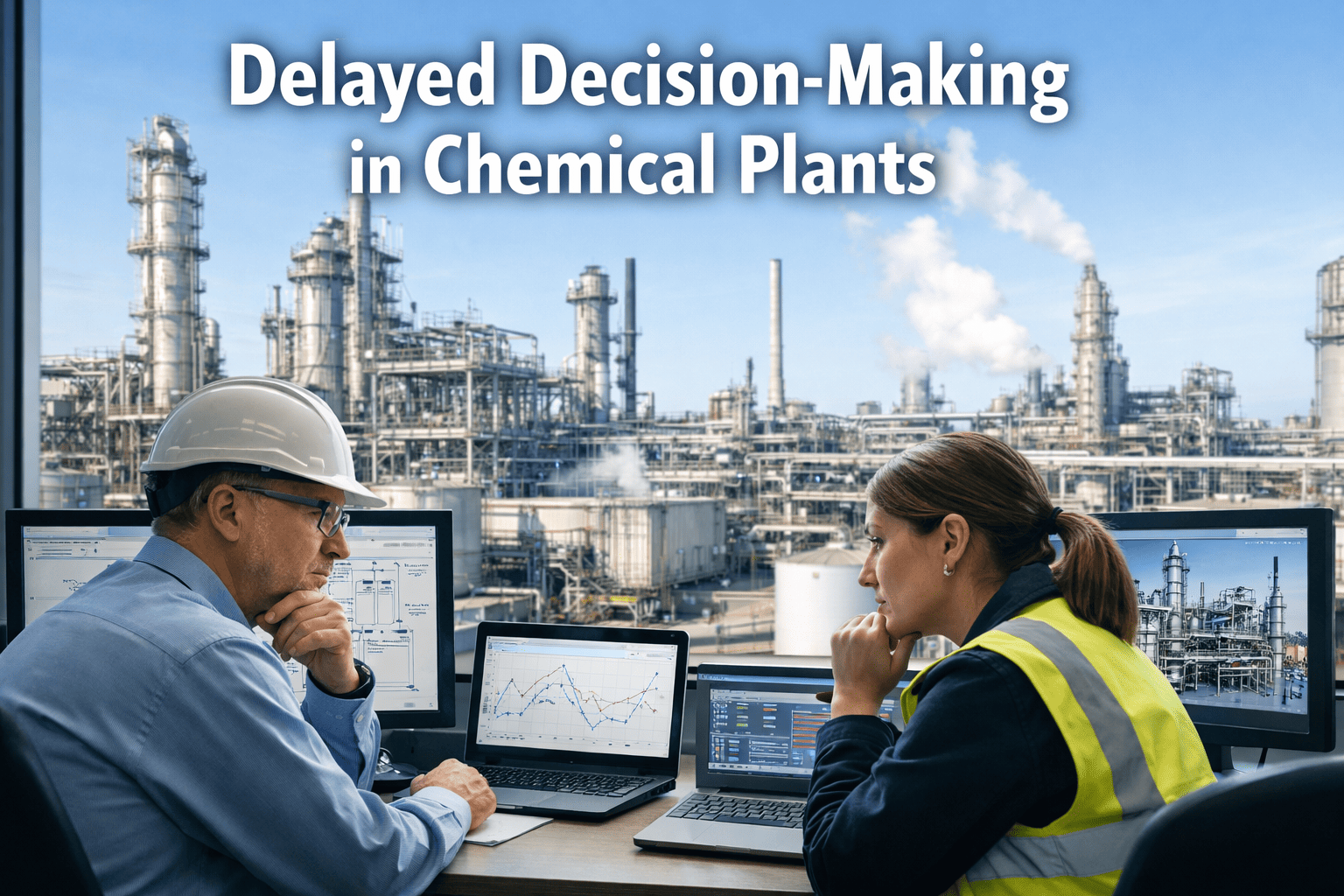
Normal operation is not where plants get hurt. The damage happens in the minutes after something drifts out of its expected envelope, when the operator has to notice it, understand it, and act — often against the clock and against an alarm flood. Two things make this harder every year: the panel presents more data than a person can hold in their head during an upset, and the deep process knowledge that used to live in thirty-year veterans is walking out the door. The result is that the same abnormal situation can be a non-event on one shift and a trip on another, depending entirely on who is at the panel.
Three Levels of Situation Awareness
Good operating decisions rest on situation awareness, and awareness has three levels. An operator has to perceive what is happening, comprehend what it means, and project where it is heading. The advisor supports each level, so the operator is not building the whole picture alone under pressure.
1
Perception
What is happening?
Advisor surfaces the signal that matters from the noise, so the real deviation is not lost in the flood.
2
Comprehension
What does it mean?
Advisor diagnoses the likely cause and puts the deviation in context, turning data into a situation.
3
Projection
What happens next?
Advisor projects the trajectory and the consequence of acting or waiting, so the operator sees ahead.
Detect, Diagnose, Guide
When a situation turns abnormal, the advisor does three things in order — catch it early, work out the likely cause, and lay out the recovery. Not a wall of alarms, but a clear recommendation the operator can act on or override.
Detect
Spots the deviation as it develops, before it reaches an alarm limit.
Diagnose
Identifies the most likely cause from the process signature.
Guide
Recommends the recovery steps, in order, with the reasoning.
Operator Advisor
Abnormal situation
Reactor R-201 temperature rising above band
Likely causeCooling-water flow drop on E-201
Trend+6°C in 4 min, accelerating
ConfidenceHigh
1. Verify cooling-water flow to E-201
2. Raise CW setpoint toward target
3. If not recovering in 5 min, reduce feed rate
Advisory or Closed-Loop — You Decide Where Each Action Sits
Decision support is not all-or-nothing. Some actions should always be the operator's call; some routine, well-understood moves can run closed-loop under supervision. You set where each action sits on that spectrum, and the advisor respects it.
The autonomy spectrum
Advisoryoperator decides
Guidedoperator approves
Closed-loopauto, supervised
Upset recovery and safety-critical calls stay advisory
Setpoint and grade moves guided, approved by the operator
Routine, bounded optimization runs closed-loop
Safety systems and interlocks are never bypassed. The advisor works within them, and the operator keeps authority over everything that matters.
Every Shift Performs Like Your Best
The real prize is consistency. Without support, how well an abnormal situation is handled swings with who is on the panel — the spread between your most and least experienced operators. Captured as best-practice guidance, that spread collapses toward the top, so every shift performs closer to your best.
With advisor
near best practice
best practice
The guidance encodes how your best operators handle each situation, so newer operators reach a good decision faster and the shift-to-shift variability that causes trips and off-spec shrinks.
How wide is the gap between your best shift and your hardest one? Book a 30-minute demo and we'll walk your abnormal situations through live decision support.
What the Advisor Guides
The same decision support covers the moments that most decide a shift's outcome — the routine optimizations and the high-stakes recoveries alike.
Setpoint guidance
Recommended moves to hold the process in its best safe envelope as conditions drift.
Grade and recipe transitions
Guided changeovers that shorten transition time and cut off-spec between products.
Upset recovery
Step-by-step recovery procedures surfaced exactly when the situation demands them.
Startup and shutdown
Sequenced guidance through the highest-risk, lowest-frequency operations.
What Decision Support Delivers
Backing the operator at the panel changes the outcomes that matter most on a shift — safety, stability, and consistency.
Fewer
Trips and incidents
abnormal situations caught and recovered early
Faster
Recovery
guided steps instead of searching for the answer
Consistent
Every shift
best-practice decisions regardless of who is on
Lower
Operator load
focus on the decision, not the data hunt
Frequently Asked Questions
Does this replace the operator or the safety systems?
Neither. The advisor supports the operator's judgment and never overrides the safety instrumented systems, interlocks, or your control philosophy. It works within all of them, and the operator keeps authority over every decision that matters. Even in closed-loop mode, automation is limited to routine, well-understood, bounded actions under operator supervision, with hard safety layers untouched.
How does it diagnose a likely cause?
It learns the signatures of your process, both normal operation and known abnormal situations, from historical and live data. When a deviation develops, it matches the emerging pattern against those signatures to identify the most probable cause and shows its confidence and reasoning. The operator sees why it reached that conclusion and remains free to agree or override.
Where does the best-practice guidance come from?
From your plant. The recovery procedures and recommended actions are built from your SOPs and the way your experienced operators actually handle each situation, then made available to everyone at the panel. It is a way to capture the knowledge that would otherwise retire with your veterans and make it consistent across every shift.
Does it run on-premise?
Yes. Because it sits close to control and works with live process data, the advisor runs on-premise inside the plant, keeping process data within your firewall and avoiding external dependency for a control-room function. It integrates with your existing DCS and historian rather than replacing them.
How do we start without disrupting operations?
Most plants begin in advisory mode, where the operator sees the detection, diagnosis, and recommended steps but makes every call, so trust builds with no change to authority. Closed-loop is enabled later, action by action, only where it makes sense. The best next step is a demo where we take a few of your real abnormal situations and show how the advisor would detect, diagnose, and guide them.
Give Every Operator Your Best Operator's Judgment.
See Decision Support on Your Abnormal Situations
Bring a few of the abnormal situations that decide your shifts. We'll show how the advisor detects them early, diagnoses the likely cause, and guides the recovery — advisory or closed-loop, on-premise, with your safety systems untouched.