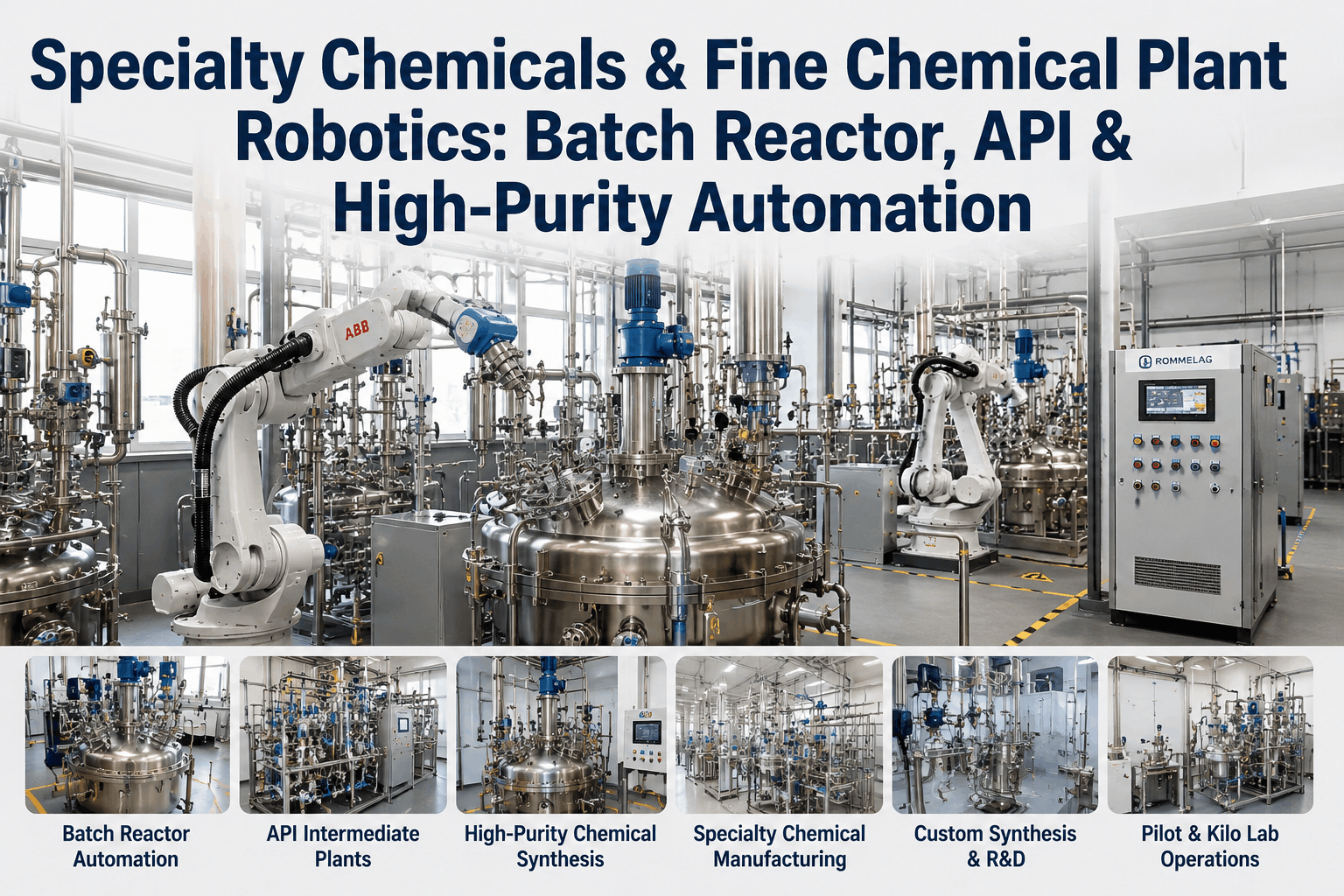
The specialty chemicals and fine chemical segment operates in a fundamentally different economic and operational reality from commodity chemical manufacturing: products selling at >$10/kg with annual volumes under 1,000 tons, multipurpose plants running campaigns of dozens of different products per year, batch reactors ranging from 60-liter kilo labs through 15,000-liter commercial vessels, and razor-thin tolerances for yield variation because every percentage point of yield loss on a $500/kg API is real margin destroyed. CDMOs like Hovione, Axplora, Fermion, and ChemCon have built their businesses on this dynamic — and the operators that win in 2026 are increasingly the ones combining batch reactor automation with AI-driven yield optimization across the full kilo-lab-to-commercial-scale journey. This guide breaks down robotic and AI automation for fine chemical batch reactors, API intermediate plants, high-purity synthesis, and custom manufacturing — with iFactory delivered as on-premise (air-gapped GMP-compliant) or cloud (SOC 2 Type II, multi-site) services. Book a Specialty Chemical Automation Workshop to scope a deployment for your facility.
>$10/kg
Defining price threshold for fine chemicals — every yield point matters
<1000 t/yr
Typical annual volume per product — small-batch, high-mix manufacturing
60–15,000 L
Batch reactor size range from kilo lab through commercial vessels
2 modes
iFactory deployment — on-premise + cloud, same GMP-grade capability
Why Fine Chemicals Are the Highest-ROI Automation Subsegment
The economics of fine chemical manufacturing make automation investments uniquely compelling. High product value plus high process variability equals high opportunity cost on every yield variance. Below is the three-vector economic case that drives specialty chemical CDMOs and producers to deploy AI automation faster than any other chemical subsegment. Read our broader chemical context in our AI batch process optimization platform.
E1
PRODUCT MARGIN
High-Value Products Amplify Yield Impact
A 2% yield improvement on commodity polymer at $1.50/kg yields modest savings. The same 2% on an API intermediate at $800/kg recovers tens of thousands of dollars per batch. AI-driven yield optimization on fine chemicals has the highest dollar-per-percentage-point return in the industry.
100–500×
Higher dollar value per yield point vs commodity
E2
CAMPAIGN COMPLEXITY
Multi-Product Plants Magnify Cross-Contamination Risk
Multipurpose plants run dozens of different products per year through shared equipment. Each product transition requires validated cleaning, recipe loading, equipment qualification. Automation collapses changeover time and eliminates the manual variability that causes cross-contamination events.
40–60%
Changeover time reduction with automation
E3
SCALE-UP RISK
Kilo Lab → Commercial Transitions Are Expensive Failures
Recipes that work at 60-liter kilo lab scale often fail at 6,000-liter commercial scale due to mixing dynamics, heat transfer, and mass transfer effects that don't scale linearly. AI batch trajectory modeling catches scale-up issues weeks before manufacturing failure.
$2–8M
Typical cost of a failed scale-up campaign
Specialty Chemicals Have the Highest Return on AI Automation in the Industry. Most Operators Are Still Waiting.
CDMOs that deploy AI batch optimization first capture the customers, the contracts, and the margin. The window of competitive advantage is narrowing.
The 4-Stage Specialty Chemical Manufacturing Journey
Fine chemical synthesis follows a stage-gated journey from discovery to commercial production. Each stage has its own automation needs, scale considerations, and validation requirements. Below is the journey map with the automation opportunities at each stage. Schedule a workshop to map automation priorities to your specific stage portfolio.
01
STAGE 1
Kilo Lab / Pilot Plant
60–500 L reactors
Process development and clinical-supply material. Recipes finalized, impurity profiles characterized, scale-up parameters identified.
AUTOMATION FOCUS
Recipe execution
Yield characterization
PAT integration
Impurity profiling
→
02
STAGE 2
Scale-Up Campaign
500–2,000 L reactors
First commercial-scale campaigns. Mixing dynamics, heat transfer, mass transfer differences from kilo lab become real. Where most fine chemical campaigns first encounter trouble.
AUTOMATION FOCUS
Multivariate scale-up modeling
Trajectory validation
Endpoint forecasting
Early failure detection
→
03
STAGE 3
Commercial Production
2,000–15,000 L reactors
Steady-state commercial supply. Yield, quality, and changeover efficiency directly drive plant profitability. Continuous improvement cycle on each campaign.
AUTOMATION FOCUS
Real-time SPC
Predictive yield optimization
CIP automation
OEE improvement
→
04
STAGE 4
Multi-Product Campaigns
Dozens of products / year
Multipurpose plant orchestrating multiple campaigns through shared equipment. Changeover, cross-contamination, and equipment qualification become the dominant operational challenges.
AUTOMATION FOCUS
Automated CIP
Recipe management
Cross-product analytics
Genealogy tracking
Batch Reactor Automation — Beyond Recipe Execution
Most specialty chemical plants already have basic batch automation — recipe-following systems controlling temperature, pressure, and addition profiles. The 2026 differentiator is what sits on top of that basic automation: AI-driven multivariate batch trajectory monitoring that predicts yield outcomes 2–6 hours before batch completion, identifies golden batches for pattern matching, and proactively prevents the slow-drift failures that traditional SPC misses entirely.
LAYER 1 — BATCH EXECUTION (EXISTING)
Recipe-Following Batch Automation
DCS/PLC Control
Recipe Database
Setpoint Control
Phase Management
Existing batch automation — what most fine chemical plants have today. Necessary but insufficient.
▲ AI Layer Adds On Top ▲
LAYER 2 — AI BATCH INTELLIGENCE (NEW)
Multivariate Trajectory + Yield Forecasting
Multiway PCA Modeling
LSTM Yield Forecasting
Golden Batch Matching
Endpoint Prediction
AI sits alongside existing batch automation — no rip-and-replace, additive value, no disruption to validated recipes.
WHAT THIS DELIVERS
2–6 hr
Advance warning before batch failure
+8–15%
Yield improvement typical
60–80%
Off-spec batch reduction
No Rip-and-Replace. Layer AI On Top of Validated Batch Automation.
iFactory's AI layer connects to your existing DCS via OPC-UA, OData, and REST. Recipes stay validated. Batch records stay unchanged. The AI adds predictive intelligence that wasn't there before.
What Major Specialty Chemical Operators Are Deploying
Robot and AI automation in specialty chemicals is no longer experimental. Below is a snapshot of public initiatives across leading European and global specialty chemical operators in 2026 — what they are piloting, the focus areas, and where the deployments sit on the kilo-lab-to-commercial spectrum.
Process intensification programs across specialty intermediates portfolio, with AI-assisted yield optimization in flagship plants
Multipurpose plant digitalization standardizing recipe management and changeover analytics
Focus areas: health care, animal nutrition, performance materials, smart materials
Industry 4.0 rollout across consumer protection, specialty additives, and engineering materials businesses
Predictive maintenance pilots on batch reactors and continuous processes across multiple European sites
Focus areas: intermediates, additives, polymers, specialty chemicals for water treatment
Digital transformation programs deploying AI-driven analytics across specialty polymers, composite materials, and solutions businesses
Process safety + sustainability automation spanning manufacturing sites globally
Focus areas: specialty polymers, solvents, surfactants, peroxides, fluorinated specialties
BASF Specialty
CHINA + EU + AMERICAS
April 2026 MoU with Sevnce Robotics covering specialty chemical site deployments alongside commodity plants
Co-developing lightweight engineering plastics for next-generation robotic components
Focus areas: automotive coatings, plastics additives, performance materials, pharma intermediates
iFactory Deployment Models — On-Premise & Cloud, GMP-Compliant Both Ways
Specialty chemical operators face heightened data sensitivity — proprietary recipes, customer-specific formulations, and GMP-regulated batch records all coexist on the same systems. iFactory delivers two deployment modes — on-premise (air-gapped, customer-private) and cloud (SOC 2 Type II, ISO 27001) — with identical GMP-grade capability and identical FDA 21 CFR Part 11 + EU GMP Annex 11 compliance.
DEPLOYMENT MODEL A
On-Premise
Air-Gapped, GMP-Compliant
ARCHITECTURE
Edge AI server on plant network. Recipes, batch records, AI inference, audit trails — all within your firewall. Zero internet connectivity for operation. No customer recipe data leaves plant boundary.
BEST FIT FOR
CDMOs handling competitor-customer recipes, API intermediate producers, GMP-regulated facilities, high-IP-sensitivity specialty chemical sites, sites preferring CapEx model.
KEY ADVANTAGES
Full IP and recipe sovereignty
Sub-50ms inference at the batch line
FDA 21 CFR Part 11 air-gapped compliance
Offline-capable during WAN outages
CapEx model — predictable amortization
DEPLOYMENT MODEL B
Cloud
SOC 2 Type II Multi-Site
ARCHITECTURE
SOC 2 Type II / ISO 27001 certified cloud. Multi-site dashboards across plant fleet. Cross-plant golden batch benchmarking. Continuous AI model improvements pushed automatically.
BEST FIT FOR
Multi-plant specialty groups, contract manufacturers with mixed-customer portfolios, fast-scaling CDMOs, sites preferring OPEX model.
KEY ADVANTAGES
Multi-site golden batch comparison
Fastest onboarding (new plants in days)
Continuous AI model improvements
21 CFR Part 11 + Annex 11 ready
OPEX — no infrastructure overhead
Identical GMP-grade capability across both modes. FDA 21 CFR Part 11 electronic signatures, EU GMP Annex 11 audit trails, ALCOA++ data integrity, IQ/OQ/PQ qualification frameworks. The choice depends on your IP sensitivity, customer mix, and multi-site strategy — not on regulatory readiness.
FAQ: Specialty & Fine Chemical Plant Automation
Common questions from CDMO operations directors, fine chemical plant managers, and process engineering leaders evaluating automation for batch reactor and multipurpose plants. Question not covered? Reach our solutions team directly, or book a Specialty Chemical Workshop.
How does AI automation differ from existing batch automation we already have?
Existing batch automation handles execution — following recipes, controlling setpoints, managing phase transitions. AI automation adds predictive intelligence on top of execution: multivariate trajectory modeling that forecasts yield outcomes 2–6 hours before batch completion, golden batch pattern matching that identifies optimal runs for replication, and early-warning detection of slow-drift failures that traditional SPC misses. AI sits alongside existing systems via OPC-UA, OData, and REST — recipes stay validated, batch records stay intact, the AI adds capability that wasn't there before.
Does iFactory provide both on-premise and cloud deployment?
Yes — both with identical GMP-grade capability. On-premise runs the full AI inference and audit trail storage on edge infrastructure within your plant firewall, fully air-gapped. Cloud delivers SOC 2 Type II / ISO 27001 certified multi-site dashboards with cross-plant benchmarking. Both modes satisfy FDA 21 CFR Part 11, EU GMP Annex 11, and ALCOA++ identically. CDMOs handling competitor-customer recipes typically choose on-premise for IP sovereignty; multi-plant specialty groups typically choose cloud for fleet visibility. The choice depends on data governance, not on capability.
How does the AI handle scale-up from kilo lab to commercial reactors?
Scale-up is one of the highest-value AI applications in specialty chemicals. The platform builds multivariate batch trajectory models at the kilo lab scale using historical campaign data, then projects expected behavior at pilot and commercial scale accounting for mixing dynamics, heat transfer, and mass transfer scaling factors. During first scale-up campaigns, the AI flags trajectory deviations from projected behavior early — typically catching failures hours before they would become visible to operators. This dramatically reduces the typical $2–8M cost of failed scale-up campaigns.
What about FDA 21 CFR Part 11 and EU GMP Annex 11 compliance for API intermediate production?
Both regulations are satisfied out of the box. iFactory provides electronic signatures with MFA, immutable audit trails with cryptographic hashing, time-zone-aware timestamps, and ALCOA++ data integrity end-to-end. Batch records, AI predictions, operator interventions, and model versions are all linked in a single audit trail. The 2026 Annex 11 revision (with new Annex 22 governing AI specifically) is supported natively — AI model lineage, training data provenance, and validation evidence are captured automatically and available through one-click audit reports.
How does iFactory handle multi-customer CDMO confidentiality?
Strong segregation is critical for CDMO operations. iFactory's architecture supports per-customer data partitioning with cryptographic separation, role-based access control, and audit trails that prove no cross-customer data access ever occurred. On-premise deployment provides the strongest IP sovereignty — customer recipe data never leaves the plant firewall. Cloud deployment uses tenant-isolated infrastructure with separate encryption keys per customer. Both modes satisfy typical CDMO master service agreement IP protection clauses.
What's the typical yield improvement from AI batch optimization?
Across deployed specialty chemical plants, yield improvement typically ranges 8–15% in the first six months. The math is straightforward: AI identifies the patterns in golden batches (highest-yielding historical runs) and guides operator decisions toward replicating those patterns on new campaigns. Off-spec batch reduction typically reaches 60–80%. On a $500/kg API at 1,000 kg/batch, a 10% yield improvement recovers $50,000 per batch. For a plant running 200 batches per year on similar products, that's $10M in recovered annual value — typically 10–20× the platform investment in year one.
Does this work for both pharma APIs and non-pharma specialty chemicals?
Yes. The platform handles the full specialty chemical spectrum — pharmaceutical APIs and intermediates, agrochemicals, fine specialty intermediates, custom synthesis products, high-purity electronic chemicals, and performance specialty polymers. The AI models are tuned per product family using historical campaign data; the underlying architecture (multivariate trajectory modeling, endpoint forecasting, golden batch matching) applies universally to batch chemistry. Pharma applications activate additional GMP compliance modules; non-pharma applications use the core platform without GMP overhead.
How quickly can we book a Specialty Chemical Automation Workshop?
Workshops are typically scheduled within 5–7 business days of request. The session is a
90-minute working call with your process engineering, operations, QA, and IT teams — we map your product portfolio, batch reactor inventory (kilo lab through commercial scale), current automation level, and use case priorities. Output includes deployment mode recommendation (on-prem or cloud), AI model scope, integration architecture, and a 12-week deployment timeline with 6-week pilot phase.
Book your workshop now.
Capture the High-Margin Opportunity Specialty Chemicals Offer. On-Premise or Cloud.
Specialty and fine chemicals deliver the highest dollar-per-percentage-point return on AI automation in the industry. CDMOs and producers deploying first capture the customers, the contracts, and the margin. iFactory's platform delivers AI batch optimization, yield forecasting, scale-up modeling, and GMP-grade compliance across on-premise and cloud deployments with identical capability.
On-premise OR cloud — same GMP capability
Kilo lab through 15,000 L commercial scale
8–15% yield improvement typical
FDA Part 11 + EU GMP Annex 11 ready
Multi-customer CDMO segregation built-in
.png)