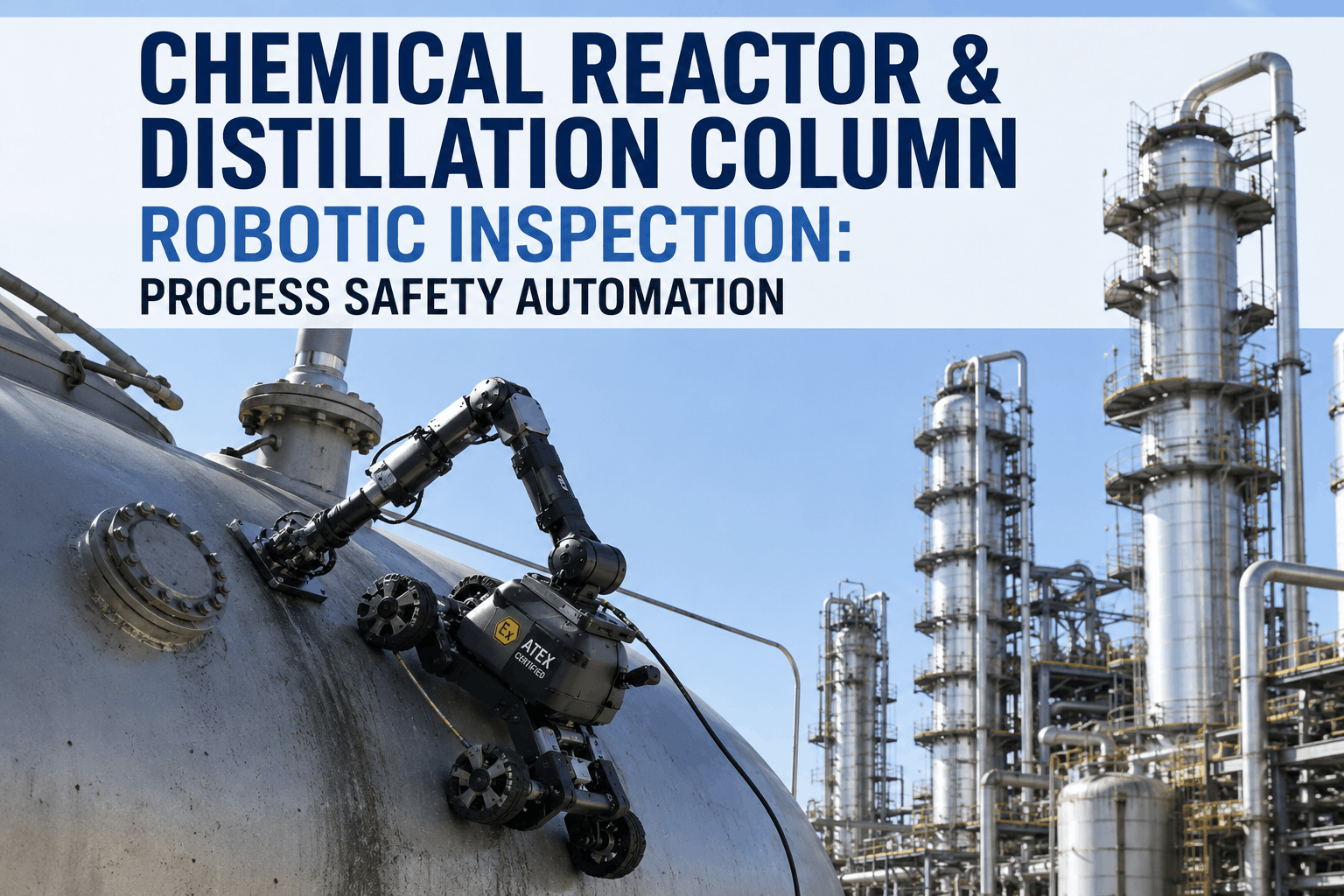
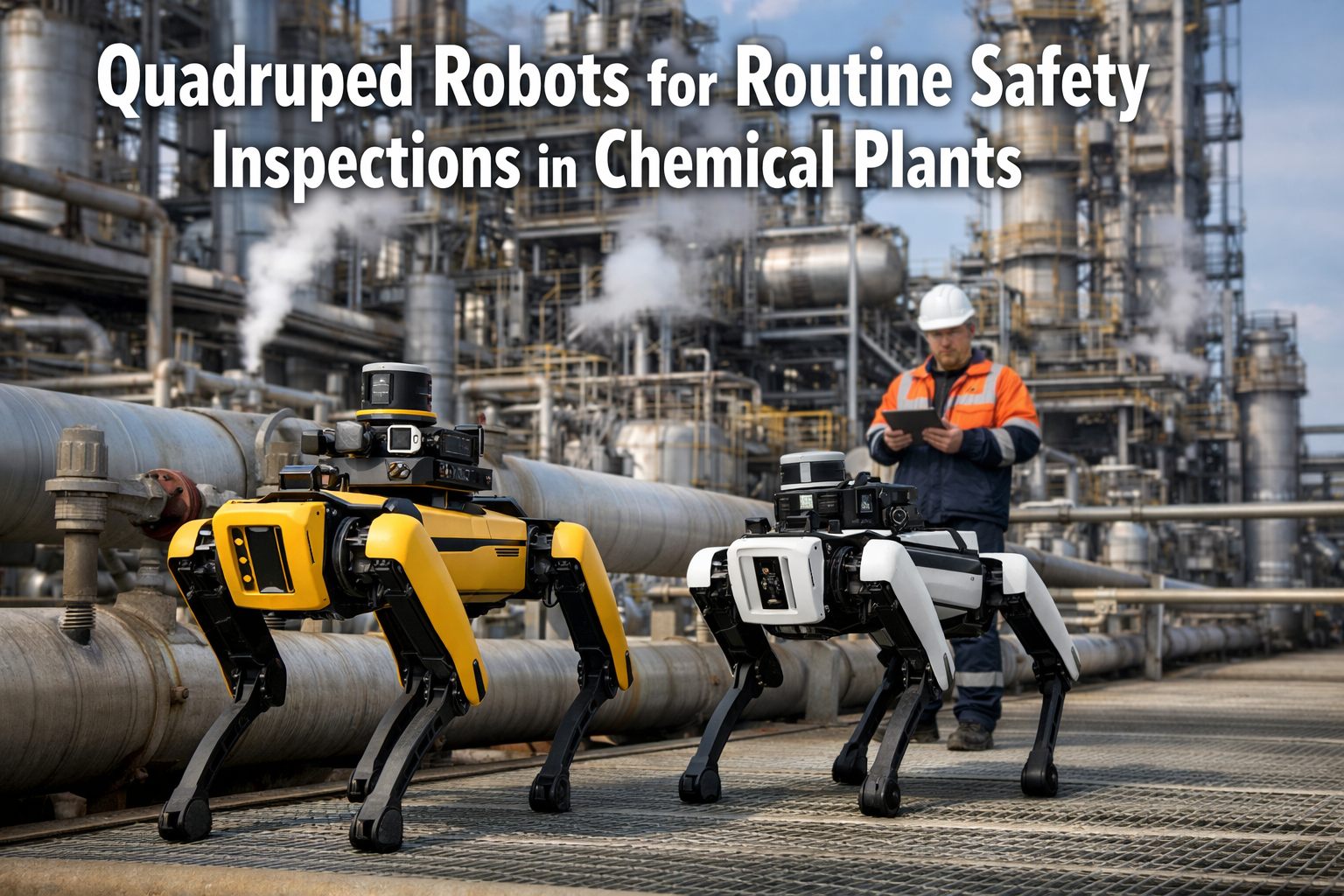
The two most operationally critical and inspection-resistant assets in any chemical plant are reactors and distillation columns. Together they typically represent 40–60% of process-safety incidents and 70%+ of unplanned turnaround scope — yet both remain among the hardest assets to inspect routinely. Reactor cooling jackets sit behind insulation, agitators run continuously, glass-lined vessels can't be touched without risk. Distillation columns reach 60–100 meters tall, contain 50+ trays, and traditionally require shutdown for internal access. The 2026 inflection point: autonomous quadruped robots with roller arms can now safely navigate slippery, confined distillation tray environments (Caltech's safety-critical autonomous inspection framework, 2024), and the global distillation column inspection equipment market is forecast to grow at a 4.8% CAGR through 2035 as operators shift from periodic manual inspections to continuous, data-driven predictive maintenance. This guide breaks down the technical reality of robotic reactor + column inspection — sensor payloads, OSHA PSM integration, the specific failure modes robots catch that humans miss. Book a Reactor & Column Robotic Inspection Workshop to scope a deployment for your facility.
40–60%
Of process safety incidents trace to reactor or distillation column failures
4.8%
CAGR forecast for column inspection equipment market 2026–2035
60–100 m
Typical distillation column height — traditional inspection requires shutdown
70%+
Of unplanned turnaround scope from reactor + column issues
The Two Assets That Define Chemical Plant Reliability
Reactors and distillation columns are the heart of any chemical process, and they share three uncomfortable characteristics: they fail in expensive ways, they fail in ways that traditional inspection cannot detect early, and they are physically hostile to human inspection. Understanding why these two asset categories dominate process safety risk is essential before evaluating robotic inspection programs. Read more in our ATEX quadruped compliance guide.
$50M+
Avg. cost of major reactor incident
3–7 yr
Typical inspection cycle
PRIMARY FAILURE MODES
RX-1Cooling jacket corrosion or fouling
RX-2Agitator bearing degradation
RX-3Glass lining cracking (glass-lined reactors)
RX-4Catalyst bed channeling and pressure drop drift
RX-5Seal leaks at agitator shaft
RX-6Hotspot formation from poor mixing
$80M+
Avg. cost of major column incident
4–6 yr
Typical internal inspection cycle
PRIMARY FAILURE MODES
DC-1Tray flooding and weeping at off-design rates
DC-2Downcomer corrosion or fouling
DC-3Reboiler tube degradation
DC-4Reflux line scaling and flow imbalance
DC-5Vacuum system leak ingress
DC-6Packing channeling and HETP drift
Reactors and Columns Fail Slowly — Until They Don't. Continuous Inspection Catches the Slow Phase.
Most reactor and column failures show measurable precursors weeks to months before functional failure. Manual periodic inspection misses the precursor window. Robotic continuous monitoring catches it.
How Robots Actually Inspect Reactors — The 4-Sensor Strategy
Reactor inspection is not a single task. It is the intersection of four complementary sensor modalities, each catching different failure signatures. A quadruped robot equipped with the right payload combination can detect early-stage degradation across all six primary failure modes — without ever entering the vessel itself. Read more in our chemical plant anomaly detection AI overview.
S1
Thermal Imaging
DETECTS
Cooling jacket fouling (uneven heat distribution), hotspot formation from poor mixing, glass lining defects (different thermal conductivity), bearing overheating in agitator drives
FLIR A700-EX · MoviTHERM
S2
Vibration Analysis
DETECTS
Agitator bearing wear (frequency spectrum signature), shaft misalignment, mechanical seal degradation, gear coupling deterioration in agitator drive trains
Triaxial accelerometer · ISO 10816 compliant
S3
Acoustic Emission
DETECTS
Glass lining microcracks (high-frequency emissions), cavitation in cooling water circulation, seal leak signatures, internal corrosion progression in stainless reactors
UE Systems Ultraprobe · SDT
S4
Gas / VOC Detection
DETECTS
Seal leaks releasing process fluids, vent system degradation, fugitive emissions from agitator mechanical seals, off-spec atmosphere around reactor vicinity indicating process upset
PID + Electrochemical multi-gas
How Robots Inspect Distillation Columns — The Caltech Tray-Walking Breakthrough
Distillation column inspection has historically required column shutdown, scaffolding inside the vessel, and direct human entry through manways — at significant cost and process safety risk. The 2024 Caltech research paper "Safety-critical Autonomous Inspection of Distillation Columns using Quadrupedal Robots Equipped with Roller Arms" demonstrated that quadruped robots can now safely navigate the slippery, confined environment between distillation trays, opening a new category of inspection that simply did not exist before. Book a workshop to evaluate column-internal robotic inspection for your specific column geometry.
UPPER SECTION
Top Trays + Reflux System
Quadruped patrol of upper column platforms inspects reflux drum, condenser approach piping, top tray downcomers. Thermal imaging catches reflux flow imbalance.
Reflux flow distribution
Condenser fouling
Vent system integrity
MIDDLE SECTION (TRAY-WALKING)
Tray Internals + Downcomers
Quadrupeds with roller arms navigate between trays during turnaround. Caltech's safety-critical motion framework handles slippery surfaces and confined geometry. Visual + thermal inspection of every tray.
Tray hole erosion
Downcomer scaling
Weir integrity
Packing distribution
LOWER SECTION + REBOILER
Bottoms + Reboiler Loop
External quadruped patrols inspect reboiler tube bundles, steam supply lines, bottoms pump packing. Acoustic emission catches early reboiler tube degradation.
Reboiler fouling
Tube degradation
Bottoms pump health
Caltech's safety-critical motion framework uses control barrier functions to guarantee the robot stays within safe regions during tray-to-tray transitions. Footstep re-planning compensates for slippery surfaces. This is the first robotic capability that makes column-internal inspection practical without full shutdown access at every tray.
Internal Column Inspection Without Pulling Down the Column. The Math Has Changed.
A single 5-day turnaround at a refinery atmospheric column averages $3M+ in lost throughput. Robotic tray-walking inspection during planned short outages preserves most of that value.
Process Safety Integration — OSHA PSM & the MOC Process
Adding robotic inspection to OSHA PSM-covered reactors and columns is not a plug-and-play activity. The process safety implications must be documented through a formal Management of Change (MOC) review, integrated into your PSM file, and validated against the 14 PSM elements specified in 29 CFR 1910.119. Below is the integration checklist.
PSM-1
Process Safety Information
Robot inspection routes documented against PFDs and equipment lists. Sensor payload specs added to PSI files.
PSM-2
Process Hazard Analysis
HAZOP review covering robot upset conditions — loss of power, communication failure, sensor malfunction during patrol.
PSM-3
Management of Change
Full MOC documentation for adding a robot to a PSM-covered process. Pre-startup safety review. Operator training before live deployment.
PSM-4
Operating Procedures
Standard operating procedures updated to include robot interaction protocols. Emergency stop procedures clearly defined.
PSM-5
Mechanical Integrity
Robotic inspection findings feed directly into the MI program. Auto-generated work orders for follow-up inspection or repair.
PSM-6
Incident Investigation
Robot inspection video and sensor data preserved for incident root-cause analysis. Time-stamped audit trail.
The PdM Workflow — From Robot Patrol to Maintenance Action
Robotic inspection data has value only when it drives action. The end-to-end PdM workflow integrates robot patrols with AI anomaly detection, work-order generation, repair planning, and verification — closing the loop from sensor reading to maintenance execution.
01
Autonomous Robot Patrol
Quadruped executes scheduled patrol route through reactor and column areas. All sensors capture data continuously with geo-tag and timestamp.
↓
02
AI Anomaly Detection
Edge AI compares current readings against baseline patterns. Multivariate models flag deviations exceeding thresholds across thermal, vibration, acoustic, and gas signals.
↓
03
Severity Classification + CMMS Routing
Anomalies classified as Information / Watch / Warning / Critical. Critical findings auto-route to CMMS as priority work orders with all sensor evidence attached.
↓
04
Maintenance Engineer Diagnosis
Engineer reviews video, thermal images, vibration spectra in CMMS. Confirms diagnosis. Plans repair during next planned outage or schedules emergency intervention.
↓
05
Repair Execution + Verification Patrol
Repair completed. Robot executes verification patrol post-repair. Sensors confirm anomaly resolved. CMMS work order closed with documented evidence.
FAQ: Reactor & Column Robotic Inspection
Common questions from maintenance engineers, process safety leaders, and asset reliability managers evaluating robotic inspection for reactors and distillation columns. Question not covered? Reach our solutions team directly, or book a Robotic Inspection Workshop.
Can robots actually walk between distillation column trays safely?
Yes — but only with specific safety-critical motion frameworks. The Caltech 2024 research (Lee, Kim, and Ames) demonstrated quadruped robots equipped with roller arms executing autonomous inspection of industrial-grade distillation column trays. The framework integrates control barrier functions, safety filters, and footstep re-planning to guarantee safe transitions between trays despite slippery surfaces and confined geometry. Commercial deployment is moving forward in 2026 — but this is still an emerging capability that requires column-specific qualification and process safety review.
What sensor payload is best for batch reactor PdM?
A 4-sensor combination is standard: thermal imaging (FLIR A700-EX or equivalent) for cooling jacket fouling and agitator drive overheating; triaxial accelerometer (ISO 10816 compliant) for agitator bearing degradation; acoustic emission probe for glass lining microcracks and seal leak detection; multi-gas detector (PID + electrochemical) for fugitive emissions at mechanical seals. Most ATEX-certified quadrupeds support modular payload swaps, so different reactor types can use different sensor combinations as patrol routes change.
How do you inspect glass-lined reactors without touching them?
Glass-lined reactors are uniquely vulnerable to lining cracks that propagate quickly into product contamination events. Direct contact inspection is impossible without damaging the lining. Robotic inspection uses standoff thermal imaging to detect localized temperature anomalies indicating subsurface defects (cracks change thermal conductivity), plus acoustic emission sensors from external mounting points that capture high-frequency stress wave signatures from microcrack propagation. This is significantly more sensitive than visual or hydraulic test methods commonly used today.
How does robotic inspection integrate with OSHA PSM requirements?
Adding a robot to a PSM-covered process triggers a full Management of Change (MOC) review per 29 CFR 1910.119(l). The MOC must include HAZOP coverage of robot upset conditions, updated operating procedures, pre-startup safety review, and operator training. Robot inspection findings flow directly into the Mechanical Integrity program (PSM Element 8). Audit trails preserve all sensor data and decisions for incident investigation. iFactory's deployment program includes MOC documentation templates and PSM integration consulting as standard scope.
What about CSTR vs batch reactor inspection differences?
CSTRs (Continuous Stirred-Tank Reactors) run continuously, so robotic patrols must monitor steady-state operating conditions and detect drift from baseline. Vibration and thermal trends over time are the most valuable signals. Batch reactors have distinct phases (charging, heating, reaction, cooling, discharge), and the robot patrol schedule aligns with batch phase to capture phase-specific anomalies. Both reactor types benefit from the same 4-sensor payload combination; the difference is in patrol timing and baseline model construction.
Can robots inspect vacuum distillation columns?
External quadruped patrols inspect vacuum system integrity (vacuum pump bearing health, seal leak detection at flanges, condenser tube degradation), but cannot enter the vacuum envelope during operation. Internal tray inspection requires breaking vacuum for access. Robotic tray-walking after vacuum break and pre-startup verification has shown the strongest value — particularly for catching downcomer corrosion and packing channeling that develop slowly during operation but become visible only at shutdown.
What's the typical ROI for reactor + column robotic inspection?
Three primary value streams: (1) Unplanned outage avoidance — catching reactor or column failures weeks ahead of functional failure typically saves $2–10M per major incident avoided; (2) Turnaround scope reduction — robotic pre-inspection during planned outages identifies needed work in advance, reducing turnaround duration by 1–3 days at $1M+ per day for many plants; (3) Inspection labor reallocation — engineers shift from routine walk-downs to higher-value diagnosis work. Typical full-program payback is 14–24 months.
How quickly can we book a Robotic Inspection Workshop?
Workshops are typically scheduled within 5–7 business days of request. The session is a
90-minute working call with your maintenance engineering, process safety, and operations teams — we map your specific reactor and column inventory, current inspection cycle, OSHA PSM posture, and turnaround planning to a tailored robotic deployment plan. Output includes sensor payload recommendation, MOC documentation framework, and a 12-week deployment timeline.
Book your workshop now.
Bring Robotic Inspection to Your Reactors and Columns. Live in 12 Weeks.
The two assets that define your plant's process safety profile are also the two hardest to inspect. ATEX-certified quadrupeds with 4-sensor payloads now patrol reactor exteriors continuously, and tray-walking capability brings internal column inspection within reach. iFactory's Reactor & Column Robotic Inspection Workshop scopes your specific equipment, OSHA PSM integration, and CMMS workflow into a 12-week deployment plan.
4-sensor payload (thermal, vibration, acoustic, gas)
OSHA PSM MOC documentation included
Tray-walking capability for column internals
CMMS auto-work-order integration
$2–10M per major incident avoided