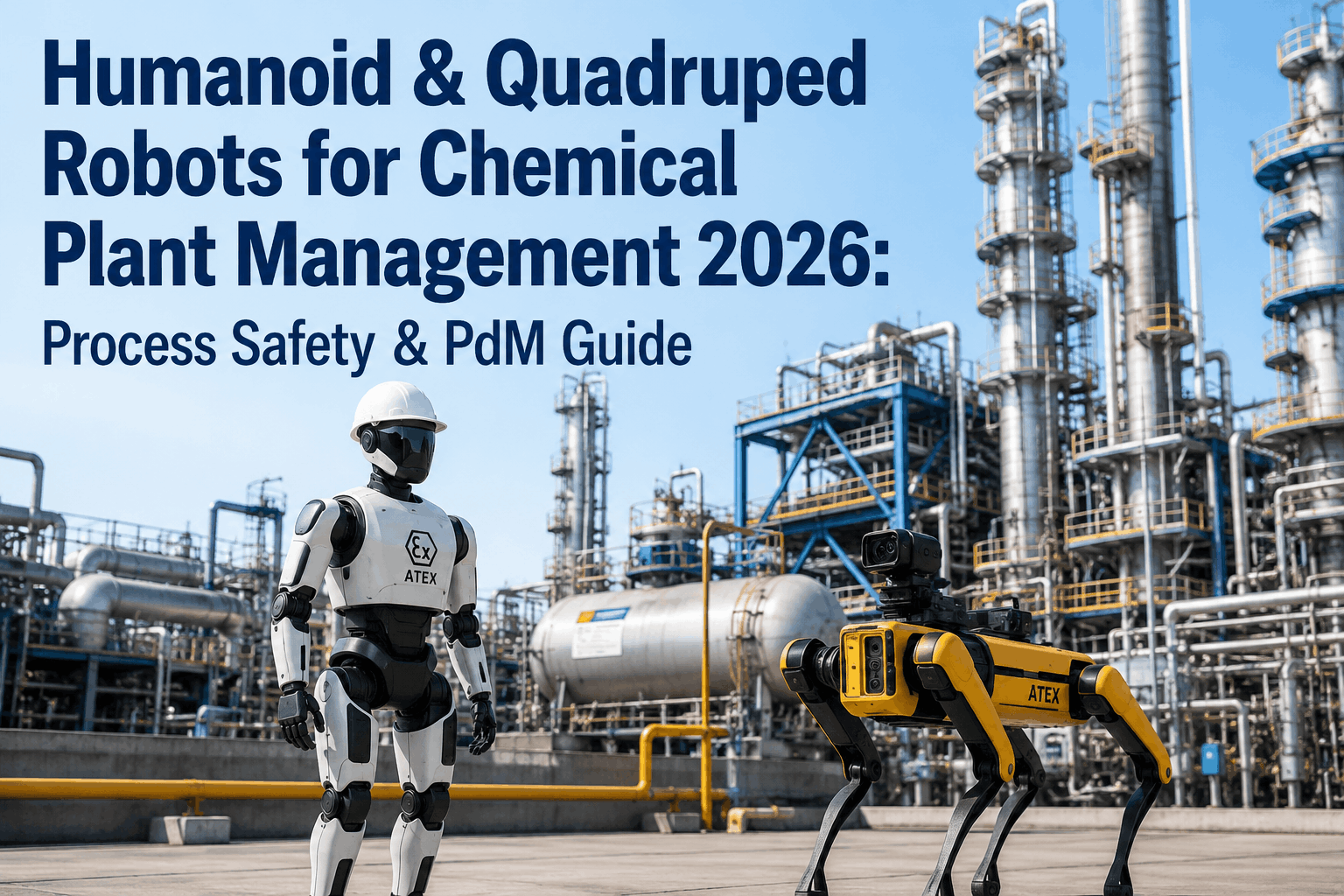
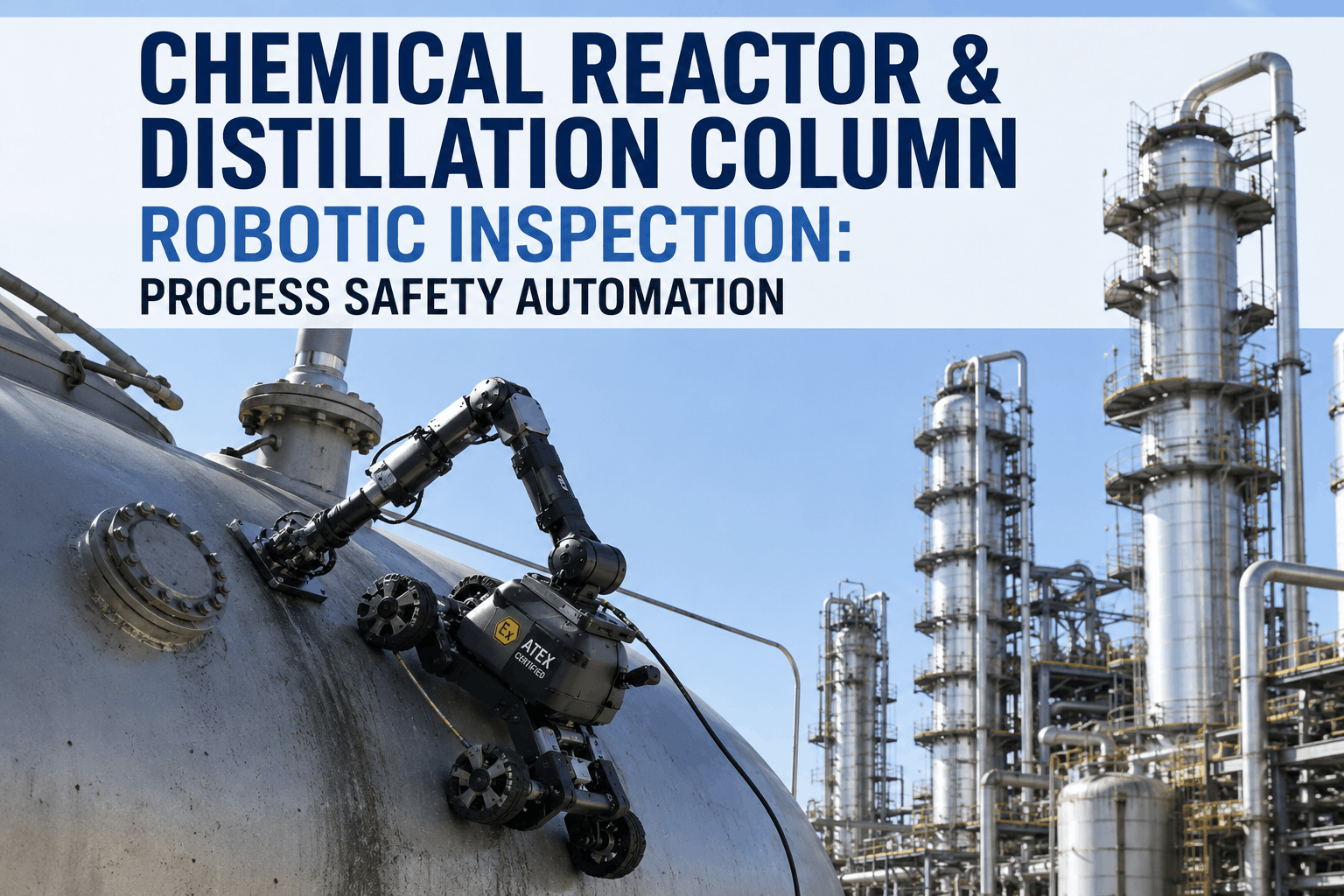
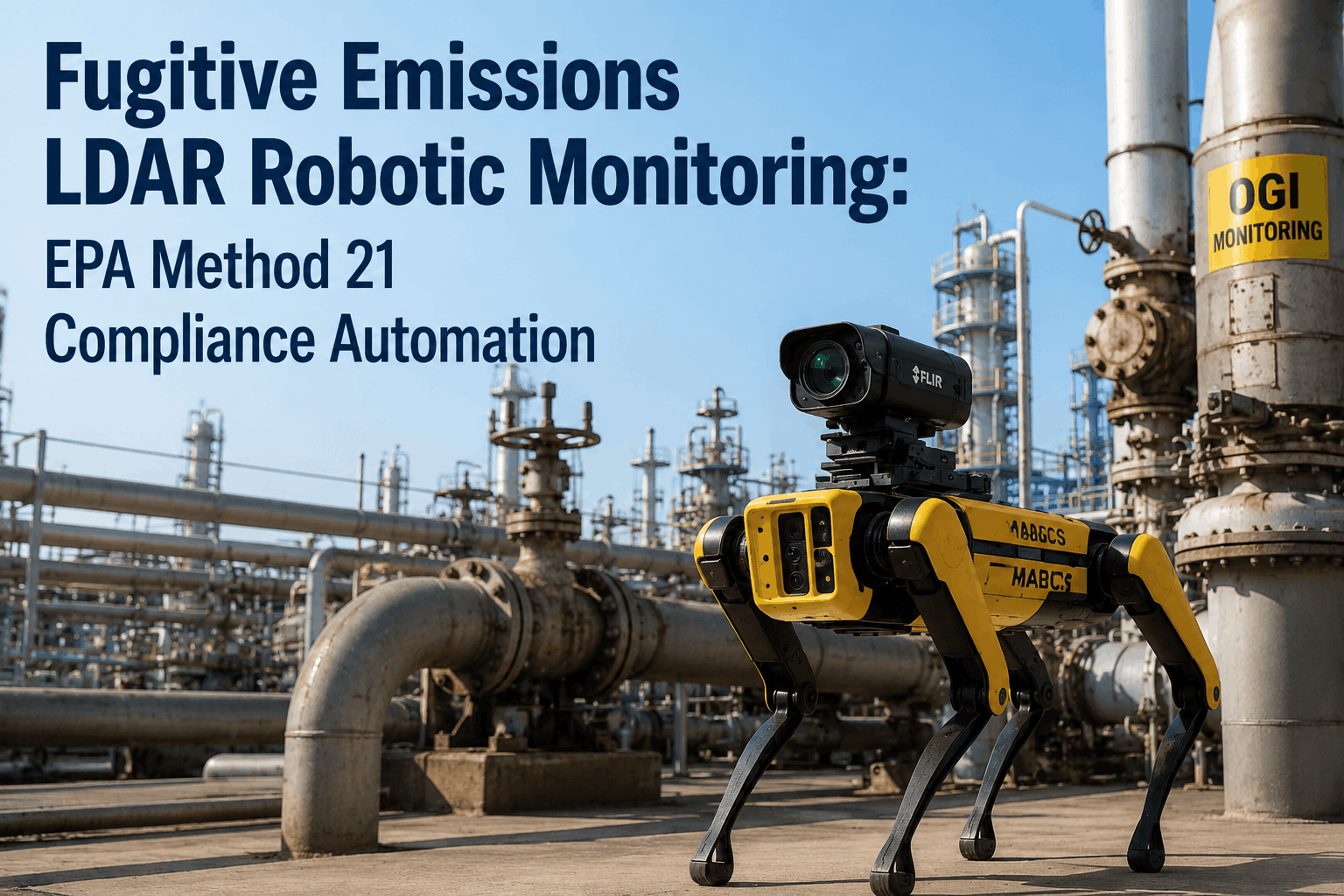
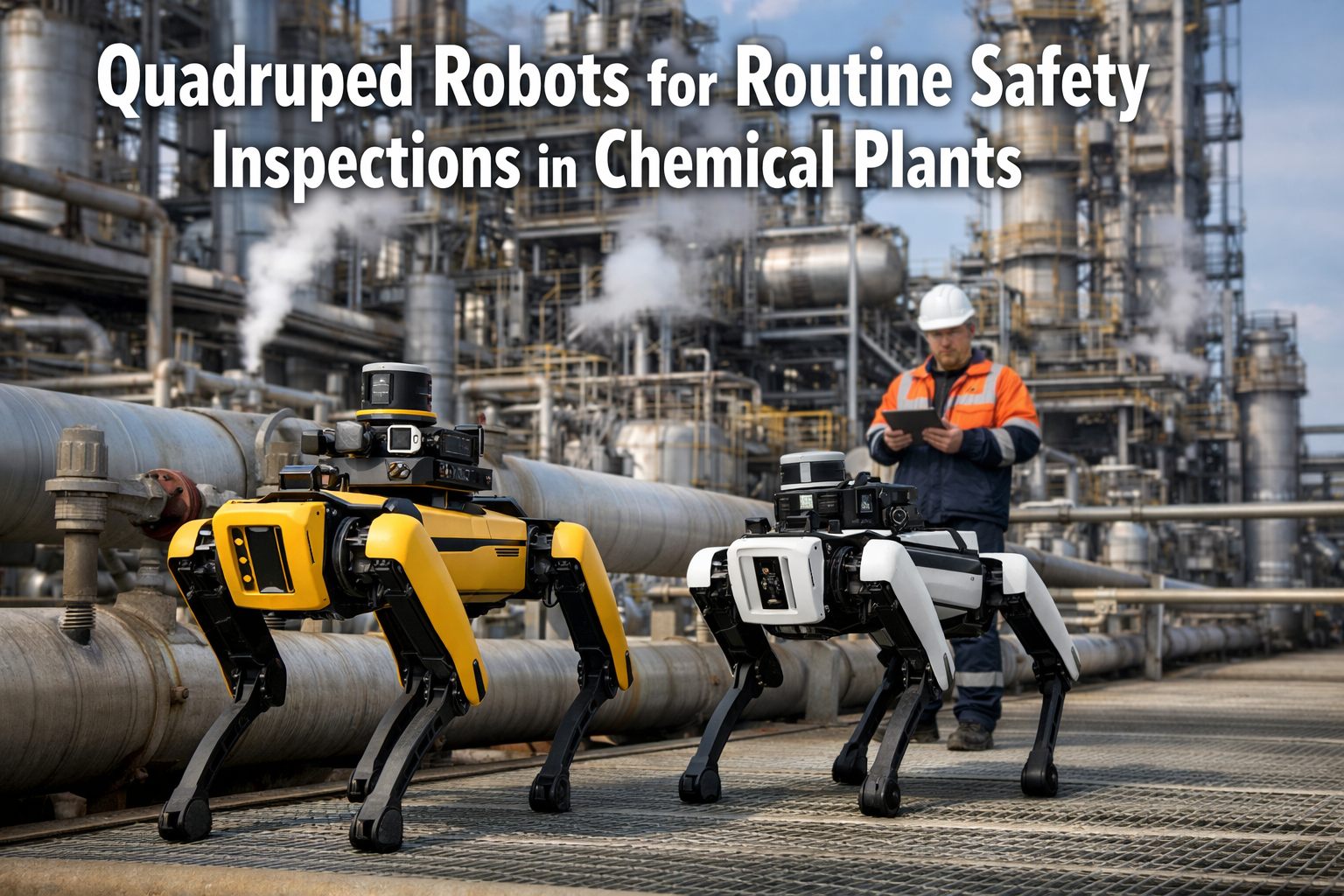
The chemical industry crossed a threshold in April 2026 when BASF and Sevnce Robotics signed an MoU to deploy explosion-proof humanoid and quadruped robots across chemical sites — the most public commitment yet from a major operator to robot-driven plant management. The driving forces are not novelty: an aging workforce, a tightening regulatory environment with OSHA GHS Revision 7 taking effect May 19, 2026, and the persistent risk of fugitive emissions that account for over 60% of upstream methane releases. Today's ATEX-certified quadrupeds and emerging humanoid platforms now patrol hazardous zones 24/7, perform LDAR (Leak Detection and Repair) campaigns at sub-10 parts-per-billion sensitivity, and integrate into OSHA PSM-compliant safety programs that human inspectors alone cannot match. This guide breaks down the chemical plant robotics landscape in 2026 — platforms, certifications, deployment scenarios, regulatory framework, and what BASF, Dow, SABIC, and LyondellBasell are actually piloting. Book a Chemical Robotics Deployment Workshop to map a compliant program for your facility.
April 2026
BASF–Sevnce MoU — major operator commitment to robot deployment
May 19, 2026
OSHA GHS Revision 7 deadline — affects all hazard zone classifications
<10 ppb
Methane detection sensitivity with modern robot-mounted OGI sensors
24/7
Continuous hazardous zone patrol without human exposure
Why Chemical Plants Are Deploying Robots in 2026
Three forces are converging in 2026 to make robot deployment in chemical plants a near-term operational requirement rather than a long-term innovation experiment. Each one alone would justify the investment. Together, they make the business case unmistakable. Read more on the broader compliance backdrop in our quadruped robots in ATEX zones compliance guide.
F1
SAFETY IMPERATIVE
Removing Humans from Hazardous Exposure
Every chemical plant has zones operators should never enter routinely — toxic gas areas, high-pressure reactor vicinities, fugitive emissions hotspots, confined spaces. Robots provide 24/7 coverage in these zones with zero human exposure risk.
F2
REGULATORY PRESSURE
OSHA GHS Rev 7 + TSCA PFAS + Annex 11
May 19, 2026 brings OSHA's GHS Revision 7 deadline — new hazard classifications that affect ATEX zone drawings. Combined with TSCA PFAS amendments and EU GMP Annex 11 revisions, the compliance documentation burden is multiplying.
F3
WORKFORCE GAP
Aging Operators, Talent Shortage
The most experienced chemical plant operators are retiring faster than replacements are entering the workforce. Robots preserve institutional knowledge of inspection routes and deliver consistent execution shift after shift.
"BASF looks forward to deepening strategic cooperation with Sevnce Robotics, focusing on digital transformation and safe production scenarios in the chemical industry."
— Dr. Jeffrey Lou, Chairman & President, BASF Greater China (April 2026)
The Robot Era in Chemical Plants Has Started. The Compliance Framework Is Still Catching Up.
Plants that deploy without a rigorous ATEX, OSHA PSM, and PdM integration framework will face catastrophic regulatory and operational liability.
Humanoid vs. Quadruped: Choosing the Right Platform
The two robot form factors solve different chemical plant problems. Quadrupeds dominate today because they are commercially mature, ATEX-certifiable, and field-proven across hundreds of industrial sites. Humanoids are emerging in 2026 H2 pilot deployments and will scale through 2027–2028. Most chemical operators will run mixed fleets. Schedule a workshop to map the right form factor mix for your facility.
The 2026–2028 reality: Most chemical plants will run mixed fleets — quadrupeds handling continuous patrol and observation, humanoids handling specific manipulation tasks. iFactory's Chemical Robotics Deployment Workshop maps the right mix for your specific facility layout, hazard zones, and operational priorities.
What Major Chemical Operators Are Actually Deploying
Robot deployment in chemical plants moved from PR-stage to operational-stage in 2025–2026. Below is a snapshot of public initiatives at four major operators — what they are piloting, the form factors involved, and the use cases driving deployment.
BASF
CHINA + EU + AMERICAS
2026 MoU with Sevnce Robotics for explosion-proof quadruped + humanoid deployment across chemical sites
Joint material innovation — engineering plastics, TPU, and polyurethanes for lightweight robot components
Use cases: hazardous zone patrol, safety-critical inspections, predictive maintenance route automation
Boston Dynamics Spot deployments across multiple US chemical complexes for inspection automation
Thermal imaging payloads for heat exchanger fouling and bearing degradation detection
Use cases: tank farm patrol, leak detection, fire/smoke surveillance, confined space pre-entry assessment
ATEX-rated quadruped trials at petrochemical complexes in Jubail and Yanbu
Fugitive emissions LDAR programs using OGI-equipped quadrupeds for methane and VOC detection
Use cases: high-temperature reactor area patrol, emissions compliance, OSHA PSM-aligned safety walks
Quadruped pilot programs for polymer plant predictive maintenance and reliability monitoring
Acoustic sensor payloads for steam trap monitoring and compressed-air leak detection
Use cases: rotating equipment vibration analysis, ultrasonic leak detection, night-shift autonomous patrol
The ATEX Certification Reality — What You Actually Need
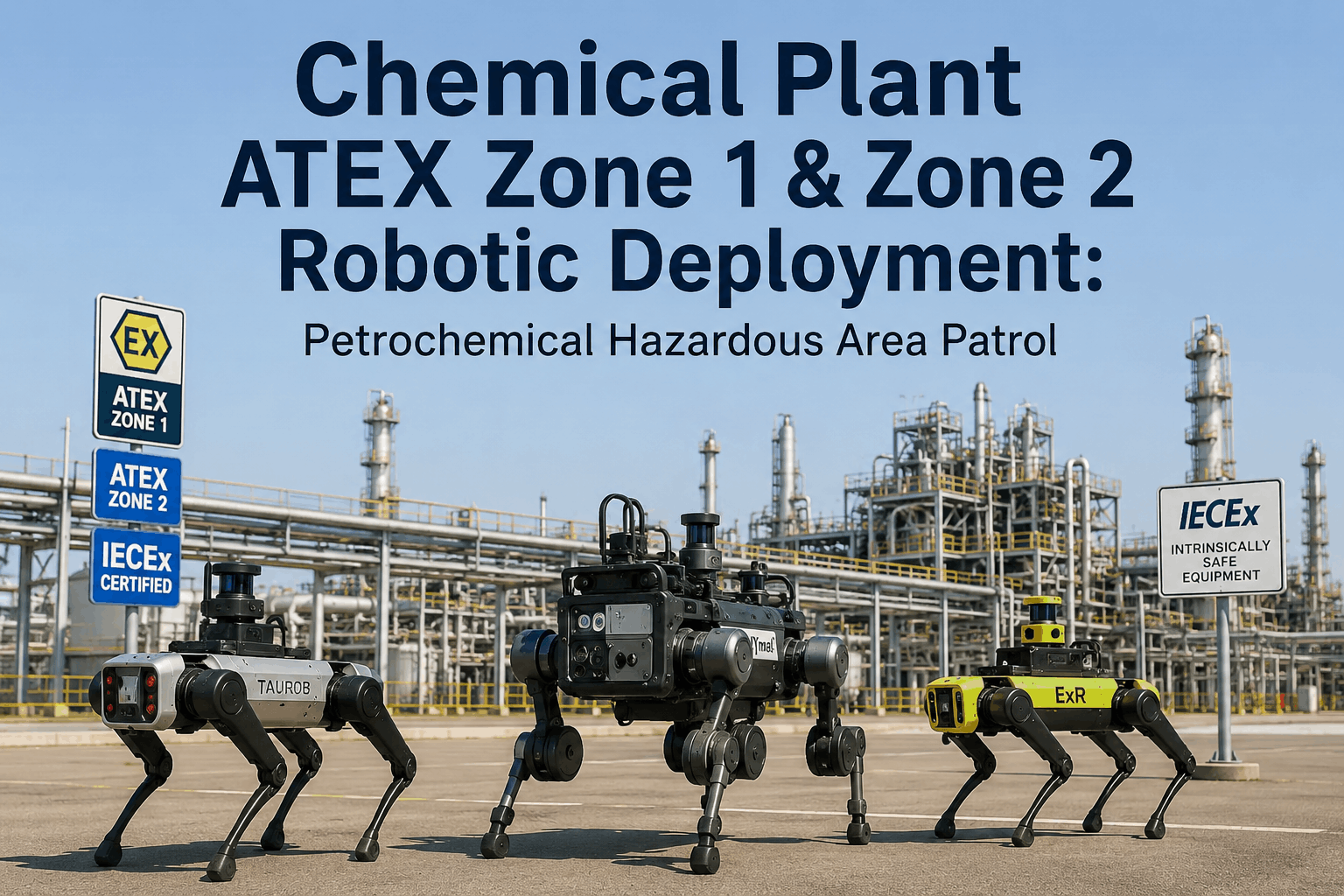
Most consumer-grade quadrupeds are not ATEX-certified and cannot legally enter hazardous-classified zones in chemical plants. The certification pathway is rigorous, expensive, and limited to a small number of platforms in 2026. Understanding the certification matrix is essential before any deployment plan. Read deeper context in our ATEX compliance guide.
ZONE 0
Continuous Risk
Explosive atmosphere present continuously or for long periods
CATEGORY 1G EQUIPMENT
Inside reactors, fuel tanks. No quadruped certified. Human-only entry with full PPE.
ZONE 1
Likely Risk
Explosive atmosphere likely to occur in normal operation
CATEGORY 2G EQUIPMENT
Reactor vicinity, loading bays. ANYbotics ANYmal X + Sevnce ex-quadruped certified.
ZONE 2
Occasional Risk
Explosive atmosphere unlikely; brief duration if present
CATEGORY 3G EQUIPMENT
Most chemical patrol routes. Several certified quadruped options; majority of deployment scenarios.
UNCLASSIFIED
No Hazard Zone
Standard industrial environment outside hazardous classifications
NO ATEX REQUIRED
Warehouses, control rooms, office corridors. Boston Dynamics Spot, Unitree.
Critical reminder: OSHA GHS Revision 7 (May 19, 2026) introduces updated criteria for flammable gas and liquid classifications. If a chemical's GHS classification changes, the corresponding ATEX zone may change too — potentially requiring different equipment categories for your robot fleet.
Book a workshop to cross-reference your zone drawings against revised SDS classifications.
Robot Deployment Without ATEX Compliance = Catastrophic Liability.
Get an audit-ready ATEX, OSHA PSM, and OSHA GHS Rev 7 robot deployment framework before you sign any vendor contract.
Book your Compliance Workshop today.
The 6 High-Value Use Cases for Chemical Plant Robots
Robots make sense when they replace dangerous, repetitive, or impossible-for-humans tasks at higher quality and consistency. Below are the six deployment scenarios where chemical operators consistently report the strongest ROI in 2026.
U1
LDAR / Fugitive Emissions
Quadrupeds equipped with optical gas imaging (OGI) cameras patrol flanges, valves, and seals continuously. Modern sensors detect methane at <10 ppb. EPA Method 21 compliant.
Payload: Mileva 33 OGI · SeekOps mass-flow
U2
Hazardous Zone Patrol
ATEX Category 2G/3G quadrupeds replace operator walk-downs in classified zones. Zero human exposure. Consistent route execution every shift.
Payload: Multi-gas detector · Thermal imager
U3
Predictive Maintenance (PdM)
Vibration, thermal, and acoustic payloads detect bearing degradation, steam trap failures, and rotating equipment anomalies weeks before failure. Integrates with CMMS for auto-work-orders.
Payload: Vibration sensor · Thermal camera · Acoustic mic
U4
Confined Space Pre-Entry
Robots enter confined spaces ahead of human teams to test atmosphere, capture visual inspection, and confirm safe-entry conditions. OSHA 1910.146 supports this approach.
Payload: 4-gas monitor · 360° camera
U5
Tank Farm Inspection
Continuous patrol of storage tank exteriors for corrosion, leak signatures, and structural anomalies. Thermal imaging catches subsurface defects invisible to walk-arounds.
Payload: Thermal camera · UT sensor probe
U6
Emergency Response
Robots deploy into incident scenes (chemical releases, fires) where human entry is unsafe. Gather situational awareness data to inform response decisions without exposure risk.
Payload: Multi-gas · Thermal · Live-stream camera
Connecting Robots to Plant Systems — The Integration Stack
A robot generating sensor data with no destination is just an expensive walking gadget. The value comes from integration: robot inspection findings flow into CMMS, PSM, and digital plant systems where they drive maintenance work orders, compliance records, and operational decisions. Below is the integration stack that turns robot patrol into measurable operational impact.
LAYER 1 — ROBOT FLEET
Quadruped + Humanoid Platforms
ATEX-Cert Quadrupeds
Sensor Payloads
Autonomous Route Mgmt
Edge AI Inference
Spot · ANYmal X · Sevnce ex-quadruped · Humanoid pilots
LAYER 2 — AI ANALYTICS + COMPLIANCE
iFactory Robot Data Pipeline
Anomaly Detection AI
LDAR Compliance Engine
PdM Forecasting
Audit Trail Generation
Turns raw sensor data into actionable insights and compliance records
LAYER 3 — ENTERPRISE SYSTEMS
CMMS · PSM · ERP · EHS
Work Order Mgmt
PSM Documentation
Compliance Reporting
EHS Dashboards
SAP S/4HANA · SAP PM · IBM Maximo · Oxmaint · EHS platforms
OSHA PSM + Regulatory Compliance Framework
Robot deployment in chemical plants must satisfy a stack of overlapping safety and environmental regulations. The four primary frameworks each impose specific requirements on how robots are deployed, monitored, and integrated into safety management systems. Book a Compliance Workshop to map your specific framework obligations.
OSHA
OSHA 29 CFR 1910.119 PSM
MANDATORY
Requires: Process Safety Management for highly hazardous chemicals. Robot inspection routes must integrate with PSM documentation, MOC processes, and operating procedures.
EPA
EPA Method 21 + Subpart OOOOb
MANDATORY
Requires: LDAR for fugitive emissions, methane reductions for oil and gas. Robot-based OGI inspections must meet detection thresholds and documentation standards.
MAY 19, 2026
Requires: SDS and facility labeling re-authored to GHS Rev 7. New flammable gas categories may shift ATEX zone classifications — directly affecting which robot equipment categories you need.
ATEX
ATEX 2014/34/EU + IECEx
MANDATORY
Requires: Equipment certified for the specific zone classification where it operates. Only ATEX-certified quadrupeds permitted in Zone 1/2; certifications must match gas/dust group and temperature class.
The 12-Week Robot Deployment Roadmap
A compliant chemical plant robot deployment is not a 4-week project. The combined requirements of ATEX certification matching, OSHA PSM integration, sensor payload validation, and CMMS connectivity drive a 12-week minimum timeline. Skipping any phase increases regulatory and operational risk dramatically.
Weeks 1–3
Hazard Zone Mapping & Use Case Selection
Audit existing ATEX zone drawings, cross-reference against GHS Rev 7. Identify high-value patrol routes, LDAR targets, and PdM scenarios. Select form factor mix.
Weeks 4–6
Platform Selection & Payload Spec
Match ATEX category requirements to certified platforms. Specify sensor payloads (OGI, thermal, vibration, gas). Validate vendor certifications match your gas group and temperature class.
Weeks 7–9
PSM Integration & Operator Training
Update PSM documentation, MOC, and operating procedures. Train operators and EHS staff on robot interaction protocols. Pilot autonomous routes in non-hazardous zones first.
Weeks 10–12
CMMS Integration & Live Cutover
Connect robot data pipeline to CMMS, PSM, and EHS systems. Validate auto-work-order generation. Expand patrol routes to hazardous zones. First compliance report generated.
FAQ: Chemical Plant Robotics in 2026
Common questions from EHS managers, plant operations directors, and process safety leaders evaluating humanoid and quadruped robot deployment. Question not covered? Reach our solutions team directly, or book a Deployment Workshop.
Which quadruped robots are actually ATEX-certified for chemical plants?
As of 2026, ANYbotics ANYmal X is the only Western-market quadruped commercially certified for ATEX Zone 1 (Category 2G). Sevnce Robotics manufactures a full range of explosion-proof quadruped, wheeled, and track-mounted models certified for hazardous environments in Asia, Middle East, and other markets. Boston Dynamics Spot is not ATEX-certified and can only operate in unclassified or Zone 2 areas with mitigations. Certification must match your specific gas group (IIA, IIB, IIC), temperature class (T1–T6), and zone (0/1/2). EU and US certifications differ.
Are humanoid robots ready for chemical plant deployment in 2026?
Not for hazardous-zone deployment yet. 2026 H2 is the pilot phase for humanoid robots in industrial environments — EVST, Apptronik, and Figure are running select industrial pilots. ATEX certification for humanoid platforms is still in development. Full commercial deployment in chemical plants is on the 2027–2028 roadmap. Most chemical operators should focus on quadrupeds in 2026 and plan humanoid pilots for late 2027 onward.
How does the OSHA GHS Revision 7 deadline affect our existing robot deployments?
The May 19, 2026 deadline requires all SDS and facility labeling re-authored to GHS Rev 7. The new criteria for flammable gas and liquid classifications (including new Category 1A and 1B for flammable gases) may shift your ATEX zone drawings. If a zone's classification changes, the required equipment category for robots operating there may change too. We recommend cross-referencing your zone drawings against revised SDS classifications as part of GHS Rev 7 preparation — and re-validating that your existing quadruped certifications still match the new zone boundaries.
What sensor payloads are most valuable for chemical plant patrol?
The four highest-value payloads are: (1) Optical Gas Imaging (OGI) for methane and VOC leak detection at sub-10 ppb — supports EPA Method 21 LDAR compliance; (2) Multi-gas detector for H2S, CO, O2, LEL monitoring during patrols; (3) Thermal imaging for bearing degradation, heat exchanger fouling, and electrical hotspots; (4) Acoustic/ultrasonic sensors for steam trap monitoring and compressed-air leak detection. Most ATEX-certified quadrupeds support modular payload swaps, so different missions can use different sensors.
How do robots integrate with our existing SAP and CMMS systems?
Modern robot fleets connect via standard protocols: MQTT and OPC-UA for sensor data, REST APIs for orchestration. Inspection findings flow into your CMMS (SAP PM, IBM Maximo, Oxmaint) as structured work orders with thermal images, vibration spectra, gas readings, and recommended actions automatically attached. PSM documentation gets enriched in real time with inspection evidence and timestamps. Every sensor reading is geo-tagged and linked to a specific asset ID for full audit traceability — no manual data entry.
What's the typical ROI timeline for chemical plant robot deployment?
ROI varies significantly by use case. LDAR programs typically pay back in 12–18 months through emissions credits, regulatory fine avoidance, and lost-product recovery. Predictive maintenance patrols show 30–50% reduction in unplanned downtime within the first year, with payback typically 18–24 months. Hazardous zone patrol automation delivers safety value that is harder to monetize but reduces insurance premiums and liability exposure significantly. Mixed deployments combining all three use cases typically deliver positive ROI within 18 months across the fleet.
How do we handle MOC (Management of Change) for adding a robot to a hazardous zone?
Adding a robot to a PSM-covered process requires a full Management of Change review. Document the robot's ATEX certification, intended patrol routes, sensor payloads, and emergency procedures. Conduct a HAZOP review covering robot behavior in upset conditions (loss of power, communication failure, sensor malfunction). Update operating procedures and emergency response plans. Train all affected personnel. The MOC documentation becomes part of your PSM file and must be available during compliance audits.
How quickly can we book a Chemical Robotics Deployment Workshop?
Workshops are typically scheduled within 5–7 business days of request. The session is a
90-minute working call with your EHS, operations, and IT teams — we map your specific facility hazard zones, current PSM posture, GHS Rev 7 readiness, and target use cases to a tailored robot deployment plan. Output includes a form factor recommendation, ATEX certification roadmap, 12-week deployment timeline, and CMMS integration architecture.
Book your workshop now.
Plan Your Chemical Plant Robot Fleet Before the May 2026 GHS Deadline.
BASF, Dow, SABIC, and LyondellBasell are not the only operators rolling out humanoid and quadruped robots in 2026. The compliance framework matters as much as the platform choice. iFactory's Chemical Robotics Deployment Workshop maps your facility hazard zones, certification requirements, sensor payloads, and CMMS integration into a 12-week deployment plan.
ATEX + OSHA PSM compliance from day one
Mixed quadruped + humanoid fleet planning
LDAR program integration with EPA Method 21
CMMS + PSM + EHS auto-integration
GHS Rev 7 zone-drawing cross-reference