MoCRA's safety substantiation mandate isn't a documentation formality — it's an enforcement trigger. Every cosmetic product marketed in the United States must now be backed by adequate substantiation of safety before it reaches consumers, and the FDA's authority to access, audit, and act on deficient safety files is no longer theoretical. Facilities without a defensible, inspection-ready safety file are accumulating regulatory liability with every shipment — and when enforcement arrives, retroactive documentation is not a remedy.
Is Your Cosmetic Safety File MoCRA-Defensible?
iFactory's Quality Management platform helps cosmetics manufacturers build, store, and audit safety substantiation files — with AI-assisted gap detection and GMP-compliant document vaults.
What MoCRA Demands: The Safety Substantiation Standard Explained
MoCRA codifies what the FDA has long expected but could not formally enforce: that cosmetic manufacturers possess adequate information to substantiate the safety of every ingredient and finished product before market distribution. This standard applies universally — regardless of product category, brand size, or distribution channel.
Adequate Substantiation Standard
Safety must be substantiated through reliable scientific evidence — including toxicological data, published literature, historical safe use, and quantitative exposure modeling — sufficient to conclude the product is safe under labeled conditions of use.
Product Information File (PIF)
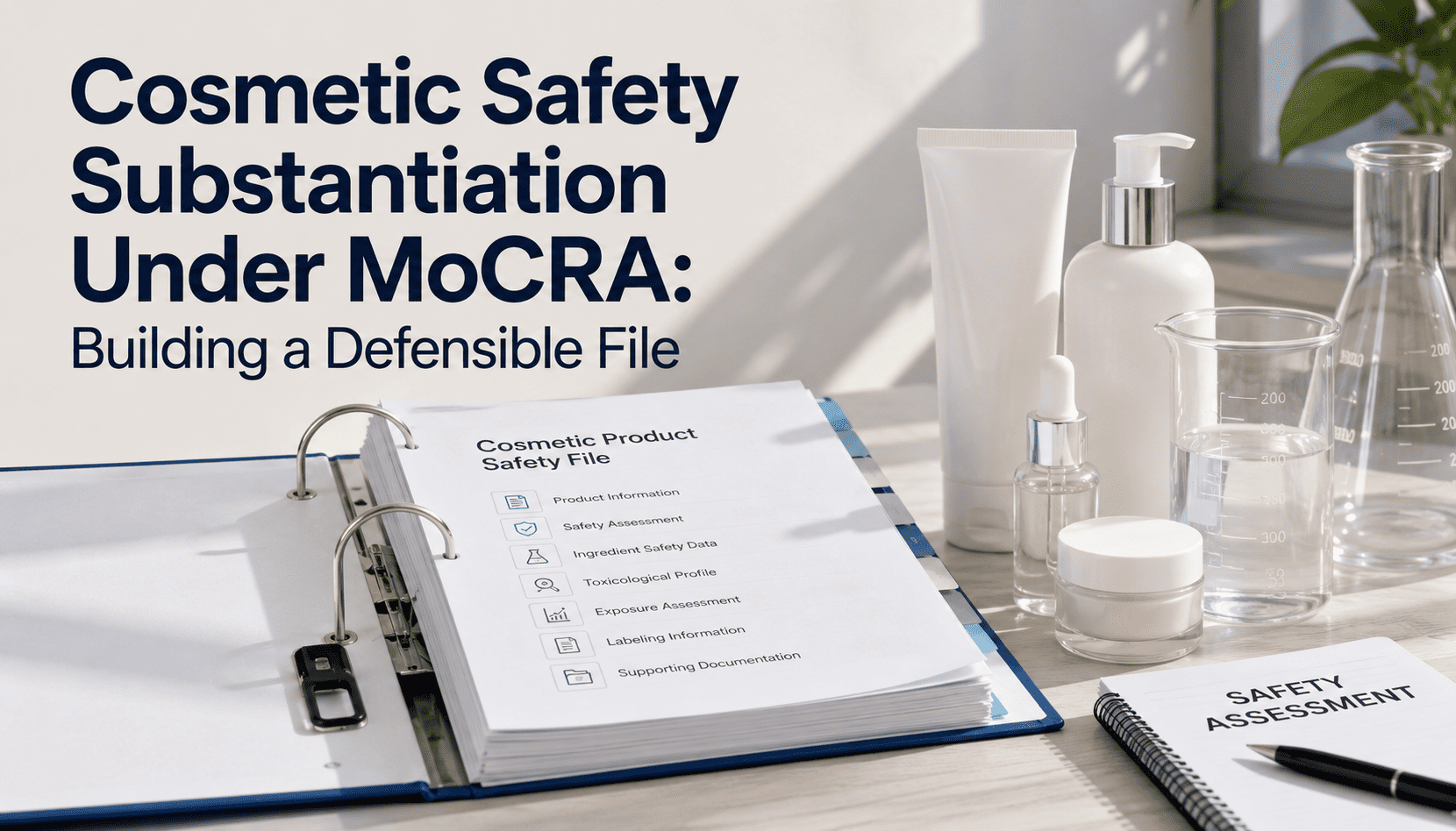
Each cosmetic product requires a structured PIF containing formulation details, ingredient safety data, manufacturing specifications, and substantiation rationale — maintained and accessible for FDA inspection at any time post-launch.
Ingredient-Level Evidence
Safety substantiation must extend to every ingredient in the formulation, including preservatives, fragrance components, and colorants — with concentration-specific safety rationale linked to recognized toxicological thresholds and exposure limits.
Exposure & Risk Assessment
Quantitative exposure assessments that account for use frequency, body surface area, and systemic absorption are increasingly expected components of a defensible safety file — particularly for leave-on, rinse-off, and children's product categories.
Safety Substantiation File Architecture: Components That Withstand FDA Scrutiny
A defensible cosmetic safety file is not a collection of supplier CoAs — it is a structured, evidence-linked dossier that connects formulation data to validated safety conclusions. The table below maps the required components of a MoCRA-compliant safety substantiation file, ranked by documentation priority.
| Safety File Component | Documentation Standard | AI Integration Value | Compliance Impact | Priority |
|---|---|---|---|---|
| Finished Product Safety Assessment | Toxicologist-signed safety conclusion | Auto-flags incomplete sign-off chains | Primary FDA inspection deliverable | High |
| Ingredient Safety Dossiers | CoAs, SDS, published toxicology studies | Gaps detected against INCI master list | Substantiates every formula component | High |
| Quantitative Exposure Assessment | SCCS or EPA exposure modeling | Auto-calculates systemic exposure dose | Defensible for leave-on/children categories | Medium |
| Literature & Clinical Evidence Library | PubMed-indexed, peer-reviewed sources | AI-assisted literature gap analysis | Supports historical safe-use arguments | Medium |
| Adverse Event & Post-Market Surveillance | MedWatch-linked SAE records | Auto-routes severity classifications | Closes the post-launch safety loop | Lower |
5-Step Framework: Building a Defensible Cosmetic Safety File
Constructing a MoCRA-compliant safety substantiation file requires systematic evidence assembly, qualified toxicologist review, and an audit-ready storage architecture. The roadmap below provides a structured pathway for compliance teams building or upgrading safety files across single or multi-SKU portfolios.
Conduct a Full Formulation Ingredient Inventory
Map every ingredient in each product formulation to its INCI name, concentration range, and function. Identify regulated substances, restricted colorants, and ingredients with established SCCS or CIR safety opinions — this inventory is the foundation of every downstream safety determination.
Assemble Ingredient-Level Safety Evidence
Collect CoAs, safety data sheets, toxicological studies, and published literature for every ingredient. Where proprietary ingredients are used, obtain safety substantiation documentation from suppliers under NDA — gaps at this stage are the most common source of incomplete PIF filings.
Commission a Qualified Safety Assessment
A qualified toxicologist or cosmetic safety assessor must review the assembled evidence, apply exposure modeling where required, and produce a signed safety conclusion document. This assessment — not the raw data — is the legally substantiating artifact under MoCRA's adequacy standard.
Structure the Product Information File
Organize the safety assessment, formulation specification, manufacturing method, labeling, and adverse event records into a structured PIF that mirrors FDA inspection expectations. Each PIF must be version-controlled, linked to the product's FEI-registered facility, and retrievable within 48 hours of an inspection request.
Establish Post-Launch Surveillance & Update Triggers
Safety substantiation is not a one-time event — new adverse event data, reformulations, or updated regulatory opinions on ingredients require PIF updates. Embed surveillance review cycles into your quality calendar and define clear triggers that mandate safety reassessment before continued distribution.
Legacy Documentation vs. MoCRA-Optimized Safety Substantiation
Most cosmetics manufacturers carry safety documentation inherited from pre-MoCRA practices — supplier CoAs in email chains, informal toxicologist sign-offs, and scattered literature files. The comparison below illustrates the operational and legal gap between legacy documentation and a defensible MoCRA safety architecture.
- Safety conclusions stored in email threads, not versioned systems
- Ingredient CoAs collected ad hoc without completeness checks
- No structured exposure assessment for leave-on or children's products
- Safety assessor sign-off undocumented or informally emailed
- PIF components scattered across ERP, email, and shared drives
- Post-launch adverse events not linked back to safety files
- No defined trigger for safety reassessment after reformulation
- FDA inspection response requires weeks of manual document retrieval
- Version-controlled safety conclusions in a centralized document vault
- AI-driven ingredient gap detection against INCI master list on intake
- Automated exposure modeling integrated into safety assessment workflow
- Digital sign-off with 21 CFR Part 11-compliant electronic signatures
- Unified PIF linking formulation, facility FEI, and safety evidence
- MedWatch-integrated adverse event records auto-linked to product PIFs
- Reformulation change triggers automatic safety reassessment workflow
- Inspection-ready document retrieval in under 48 hours across all sites
Operational Impact: What a Unified Safety Substantiation Platform Delivers
Beyond regulatory compliance, an integrated safety substantiation architecture delivers measurable operational gains — reducing regulatory labor, accelerating launch timelines, and eliminating the revenue disruption caused by FDA enforcement actions on inadequately substantiated products.
Faster Product Launch
- Pre-built safety file templates reduce PIF assembly time by up to 55%
- AI ingredient gap detection eliminates iterative manual review cycles
- Parallel toxicologist review workflows shorten sign-off timelines
- Launch gate checklists enforce safety completeness before distribution
Enforcement Risk Elimination
- Inspection-ready PIFs available within 48 hours of FDA request
- Zero documentation gaps from AI-validated completeness scoring
- Electronic audit trails satisfy 21 CFR Part 11 record integrity standards
- Proactive safety reassessment triggers prevent post-launch exposure
Scalable Compliance Operations
- Single dashboard manages PIFs across unlimited SKUs and facilities
- Centralized ingredient safety library reused across product portfolio
- Supplier CoA intake automation reduces regulatory team labor by 40%
- Multi-site safety data synchronized without manual ERP re-entry
Top Safety Substantiation Failures That Trigger FDA Enforcement
The following failure patterns appear consistently in FDA Warning Letters and import alerts targeting cosmetics manufacturers — each representing a preventable documentation gap that a unified quality management platform systematically eliminates.
Safety data assembled without a qualified toxicologist's formal conclusion does not meet MoCRA's adequacy standard, regardless of data volume. Unsigned or informally communicated assessments are not defensible during inspection.
Missing CoAs or safety data for even a single ingredient — particularly novel actives or fragrance components — creates a substantiation gap that invalidates the entire finished product safety conclusion under regulatory scrutiny.
Leave-on products, children's cosmetics, and products with potential systemic absorption require quantitative exposure modeling — omitting this element is a common deficiency cited in FDA correspondence for these product categories.
A safety file that reflects the original formula but not subsequent reformulations — changed preservative systems, new actives, adjusted concentrations — provides no substantiation for the product currently on market.
Post-market adverse event data that is captured but never integrated into product safety files creates a disconnect that undermines ongoing substantiation — and fails MoCRA's post-launch safety surveillance expectations.
Safety files distributed across shared drives, email archives, and siloed ERP modules cannot be assembled within the response windows FDA inspections demand — turning complete data into effectively absent documentation.
iFactory's MoCRA Quality Management module closes every one of these gaps through integrated safety file workflows, AI-validated completeness scoring, and inspection-ready document retrieval. Book a Demo to assess your current safety substantiation exposure.
AI-Assisted Safety Substantiation: Governance Requirements for MoCRA Compliance
As manufacturers adopt AI tools to accelerate ingredient safety screening, literature gap analysis, and exposure modeling, FDA guidance on AI in GMP-regulated environments requires that AI-generated safety determinations remain human-supervised, fully traceable, and validated against accepted scientific standards. Quality management platforms that embed role-based approval workflows, electronic signature controls, and immutable audit trails ensure that AI-assisted safety substantiation outputs are defensible artifacts — not unverifiable algorithmic conclusions. Selecting a platform that treats AI governance as a compliance architecture — with ISO 22716 GMP alignment and 21 CFR Part 11 electronic record integrity — positions cosmetics manufacturers for sustained regulatory confidence as AI use in safety operations expands. Book a Demo to explore iFactory's full AI governance and safety compliance architecture.
Build Inspection-Ready Cosmetic Safety Files Across Your Entire Portfolio
iFactory gives cosmetics manufacturers a unified platform to build, manage, and audit safety substantiation files — with AI gap detection, toxicologist workflow integration, and GMP-compliant document vaults.
Cosmetic Safety Substantiation — Frequently Asked Questions
What counts as "adequate" safety substantiation under MoCRA?
MoCRA defines adequate substantiation as sufficient information to conclude that the cosmetic product is safe when used as directed on the label. Acceptable evidence includes published toxicological studies, in vitro and in vivo test data, historical safe-use data, quantitative exposure assessments, and qualified expert safety assessments — with the adequacy determination made by a qualified professional, not the manufacturer alone.
Who qualifies as a competent safety assessor for cosmetics under MoCRA?
MoCRA does not prescribe a specific credential, but the FDA expects safety assessments to be conducted by individuals with sufficient toxicological, scientific, or medical expertise to evaluate cosmetic ingredient safety. In practice, this means a licensed toxicologist, dermatologist, or equivalent qualified professional whose credentials are documented within the safety file.
Does safety substantiation need to be submitted to the FDA, or only held on file?
Under MoCRA, safety substantiation records are not proactively submitted to the FDA — they are maintained by the manufacturer and must be made available upon FDA request or during inspection. This makes internal record management infrastructure critical; the FDA can request access, and inability to produce complete files promptly is itself an enforcement risk.
How does MoCRA safety substantiation interact with product listing requirements?
Product listing and safety substantiation are parallel obligations — a product listed through Cosmetics Direct without an underlying safety file is partially compliant at best. The safety substantiation file supports the product listing's implicit claim that the product is safe for distribution, and FDA inspectors increasingly cross-reference listing records against safety documentation during facility audits.
What is the ROI of digitizing cosmetic safety substantiation workflows?
Manufacturers that centralize safety file management on an integrated platform reduce regulatory documentation labor by 40–55% through automation of ingredient data intake, gap detection, and PIF assembly. Beyond labor savings, eliminating a single FDA Warning Letter — which typically triggers recall preparation, legal fees, and retail partner remediation costs running into six figures — delivers ROI multiples well above platform investment within the first compliance cycle. Book a Demo to model your facility's specific substantiation compliance ROI.
Launch Your MoCRA Safety Substantiation Pilot with iFactory Today
Cosmetics manufacturers globally are using iFactory to build defensible safety files, automate ingredient gap analysis, and prepare for FDA inspection — turning substantiation burden into a competitive quality advantage.