Cosmetic manufacturers running blind — relying on manual spot-checks for temperature, pH, viscosity, and pressure — are hemorrhaging yield, risking batch failures, and handing regulatory auditors exactly the documentation gaps that trigger FDA Warning Letters. The facilities winning shelf space and retail contracts in 2026 are the ones where IoT sensor networks feed real-time data into unified quality platforms, turning every mixing vessel and filling line into a live compliance record.
Is Your Cosmetic Plant Capturing the Sensor Data That Protects Every Batch?
iFactory's IoT Sensor Integration connects temperature, pH, viscosity, and pressure instruments directly to your quality management system — delivering real-time alerts, automated batch records, and audit-ready traceability in one platform.
Why IoT Sensors Are Now a Core Infrastructure Decision for Cosmetic Plants
Modern cosmetic manufacturing demands process consistency that manual monitoring simply cannot deliver at scale. A single out-of-spec pH reading during emulsification, missed because a technician was occupied elsewhere, can condemn an entire production run — cascading into raw material write-offs, customer returns, and a retailer compliance audit that threatens the entire SKU relationship. IoT sensor integration transforms this risk profile by replacing periodic manual checks with continuous, automated measurement across every critical parameter, feeding verified data into a centralized quality platform that builds your GMP audit trail automatically.
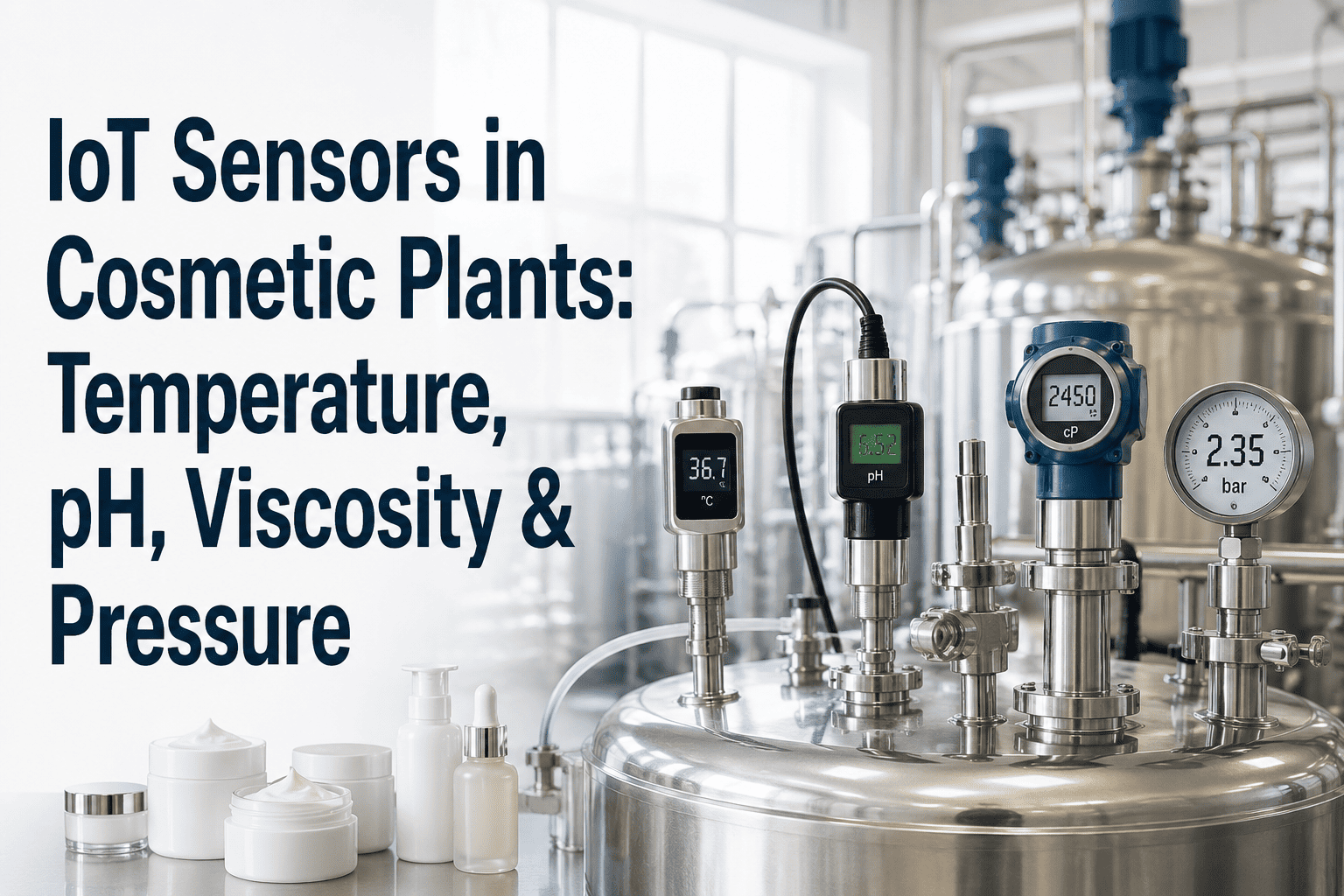
Temperature Sensors
Inline RTD and thermocouple arrays monitor jacketed vessel temperatures, cooling curves, and filling-line conditions in real time. Automated deviations trigger instant alerts before out-of-spec product advances downstream, protecting both batch integrity and energy efficiency across your entire production floor.
pH Sensors
Continuous inline pH probes eliminate the lag and variability of manual titration checks, providing real-time acidity readings throughout emulsification, neutralization, and finishing stages. Automated correction prompts and deviation logs create the evidence base required for MoCRA adverse event investigations and GMP inspections.
Viscosity Sensors
In-line rotational and vibrating viscometers track rheological consistency through every stage of batch processing, detecting formulation drift before it reaches the filling line. Real-time viscosity data integrated with your quality platform creates automatic release-hold decisions that protect product consistency at high throughput.
Pressure Sensors
Differential pressure transmitters monitor homogenizer performance, filter integrity, and filling-line backpressure — providing early warning of equipment degradation before it causes contamination or dosing errors. Pressure trend analysis feeds predictive maintenance models that reduce unplanned downtime across your production schedule.
Legacy Friction vs. Optimized Excellence: The IoT Sensor Gap in Cosmetic Manufacturing
The operational gap between manual sensor monitoring and an integrated IoT platform is not incremental — it is structural. Facilities relying on paper-based spot checks and disconnected SCADA exports are accumulating invisible risk across every shift, every batch, and every regulatory submission. The comparison below maps exactly where legacy monitoring creates compounding liability and where IoT-integrated quality management eliminates it. Book a Demo to benchmark your current sensor architecture against iFactory's integration framework.
| Parameter | Legacy Friction (Old Way) | Optimized Excellence (iFactory IoT) | Business Impact | Risk Level Eliminated |
|---|---|---|---|---|
| Temperature Monitoring | Manual spot-checks every 30–60 min; paper log | Continuous RTD streams; auto-logged to batch record | Zero missed deviations; 100% traceable thermal history | High |
| pH Measurement | Benchtop titration; operator-dependent variance | Inline probe with real-time dashboard alerts | Formulation consistency across every batch | High |
| Viscosity Tracking | End-of-batch grab sample; late detection of drift | In-process viscometer feeding QMS release logic | Batch failures caught mid-process, not post-fill | High |
| Pressure Monitoring | Gauge read-outs; no trend analysis or alerting | Predictive pressure analytics with maintenance alerts | Unplanned downtime reduced by up to 65% | Medium |
| Audit Documentation | Manual transcription; gaps, errors, missing records | Auto-generated GMP batch records from sensor streams | FDA inspection response time cut by 70% | Medium |
5-Step Deployment: Integrating IoT Sensors Into Your Cosmetic Plant Quality System
Deploying IoT sensors in a cosmetic manufacturing environment requires more than hardware installation — it demands a structured integration strategy that connects instrument outputs to your quality management platform, validates data integrity, and builds the audit trails your compliance program depends on. The roadmap below guides quality and operations teams through a systematic deployment that delivers measurable ROI within the first production cycle. Book a Demo to walk through iFactory's pre-built IoT integration templates with our solutions team.
Conduct a Critical Parameter Mapping Audit
Identify every process point where temperature, pH, viscosity, or pressure deviation creates product risk, compliance exposure, or yield loss. Prioritize sensor placement at jacketed vessels, homogenizer outlets, filling-line manifolds, and cold-chain storage zones — these locations generate the highest-value monitoring data relative to deployment cost.
Select Instrument Types and Communication Protocols
Match sensor technology to your process environment: RTDs for precise temperature ranges, inline glass or solid-state electrodes for pH in emulsions, vibrating-fork viscometers for high-viscosity creams, and differential pressure transmitters for homogenizers. Standardize on industrial protocols — HART, Modbus, or OPC-UA — to ensure seamless integration with iFactory's IoT gateway layer.
Deploy Edge Gateways and Connect to Your QMS
Install edge computing gateways at each production zone to aggregate sensor streams, apply local alarm logic, and relay validated data to iFactory's cloud quality platform. Edge processing reduces latency for critical deviation alerts while ensuring data integrity even during network interruptions — a non-negotiable requirement for GMP-regulated environments.
Configure Alert Thresholds and Automated Batch Records
Define specification limits and alert escalation logic for each sensor parameter within iFactory's quality management platform. Automated batch record generation captures every sensor reading against its specification in a timestamped, 21 CFR Part 11-compliant record — eliminating manual transcription and creating the inspection-ready documentation your QA team needs.
Validate, Qualify, and Scale Across Facilities
Execute IQ/OQ/PQ validation protocols for each sensor integration point, generating the validation package required for GMP compliance and customer audits. Once validated on a pilot line, iFactory's multi-site architecture enables rapid replication of the same sensor configuration, alert logic, and batch record templates across every facility in your manufacturing network.
Top IoT Sensor Pitfalls Cosmetic Manufacturers Must Eliminate
Even well-resourced cosmetic plants consistently make the same avoidable mistakes when deploying IoT sensor networks — errors that undermine data integrity, create compliance exposure, and deliver none of the ROI that justified the investment. These failure patterns are predictable, and every one of them is eliminated when sensor integration runs through a unified quality management platform rather than a patchwork of standalone SCADA exports and spreadsheet logs.
Installing sensors that feed only to a local display or standalone historian creates data silos that cannot contribute to batch records, CAPA workflows, or regulatory submissions. Every sensor reading must flow into your quality management system to have compliance value beyond the production floor.
pH electrodes, viscometers, and pressure transmitters drift over time — and uncalibrated sensors generate data that is worse than no data, because it creates false confidence. A structured sensor calibration schedule, tracked within your QMS, is a GMP requirement that many IoT deployments treat as an afterthought.
Setting overly tight or poorly validated alert thresholds floods operators with false alarms, leading to alarm desensitization that causes genuine deviations to be ignored. Specification limits must be validated against real process capability data before deployment, with tiered alert escalation built into the platform logic.
Legacy instruments using proprietary protocols create integration barriers that force manual data export — defeating the purpose of real-time monitoring. Standardizing on open industrial protocols (Modbus, OPC-UA, MQTT) during sensor selection prevents costly middleware workarounds during QMS integration.
Sensor data streams that are not captured with audit trails, electronic signatures, and access controls do not meet FDA electronic records requirements — meaning they cannot be used as primary evidence in GMP inspections or regulatory submissions. Your IoT platform must enforce Part 11 compliance natively, not as an add-on.
Facilities that use sensor data only for real-time monitoring leave significant value on the table by ignoring the predictive maintenance signals embedded in pressure trends, temperature drift patterns, and viscosity variability. Connecting sensor analytics to a maintenance scheduling module reduces unplanned downtime by 40–65% across production lines.
Every one of these gaps is systematically closed when IoT sensor integration runs on iFactory's unified quality management platform — Book a Demo to see how iFactory maps your sensor network to a fully compliant, audit-ready production intelligence system.
Measurable ROI: What IoT Sensor Integration Delivers Across Your Cosmetic Operations
The financial case for IoT sensor integration in cosmetic manufacturing is not theoretical — it is built from the measurable cost of the problems it eliminates: batch failures, manual labor, unplanned downtime, rejected shipments, and FDA enforcement costs that dwarf any platform investment. The impact grid below translates sensor integration capabilities into the operational and financial outcomes that matter to plant managers, quality directors, and CFOs evaluating capital allocation decisions.
Workflow Acceleration
- Batch record generation automated from sensor streams
- Real-time deviation alerts replace end-of-batch reviews
- Release decisions accelerated by up to 60% via in-process QC
- Multi-site sensor dashboards replace fragmented shift reports
Overhead Reduction
- Manual monitoring labor reduced 40–55% per production line
- Batch failure and rework costs eliminated through early detection
- Calibration compliance automated, reducing QA administrative burden
- FDA inspection preparation time cut by 70% via auto-generated records
Output & Growth
- Unplanned downtime reduced up to 65% via predictive pressure analytics
- Product consistency enables premium positioning and retailer compliance
- Scalable sensor architecture supports multi-facility expansion seamlessly
- Sensor data feeds continuous improvement programs that grow yield over time
Connect Your Cosmetic Plant's Sensors to a Unified Quality Intelligence Platform
iFactory gives cosmetic manufacturers a single, audit-ready system to capture temperature, pH, viscosity, and pressure data — with automated batch records, GMP-compliant audit trails, and real-time alerts built in.
IoT Sensors in Cosmetic Plants — Frequently Asked Questions
Which IoT sensors are most critical for cosmetic manufacturing compliance?
Temperature and pH sensors represent the highest compliance priority for most cosmetic plants, as deviations in these parameters directly affect product safety, stability, and GMP batch record requirements. Viscosity monitoring is essential for emulsion-based products, while pressure sensing is critical for homogenizer-intensive processes and filling-line integrity. A phased deployment starting with temperature and pH — connected to your QMS from day one — delivers the fastest compliance ROI.
How does IoT sensor data integrate with MoCRA documentation requirements?
Under MoCRA, cosmetic manufacturers must maintain records sufficient to support product safety substantiation and adverse event investigations — requirements that IoT-integrated batch records satisfy far more robustly than manual logs. When sensor data streams are captured with timestamps, operator IDs, and specification comparisons in a 21 CFR Part 11-compliant quality platform, every batch produces an audit-ready evidence package that supports both FDA inspection responses and MoCRA serious adverse event reporting within the 15-business-day mandate.
What is the typical payback period for IoT sensor integration in a cosmetic plant?
Cosmetic manufacturers typically recover IoT sensor integration costs within 12–18 months through a combination of reduced batch failure rates, lower manual monitoring labor, and elimination of regulatory enforcement costs. A single prevented batch failure in a mid-volume cream or serum operation — typically valued at $50,000–$200,000 in raw materials, rework, and lost customer orders — can alone justify the full platform investment. Book a Demo to model your facility's specific IoT ROI with iFactory's team.
Can IoT sensors be deployed on existing legacy equipment in cosmetic plants?
Yes — the majority of IoT sensor deployments in cosmetic facilities retrofit existing mixing vessels, homogenizers, and filling lines without requiring equipment replacement. Wireless clamp-on temperature transmitters, insertion pH probes, and non-invasive pressure sensors reduce installation downtime significantly. iFactory's IoT gateway layer supports both legacy 4–20mA analog signals and modern digital protocols, enabling phased integration of existing instrumentation alongside new sensor deployments.
How are sensor calibration records managed for GMP compliance?
GMP regulations require documented calibration records for every measurement instrument used in product quality decisions — a requirement that manual calibration logs consistently fail to meet during FDA inspections. iFactory's quality management platform automates calibration scheduling, captures calibration results with electronic signatures, and locks out-of-calibration sensors from contributing to batch release decisions, ensuring your sensor network maintains continuous GMP compliance without administrative overhead.
Launch Your IoT Sensor Integration Pilot with iFactory Today
Cosmetic manufacturers across the U.S. and globally are using iFactory to connect temperature, pH, viscosity, and pressure sensors to a unified quality platform — turning raw process data into GMP-compliant batch records and competitive advantage.