While your competitors quietly deploy machine intelligence across every stage of cosmetics production — from emulsion stability to label inspection — legacy manufacturers are absorbing losses that never appear on a single line item: batch failures blamed on "process variation," color deviations written off as "within tolerance," and audit prep that consumes weeks of regulatory labor. The question is no longer whether AI belongs on your production floor. The question is how much revenue you are leaving behind every quarter it isn't.
Is Your Cosmetics Facility Running on Gut Feel or Real-Time AI Insight?
iFactory's AI Analytics Platform transforms raw production data into precision decisions — reducing waste, accelerating throughput, and keeping every batch audit-ready from first mix to final fill.
What AI in Cosmetic Manufacturing Actually Delivers in 2026
The global cosmetic AI market is no longer a future-state conversation — it is a present-tense competitive battlefield where manufacturers deploying intelligent analytics are compressing cycle times, reducing rework costs, and passing FDA inspections without scrambling. Across 12 proven use cases documented below, iFactory clients are realizing measurable ROI within the first compliance cycle: fewer rejected batches, faster color-match approvals, and ingredient traceability that satisfies both retailer audits and regulatory demands. If your quality management stack cannot surface these insights in real time, your operations are structurally disadvantaged against facilities that can. Book a Demo to benchmark your current stack against iFactory's AI Analytics Platform.
Measurable Within 90 Days
Facilities integrating AI analytics report batch rejection rate reductions of 30–50% within the first quarter of deployment — translating directly to material savings and recovered production capacity.
Proactive, Not Reactive
AI-driven predictive quality models flag deviations before they cascade into full-batch failures, shifting your quality team from firefighting mode to strategic oversight.
Multi-Site, One Dashboard
A unified AI analytics layer consolidates production data from every facility, contract manufacturer, and filling line — giving leadership a single source of operational truth.
Inspection-Ready by Design
Every AI-assisted decision is logged with full traceability, human-override records, and GMP-compliant audit trails — eliminating the documentation scramble before FDA visits.
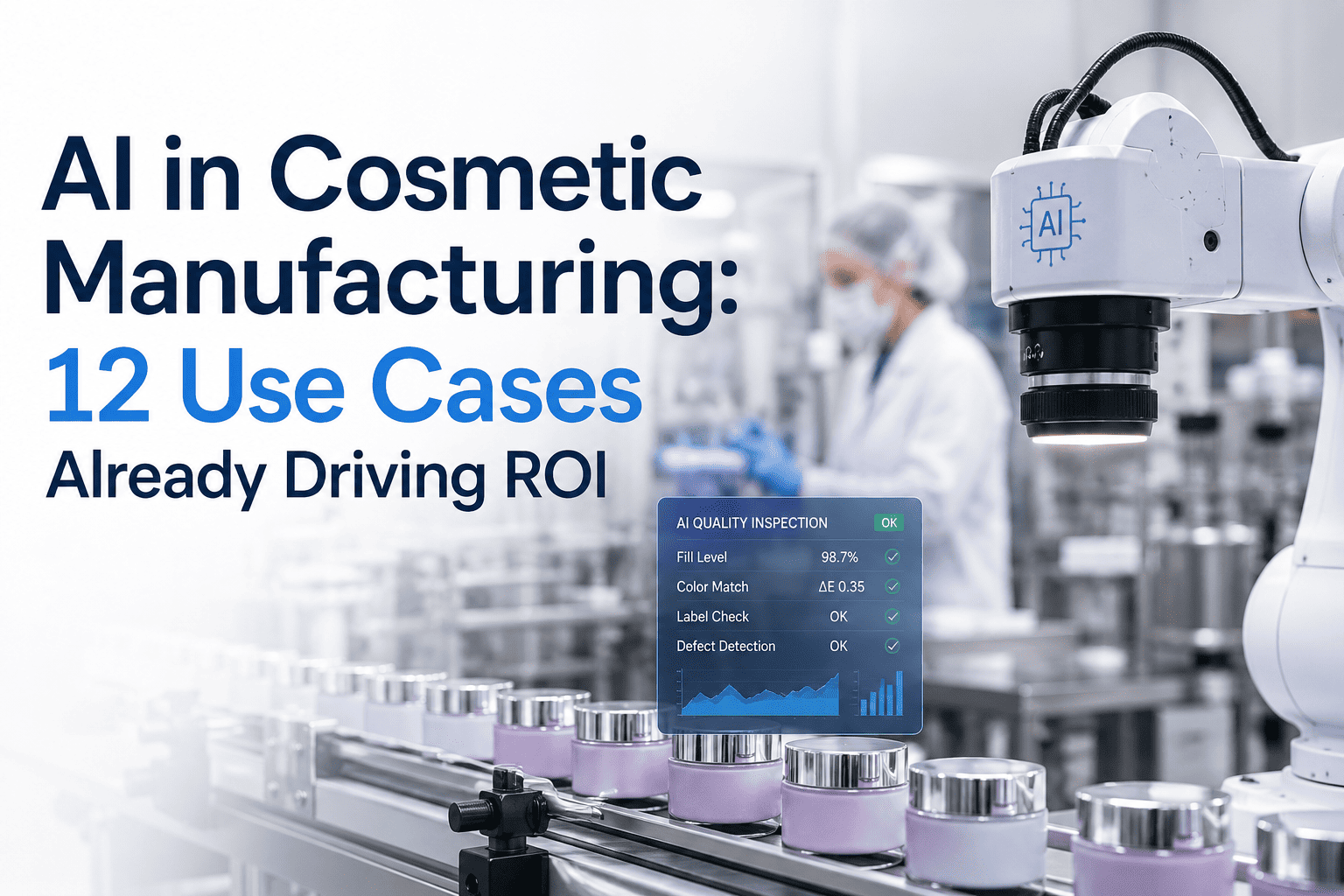
AI in Cosmetic Manufacturing: 12 Use Cases Already Driving ROI
Each use case below represents an active deployment pattern observed across cosmetics, skincare, and personal care facilities — not theoretical capability. Review them against your current operations to identify where your largest efficiency gaps exist. Book a Demo to see exactly which of these iFactory delivers out of the box.
Emulsion Stability Prediction
AI models trained on historical batch data predict emulsion instability risk at the formulation stage — before a single gram of raw material enters production. Facilities using predictive stability scoring reduce accelerated stability failures by up to 40%, compressing time-to-market for new SKUs.
Real-Time Color Matching & Deviation Detection
Computer vision systems capture spectrophotometric data inline and compare it against approved color standards in milliseconds. Any deviation beyond defined Delta E thresholds triggers an automated hold — eliminating the cost of post-fill color rejects that have historically been discovered only at final inspection.
Fill Weight & Volume Accuracy Optimization
AI-driven fill control systems dynamically adjust nozzle parameters based on real-time viscosity readings, ambient temperature, and upstream batch variability — maintaining fill accuracy within ±0.1% across high-speed lines and reducing material overfill waste by 15–25% annually.
Automated Label & Packaging Inspection
Machine vision models scan every unit at line speed for label placement accuracy, barcode readability, lot code legibility, and tamper-evident seal integrity — catching defects that manual spot-checks miss at a rate that consistently exceeds 99.7% detection accuracy in production deployments.
Ingredient Traceability & INCI Compliance Monitoring
AI-powered ingredient management engines automatically cross-reference formulation records against global INCI databases, restricted substance lists, and country-specific regulatory thresholds — flagging compliance gaps before a product reaches listing submission or retail partner review.
Predictive Equipment Maintenance for Mixing & Filling Lines
Vibration, temperature, and torque sensor data feeds continuously into AI anomaly detection models that predict bearing failures, seal degradation, and homogenizer imbalance before unplanned downtime occurs — with clients reporting 30–45% reductions in maintenance-driven production stoppages.
Batch Record Automation & Exception Flagging
AI-assisted batch record engines auto-populate production records from MES and sensor data, then apply rule-based logic to flag missing signatures, out-of-spec parameters, and incomplete in-process checks — cutting batch record closure time from days to hours and virtually eliminating 483 observations tied to documentation gaps.
Adverse Event Signal Detection & MedWatch Routing
Natural language processing engines monitor consumer complaint records, return data, and distributor feedback channels for adverse event signals — automatically classifying severity, routing serious adverse events to the responsible party within MoCRA's 15-business-day window, and building the documentation trail required for FDA MedWatch submissions.
Supplier Quality Scoring & Raw Material Risk Assessment
AI models aggregate CoA data, historical in-house test results, and external supplier audit scores to generate dynamic risk ratings for every raw material supplier — prioritizing incoming inspection resources toward high-risk inputs and automating approval workflows for consistently compliant suppliers.
Demand-Driven Production Scheduling Optimization
AI scheduling engines factor in real-time inventory positions, raw material lead times, fill line capacity, and order priority to generate optimized production sequences — reducing changeover frequency, minimizing work-in-process inventory, and improving on-time delivery rates for seasonal and promotional campaigns.
Microbial Contamination Risk Modeling
Environmental monitoring data from cleanrooms, water systems, and air handling units feeds into predictive contamination models that identify trending microbiological risk before exceedance events occur — enabling targeted interventions that protect product integrity and prevent costly recalls.
Regulatory Document Intelligence & SOP Gap Analysis
AI document analysis engines continuously compare your active SOPs, product specifications, and quality agreements against evolving FDA guidance, MoCRA requirements, and ISO 22716 GMP standards — surfacing gaps before they become 483 observations or Warning Letter citations.
The Cost of Standing Still: Legacy Friction vs. AI-Optimized Excellence
The following matrix maps the operational gap between facilities running on manual processes and those deployed on an integrated AI analytics platform. Every row represents a decision point where the cost of inaction is measurable and compounding. Book a Demo to run a live gap assessment against your current operations.
| Production Area | Legacy Friction (Old Way) | AI-Optimized Excellence (New Way) | Business Impact |
|---|---|---|---|
| Batch Quality Control | End-of-batch lab testing; defects found post-production | Inline AI sensors flag deviations in real time during mixing | Up to 50% reduction in batch rejections |
| Color Consistency | Manual spectrophotometer spot-checks; subjective approval | Automated inline color capture with Delta E threshold alerts | Eliminates post-fill color rejects |
| Label Inspection | AQL sampling; 0.65% AQL still allows thousands of escapes | 100% vision inspection at line speed; >99.7% detection rate | Near-zero defective units reaching retail |
| Equipment Reliability | Reactive maintenance after breakdown; unplanned downtime | Predictive anomaly detection; maintenance scheduled proactively | 30–45% fewer unplanned stoppages |
| Regulatory Documentation | Manual batch record assembly; multi-day closure cycle | Auto-populated records with AI exception flagging | Hours instead of days; zero 483 documentation gaps |
| Supplier Risk Management | Annual audits; static approved supplier lists | Dynamic AI risk scores updated per CoA and test result | Upstream quality failures caught before production |
Request a Performance Audit of Your Cosmetics Manufacturing Operation
iFactory's team maps your current production data architecture against all 12 AI use cases and delivers a prioritized implementation roadmap — at no cost and no commitment.
Three Dimensions of Measurable AI Impact Across Your Facility Portfolio
Enterprise cosmetics manufacturers evaluating AI analytics platforms need clarity on three operational dimensions: workflow acceleration, overhead reduction, and growth enablement. The grid below translates iFactory's AI capabilities into the language of manufacturing leadership.
AI compresses decision cycles at every stage:
- Stability predictions replace 6-week accelerated studies for line extensions
- Batch records close in hours, not days
- Supplier approvals automated for consistently compliant vendors
- Color match sign-offs driven by inline data, not lab turnaround
AI eliminates waste at the source:
- Fill optimization cuts material overfill waste by 15–25% annually
- Predictive maintenance reduces repair costs and emergency labor
- Automated QC replaces high-volume manual inspection headcount
- Regulatory labor costs reduced 40–55% through documentation automation
AI enables confident expansion:
- Multi-site compliance managed from a single dashboard
- New market entry supported by real-time regulatory gap analysis
- Retail partner audits passed without reactive documentation efforts
- SKU proliferation supported without proportional quality team growth
AI Governance in Cosmetics Manufacturing: What FDA Expects in 2026
As AI becomes embedded in quality-critical manufacturing decisions, the FDA is developing explicit expectations for traceability, human oversight, and validated decision logic in AI-assisted production environments. Cosmetics manufacturers deploying AI analytics must ensure every model-driven decision is logged, every human override is recorded, and every algorithm is validated against GMP standards. iFactory's AI Analytics Platform is architected to meet these expectations natively — with 21 CFR Part 11-compliant electronic records, role-based access controls, and full audit trail coverage across all 12 AI use cases. Book a Demo to review iFactory's complete AI governance architecture with our compliance team.
Launch Your AI Analytics Pilot Across Your Cosmetics Production Floor
Cosmetics manufacturers globally are using iFactory to deploy all 12 AI use cases — from emulsion stability prediction to label inspection — with GMP-compliant audit trails built in from day one.