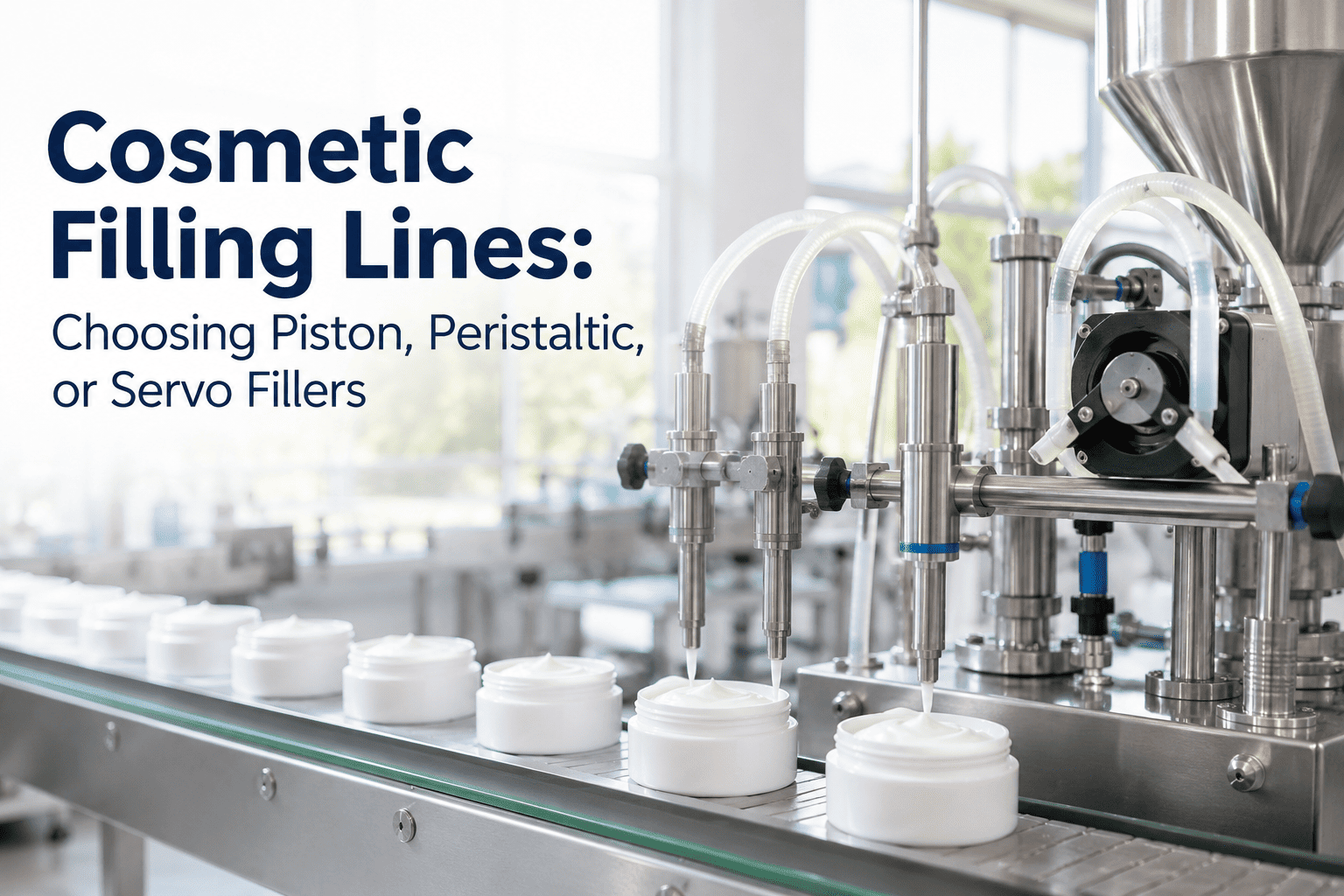
Every minute your cosmetic filling line runs below optimal throughput, you are not just losing product — you are handing margin, market share, and momentum to competitors who made smarter equipment decisions years ago. The choice between piston, peristaltic, and servo-driven fillers is not a procurement checkbox; it is a strategic infrastructure decision that determines your cost per bottle, your line changeover speed, and your ability to scale SKUs without capital bleed. If your operations team is still debating this without real-time OEE data as the decision foundation, you are optimizing blind.
Is Your Filling Line Costing You More Than It Should?
iFactory's Real-Time OEE Dashboards give cosmetics manufacturers instant visibility into filler performance, downtime root causes, and line efficiency — so every equipment decision is backed by live operational data.
Why Filler Technology Selection Defines Your Cosmetic Line's P&L
Cosmetic filling lines are not interchangeable commodities — the physics of your product formulation, your container geometry, your cleaning protocols, and your volume variability each constrain which filler architecture delivers acceptable accuracy, uptime, and total cost of ownership. Piston fillers dominate thick cream and paste applications. Peristaltic fillers protect shear-sensitive serums and biologics. Servo-driven systems unlock multi-viscosity flexibility at scale. Selecting the wrong architecture locks your operation into chronic micro-stoppages, fill weight deviations, and CIP downtime that compound invisibly until a quality audit or retail partner compliance review surfaces the damage. Book a Demo to benchmark your current line performance against industry OEE standards.
Piston Fillers
Positive-displacement piston mechanisms deliver consistent volume accuracy for high-viscosity creams, gels, and pastes — typically achieving ±0.5% fill accuracy across formulations up to 2,000,000 cP. Ideal for thick moisturizers, body butters, and color cosmetics where density variation is minimal and fill weights are tightly regulated by batch records.
Peristaltic Fillers
Tube-based peristaltic pumps isolate product from mechanical components entirely, eliminating cross-contamination risk and enabling rapid product changeovers with zero product-contact parts to clean. Essential for serums, essences, and fragrance-adjacent formulations where shear degradation or flavor carry-over would compromise product integrity and shelf life claims.
Servo-Driven Fillers
Servo motor-controlled volumetric systems combine programmable fill profiles with real-time feedback correction, delivering ±0.1% accuracy across viscosity ranges from thin tonics to medium-body lotions. Multi-product lines and contract manufacturers deploying SKU proliferation strategies gain the highest ROI from servo architectures due to rapid recipe changeover and data-driven fill optimization.
OEE-Driven Selection
Equipment selection divorced from real-time OEE data produces decisions anchored to vendor specifications rather than actual production floor performance. iFactory's OEE Dashboards capture availability, performance, and quality metrics at the filler level — giving engineering and operations leadership the evidence base to justify capital investment, plan preventive maintenance, and identify chronic micro-stoppage patterns before they compound.
Piston vs. Peristaltic vs. Servo: Full Specification Matrix
The table below maps the critical performance and operational parameters cosmetics manufacturers must evaluate before committing capital to a filling line configuration. Accuracy tolerances, viscosity ceiling, CIP compatibility, and changeover time are not abstract specifications — they translate directly into cost per bottle, batch rejection rates, and labor overhead on your production floor. Book a Demo to see how iFactory's OEE platform quantifies these variables from your existing line data.
| Parameter | Piston Filler | Peristaltic Filler | Servo Filler | OEE Impact |
|---|---|---|---|---|
| Fill Accuracy | ±0.5% | ±1.0–1.5% | ±0.1% | Critical |
| Viscosity Range | 500–2,000,000 cP | 1–50,000 cP | 1–500,000 cP | Critical |
| CIP Compatibility | Moderate — disassembly needed | High — tube replacement only | High — automated flush cycles | Medium |
| Changeover Time | 45–90 min | 10–20 min | 5–15 min (recipe recall) | Critical |
| Capital Cost | Low–Medium | Low | High | Medium |
| Maintenance Frequency | Moderate (seal wear) | Low (tube replacement) | Low (predictive via sensors) | Lower |
| Best Application | Creams, pastes, foundations | Serums, essences, fragrances | Multi-SKU, lotions, mixed lines | Lower |
5-Step Framework: Selecting and Validating Your Cosmetic Filling Line
Equipment selection without a structured validation framework produces decisions that look reasonable on paper and underperform on the floor within the first production quarter. The five-step process below reflects how high-performance cosmetics manufacturers approach filler selection — from formulation profiling through post-installation OEE baselining. Book a Demo to learn how iFactory integrates directly with your new or existing filling line for real-time performance monitoring from day one.
Profile Your Full SKU Viscosity Envelope
Before evaluating any filler architecture, compile viscosity data at fill temperature for every SKU in your current and planned portfolio. A single-SKU operation optimizes differently than a contract manufacturer running 40+ formulations — and the viscosity envelope width is the primary constraint that determines whether a piston, peristaltic, or servo system can serve your full range without compromising accuracy or requiring capital-intensive line duplication.
Define Fill Accuracy Requirements by SKU Tier
Regulatory and commercial fill accuracy requirements vary by product category, price tier, and target market. Premium serums sold at prestige retail carry tighter fill weight tolerances than mass-market body wash — and the cost of systematic underfill (consumer complaints, regulatory action) versus overfill (margin erosion at scale) must be quantified before locking in filler technology. Map your accuracy requirements to the fill volume range for each SKU tier before vendor engagement.
Assess CIP and Changeover Protocol Constraints
If your operation runs fragrance-adjacent, allergen-declared, or preservative-free formulations on shared equipment, CIP validation requirements will constrain filler architecture choices independent of accuracy or viscosity. Document your cleaning validation requirements, swab acceptance criteria, and changeover frequency before calculating true cost of ownership — a low-capital piston filler with a 90-minute manual CIP cycle delivers far worse TCO than a servo system with automated flush when run at high changeover frequency.
Run OEE-Based TCO Modeling Before Capital Commitment
Equipment vendors publish throughput specifications under ideal conditions — not under your formulations, container geometry, ambient temperature, and operator skill profile. Before committing capital, model total cost of ownership using OEE-adjusted throughput estimates: apply realistic availability (accounting for planned and unplanned downtime), performance (accounting for speed losses and minor stoppages), and quality (accounting for fill rejects and rework) to vendor-stated UPM figures. iFactory's OEE platform can generate this model from your existing line data as a comparative baseline.
Establish OEE Baseline Within 30 Days of Installation
Post-installation OEE baselining in the first 30 days of production is the single highest-value step most cosmetics manufacturers skip — and the omission guarantees that chronic micro-stoppages, fill drift, and speed losses accumulate invisibly for months before surfacing in batch records or customer complaints. Connecting iFactory's OEE dashboards to your new filling line at commissioning creates the performance record that drives preventive maintenance scheduling, operator training prioritization, and future capital justification.
Legacy Friction vs. Optimized Excellence: The Filling Line Performance Gap
The performance gap between cosmetic filling operations running legacy manual processes and those backed by real-time OEE intelligence is not marginal — it is structural. The comparison below maps the most consequential operational dimensions where data-driven filling line management produces measurable, compounding advantage over manual or spreadsheet-based approaches.
| Operational Dimension | Legacy Friction (Old Way) | Optimized Excellence (New Way) |
|---|---|---|
| Downtime Visibility | Manual stoppage logs; root cause unknown until shift end | Real-time OEE dashboard flags micro-stoppages by category as they occur |
| Fill Weight Monitoring | Periodic manual checkweigher sampling; fill drift detected late | Integrated statistical process control with automated fill drift alerts |
| Changeover Tracking | Estimated changeover times; no data on lost production windows | Precise changeover duration capture with SMED improvement benchmarking |
| Maintenance Scheduling | Reactive repair after failure; unplanned downtime spikes | Predictive maintenance triggers based on OEE degradation trends |
| Capacity Planning | Spreadsheet-based; over-reliant on vendor UPM specs | OEE-adjusted capacity models reflecting actual line performance history |
| Quality Cost Allocation | Batch rejection costs absorbed without root cause attribution | Fill reject events linked to specific equipment states and operator shifts |
Three Dimensions Where OEE Intelligence Transforms Filling Line ROI
Real-time OEE dashboards do not simply report what happened on your filling line — they create the feedback loop that drives continuous improvement across workflow efficiency, overhead reduction, and output growth. Book a Demo to see iFactory's OEE platform applied to cosmetic filling line operations.
OEE performance metrics surface the micro-stoppages and speed losses that manual observation misses entirely — typically accounting for 15–25% of theoretical capacity on unmonitored cosmetic filling lines. Structured loss analysis drives SMED-based changeover reduction and operator-led improvement cycles that compound quarter over quarter.
Predictive maintenance triggers derived from OEE availability trend data reduce unplanned downtime events by 30–50% in first-year deployments by catching seal wear, pump degradation, and valve drift before they produce batch failures. Shifting from reactive to predictive maintenance on a filling line eliminates the premium labor and expedited parts costs that inflate maintenance budgets on reactive schedules.
Most cosmetic filling lines operating without OEE monitoring run at 55–70% of their true throughput potential. Closing that gap through data-driven loss elimination and changeover optimization typically delivers 20–35% output growth on existing equipment — deferring capital investment in additional filling lines and accelerating the payback window on OEE platform deployment.
Turn Your Filling Line Data Into a Competitive Advantage
iFactory's Real-Time OEE Dashboards connect directly to your cosmetic filling line — giving operations leadership live visibility into availability, performance, quality metrics, and root cause data that drives measurable throughput improvement from the first week of deployment.
Six Filling Line Decisions That Erode Margin Before the First Bottle Ships
Equipment selection mistakes in cosmetic filling operations are rarely visible at the point of decision — their cost accumulates invisibly in batch rejection rates, changeover labor, and maintenance events until a quality audit, capacity constraint, or retail compliance review forces a capital reinvestment that could have been avoided. These are the six most consequential filling line decision errors cosmetics manufacturers make.
Vendor-published units-per-minute specifications are generated under controlled conditions with optimal formulations and no changeovers. OEE-adjusted throughput under actual operating conditions is consistently 20–40% below headline UPM on unmonitored lines — making equipment comparisons based on vendor specs structurally misleading without real production data as a calibration baseline.
Cleaning validation labor, swab testing, microbiological hold time, and documentation overhead add 15–30% to the true changeover cost on filling lines running multiple formulation types. A piston filler that appears cost-competitive on capital cost frequently becomes the highest-TCO option when cleaning labor and validation documentation requirements are fully loaded into the comparison.
Peristaltic pumps lose fill accuracy rapidly above 50,000 cP as tube elasticity variability begins to dominate volume delivery. Cosmetics manufacturers expanding into richer moisturizer or eye cream formulations on existing peristaltic lines frequently discover fill weight deviation problems only after launch — requiring either formulation reformulation or capital line investment at the worst possible time.
Servo filler systems without integrated recipe management and electronic batch record linkage require manual parameter re-entry between changeovers — introducing human error, changeover time variability, and documentation gaps that create FDA inspection exposure. The value of servo accuracy is only fully realized when recipe parameters are digitally managed and version-controlled at the line level.
Installing new filling equipment without establishing an OEE baseline in the first 30 days of production means that performance degradation, chronic micro-stoppages, and fill drift accumulate without reference — making root cause analysis during later quality events significantly more difficult and time-consuming than it would be with a documented commissioning performance baseline.
Capacity expansion decisions made from spreadsheets rather than OEE data routinely result in capital investment in additional filling equipment when existing assets are operating at 55–65% of attainable throughput. Closing the OEE gap on existing lines through loss elimination consistently delivers more capacity per dollar than capital equipment additions — a fact only visible when real production data drives the analysis.
Every one of these gaps closes faster when your filling line is connected to a real-time OEE platform — Book a Demo to see how iFactory's dashboards surface the hidden losses on your specific filling line configuration.
Cosmetic Filling Line Selection — Frequently Asked Questions
What fill accuracy is achievable with piston fillers for thick cosmetic creams?
Positive-displacement piston fillers typically achieve ±0.5% volumetric accuracy for high-viscosity creams and pastes under stable formulation conditions. Accuracy degrades when formulation density varies between batches or when fill temperature is not tightly controlled — making temperature-controlled product hoppers and real-time checkweigher feedback essential for maintaining specification compliance across production runs.
When does a servo-driven filler justify its higher capital cost over piston or peristaltic?
Servo filler ROI becomes compelling when three conditions converge: high SKU count requiring frequent changeovers, a viscosity range that spans both thin serums and medium-body lotions, and fill accuracy requirements below ±0.5%. Contract manufacturers and multi-brand operators typically reach servo payback within 18–24 months through changeover labor savings and fill reject reduction alone — independent of the OEE visibility benefits that servo sensor integration enables. Book a Demo to model your specific ROI scenario with iFactory's team.
How does OEE measurement specifically improve cosmetic filling line performance?
OEE measurement decomposes filling line performance into three independently actionable components: availability (equipment uptime minus planned and unplanned stoppages), performance (actual speed versus rated speed), and quality (good units as a percentage of total units produced). Each dimension points to a different category of intervention — maintenance scheduling for availability, changeover optimization for performance, and fill parameter control for quality — allowing operations teams to prioritize improvement resources with precision rather than intuition.
Can iFactory's OEE dashboards integrate with existing filling line PLCs and SCADA systems?
Yes — iFactory's OEE platform supports OPC-UA, Modbus, and direct PLC integration with major filling line equipment brands, enabling real-time machine state, speed, and counter data capture without manual operator input. For lines without existing PLC connectivity, iFactory provides sensor-based data collection solutions that deliver OEE visibility without requiring capital equipment replacement. Book a Demo to review iFactory's hardware integration options for your specific filling line configuration.
What is the typical implementation timeline for OEE dashboards on a cosmetic filling line?
For lines with existing PLC connectivity, iFactory OEE dashboards are typically live within 5–10 business days of integration engagement — including data validation, KPI configuration, and operator training. Lines requiring physical sensor installation add 2–4 weeks for hardware deployment and signal commissioning. First meaningful performance insights, including top loss category identification and shift comparison analytics, are available within the first full week of production data capture.
Connect Your Cosmetic Filling Line to Real-Time OEE Intelligence
iFactory gives cosmetics manufacturers live OEE visibility across piston, peristaltic, and servo filling lines — turning machine data into throughput gains, maintenance savings, and capacity growth without additional capital investment.