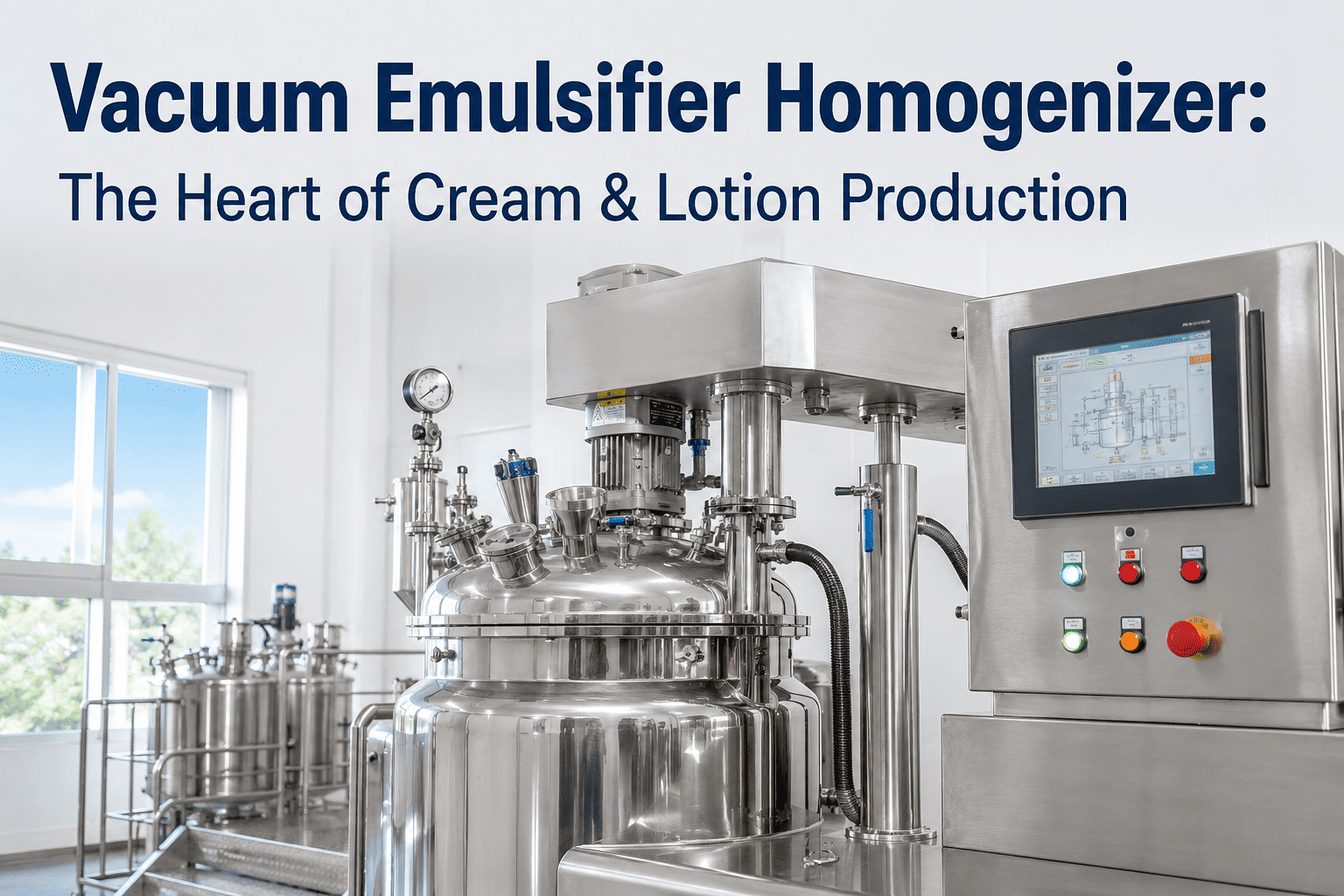
Every batch of luxury cream or precision lotion your facility produces lives or dies at one inflection point: the emulsification stage. When your homogenizer underperforms — inconsistent shear, uncontrolled temperature, vacuum fluctuations — you don't just get a failed batch. You absorb the cost of wasted raw materials, delayed shipping windows, retailer chargebacks, and the irreplaceable damage to brand credibility that follows a product recall. The vacuum emulsifier homogenizer is not a commodity piece of equipment. It is the single most consequential investment in your cosmetic production architecture — and facilities still running legacy units without integrated PLC/SCADA oversight are quietly hemorrhaging margin on every production cycle.
Is Your Vacuum Emulsifier Homogenizer Costing You More Than You Know?
iFactory's Quality Management platform integrates directly with your cosmetic homogenizer and PLC/SCADA infrastructure — automating batch records, process parameters, and GMP-compliant audit trails in one unified system.
What Is a Vacuum Emulsifier Homogenizer — and Why It Defines Cream Quality
A vacuum emulsifier homogenizer is a closed-vessel mixing system that combines high-shear mechanical emulsification with vacuum degassing and precise temperature control to produce stable, air-free emulsions — the technical foundation of every premium cream, lotion, serum, and ointment. Unlike open-vessel mixers, the vacuum environment eliminates oxidative degradation, prevents microbubble incorporation, and creates the viscosity consistency that premium cosmetic brands demand from every batch. Understanding the four core operational variables — shear rate, vacuum level, temperature profile, and mixing geometry — is the prerequisite for any cosmetics manufacturer serious about formulation stability, scale-up repeatability, and regulatory defensibility.
High-Shear Rotor-Stator System
The rotor-stator assembly generates shear rates between 10,000 and 30,000 RPM, reducing dispersed phase droplets to sub-micron sizes and creating the emulsion stability index that determines product shelf life, texture, and consumer sensory perception. Shear rate calibration and real-time RPM logging are non-negotiable for repeatable batch outcomes.
Vacuum Degassing & Pressure Control
Operating under 0.05–0.09 MPa vacuum removes dissolved gases and prevents oxidation of active ingredients — a critical factor for vitamin C serums, retinol formulations, and any oxygen-sensitive cosmetic matrix. Vacuum level stability, monitored via integrated pressure transducers, directly correlates with finished product clarity and active ingredient potency retention.
Jacketed Temperature Management
Precise heating and cooling via jacketed vessel walls — typically ranging from 20°C to 90°C with ±0.5°C tolerance — governs emulsifier activation, wax melting, and active ingredient incorporation. Temperature deviations beyond specification windows during critical phases cause phase separation, crystal formation, and viscosity collapse that no downstream correction can reverse.
PLC/SCADA Process Automation
Modern vacuum emulsifier homogenizers integrated with PLC/SCADA systems execute multi-phase production recipes automatically — sequencing shear speeds, vacuum engagement, temperature ramps, and hold times with zero manual intervention. This integration transforms process consistency from operator-dependent to system-enforced, making batch-to-batch repeatability a structural outcome rather than a staffing challenge.
Legacy Friction vs. Optimized Excellence: The True Cost of Your Current Homogenizer Setup
The performance gap between a legacy vacuum emulsifier homogenizer operation and a PLC/SCADA-integrated production environment is not theoretical — it is measurable in batch rejection rates, raw material waste, and FDA inspection exposure. The table below maps the specific operational divergences that cosmetics manufacturers must confront when evaluating equipment modernization and digital integration investments. Book a Demo to benchmark your current operation against iFactory's integrated performance model.
| Process Variable | Legacy Friction (Old Way) | Optimized Excellence (New Way) | Business Impact | Risk Level |
|---|---|---|---|---|
| Shear Rate Control | Manual RPM adjustment by operator judgment | PLC-enforced recipe-driven shear profiles | Eliminates batch-to-batch viscosity variance | High |
| Vacuum Monitoring | Analog gauges read intermittently by technician | Continuous transducer data logged to SCADA | Prevents oxidative degradation of actives | High |
| Temperature Profiling | Manual thermocouple checks at fixed intervals | Real-time closed-loop PID temperature control | Removes phase separation risk at critical stages | High |
| Batch Record Creation | Paper-based manual entry post-production | Automated electronic batch records via iFactory | Reduces documentation labor by up to 65% | Medium |
| Deviation Detection | Post-batch QC review catches failures late | In-process SPC alerts trigger real-time correction | Prevents batch loss before it becomes waste | Medium |
| GMP Audit Readiness | Manual document retrieval during FDA inspection | AI-searchable vault with full process traceability | Reduces inspection response time by 70% | Lower |
5-Step Framework: Integrating Your Vacuum Emulsifier Homogenizer with PLC/SCADA Quality Management
Connecting your vacuum emulsifier homogenizer to a unified digital quality management environment requires a structured integration sequence — from PLC signal mapping through SCADA visualization to automated batch record generation. Manufacturers who execute this integration systematically eliminate the three most costly failure modes in cosmetic emulsification: operator variability, documentation gaps, and late-stage deviation detection. Book a Demo to see iFactory's PLC/SCADA integration architecture deployed in a live cosmetics production environment.
Map PLC I/O Points to Quality Parameters
Identify every process signal your vacuum emulsifier homogenizer PLC outputs — including rotor RPM, vacuum pressure, jacket temperature, agitator torque, and phase addition valve states — and map each to a corresponding quality attribute in your product specification. This mapping is the data architecture foundation that makes every downstream integration decision defensible during a GMP audit.
Configure SCADA Recipe Management
Build validated production recipes within your SCADA system that encode the complete process sequence for each emulsion formula — including shear ramping curves, vacuum engagement timing, temperature hold windows, and cooling profiles. Recipe-driven production replaces operator judgment with system enforcement, making your emulsification process auditable, repeatable, and scalable across shifts and facilities.
Deploy Real-Time Statistical Process Control
Implement SPC monitoring on your four critical emulsification variables — shear rate, vacuum level, temperature profile, and mixing time — with control limits derived from validated batch data. Real-time SPC alerts integrated with your quality management system allow in-process correction before deviations propagate into batch failure, transforming your cosmetic mixing equipment from a reactive to a proactive quality instrument.
Automate Electronic Batch Record Generation
Configure your quality management platform to automatically compile electronic batch records from PLC/SCADA process data at batch completion — capturing every parameter deviation, operator intervention, material lot number, and in-process test result into a single, FDA 21 CFR Part 11-compliant document. This eliminates transcription errors, reduces documentation labor, and delivers inspection-ready records within minutes of batch close.
Establish Continuous Improvement Feedback Loops
Use aggregated batch performance data from your integrated quality management platform to drive formulation refinement, equipment calibration scheduling, and preventive maintenance prioritization. Manufacturers who close the loop between production data and R&D formulation decisions reduce new product development cycle times by 30–40% while simultaneously improving first-pass batch success rates across their full cream and lotion portfolio.
Three Dimensions of Competitive Advantage Through Integrated Homogenizer Management
Cosmetics manufacturers that integrate vacuum emulsifier homogenizer operations with digital quality management systems do not simply reduce errors — they fundamentally restructure the economics of cream and lotion production. The impact grid below captures the three operational dimensions where integrated PLC/SCADA quality management delivers compounding returns. Book a Demo to model your facility's specific ROI with iFactory's team.
PLC/SCADA-driven recipe execution compresses batch cycle times by 20–35% by eliminating manual phase sequencing delays and operator wait states. Automated in-process checks remove hold-and-test bottlenecks that throttle output on manual operations — enabling higher batch volume from the same equipment footprint without adding production staff.
A single failed 2,000-liter emulsification batch in a premium skincare line typically costs $18,000–$45,000 in raw material write-offs, reprocessing labor, and schedule disruption. Real-time deviation detection and in-process correction capability reduces batch rejection rates to below 0.5% — translating directly into recovered margin across every production run.
Digital process records from every production batch create the validated dataset that R&D teams need to scale new emulsion formulations from pilot to commercial production in weeks rather than months. Manufacturers with integrated quality management systems consistently reduce scale-up validation cycles by 40%, compressing time-to-market for new cream and lotion SKUs while maintaining regulatory defensibility.
Top Vacuum Emulsifier Homogenizer Integration Failures Cosmetics Manufacturers Must Avoid
The gap between a vacuum emulsifier homogenizer investment and the production quality improvements it should deliver is almost always a data and integration problem — not an equipment problem. Understanding the recurring failure patterns in cosmetic mixing equipment deployments is the first step toward closing them systematically.
Production teams that rely on operator knowledge rather than SCADA-enforced recipe parameters introduce uncontrolled variability at every batch — variability that compounds across shifts, seasons, and personnel changes until it surfaces as chronic quality complaints from retail partners or a regulatory non-conformance during an FDA inspection.
Vacuum emulsifier homogenizer operators who set initial vacuum levels without continuous monitoring allow seal degradation, line leaks, and pump wear to introduce undetected air incorporation — resulting in product instability, reduced active ingredient efficacy, and accelerated shelf-life degradation that only appears during stability testing months after production.
Cosmetics facilities that maintain separate systems for equipment process data and quality management records create a documentation architecture that cannot survive an FDA inspection or a retailer audit. Without automated data transfer from PLC/SCADA to your electronic batch record system, every compliance document becomes a manual reconstruction — and every manual reconstruction is a liability.
Shear rate profiles validated on pilot-scale cosmetic homogenizers do not automatically translate to production-scale equipment — changes in vessel geometry, rotor-stator clearance, and recirculation dynamics require re-validation at commercial scale. Facilities that skip this step absorb recurring batch failures until empirical trial-and-error rediscovers what systematic validation would have established in a single production run.
Single-point temperature measurement in a jacketed vacuum homogenizer vessel creates blind spots where localized thermal gradients drive emulsifier deactivation, active ingredient degradation, or wax recrystallization — failure modes that appear in finished product testing without any traceable process signal to explain them. Multi-point temperature mapping integrated with SCADA visualization eliminates these blind spots permanently.
Homogenizer rotor-stator wear, seal degradation, and pump performance decline are predictable failure progressions — but only if equipment condition data is continuously monitored and trended. Facilities without condition-based maintenance triggers experience unplanned downtime rates 3–5x higher than integrated operations, with each production stoppage costing an average of 4–8 hours of output capacity per event.
Every one of these failure modes is systematically prevented when cosmetic manufacturing equipment is integrated with a unified quality management platform — Book a Demo to see how iFactory's PLC/SCADA integration closes these gaps across your full production operation.
Connect Your Cosmetic Homogenizer to a Unified Quality Management Platform
iFactory gives cosmetics manufacturers a single, GMP-compliant platform to integrate vacuum emulsifier homogenizer data, automate electronic batch records, monitor process deviations in real time, and deliver inspection-ready documentation — from pilot to full commercial scale.
Vacuum Emulsifier Homogenizer — Frequently Asked Questions
What shear rate range does a vacuum emulsifier homogenizer deliver, and how does it affect emulsion stability?
Production-scale vacuum emulsifier homogenizers deliver rotor-stator shear rates between 10,000 and 30,000 RPM, with optimal emulsion droplet size reduction occurring between 15,000 and 25,000 RPM for most O/W cosmetic emulsions. Droplet size directly governs emulsion stability index — formulations processed at controlled shear rates with validated recipes consistently achieve D50 particle sizes below 1 micron, the benchmark for premium cream and lotion shelf-life performance.
Why is vacuum level stability more important than vacuum depth in cosmetic homogenizer operations?
While achieving adequate vacuum depth (typically 0.05–0.09 MPa) is necessary to prevent air incorporation and oxidation, vacuum stability throughout the emulsification phase is the more critical variable. Vacuum fluctuations above ±0.005 MPa during high-shear mixing can introduce cyclic air entrainment that creates microbubble populations undetectable in visual QC but measurable in finished product instability testing — a failure mode that continuous SCADA vacuum monitoring catches and prevents in real time.
How does PLC/SCADA integration with a vacuum homogenizer support 21 CFR Part 11 compliance?
PLC/SCADA systems that log process parameters continuously — with timestamped, operator-attributed entries and no manual editing capability — generate the electronic records that meet FDA 21 CFR Part 11 requirements for audit trail integrity and data authenticity. When this process data flows automatically into an integrated quality management platform like iFactory, the complete batch record from raw material receipt through finished product release becomes a single, inspection-ready document without manual transcription or retroactive reconstruction. Book a Demo to review iFactory's full 21 CFR Part 11 compliance architecture.
What is the ROI timeline for cosmetics manufacturers integrating vacuum emulsifier homogenizer data with a QMS platform?
Cosmetics manufacturers typically recover their quality management platform investment within 6–12 months of PLC/SCADA integration through three compounding mechanisms: reduction in batch rejection rates (recovering $18,000–$45,000 per avoided failure), documentation labor savings of 40–65%, and elimination of regulatory penalty exposure including Warning Letter response costs that routinely exceed $200,000 per event. Facilities with annual production volumes above 500 batches typically see full ROI within one production quarter. Book a Demo to model your specific ROI with iFactory's team.
Can iFactory integrate with any vacuum emulsifier homogenizer brand or PLC platform?
iFactory's integration architecture supports OPC-UA, Modbus TCP/IP, and MQTT communication protocols — the three dominant standards used by leading vacuum emulsifier homogenizer manufacturers including IKA, Silverson, VMI, and INOXPA, as well as PLC platforms from Siemens, Allen-Bradley, Mitsubishi, and Beckhoff. Custom protocol adapters are available for legacy equipment, ensuring manufacturers can integrate existing cosmetic mixing equipment investments without capital equipment replacement.
Launch Your Vacuum Emulsifier Integration Pilot with iFactory Today
Cosmetics manufacturers globally are using iFactory to connect vacuum emulsifier homogenizer operations with automated batch records, real-time SPC, and GMP-compliant documentation — turning equipment data into operational confidence at every scale.