Every cosmetic product without a validated preservative system is a liability waiting to manifest — in contaminated inventory, failed retail audits, and regulatory enforcement that pulls your SKUs from shelves. ISO 11930 Preservative Efficacy Testing (PET) is the scientific standard that separates defensible formulations from commercially exposed ones, and manufacturers who treat the 28-day challenge test as a checkbox rather than a quality architecture are accumulating risk with every batch released.
Is Your Cosmetics Lab ISO 11930 PET-Ready for Every Formulation Release?
iFactory's Quality Management platform helps cosmetics manufacturers automate PET documentation, ISO 11930 audit trails, and microbial challenge test workflows — all in one unified system.
Why ISO 11930 Preservative Efficacy Testing Defines Cosmetic Safety Architecture
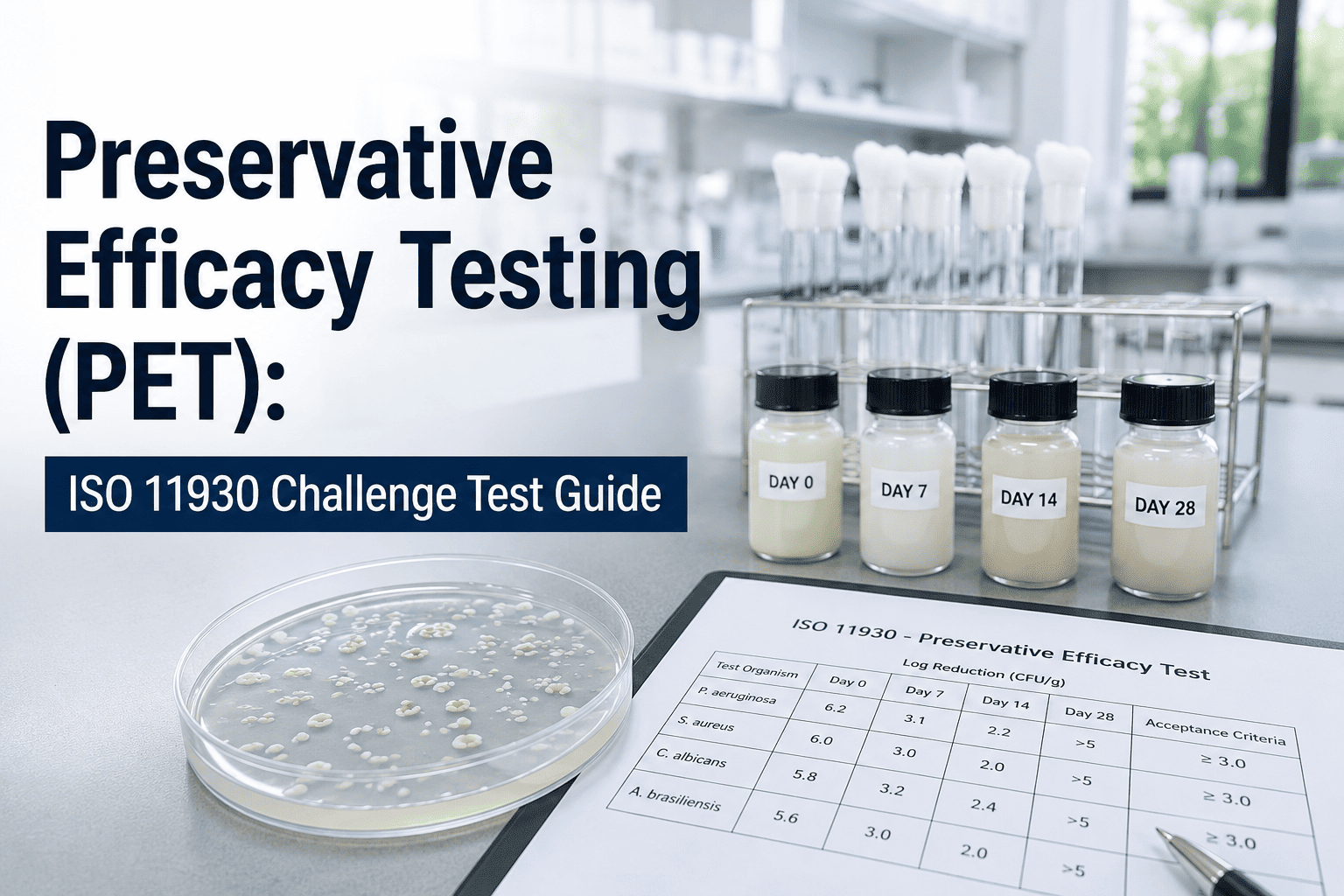
ISO 11930 is the globally recognized framework for evaluating whether a cosmetic formulation's preservative system can resist microbial contamination throughout its intended shelf life and consumer use cycle. Unlike stability testing, PET directly measures the formulation's biological defense — inoculating finished products with five compendial challenge organisms and measuring log reductions over a 28-day incubation period to determine whether the preservative system meets acceptance criteria A or B. Brands that skip or under-document PET expose themselves to FDA adverse event liability, retailer delisting, and consumer safety incidents that no marketing investment can recover. The manufacturers winning on compliance are those who have embedded ISO 11930 testing into a continuous quality workflow — not a periodic scramble before a product launch. Book a Demo to see how iFactory integrates PET workflows into your QMS.
Challenge Organism Panel
ISO 11930 mandates inoculation with five standard organisms — Staphylococcus aureus, Pseudomonas aeruginosa, Candida albicans, Aspergillus brasiliensis, and Escherichia coli — each prepared to a defined inoculum concentration to stress-test the formulation's preservative capacity under worst-case contamination scenarios.
28-Day Incubation Protocol
Inoculated samples are incubated at 22.5°C ± 2.5°C and sampled at defined intervals — Day 2, Day 7, Day 14, and Day 28 — with viable count determination at each time point to establish the log reduction trajectory required by ISO 11930 acceptance criteria A and B.
Acceptance Criteria A & B
Criterion A represents the preferred efficacy benchmark with stricter log reduction requirements at Day 2 and Day 7, while Criterion B provides an alternative for products where Criterion A is unachievable without formulation compromise. Product category, intended use, and risk profile determine which criterion is appropriate for regulatory defensibility.
Test Report & QMS Integration
A complete ISO 11930 test report includes organism identification, inoculum preparation data, count results at each time point, log reduction calculations, and a formal pass/fail determination — documentation that must be version-controlled, audit-ready, and linked to the corresponding product batch and formulation revision in your QMS.
ISO 11930 PET Platform Components — Ranked by Compliance Deployment Priority
A production-grade PET compliance program requires more than a laboratory protocol — it demands an integrated data architecture connecting test scheduling, result capture, formulation versioning, and audit-ready documentation into a single quality management environment. The table below maps the core platform components that mature cosmetics quality operations deploy to eliminate manual bottlenecks, reduce testing cycle time, and ensure every PET result is traceable from inoculation through acceptance determination. Book a Demo to map iFactory's PET module to your existing quality stack.
| Platform Component | Primary Role | AI Integration Value | Operational Impact | Deployment Priority |
|---|---|---|---|---|
| PET Test Scheduler | ISO 11930 test plan & lab assignment | Auto-triggers PET on formulation change events | Zero missed testing cycles at product launch | High |
| Microbial Result Capture | Day 2/7/14/28 count entry & log reduction | Flags out-of-trend reductions before Day 28 | Early reformulation signal reduces batch waste | High |
| Acceptance Criteria Engine | Automated A/B determination per category | Maps product type to correct criterion automatically | Eliminates manual determination errors | High |
| PET Report Generator | ISO 11930-compliant test report output | Auto-populates organism, inoculum, and batch data | Reduces report preparation time by 65% | Medium |
| Audit Trail & Document Vault | Inspection-ready PET record storage | AI search across PET reports, CoAs, and formulations | Reduces inspection response time by 70% | Lower |
5-Step Walkthrough: Executing ISO 11930 Preservative Efficacy Testing
Executing a defensible ISO 11930 PET study requires systematic preparation across organism selection, inoculum standardization, incubation conditions, viable count methodology, and formal acceptance determination — errors at any stage invalidate the study and delay product release. The roadmap below distills the complete PET process into five actionable steps that quality teams can execute consistently across every formulation category, from rinse-off products to leave-on eye-area cosmetics. Book a Demo to see how iFactory automates each PET step with pre-built ISO 11930 workflows.
Prepare Challenge Organism Inocula
Cultivate the five ISO 11930 reference organisms to standardized cell suspensions with inoculum concentrations targeted at 1×10⁵ to 1×10⁶ CFU/g or CFU/mL per organism. Verify inoculum concentration by viable count before inoculation to ensure the challenge is within the standard's required range — deviations here void the entire test.
Inoculate Finished Product Samples
Add each challenge organism separately to representative finished product samples at the specified inoculum level, mix thoroughly, and confirm initial viable count (N₀) at Day 0 as the baseline for all subsequent log reduction calculations. Separate inoculated containers must be maintained per organism for independent time-point sampling.
Incubate at Controlled Temperature
Store all inoculated samples at 22.5°C ± 2.5°C throughout the 28-day test period, maintaining temperature monitoring records to demonstrate incubation condition compliance. Retrieve individual sample containers at Day 2, Day 7, Day 14, and Day 28 for viable count determination using appropriate neutralization and recovery media for each organism class.
Determine Viable Counts and Log Reductions
At each time point, perform plate count or membrane filtration viable count determination, calculate log reduction from N₀ for each organism, and record results against the ISO 11930 Criterion A and Criterion B thresholds. Document no-increase criteria for fungi and bacteria separately, as the standard applies distinct reduction requirements by organism category.
Issue Formal PET Report and Link to Formulation Record
Compile all organism data, time-point counts, log reduction tables, and pass/fail determination into a formal ISO 11930 test report, reference the applicable acceptance criterion, and link the signed report to the corresponding product formulation version and batch record in your QMS for complete audit traceability.
Legacy PET Management vs. Integrated ISO 11930 Quality Architecture
The gap between spreadsheet-driven PET management and a unified quality platform is not a technology preference — it is a measurable operational and compliance risk. Manufacturers still managing ISO 11930 testing through disconnected lab notebooks, email chains, and manual report templates are absorbing preventable costs in delayed product releases, repeated testing cycles, and inspection-ready documentation failures. The matrix below makes the operational difference visible.
| Compliance Dimension | Legacy Friction (Old Way) | Optimized Excellence (New Way) |
|---|---|---|
| Test Scheduling | Manual calendar entries; missed triggers on formula changes | Auto-triggered PET on formulation change events in QMS |
| Inoculum Data Capture | Handwritten lab notebooks; no version control | Structured digital entry with organism lot and count validation |
| Log Reduction Calculation | Manual spreadsheet; error-prone on multi-organism studies | Automated calculation with out-of-trend flagging at Day 7 |
| Acceptance Determination | Analyst-dependent; inconsistent A/B criterion selection | Rules-based engine maps product category to correct criterion |
| Report Generation | Hours of manual formatting per study | Auto-populated ISO 11930 report in minutes |
| Audit Readiness | Fragmented files; slow retrieval under inspection | Centralized vault with AI search across all PET records |
Top ISO 11930 PET Pitfalls That Invalidate Cosmetic Preservative Studies
Preservative efficacy testing failures rarely occur in the incubator — they originate in the documentation, inoculum preparation, and acceptance determination steps where manual workflows introduce inconsistency. The six failure patterns below represent the most common reasons ISO 11930 PET studies are invalidated, repeated at cost, or rejected during FDA or retailer technical audits. Recognizing these gaps is the foundation of a defensible testing program.
Failing to verify inoculum concentration by viable count before study initiation is the most common technical invalidation in PET. If N₀ falls outside the ISO 11930 required range, all subsequent log reduction calculations are non-compliant and the study must be repeated from organism preparation.
Applying Criterion A to a product category where Criterion B is permissible — or misidentifying the product's risk classification — results in unnecessary reformulation cycles. Without a rules-based criterion assignment engine, analyst variability drives inconsistent determination outcomes across product lines.
Preservative carry-over into recovery media produces falsely elevated log reductions that overstate efficacy. ISO 11930 requires confirmed neutralizer validation for each product-preservative combination — a step routinely omitted in contract lab studies operating without formulation-specific protocols.
PET reports disconnected from the specific formulation version and batch record tested cannot demonstrate that the preservative system currently in production matches the validated system. Retailers and auditors increasingly require this traceability chain as a condition of supplier qualification.
Temperature excursions during the 28-day incubation period that are not documented and evaluated invalidate the study's environmental controls. Without continuous temperature monitoring records linked to the PET study file, auditors treat unmonitored incubation as a protocol deviation requiring repeat testing.
Manufacturers who reformulate without a defined PET re-triggering policy release products with unevaluated preservative systems after ingredient substitutions, concentration adjustments, or pH shifts — each of which can materially alter microbial challenge performance. A QMS-integrated change control workflow closes this gap automatically.
Every one of these gaps is systematically closed when PET operations run on a unified quality management platform — Book a Demo to see how iFactory's ISO 11930 module eliminates testing risk across your entire product portfolio.
How Integrated PET Management Transforms Quality, Speed, and Compliance
Digitizing ISO 11930 preservative efficacy testing within a unified QMS delivers measurable outcomes across three dimensions that directly impact profitability and market access. The impact grid below translates platform capabilities into the business outcomes that quality directors, regulatory affairs leads, and operations executives track on their dashboards.
Accelerated Product Release
- Auto-scheduled PET on formulation finalization
- Real-time Day 7 out-of-trend alerts enable early reformulation
- Report generation reduced from hours to minutes
- Parallel multi-product study tracking on one dashboard
Reduced Compliance Overhead
- Rules-based Criterion A/B assignment eliminates analyst error
- Formulation-linked PET records satisfy retailer audit requirements
- Neutralizer validation tracked per product-preservative pair
- Full traceability chain from inoculum to acceptance determination
Scalable Quality Growth
- Multi-site PET visibility from a single compliance dashboard
- Change control auto-triggers retesting on formula updates
- ERP and PLM integration eliminates duplicate data entry
- Audit-ready vault reduces FDA inspection response time by 70%
AI Governance in ISO 11930 PET Workflows — What Cosmetics QMs Must Know
As cosmetics quality teams deploy AI-assisted platforms to automate PET scheduling, log reduction calculations, and acceptance determinations, regulatory bodies expect AI-driven compliance tools to meet the same traceability, validation, and human oversight standards as any other quality-critical system. Platforms built on 21 CFR Part 11 electronic record integrity, GMP-aligned audit trails, and role-based access controls ensure that every AI-assisted PET determination is defensible, reviewer-attributed, and fully reconstructable under FDA inspection. Selecting a QMS that treats AI governance as a compliance layer — not a product feature — is a foundational decision for cosmetics manufacturers scaling their preservative testing programs across multiple laboratories and product portfolios. Book a Demo to explore iFactory's full compliance governance architecture, including ISO 22716 GMP alignment and PET workflow validation documentation.
Launch an Integrated Preservative Efficacy Testing Platform for Your Cosmetics Lab
iFactory gives cosmetics quality teams a single, audit-ready platform to manage ISO 11930 PET scheduling, microbial result capture, acceptance determination, and compliant report generation — with AI-powered alerts and GMP documentation built in.
Roadmap to Scaling ISO 11930 PET Compliance Across Your Cosmetics Portfolio
Single-product preservative efficacy testing is manageable with manual lab workflows — but the moment a cosmetics brand manages dozens of active formulations across multiple manufacturing sites and contract labs, the complexity of scheduling, tracking, and documenting ISO 11930 studies multiplies into a systemic quality risk. Enterprise cosmetics groups are building scalable PET architectures that centralize study scheduling, synchronize result capture across internal and external labs, and automate change-control-triggered retesting from a single QMS dashboard. The quality teams who invest in this infrastructure today will maintain uninterrupted formulation compliance and retail qualification as both retailer audit intensity and FDA adverse event scrutiny increase through 2026 and beyond. Book a Demo to see iFactory's multi-product PET compliance dashboard in action.
Preservative Efficacy Testing — Frequently Asked Questions
Which cosmetic products require ISO 11930 preservative efficacy testing?
Any cosmetic product containing water activity sufficient to support microbial growth should undergo PET — including emulsions, lotions, creams, gels, shampoos, conditioners, mascaras, and liquid foundations. Anhydrous products and products with pH below 3 or above 10 may be exempt with documented scientific justification, but that justification itself requires quality documentation as robust as the PET study it replaces.
What is the difference between ISO 11930 Criterion A and Criterion B?
Criterion A defines more stringent log reduction thresholds — particularly at Day 2 and Day 7 — and is the preferred standard for products with higher contamination risk, such as eye-area cosmetics and products used by vulnerable populations. Criterion B provides an alternative where Criterion A is not achievable without formulation compromise, typically applied to rinse-off products and single-use formats with inherently lower contamination exposure. Product category and intended use govern which criterion is appropriate.
Does reformulating a product trigger a new ISO 11930 PET study?
Any change that could materially affect the preservative system's efficacy — including ingredient substitutions, concentration adjustments, pH shifts, or changes to the water phase composition — requires PET retesting to maintain formulation validity. A defined change control procedure linked to PET re-triggering logic is the only reliable mechanism for ensuring reformulated products are not released with unevaluated preservative performance. Book a Demo to see iFactory's change control-to-PET integration in action.
What is the ROI for cosmetics labs that digitize ISO 11930 PET workflows?
Quality teams that integrate ISO 11930 PET management into a unified QMS platform typically reduce study cycle administration time by 50–65% through automation of scheduling, result capture, and report generation. Beyond labor savings, the elimination of repeated studies from documentation errors, faster acceptance determination, and audit-ready record retrieval deliver ROI multiples that exceed platform investment within the first product cycle. Book a Demo to model your lab's specific PET compliance ROI with iFactory's team.
Can contract labs submit ISO 11930 results directly into the brand's QMS?
Yes — an enterprise-grade quality management platform should provide structured data intake from external contract microbiology laboratories via API or standardized upload templates, so PET results from CMOs and third-party labs are captured directly into the brand owner's QMS with full organism, time-point, and count data integrity. Book a Demo to review iFactory's contract lab integration capabilities for cosmetics manufacturers.
Launch Your ISO 11930 PET Compliance Pilot with iFactory Today
Cosmetics quality teams across the U.S. and globally are using iFactory to automate preservative efficacy testing workflows, ISO 11930 report generation, and change-control-triggered retesting — turning testing burden into formulation confidence.