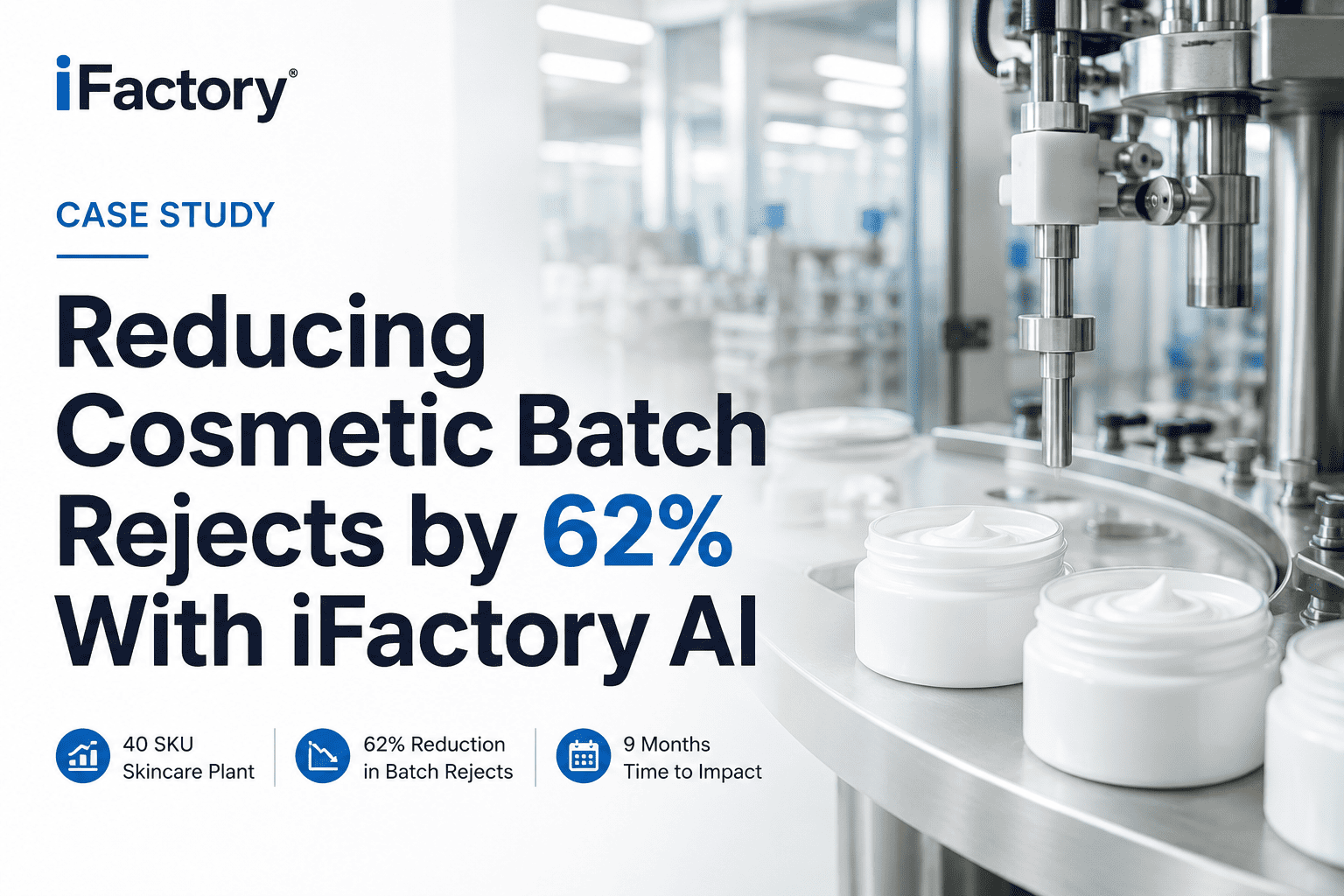
A premium skincare manufacturer was hemorrhaging revenue — not from a failed product launch or supply chain disruption, but from the quiet, compounding cost of unplanned downtime. Every unscheduled stoppage on the filling line translated into scrapped batches, missed retailer windows, and maintenance crews reacting instead of preventing. Six months after deploying iFactory's Edge AI platform, that same facility cut unplanned downtime by 38% and lifted Overall Equipment Effectiveness (OEE) by 22 points. This is the operational and financial case that decision-makers cannot afford to ignore.
Is Unplanned Downtime Quietly Eroding Your Skincare Plant's Margins?
iFactory's Edge AI platform gives cosmetics manufacturers real-time machine intelligence, predictive fault detection, and OEE dashboards — deployed at the equipment level, with no cloud latency and no operational disruption.
From Reactive Maintenance to Predictive Intelligence: The Business Case for Edge AI in Skincare Manufacturing
For premium skincare manufacturers, the production floor is where brand promises meet operational reality — and where legacy maintenance practices silently destroy margin. The average cosmetics plant loses between 15% and 30% of theoretical capacity to unplanned stoppages, changeover inefficiency, and equipment degradation that only surfaces during a breakdown. iFactory's Edge AI deployment model places machine-learning inference directly at the equipment level, processing vibration, temperature, pressure, and speed data in real time without routing signals through a central cloud. The result: fault signatures are detected 48 to 72 hours before failure, maintenance is scheduled during planned windows, and OEE climbs quarter over quarter as a measurable, boardroom-ready metric.
38% Downtime Reduction
Predictive fault detection eliminated the majority of unscheduled stoppages across filling, mixing, and capping lines — translating directly into recovered production hours, reduced scrap costs, and improved on-time delivery performance for retail partners.
+22 Points OEE Gain
Overall Equipment Effectiveness rose from an industry-average baseline to top-quartile performance within two production quarters, driven by simultaneous improvements in availability, performance rate, and first-pass quality yield across monitored assets.
6-Month Deployment Horizon
Edge AI hardware installation, model training on historical fault data, and live alerting were fully operational within a single production semester — requiring zero production line shutdowns and integrating with the facility's existing MES and CMMS infrastructure.
Maintenance Cost Compression
Shifting from time-based preventive maintenance to condition-based intervention reduced parts spend, eliminated unnecessary scheduled downtime, and freed maintenance labor for higher-value tasks — compressing total maintenance cost per unit of output.
The Operational Gap: Legacy Maintenance Friction vs. Edge AI Excellence
The gap between how most skincare facilities manage equipment today and how top-quartile manufacturers operate is not a technology gap — it is a data-latency gap. Legacy reactive and time-based maintenance models generate decisions hours or weeks after the optimal intervention window has closed. Edge AI closes that gap by making the equipment itself the intelligent agent. The matrix below maps the operational contrast that drives the 38% downtime reduction outcome.
| Operational Dimension | Legacy Friction (Old Way) | Edge AI Excellence (New Way) | Business Impact |
|---|---|---|---|
| Fault Detection | Operator-reported or alarm-triggered after failure | AI detects anomaly signatures 48–72 hrs pre-failure | Eliminates unplanned stoppages |
| Maintenance Scheduling | Calendar-based intervals regardless of equipment condition | Condition-based work orders generated automatically | Reduces unnecessary downtime by 30–45% |
| OEE Visibility | Reported weekly from manual operator logs | Live OEE dashboard updated every 30 seconds per asset | Enables real-time production decisions |
| Data Latency | Cloud-routed signals with 2–15 second processing lag | On-device inference with sub-100ms response time | Actionable alerts before cascade failure |
| Root Cause Analysis | Post-mortem review after each breakdown event | AI-generated fault genealogy available within minutes | Prevents repeat failure patterns |
| Maintenance Labor | Reactive crews on standby, high overtime cost | Planned interventions with precise parts and time estimates | 20–35% reduction in maintenance labor spend |
Every row in this matrix represents a recurring revenue leak that the skincare facility in this case study has permanently closed. Book a Demo to see how quickly iFactory can map these gaps across your specific asset base.
Three Dimensions of Measurable Impact: Workflow, Overhead, and Growth
Edge AI deployment does not deliver value in a single dimension. The skincare facility in this case study experienced simultaneous improvements across production workflow continuity, operational overhead reduction, and capacity-driven revenue growth — three levers that compound over time. The impact grid below structures these outcomes for board-level and plant-level audiences alike.
With predictive alerts replacing reactive breakdowns, the facility's filling and capping lines now operate through planned maintenance windows rather than emergency stops. Batch sequencing is preserved, changeover schedules are honored, and downstream packaging teams receive consistent upstream supply without buffer stock inflation.
- Filling line availability up 19%
- Emergency maintenance events down 61%
- Batch-to-batch cycle time variance reduced 44%
Transitioning from time-based to condition-based maintenance removed the single largest source of unnecessary planned downtime. Parts inventory carrying costs dropped as procurement aligned to actual wear data rather than conservative replacement schedules. Overtime spend fell as crews stopped responding to cascading failures.
- Parts spend reduced 28% in first two quarters
- Maintenance overtime hours down 52%
- CMMS work order volume reduced 35%
Every percentage point of OEE recovered translates into additional saleable units from existing assets without capital investment. The 22-point OEE improvement unlocked meaningful incremental capacity that the facility deployed against a backlog of retail orders — turning a compliance and maintenance initiative into a direct revenue growth instrument.
- Incremental output equivalent to 1.4 production lines
- Retailer on-time delivery compliance up to 97.2%
- Scrap rate reduced 31% through early quality deviations detection
Deploy iFactory Edge AI Across Your Skincare Production Floor
iFactory's Edge AI platform delivers fault prediction, live OEE dashboards, and condition-based maintenance workflows — deployed at the equipment level in under six months, with measurable downtime and cost outcomes from the first production quarter.
5-Step Edge AI Deployment Roadmap for Cosmetics Manufacturers
The skincare facility in this case study followed a structured deployment sequence that protected production continuity at every stage — from initial asset prioritization through live model operation. The roadmap below is repeatable across filling, mixing, emulsification, capping, and secondary packaging lines regardless of equipment age or existing automation level. Book a Demo to review how iFactory maps this sequence to your facility's specific asset base and maintenance maturity.
Asset Criticality Assessment and Sensor Mapping
iFactory's deployment engineers conduct a structured asset criticality ranking across the production floor — identifying the equipment where unplanned failure carries the highest downtime, scrap, and compliance cost. Sensor placement is designed to capture the specific failure modes most relevant to each asset class: vibration for rotating equipment, temperature for mixing vessels, pressure for filling systems.
Edge Hardware Installation Without Production Interruption
iFactory edge nodes are installed during scheduled maintenance windows or alongside running equipment using non-intrusive sensor mounting — eliminating the need for production line shutdowns. Each edge device operates independently from enterprise IT infrastructure, processing sensor data locally and transmitting only alert events and aggregated metrics upstream.
Historical Fault Data Ingestion and Model Training
iFactory ingests available CMMS maintenance records, operator downtime logs, and historical sensor data to train asset-specific fault detection models. Where historical data is limited, supervised learning protocols accelerate model performance using iFactory's cosmetics-industry fault signature library — covering common failure modes in emulsification, homogenization, and high-speed filling applications.
Live Alerting, OEE Dashboard, and CMMS Integration
Predictive alerts are routed to maintenance team mobile devices and integrated directly into the facility's CMMS as condition-based work orders — complete with fault classification, recommended intervention, and estimated time-to-failure. The live OEE dashboard provides plant managers with availability, performance, and quality metrics at the asset, line, and facility level in real time.
Continuous Model Improvement and Quarterly Performance Review
iFactory's edge models improve continuously as new production data accumulates — tightening fault detection precision and reducing false positive alert rates over successive production quarters. Quarterly performance reviews translate OEE gains and downtime reductions into board-ready financial summaries, ensuring the platform's ROI remains visible at every organizational level.
Edge AI for Skincare Manufacturing — Frequently Asked Questions
Does Edge AI require replacing existing production equipment or PLCs?
No. iFactory's Edge AI platform is designed as an overlay deployment — sensors are mounted externally or connected to existing signal outputs without modifying PLCs, HMIs, or control architecture. The edge node processes data independently, meaning manufacturers can deploy predictive intelligence on equipment ranging from 3-year-old servo-driven fillers to 25-year-old pneumatic lines without capital equipment replacement.
How quickly does the AI model reach reliable predictive accuracy?
For facilities with accessible CMMS maintenance history and at least 6 months of operational data, iFactory's models typically reach alert-grade accuracy within 4 to 8 weeks of live sensor operation. Facilities with limited historical data benefit from iFactory's cosmetics-industry pre-trained fault models, which provide a validated starting baseline that site-specific data refines over the following two to three production months.
What cosmetic manufacturing equipment types are covered by iFactory Edge AI?
iFactory's platform covers the full range of cosmetics production assets: high-speed filling lines, emulsification and homogenization vessels, tube and pump dispensing systems, bottle capping and sealing equipment, conveyor and transfer systems, and HVAC and environmental control systems in cleanroom environments. Asset coverage is determined during the initial criticality assessment and can be expanded modularly as deployment scales.
What is the typical payback period for Edge AI deployment at a cosmetics facility?
Based on deployment outcomes across cosmetics and personal care manufacturing clients, iFactory's Edge AI platform typically delivers full capital payback within 9 to 14 months — driven by reductions in unplanned downtime cost, maintenance labor and parts spend compression, and incremental output recovered from OEE improvements. Facilities with high downtime frequency or premium SKU product mixes consistently reach payback at the shorter end of this range. Book a Demo to model your facility's specific ROI scenario.
Deploy iFactory Edge AI at Your Cosmetics Facility — Results in 6 Months
Join premium skincare and cosmetics manufacturers using iFactory to predict faults before failure, recover OEE points quarter over quarter, and turn maintenance from a cost center into a competitive advantage.