Every cosmetics facility operating without a verified ISO 22716 Good Manufacturing Practices framework is quietly absorbing a compounding risk — failed audits, retailer delistings, MoCRA enforcement exposure, and the revenue erosion that follows. In 2026, ISO 22716 is no longer a differentiator; it is the baseline expectation from global retail partners, regulatory bodies, and institutional buyers who will not negotiate on quality system maturity.
Is Your Cosmetics Facility ISO 22716 Compliant Before Your Next Audit?
iFactory's Quality Management platform automates GMP documentation, audit trails, personnel training records, and production controls — so your facility is always inspection-ready.
What ISO 22716 Actually Demands — And Why Most Facilities Fall Short
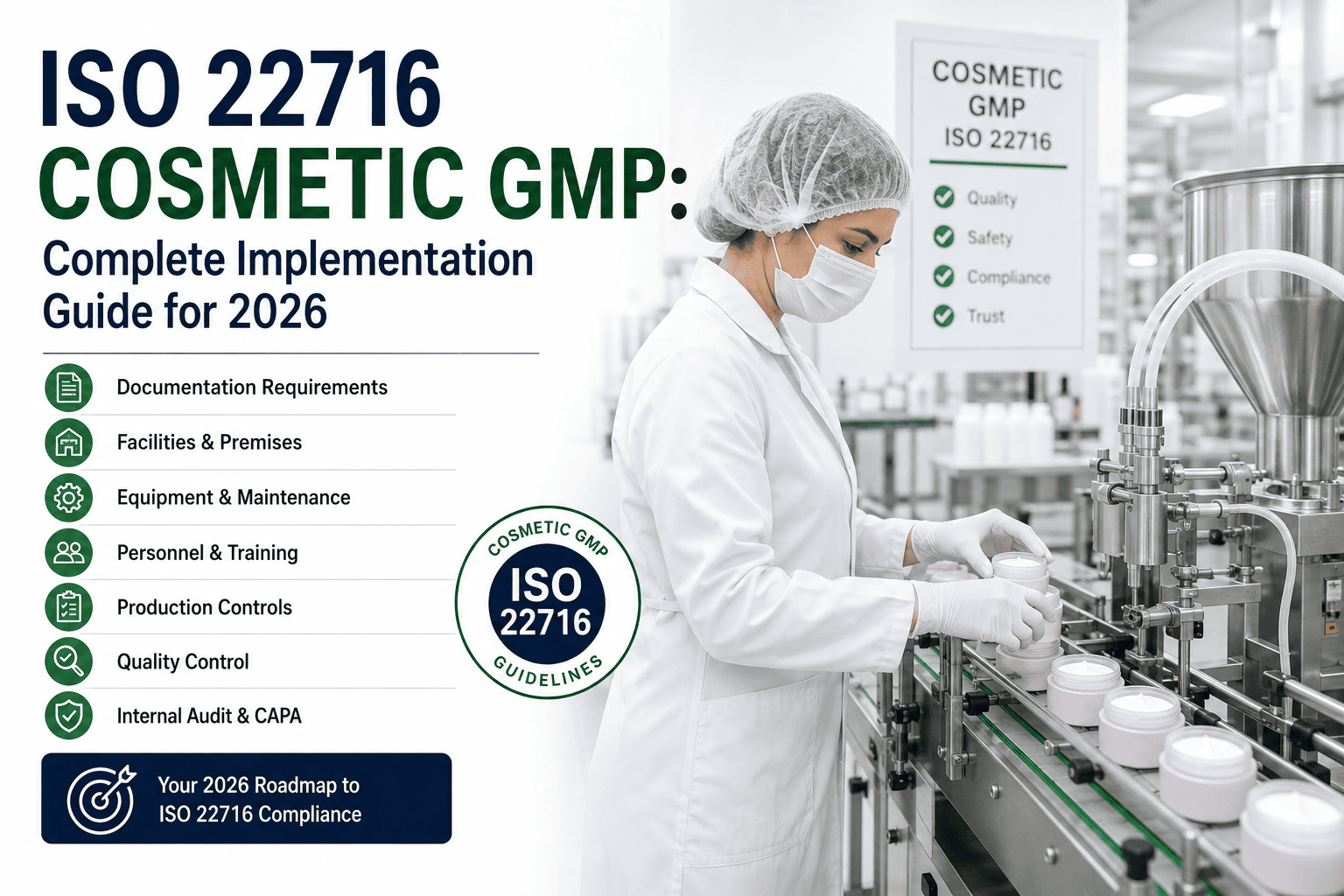
ISO 22716 establishes the internationally recognized framework for cosmetics Good Manufacturing Practices, governing every operational layer from raw material receipt and personnel hygiene to batch documentation and product release. Published by the International Organization for Standardization and adopted by regulators across the EU, ASEAN, and increasingly the U.S. under MoCRA alignment, compliance with ISO 22716 is now a prerequisite for export access, major retail partnerships, and regulatory goodwill during FDA inspections. Facilities that treat GMP as a paper exercise rather than a living operational system are building audit liability into every production run. Book a Demo to see how iFactory transforms ISO 22716 requirements into automated, audit-ready workflows.
Personnel & Hygiene Controls
ISO 22716 requires documented training programs, hygiene protocols, and role-based competency records for every employee with production floor access. Without a centralized training management system, these records become audit vulnerabilities.
Premises & Equipment Qualification
The standard mandates validated facility layouts, equipment qualification records, and documented cleaning and calibration schedules — all of which must be retrievable within minutes during a regulatory inspection.
Raw Material & Batch Documentation
Every raw material intake, batch manufacturing record, and in-process control result must form an unbroken chain of documented evidence linking supplier Certificates of Analysis to finished product release decisions.
Deviation & CAPA Management
ISO 22716 requires formal deviation investigation workflows and Corrective and Preventive Action records that demonstrate closed-loop quality responses — a requirement routinely cited during third-party retailer audits.
Legacy Friction vs. Optimized Excellence: ISO 22716 Implementation Comparison
The gap between a reactive, document-heavy GMP program and a digitized, audit-ready quality system is not a matter of intent — it is a matter of infrastructure. The table below maps the operational reality of spreadsheet-managed GMP programs against the performance benchmarks that enterprise-grade quality management platforms deliver. Book a Demo to benchmark your facility's current GMP posture against ISO 22716 requirements.
| ISO 22716 Requirement | Legacy Friction (Old Way) | Optimized Excellence (iFactory) | Business Impact |
|---|---|---|---|
| Personnel Training Records | Paper sign-off sheets, scattered folders | Automated training assignments, digital sign-off, expiry alerts | Zero audit gaps from missing training proof |
| Equipment Calibration Logs | Manual Excel logs updated inconsistently | Scheduled calibration workflows with auto-escalation | Eliminates out-of-calibration production risk |
| Batch Manufacturing Records | Paper BMRs, manual transcription errors | Electronic BMRs with real-time data capture and e-signatures | Reduces batch release cycle by up to 50% |
| Deviation Management | Email threads, untracked resolutions | Structured deviation forms with CAPA linkage and closure tracking | Closed-loop quality evidence for retailer audits |
| Supplier CoA Management | PDF inboxes, no cross-reference to batches | CoA auto-linked to raw material receipts and batch records | Full traceability from supplier to finished product |
| Audit Readiness | Days of manual document compilation | AI-powered audit package generation in minutes | Reduces FDA inspection response time by 70% |
5-Step ISO 22716 Implementation Roadmap for Cosmetics Manufacturers
Achieving ISO 22716 certification or sustained GMP compliance is not a one-time project — it is the construction of a quality operating system that evolves with your facility, product portfolio, and regulatory environment. The roadmap below provides a structured, actionable sequence that compliance leaders can execute whether building a GMP program from the ground up or modernizing an existing framework. Book a Demo to review how iFactory maps to each phase of your GMP implementation plan.
Conduct a Baseline GMP Gap Assessment
Map your current quality documentation, facility controls, personnel records, and equipment qualification status against each chapter of ISO 22716. Quantify open gaps by risk severity and assign remediation owners before building your implementation timeline. This baseline assessment becomes the foundation of your CAPA program and audit defense strategy.
Build Your Document Control Architecture
Establish a controlled document management system covering SOPs, work instructions, forms, and batch records — with defined approval workflows, version control, and distribution logs. ISO 22716 requires that current versions of all controlled documents are accessible at points of use, making a digital document vault a non-negotiable infrastructure investment.
Implement Personnel Training & Hygiene Programs
Develop role-based training curricula aligned to ISO 22716 Chapter 4 requirements, with documented competency assessments, initial qualification records, and refresher training schedules. Hygiene protocols must be written, trained, and evidenced — particularly for personnel with direct contact with cosmetic products or production surfaces.
Digitize Batch Records & In-Process Controls
Replace paper Batch Manufacturing Records with electronic systems that capture real-time production data, in-process test results, and yield calculations with audit-trail-protected entries. Electronic BMRs eliminate transcription errors, accelerate batch review cycles, and produce inspection-ready documentation that paper systems cannot match under regulatory scrutiny.
Establish Continuous Improvement via CAPA & Internal Audits
ISO 22716 compliance is sustained — not achieved — through a functioning internal audit program and Corrective and Preventive Action system that closes quality gaps before external auditors identify them. Schedule quarterly internal audits, track CAPA completion rates as a KPI, and integrate audit findings directly into your annual quality review for executive reporting.
Six ISO 22716 Failure Points That Trigger Audit Findings and Retailer Delistings
ISO 22716 audit failures are rarely caused by intentional negligence — they are caused by predictable systemic gaps that emerge when quality management runs on disconnected tools, manual processes, and tribal knowledge rather than integrated digital infrastructure. Understanding the six most common failure patterns is the first step toward eliminating them before they appear in an audit report or a retail partner's compliance scorecard.
Missing signatures, blank fields, or retrospective entries in Batch Manufacturing Records are among the most frequently cited ISO 22716 deficiencies. Auditors treat incomplete BMRs as evidence of systemic quality culture failure, not isolated human error.
Personnel operating without current, documented training qualification — particularly after SOP revisions — creates direct ISO 22716 non-conformance. Without automated training expiry alerts, this gap accumulates silently across large production teams.
Production data generated by out-of-calibration instruments is technically suspect under ISO 22716, potentially requiring batch investigations and product holds. Manual calibration scheduling is the leading cause of missed calibration windows across multi-equipment facilities.
Deviations that are verbally resolved without formal investigation and CAPA documentation leave no evidence of corrective action — a pattern that auditors identify as indicative of an uncontrolled production environment rather than an isolated event.
ISO 22716 requires documented supplier qualification, approved supplier lists, and incoming material verification against specifications. Facilities using unqualified or lapsed suppliers expose every associated product batch to regulatory and recall risk.
Facilities without a structured internal audit schedule have no proactive mechanism to identify compliance gaps before external audits expose them. The absence of internal audit records is itself a major non-conformance under ISO 22716 Chapter 17 requirements.
iFactory's Quality Management platform systematically closes every one of these gaps through automated workflows, real-time alerts, and AI-powered audit trail management — Book a Demo to see the full GMP compliance module in action.
How ISO 22716 Digitization Transforms Workflow, Overhead, and Output
The business case for digitizing ISO 22716 compliance extends well beyond audit readiness — it is a direct driver of operational efficiency, cost reduction, and production throughput that compounds in value as your facility scales. The impact framework below quantifies the operational transformation that cosmetics manufacturers achieve when GMP compliance moves from paper-based burden to integrated digital infrastructure.
Workflow Acceleration
- Electronic BMRs reduce batch review cycles by up to 50%
- Automated deviation routing eliminates multi-day resolution delays
- Digital training assignment replaces manual scheduling overhead
- AI audit package generation compresses inspection prep from days to hours
Overhead Reduction
- 40–55% reduction in regulatory labor costs through automation
- Eliminated paper storage and document retrieval costs
- Reduced rework and batch investigation costs via real-time in-process data
- Lower audit preparation costs across multi-site operations
Output & Growth
- Faster product release cycles from digitized batch record review
- Expanded retail partner access through verifiable GMP certification
- Scalable compliance architecture that supports facility and SKU growth
- ISO 22716 alignment accelerates EU, ASEAN, and export market entry
Launch a Fully Integrated ISO 22716 GMP Platform for Your Cosmetics Facility
iFactory gives cosmetics manufacturers a unified, audit-ready quality management system covering batch records, personnel training, CAPA, equipment calibration, and supplier qualification — with AI-powered alerts and 21 CFR Part 11 compliant documentation built in.
ISO 22716 Cosmetic GMP — Frequently Asked Questions
Is ISO 22716 certification mandatory for cosmetics manufacturers in the U.S.?
ISO 22716 certification is not a statutory requirement under U.S. federal law, but it is widely required by major retail partners, contract manufacturing agreements, and export markets including the EU and ASEAN. Under MoCRA, the FDA has referenced ISO 22716 as the benchmark GMP standard for cosmetics facilities, making alignment a practical regulatory expectation even where formal certification is not mandated. Facilities without verifiable GMP compliance increasingly face exclusion from premium retail channels regardless of regulatory minimums.
How long does ISO 22716 implementation typically take for a mid-size cosmetics facility?
A mid-size cosmetics facility with an existing quality framework typically requires six to twelve months to close ISO 22716 gaps, develop required documentation, train personnel, and complete at least one full internal audit cycle before pursuing third-party certification. Facilities starting from a low GMP maturity baseline should plan for twelve to eighteen months. Digital quality management platforms that provide pre-built ISO 22716 templates and automated workflows can compress these timelines by 30–40% compared to manual implementation approaches. Book a Demo to map iFactory's implementation timeline to your facility's specific readiness profile.
What is the difference between ISO 22716 and 21 CFR Part 111 for cosmetics?
ISO 22716 is an internationally recognized voluntary GMP guideline specifically developed for the cosmetics industry covering the full product lifecycle from raw material to distribution. U.S. 21 CFR Part 111 governs Good Manufacturing Practice for dietary supplements — a different product category with distinct regulatory requirements. MoCRA's GMP provisions for cosmetics reference ISO 22716 as the applicable framework, distinguishing cosmetics compliance from the dietary supplement regulatory pathway that Part 111 addresses.
Can ISO 22716 compliance data integrate with our existing ERP and MES systems?
Yes — enterprise-grade quality management platforms provide bi-directional API integration with leading ERP systems including SAP, Oracle, and Microsoft Dynamics, as well as MES platforms, ensuring that batch records, calibration statuses, training records, and CAPA data are synchronized in real time without manual re-entry. This integration eliminates the data fragmentation that creates compliance gaps between production systems and quality records during FDA inspections and retailer audits. Book a Demo to review iFactory's full API integration library for cosmetics manufacturers.
What is the estimated ROI for cosmetics manufacturers that digitize ISO 22716 compliance?
Manufacturers that migrate ISO 22716 compliance onto a unified digital quality management platform typically achieve 40–55% reductions in regulatory labor costs through automation of training management, batch record review, deviation routing, and audit preparation. Beyond direct labor savings, the elimination of batch failures attributable to documentation gaps, the acceleration of product release cycles, and the avoidance of retail partner audit failures each deliver ROI multiples that significantly exceed platform investment within the first annual compliance cycle. Book a Demo to model your facility's specific compliance ROI with iFactory's team.
Launch Your ISO 22716 GMP Compliance Pilot with iFactory Today
Cosmetics manufacturers globally are using iFactory to automate GMP documentation, batch records, personnel training, CAPA, and audit readiness — turning regulatory burden into operational confidence and competitive advantage.