Every day your cosmetics facility operates without a verified MoCRA GMP compliance architecture, you are accumulating regulatory debt that compounds into import alerts, Warning Letters, and supply chain shutdowns — the 2026 FDA enforcement window is not a future risk, it is an active operational countdown that non-compliant manufacturers are losing right now.
Is Your Cosmetics Facility GMP-Ready Before the MoCRA Final Rule Hits?
iFactory's Quality Management platform automates GMP documentation, audit trails, CAPA workflows, and MoCRA inspection readiness — in one unified system built for cosmetics manufacturers.
Why GMP Readiness Is Your Most Critical MoCRA Obligation in 2026
MoCRA's GMP final rule introduces binding manufacturing standards that the FDA will enforce through facility inspections, import screenings, and product seizures — and facilities treating GMP as paperwork rather than a living operational system are building direct exposure into every production run.
Documentation Control
- Batch records must be complete, traceable, and inspection-ready
- SOPs require version control with electronic signature authority
- Master Manufacturing Records linked to product listings
Microbial & Quality Control
- In-process and finished product testing with CoA retention
- Environmental monitoring logs tied to batch genealogy
- Out-of-spec investigation workflows with CAPA closure
Supplier & Raw Material
- Approved supplier list with qualification audit records
- Incoming material testing and release documentation
- Traceability from raw material to finished unit
CAPA & Deviation Management
- Structured deviation capture with root cause analysis
- CAPA effectiveness verification before closure
- Trend analysis to identify systemic quality risks
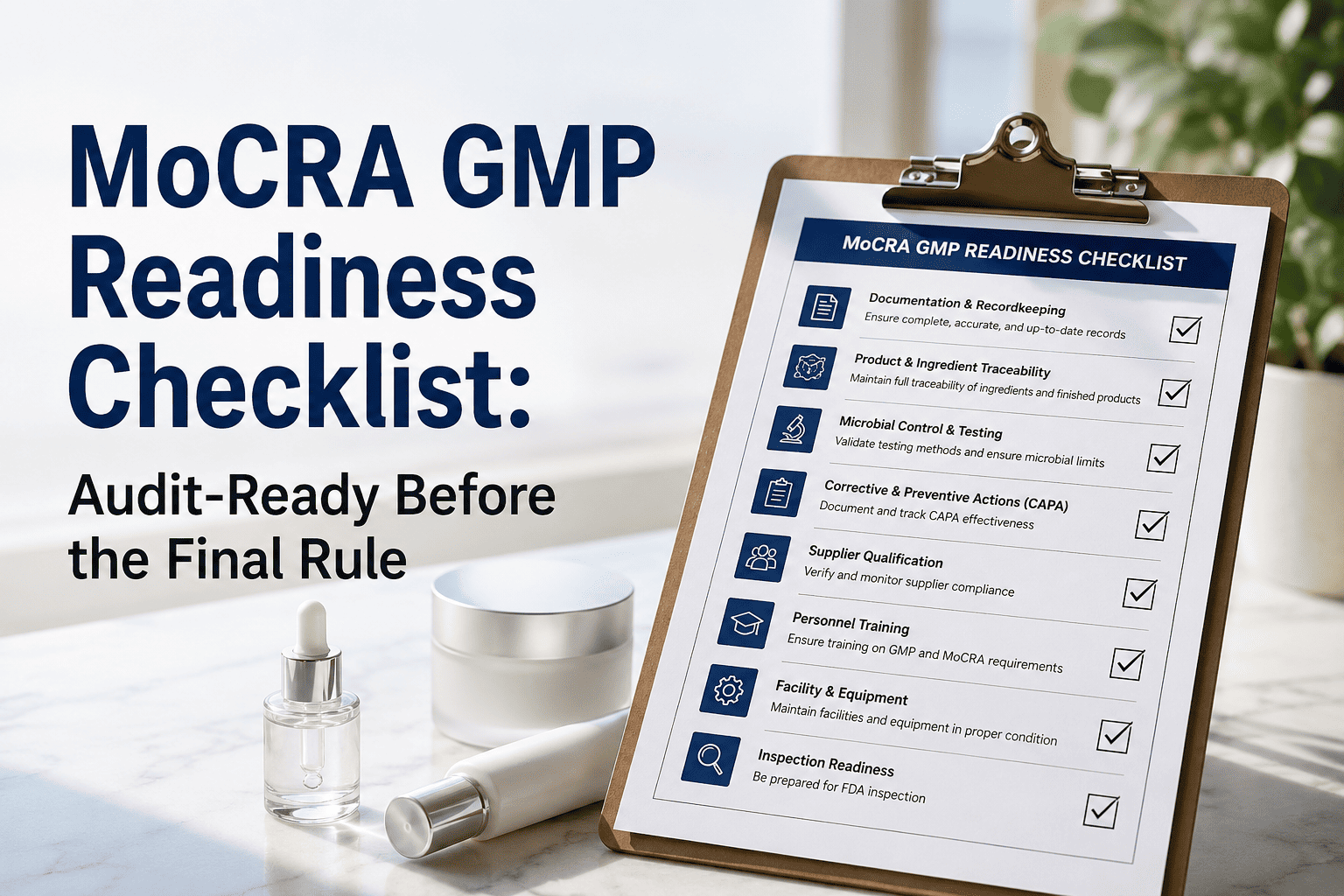
The MoCRA GMP Audit-Readiness Checklist: 5 Core Domains
FDA cosmetic inspectors will evaluate your facility against these operational domains — each gap found during inspection is a direct enforcement trigger. Audit your current state against this checklist before the inspector does.
| GMP Domain | What FDA Inspectors Verify | Common Gap Found | iFactory Automation | Risk Level |
|---|---|---|---|---|
| Documentation & Records | Complete batch records, SOP currency, e-signature audit trails | Missing batch entries, unsigned records | Auto-locked batch templates with 21 CFR Part 11 trails | Critical |
| Microbial Control | Environmental monitoring logs, finished product release testing | Gaps in EM frequency, missing CoA retention | Automated EM scheduling and CoA vault linkage | Critical |
| CAPA System | Root cause analysis, effectiveness checks, closure timelines | Open CAPAs without effectiveness verification | CAPA workflow with escalation alerts and closure gates | Critical |
| Supplier Qualification | Approved supplier list, qualification audits, material CoAs | Unapproved suppliers used in production runs | Approved supplier registry with qualification expiry alerts | High |
| Adverse Event Reporting | SAE capture, MedWatch integration, 15-day reporting adherence | Delayed or incomplete SAE submissions | Auto-classification and responsible party routing | High |
5-Step Walkthrough: Building Audit-Ready GMP Infrastructure
Achieving MoCRA GMP inspection readiness is a sequential build — each layer depends on the previous one being operationally stable. The roadmap below gives compliance teams a structured execution path from documentation foundation to full inspection posture.
Establish Your Documentation Control Foundation
- Audit all existing SOPs for version currency and approval status
- Migrate batch record templates to a locked, electronic format with audit trail
- Assign electronic signature authority to all responsible parties under 21 CFR Part 11
Activate Microbial and In-Process Quality Controls
- Define and schedule environmental monitoring frequency per ISO 22716 guidance
- Establish finished product release criteria with CoA linkage to batch records
- Configure out-of-specification alert workflows with mandatory investigation triggers
Build Your Supplier Qualification Registry
- Compile and digitize all approved supplier qualification audit records
- Link incoming material CoAs to approved supplier list entries
- Set expiry alerts for supplier qualification renewals across all material categories
Deploy CAPA and Deviation Management Workflows
- Standardize deviation classification criteria across all production lines
- Implement structured root cause analysis templates with required evidence fields
- Build effectiveness verification checkpoints before CAPA closure is permitted
Conduct a Pre-Inspection Internal GMP Audit
- Run a mock FDA inspection against all five GMP domains in this checklist
- Document all findings as internal CAPAs with assigned owners and deadlines
- Generate an inspection readiness score and remediation timeline before the FDA arrives
Legacy GMP Friction vs. iFactory Optimized Compliance: The Performance Gap
The gap between manual GMP compliance and an integrated quality management platform is not incremental — it is the difference between reactive enforcement exposure and proactive inspection confidence. This comparison reflects the operational reality for cosmetics manufacturers in 2026.
- Batch records in spreadsheets with no audit trail
- CAPA tracked in email threads, closures missed
- Supplier CoAs stored in shared drives, not linked to batches
- EM logs in paper binders, gaps discovered at inspection
- SOP versions managed manually, outdated copies in use
- SAE reporting delayed due to manual classification steps
- Inspection prep requires weeks of manual document assembly
- Renewal deadlines tracked in personal calendars
- Locked electronic batch records with 21 CFR Part 11 audit trail
- Automated CAPA workflows with escalation and closure gates
- Supplier CoAs auto-linked to batch genealogy records
- Environmental monitoring scheduled and logged automatically
- SOP version control with forced re-acknowledgment on update
- AI-assisted SAE classification with 15-day deadline tracking
- Inspection-ready document vault with AI search across all records
- Biennial renewal alerts at 90, 30, and 7 days before deadline
Top MoCRA GMP Gaps That Trigger FDA Enforcement Action
These are not theoretical risks — they are the documented patterns that cosmetics manufacturers encounter when FDA investigators arrive at facilities with manual or fragmented quality systems. Closing these gaps before inspection is the only defensible strategy.
- Missing operator sign-offs on critical process steps
- No linkage between batch and raw material CoAs
- Gaps trigger immediate data integrity observations
- CAPAs without root cause documentation cannot be closed
- Effectiveness checks routinely skipped under manual systems
- Recurring deviations signal systemic GMP failure to FDA
- Unapproved raw materials used when primary supplier is unavailable
- No documented qualification audit for substituted suppliers
- Creates product safety and label accuracy liability simultaneously
- Operators working from superseded SOP versions on the floor
- No forced re-training triggered by SOP revision events
- Observed training gaps become Warning Letter citations
- MoCRA mandates SAE submission within 15 business days
- Manual classification steps create routine deadline breaches
- Missed SAE filings escalate to injunctive enforcement risk
- Facilities with no internal audit program have no warning of gaps
- First discovery of deficiencies occurs during FDA inspection
- Reactive remediation during inspection signals poor GMP culture
AI Governance in MoCRA GMP Compliance: What Manufacturers Must Require
As AI-powered quality management tools automate GMP workflows, the FDA requires that all AI-assisted compliance determinations be traceable, human-supervised, and validated — platforms without embedded governance architecture create new regulatory exposure while solving old operational ones.
Validated Decision Logic
- All AI-assisted classifications must be validated against GMP criteria
- Validation documentation must be retained and inspection-ready
- System change control required before algorithm updates go live
21 CFR Part 11 Integrity
- Electronic records must be attributable, legible, and contemporaneous
- Audit trails must be computer-generated, not user-editable
- Role-based access controls enforced at every system interaction
Human Oversight Requirements
- AI-flagged deviations must require human review before closure
- Automated SAE routing must include responsible party confirmation
- Override logs captured whenever AI recommendations are overridden
Launch Your MoCRA GMP Readiness Pilot with iFactory Today
iFactory gives cosmetics manufacturers a single, audit-ready platform to automate batch records, CAPA workflows, supplier qualification, SAE reporting, and GMP inspection readiness — with AI-powered alerts and 21 CFR Part 11 compliance built in.
MoCRA GMP Readiness — Frequently Asked Questions
When does the MoCRA GMP final rule take effect for cosmetics manufacturers?
The FDA is finalizing GMP regulations under MoCRA's Section 606 authority, with enforcement timelines phased by company size. Large manufacturers face earlier compliance deadlines, while smaller facilities have extended timelines — but preparation must begin now given the documentation build required for a defensible GMP posture at inspection.
What is the difference between ISO 22716 and MoCRA GMP requirements?
ISO 22716 is the internationally recognized voluntary GMP standard for cosmetics that FDA has referenced as a baseline framework — facilities already operating to ISO 22716 have a strong foundation, but MoCRA adds binding federal regulatory obligations including adverse event reporting, facility registration, and inspection authority that ISO 22716 alone does not satisfy.
Does a cosmetic contract manufacturer need its own GMP compliance program?
Yes — MoCRA GMP obligations attach to the physical facility performing manufacturing or processing operations, regardless of brand ownership arrangements. Contract manufacturers bear independent GMP compliance obligations and are subject to FDA inspection on the same basis as brand-owned facilities. Book a Demo to see how iFactory manages GMP compliance across CMO and brand-owned facility portfolios simultaneously.
What ROI can cosmetics manufacturers expect from digitizing GMP compliance?
Manufacturers that integrate GMP workflows into a unified quality management platform typically reduce compliance labor by 40–55%, eliminate costs associated with rejected submissions and import holds, and reduce FDA inspection response time by up to 70%. The elimination of a single Warning Letter — which can cost six to seven figures in remediation and revenue disruption — typically delivers full-cycle ROI within the first compliance period. Book a Demo to model your facility's specific GMP compliance ROI with iFactory's team.
Get Inspection-Ready Before the FDA Arrives at Your Facility
Cosmetics manufacturers across the U.S. and globally are using iFactory to automate GMP documentation, CAPA workflows, microbial controls, and adverse event reporting — turning inspection risk into operational confidence.