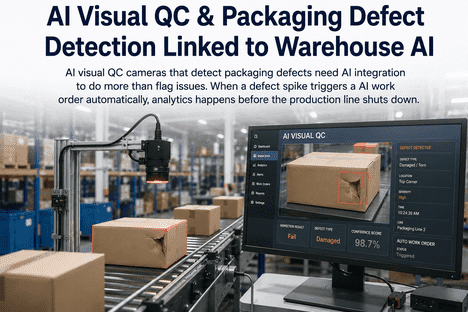
The convergence of AI visual quality control and warehouse AI is redefining how industrial operations detect, respond to, and eliminate packaging defects at scale. With global AI in quality control market projected to reach USD 12.4 billion by 2030 at 24.8% CAGR, and manufacturers reporting up to 90% reduction in defect escape rates through vision-AI systems, the case for integrating visual QC cameras directly into warehouse AI workflows has never been stronger. AI vision cameras inspect every unit in real time — detecting label misalignment, seal failures, fill-level deviations, barcode errors, and surface contamination at speeds no human inspector can match. When that visual QC data feeds directly into iFactory AI's warehouse intelligence layer, defect spikes automatically trigger work orders, production line alerts, and supplier quality notifications — before a single non-conforming shipment leaves your facility. Book a Demo to see how AI visual QC integrated with warehouse AI eliminates defect escapes across your packaging and distribution operations.
WAREHOUSE AI · VISUAL QUALITY CONTROL · PACKAGING DEFECT DETECTION · 2026
AI Visual QC & Packaging Defect Detection — Integrated with Warehouse AI
AI vision cameras inspect 100% of packaging output in real time — detecting defects at line speed and feeding anomaly data directly into warehouse AI workflows. Defect spikes trigger automated work orders, supplier alerts, and production holds before non-conforming units reach your customer. Zero escapes. Zero manual sorting.
99.4%Defect Detection Accuracy (AI Vision, 2025)
90%Reduction in Defect Escape Rate
3–5xFaster Than Manual Inspection
$12.4BAI Quality Control Market by 2030
Why Packaging Defect Detection Needs Warehouse AI — Not Just a Camera
Standalone vision cameras flag defects. But a flag without a workflow is just noise. The critical gap in most packaging QC deployments is the disconnect between defect detection and operational response. A camera that identifies a label misalignment on line 4 is only valuable if that data instantly reaches the warehouse management system, triggers a quarantine work order, alerts the shift supervisor, and logs the event against the supplier batch — all without a human manually bridging those systems.
iFactory AI closes this gap by embedding AI visual QC data directly into the warehouse AI layer. Every defect event becomes a structured data point that drives downstream action: hold orders, rework queues, outbound shipment blocks, and supplier scorecards — all generated automatically based on defect type, severity, and production context. This is the difference between a quality camera and a quality system.
Defect Detection Without Workflow Integration Fails at ScaleStudies across FMCG and pharmaceutical packaging show that facilities with vision systems but no warehouse AI integration still experience 60–70% of their quality escapes — not because the camera missed the defect, but because the alert wasn't acted upon in time. Human relay between QC systems and WMS introduces delays of 15–45 minutes on average. In high-speed packaging lines running 300–800 units per minute, that delay means thousands of non-conforming units already staged for shipment before the first work order is created.
iFactory AI Vision Camera — Built for Integration, Not IsolationiFactory's AI Vision Camera module is engineered to operate as a native data source within the broader iFactory AI platform. Defect classifications — seal integrity, label registration, fill level, barcode readability, cap torque anomalies, surface contamination — are transmitted to the warehouse AI engine in real time. The system correlates visual defect data with production batch records, line speed, upstream sensor readings, and supplier lot information to identify root cause and trigger the right response automatically.
What AI Visual QC Detects: Packaging Defect Categories
Modern AI vision systems operating in warehouse and packaging environments are trained on millions of defect samples across product categories. iFactory AI's vision models cover the full spectrum of packaging defects relevant to FMCG, food and beverage, pharmaceutical, cosmetics, and industrial goods manufacturing.
Label & Print Defects
Label Registration & Print Quality
- Label misalignment beyond ±0.5mm tolerance — detected at full line speed
- Print quality failures: smearing, fading, missing text, barcode deformity
- Wrong label applied — model cross-references product SKU against label database in real time
- Expiry date and batch code verification against ERP production records
Label defects account for 34% of packaging recalls — AI vision eliminates this category entirely
Seal & Closure Defects
Seal Integrity & Cap Verification
- Heat seal failures: incomplete seals, channel leaks, wrinkle patterns indicating weak bonds
- Cap torque anomalies detected via vision torque markers and thread engagement analysis
- Tamper-evident band integrity: missing, broken, or improperly seated bands
- Foil seal detection for pharmaceutical blister and sachet packaging
Seal failures are the #1 cause of product contamination claims — detected before palletization
Fill & Volume Defects
Fill Level & Quantity Verification
- Fill level inspection using structured light and volumetric AI models — ±2ml accuracy on liquid lines
- Under/overfill detection for regulated products (pharmaceutical, food) with automatic reject triggering
- Tablet count verification for blister packs and bottle-count pharmaceutical packaging
- Missing inner components: sachets, desiccants, instruction leaflets, accessories
Automated fill verification replaces manual sampling with 100% inline inspection
Surface & Structural Defects
Container Integrity & Contamination
- Surface contamination: foreign material, particulates, staining on packaging exterior
- Structural damage: dents, cracks, deformation in rigid containers (glass, PET, HDPE)
- Color deviation detection: batch-to-batch color consistency for brand compliance
- Secondary packaging: carton squareness, insert placement, bundle integrity
Surface and structural defects caught pre-palletization eliminate downstream sorting costs
When a defect spike on packaging line 3 triggers a work order, quarantine hold, and supplier alert in iFactory AI — all within 90 seconds of the first anomaly — you've moved from quality inspection to quality prevention. That's the difference between a camera and a connected quality system.
How Warehouse AI Transforms Visual QC Data Into Operational Response
iFactory AI's warehouse intelligence layer receives every defect event from the vision system and converts it into a structured workflow trigger. This is the core value of integration: defect data doesn't sit in a QC dashboard — it drives real-time operational decisions across the warehouse, production floor, and supply chain.
Automated Work Order Generation on Defect Threshold BreachWhen AI vision detects that defect rate on a specific line or SKU has crossed a configurable threshold (e.g., more than 0.5% label failures in a 10-minute window), iFactory AI automatically generates a maintenance or quality work order — routed to the appropriate team based on defect type. A seal failure spike routes to the sealing machine maintenance team. A label misalignment trend routes to the label applicator technician. No manual intervention required between defect detection and corrective action dispatch.
Quarantine Hold & Inventory SegregationLots containing units with confirmed or suspected defects are automatically placed on quarantine hold in the iFactory AI inventory system. WMS-integrated quarantine zones are designated in real time — the warehouse AI directs affected pallet movements to hold areas before they reach outbound staging. This eliminates the scenario where non-conforming stock is inadvertently shipped because a QC flag wasn't actioned before the pick wave ran.
Supplier Quality Alerts & Batch TraceabilityiFactory AI correlates defect events with incoming material batch records. When vision QC detects a pattern of seal failures traceable to a specific packaging film lot, the system automatically generates a supplier quality notification, flags the affected batch in the material ledger, and triggers a hold on remaining stock from that lot. Full batch traceability from raw material receipt to finished goods shipment is maintained without manual data entry.
Outbound Shipment Verification & Release ControlBefore any outbound shipment is released, iFactory AI's warehouse AI cross-checks the dispatch list against active quarantine holds and open quality events. Shipments containing flagged lot numbers are blocked at the warehouse management level — the system will not generate a dispatch confirmation or update the carrier integration until quality release is confirmed. This creates a system-enforced quality gate that human oversight alone cannot consistently provide at volume.
CONNECT YOUR VISION SYSTEM TO WAREHOUSE AI
Ready to turn packaging defect detection into automated warehouse action?
iFactory AI connects your existing vision cameras or deploys new AI vision infrastructure — then integrates defect data directly into warehouse workflows, work order management, inventory control, and supplier quality systems. Start with your highest-volume packaging line and see measurable defect escape reduction within 30 days.
AI Visual QC vs. Traditional Packaging Inspection: What the Data Shows
| Inspection Aspect | Traditional Manual / Sampling | AI Vision + Warehouse AI (iFactory) |
| Coverage |
1–5% statistical sampling — 95%+ of production uninspected |
100% inline inspection of every unit at full line speed — no sampling gaps |
| Detection Speed |
Defects found at end-of-line or post-shipment (hours to days) |
Defect detected within milliseconds — reject triggered before unit leaves inspection zone |
| Consistency |
Inspector fatigue, shift variation, and subjectivity create 15–25% inconsistency in defect classification |
AI model applies identical classification criteria across every unit, every shift — zero inspector fatigue |
| Operational Response |
Manual escalation: inspector → supervisor → QC manager → WMS update (15–45 min average) |
Automated: defect threshold breach → work order + quarantine hold + supplier alert in under 90 seconds |
| Traceability |
Paper-based or manual CMMS entry — incomplete records, no real-time batch correlation |
Full digital traceability: defect event linked to production batch, material lot, line parameters, and supplier in real time |
| Cost of Quality |
Escapes cost 10–50x more than prevention (recalls, returns, regulatory penalties) |
Defect escape rate reduced 85–90% — cost of quality shifts from failure cost to prevention investment |
iFactory AI Platform: What Powers Visual QC + Warehouse AI Integration
iFactory AI is an on-premise industrial software platform purpose-built for manufacturing and warehouse operations. The AI Vision Camera module and Warehouse AI layer are natively integrated components — not bolt-on integrations between separate vendor systems. This architectural advantage means defect data flows without middleware latency, API failures, or vendor support dependencies.
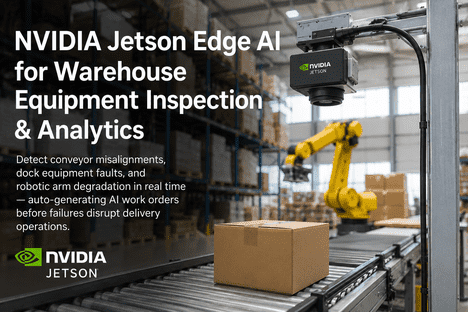
AI Vision Camera ModuleiFactory's AI Vision Camera module deploys high-resolution industrial cameras with embedded AI inference at the edge. Models are trained on your specific packaging formats, defect types, and tolerance specifications — not generic datasets. Line-speed inspection at up to 1,200 units per minute with sub-100ms defect classification latency. No cloud inference dependency — all processing runs on-premise, ensuring zero connectivity-driven inspection gaps.
Work Order Management — Defect-Triggered DispatchiFactory's Work Order Management system receives structured defect alerts from the vision layer and generates, assigns, and tracks corrective action work orders automatically. Technician dispatch, parts requirements, and repair verification are all managed within the platform — providing a closed loop from defect detection to confirmed resolution, with full audit trail for quality management system compliance.
Quality Control Management — Statistical Process Control IntegrationDefect data from AI vision feeds directly into iFactory's Statistical Quality Control module. Control charts, Cpk analysis, and defect Pareto reporting are generated in real time from 100% inspection data — not sampled estimates. Quality engineers see process drift developing before it crosses specification limits, enabling corrective action before defects occur rather than after.
Parts & Inventory — Quarantine and Rework Queue ManagementDefective lots are automatically quarantined within iFactory's Parts & Inventory module. Rework queues are generated with defect type, quantity, and recommended action. Disposition decisions (rework, scrap, return to supplier) are logged against the batch record and reflected in real-time inventory valuations — eliminating the common problem of quarantined stock appearing as available inventory in the WMS.
Analytics Reporting — Defect Trend IntelligenceiFactory's Automated Analytics Reporting aggregates AI vision defect data across lines, shifts, SKUs, and time periods. Defect rate trending, supplier quality scorecards, cost-of-quality calculations, and compliance reporting are generated automatically — providing quality managers with the intelligence to make strategic decisions about line configuration, supplier selection, and inspection protocols without manual data aggregation.
Implementation: From Camera Installation to Live Warehouse AI Integration
Phase 1: Packaging Line Assessment & Camera Placement (1–2 weeks)iFactory engineers assess your packaging line configuration, product portfolio, and defect history to determine optimal camera placement, lighting requirements, and inspection zone coverage. Existing vision hardware is evaluated for integration compatibility. Most facilities can deploy initial inspection coverage on 2–3 critical lines without production downtime.
Phase 2: AI Model Training & Defect Classification Setup (2–4 weeks)AI vision models are trained on your specific packaging formats using a combination of production samples and synthetic augmentation. Defect classifications, severity thresholds, and rejection criteria are configured with your quality team. Initial model accuracy targets of 95%+ are validated against your golden sample library before live deployment.
Phase 3: Warehouse AI Integration & Workflow Configuration (1–2 weeks)Defect event triggers are mapped to warehouse AI workflows: work order templates, quarantine hold rules, supplier alert criteria, and outbound shipment release gates are configured. Integration with existing WMS, ERP (SAP, Oracle), and CMMS systems is completed via standard APIs. No production disruption — integration is validated in parallel with existing processes.
Phase 4: Live Operations & Continuous Model Improvement (ongoing)Full 100% inspection goes live across configured lines. AI models improve continuously as production data accumulates — false positive rates typically decrease 40–60% within the first 90 days as models adapt to your specific process variation. New SKUs and packaging formats are onboarded incrementally without system downtime.
Frequently Asked Questions
Can iFactory AI Vision integrate with our existing packaging line cameras?
Yes. iFactory supports integration with major industrial vision camera brands (Cognex, Keyence, Basler, Allied Vision, FLIR) via standard machine vision interfaces (GigE Vision, USB3 Vision, GenICam). If your existing cameras meet resolution and frame rate specifications for your line speed, iFactory can connect to them directly. For lines where new cameras are required, iFactory recommends and deploys purpose-specified hardware matched to your packaging format and defect classification requirements.
How quickly does the system respond when a defect spike is detected?
iFactory's edge-based defect detection operates with sub-100ms classification latency — defects are identified and reject signals triggered before the unit reaches the end of the inspection zone. Warehouse AI workflow triggers (work orders, quarantine holds, supervisor alerts) are generated within 90 seconds of a threshold breach being confirmed. This compares to 15–45 minutes for manual escalation in traditional QC workflows.
What defect types can the AI vision system detect on our packaging lines?
iFactory's AI vision models are trained for your specific packaging formats and defect taxonomy. Standard detection categories include: label misalignment and print quality (text, barcode, QR code), seal integrity (heat seals, foil seals, cap torque), fill level and quantity verification, surface contamination and structural damage, color consistency, and secondary packaging integrity. Custom defect categories can be added through model fine-tuning — typically requiring 500–2,000 labeled examples of the new defect type.
Does the warehouse AI integration require changes to our existing WMS or ERP?
No structural changes to your existing systems are required. iFactory AI integrates via standard APIs with major WMS platforms (SAP EWM, Oracle WMS, Manhattan Associates, Blue Yonder) and ERP systems (SAP, Oracle, Microsoft Dynamics). Quarantine holds, inventory status updates, and supplier quality notifications are written back to your existing systems through API calls — your WMS and ERP continue to operate as system of record. Integration is typically completed within 1–2 weeks.
How does iFactory AI handle new SKUs or packaging format changes?
New SKUs are onboarded through iFactory's model management interface — quality engineers upload golden sample images, define tolerance specifications, and configure defect severity thresholds without vendor support. For significantly different packaging formats, model fine-tuning is completed within 1–2 weeks using production samples. iFactory's platform is designed for continuous SKU evolution in FMCG and manufacturing environments where product and packaging changes are frequent.
What ROI can we expect from AI visual QC integrated with warehouse AI?
ROI drivers include: elimination of manual inspection labor (typically 4–12 FTEs per shift for high-volume lines), reduction in defect escape costs (returns, recalls, regulatory penalties — often 10–50x the prevention cost), reduction in rework costs through earlier defect detection, and supplier quality improvement through data-driven scorecards. Most facilities achieve positive ROI within 6–12 months. For a facility-specific ROI model based on your line configuration and defect history,
Book a Demo and our team will run the calculation with your data.
AI VISION CAMERA · WAREHOUSE AI · PACKAGING QUALITY CONTROL
Stop Defects Before They Become Escapes. Connect Your Packaging QC to Warehouse AI Today.
iFactory AI Vision Camera detects packaging defects at 100% inline coverage — and feeds every defect event into warehouse AI workflows that trigger work orders, quarantine holds, and supplier alerts automatically. Deploy on your critical packaging lines in 4–6 weeks. Eliminate defect escapes immediately.