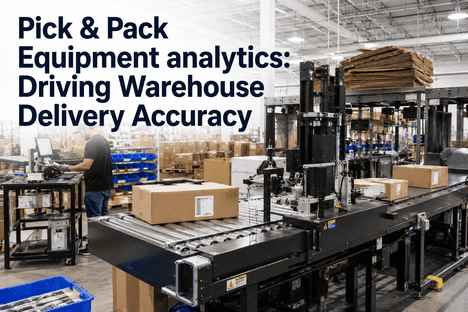
Packaging line failures don't just slow throughput they manufacture failed deliveries. A drifting label applicator produces 2,400 mislabeled shipments per shift that route to wrong addresses. A failing heat-seal carousel produces compromised packages that fail integrity checks at the carrier sortation hub. A weight-drift on the checkweigher passes underweight cartons that trigger marketplace chargebacks days later. A bent corrugate folder produces damaged boxes that arrive crushed and trigger customer return cycles. Every one of these defects starts at the packaging line and cascades into the metric that actually matters:first-attempt delivery success rate. Industry benchmarks show defect rates above 0.3% on outbound packaging trigger measurable spikes in carrier rejection, customer returns, and marketplace SLA chargebacks yet most warehouses run packaging equipment on calendar-based maintenance that cannot detect the slow degradation modes (lubrication breakdown, sensor drift, label adhesive variation, heat-seal temperature creep) that produce defects between scheduled inspections. AI-maintained packaging line analytics closes this gap completely monitoring label placement accuracy, seal integrity, weight conformance, dimensional checks, and equipment health continuously, triggering corrective work orders the moment any parameter trends toward defect threshold. Book a Demo to see how iFactory AI deploys packaging line analytics across warehouse delivery hubs in 6 to 8 weeks.
< 0.3%
Outbound packaging defect rate threshold maintained through AI analytics
2,400
Mislabeled shipments per shift from a single drifting label applicator at 80K volume
97%+
First-attempt delivery success rate sustained through packaging defect prevention
6-8 wks
Deployment timeline from baseline audit to live AI packaging analytics
What Packaging Line Analytics Actually Requires in Warehouse Delivery Operations
A warehouse packaging line is not one machine — it is a sequence of interdependent stations: corrugate erection, product induction, void-fill dispensing, carton sealing, label application, weight verification, dimensioning, and palletizing. Each station has its own failure profile and each produces a different defect mode that fails at delivery. Label applicators drift in placement accuracy as adhesive viscosity changes with temperature; heat-seal carousels lose seal integrity as temperature regulators degrade; checkweighers report false-pass weights as load cells drift; dimensional scanners miss oversized cartons as camera focus shifts. Calendar-based maintenance treats these stations uniformly when their actual condition varies daily — and the result is defective shipments leaving the facility undetected until carrier returns or customer complaints surface them.
iFactory's AI packaging analytics platform unifies every station under a single intelligence layer. Real-time defect rate per station, label placement accuracy, seal integrity score, weight conformance, and dimensional check pass-rate stream into AI models that learn each line's baseline performance and trigger corrective work orders the moment any parameter trends toward threshold. The result is sustained packaging quality that protects first-attempt delivery success rates — not as an aspirational target but as a continuously enforced operational state.
Real-Time Defect Rate Monitoring Per Station
Continuous tracking of label placement accuracy, seal integrity, weight conformance, dimensional check pass-rate, and corrugate quality per packaging station — converting raw scan data into early-warning defect intelligence that flags drift before quality crosses threshold.
Predictive Failure Detection 2-6 Weeks Ahead
AI surfaces label applicator drift, heat-seal temperature creep, checkweigher load cell degradation, and dimensioner focus shift 2 to 6 weeks before defect rates spike — enabling correction during planned downtime windows rather than during peak fulfillment.
Label Quality and Adhesion Analytics
AI vision monitors label placement angle, adhesion quality, barcode print contrast, and address accuracy in real time — auto-generating maintenance work orders when applicator drift, label stock issues, or print quality begins to compromise carrier scanning.
Heat-Seal and Carton Integrity Monitoring
Temperature regulator data, seal pressure trends, and cycle-time consistency tracked per heat-seal station — preventing seal integrity failures that produce compromised cartons rejected at carrier sortation or arriving damaged at customer.
AI-Powered Shift Logbook for Packaging Operations
iFactory's Shift Logbook captures every defect event, calibration completion, and outstanding packaging exception with AI-generated summaries and photo evidence — ensuring 24/7 packaging teams inherit full line history across shift handovers.
Integration with Major Packaging Platforms
iFactory integrates with Sealed Air, Pregis, Ranpak, Dematic, Honeywell, and other major packaging line platforms via OPC-UA, MQTT, BACnet, Modbus, and REST APIs — adding AI defect-prevention intelligence on top of existing packaging infrastructure.
Why Calendar-Based Packaging Maintenance Cannot Prevent Delivery Defects
Industry data shows six failure modes account for 85%+ of warehouse packaging defects: label applicator drift, heat-seal temperature creep, checkweigher load cell degradation, dimensioner focus shift, corrugate stock quality variance, and adhesive viscosity change. Calendar-based maintenance treats all six on identical schedules regardless of actual condition. The following comparison shows where calendar workflows fail versus what AI packaging analytics delivers.
| Packaging Parameter |
Calendar-Based Maintenance |
iFactory AI Packaging Analytics |
| Defect Rate Visibility |
Defects discovered at carrier rejection or customer return — days after the originating packaging event. Re-shipment cost and SLA penalty already incurred. |
Defect rate, label accuracy, seal integrity, and weight conformance tracked continuously per station. Drift detected within minutes; corrective work orders triggered automatically. |
| Label Applicator Performance |
Quarterly focus calibration applied uniformly. Adhesive viscosity changes with seasonal temperature go undetected; address misreads cascade into wrong-route deliveries. |
AI vision tracks label placement angle, adhesion quality, and barcode contrast in real time — triggering applicator calibration based on actual drift, not calendar. |
| Heat-Seal Integrity |
Manual inspection of random samples. Slow temperature regulator degradation produces compromised seals that pass visual check but fail at carrier handling. |
Temperature regulator data, seal pressure trends, and cycle-time consistency monitored continuously — preventing seal failures before any compromised carton ships. |
| Checkweigher Accuracy |
Load cell calibration on quarterly cycle. Daily drift produces false-pass weights that trigger marketplace chargebacks 3–7 days post-shipment. |
AI tracks load cell drift, vibration interference, and reference weight pass-rate continuously — triggering recalibration the moment accuracy trends downward. |
| Dimensional Accuracy |
Dimensioner camera focus inspected monthly. Drift produces oversized parcels misrouted to wrong carrier service tiers, costing $4–$12 per misclassified shipment. |
Continuous focus stability monitoring with AI cross-validation against actual carton dimensions — eliminating misclassification cost before it accumulates. |
| First-Attempt Delivery Impact |
Packaging defects produce 3–7% delivery failure rate during seasonal degradation cycles. Returns processing, re-shipment, and customer churn compound the impact. |
Continuous defect prevention sustains 97%+ first-attempt delivery success. Returns processing cost reduced 50–70%; carrier rejection rate drops below industry average. |
Every Packaging Defect Becomes a Failed Delivery. AI Stops It at the Source.
iFactory AI gives warehouse operators continuous packaging line monitoring, predictive failure detection, label and seal quality analytics, and station-specific calibration triggering — integrated with existing CMMS, WMS, and packaging platforms in 6 to 8 weeks.
Book a Demo to see packaging analytics applied to your delivery operation.
How iFactory AI Deploys Packaging Line Analytics Across Warehouse Delivery Hubs
iFactory follows a structured deployment process that delivers live packaging defect visibility within the first two weeks and full AI analytics by week eight. Each stage has defined deliverables so operations teams see measurable defect-rate improvement — not analytics rollouts that produce dashboards instead of dispatched corrective action.
Weeks 1–2
Packaging Line Audit and Defect Baseline Mapping
All packaging stations catalogued — corrugate erection, induction, void-fill, sealing, labeling, weighing, dimensioning, palletizing. Current defect rates baselined per station from historical CMMS and WMS data. Packaging platform, CMMS, and WMS integrations established. Digital Shift Logbook deployed.
Weeks 3–4
IoT Sensor Activation and Live Defect Dashboards
Temperature, vibration, load cell, and vision sensors retrofit-mounted on priority packaging stations. AI begins learning baseline behavior per station. Real-time defect rate dashboards activate; first calibration alerts deliver to maintenance teams within this window.
Weeks 5–6
Predictive Models and Automated Work Order Generation
AI failure prediction models active across monitored stations with drift detection 2–6 weeks ahead. AI-generated work orders flow into existing CMMS with required parts, recommended procedures, and optimal scheduling windows avoiding peak fulfillment hours.
Weeks 7–8
Full Packaging Analytics, SLA Reporting, and Multi-Site Rollout
Hub-wide packaging analytics live across all stations. Automated delivery success rate reporting, carrier rejection tracking, and SLA performance documentation activated. Multi-site rollout templates configured for additional fulfillment hubs.
MEASURABLE OUTCOMES FROM WEEK 4: PACKAGING DEFECT DETECTION BEGINS IMMEDIATELY
Warehouse operators completing iFactory's 6 to 8 week deployment report packaging defect rates dropping below 0.3% within the first 30 days — eliminating 50–70% of returns processing cost, reducing carrier rejection rates, and sustaining first-attempt delivery success at 97%+ across peak shifts. By month 6, deployments report measurable improvement in marketplace ratings and contract renewal pricing power.
< 0.3%
Sustained packaging defect rate every shift post-deployment
50-70%
Returns processing cost reduction within 6 months
97%+
First-attempt delivery success rate sustained across peak shifts
Packaging Line Analytics: Use Cases from Live Warehouse Deployments
The following outcomes are drawn from iFactory deployments at operating fulfillment centers and distribution hubs across e-commerce, 3PL, retail distribution, and parcel sorting operations. Each use case reflects 9 to 12 month post-deployment performance data.
A national e-commerce fulfillment hub running 80,000 parcels per peak shift was experiencing seasonal label applicator drift on its three primary lines — adhesive viscosity dropped in colder months, label placement angle drifted 4–7 degrees off-center, and carrier scanning success rate fell from 99.6% to 96.8%. The result: 2,400 mislabeled or carrier-rejected parcels per peak shift, generating $48K weekly in re-induction labor and SLA chargebacks. iFactory deployed AI vision monitoring across all three applicators with label placement angle, adhesion quality, and barcode contrast tracking. Within 14 days, the system identified all three lines drifting toward threshold and dispatched calibration work orders during planned windows. Carrier scanning success rate restored to 99.6%+ and held through peak season; annual recovered value exceeded $940K.
Book a Demo to see label drift analytics applied to your operation.
$940K
Annual recovered value from label applicator drift prevention
99.6%+
Carrier scanning success rate restored and sustained
14 days
Drift detection time vs prior quarterly inspection cycle
A 3PL operator handling fragile electronics shipments was experiencing carrier rejection rates of 1.8% at primary parcel hubs — driven by compromised heat-seal cartons that opened during sortation handling. Manual inspection of seal samples missed slow temperature regulator degradation. iFactory deployed temperature and pressure monitoring across 12 heat-seal carousels with AI integrity scoring. Within 60 days, the system identified 4 carousels drifting below seal-integrity baseline 18 to 26 days before traditional inspection would have caught them. Calibration completed during planned windows; carrier rejection rate dropped from 1.8% to 0.21%, returns processing cost reduced 63%, and the operator restored premium carrier contract pricing based on documented quality improvement.
Book a Demo to see heat-seal analytics applied to your operation.
1.8 → 0.21%
Carrier rejection rate reduction from heat-seal integrity monitoring
63%
Returns processing cost reduction within 9 months
18-26 days
Lead time on detected seal-integrity drift vs manual inspection
A marketplace seller running 14 outbound packaging lines was paying $1.4M annually in chargebacks — driven by checkweigher load cell drift producing false-pass underweight shipments and dimensioner focus drift misclassifying cartons into wrong carrier service tiers. Calendar-based calibration could not keep pace with daily drift cycles. iFactory deployed continuous load cell drift monitoring, vibration interference detection, and dimensioner focus stability tracking. Within 6 months, false-pass weight events dropped 91%, dimensional misclassification dropped 78%, and total marketplace chargeback spend dropped from $1.4M to $284K annually. Three marketplace accounts restored premium seller ranking based on documented packaging quality.
Book a Demo to see checkweigher and dimensioner analytics applied to your operation.
$1.1M
Annual marketplace chargeback spend eliminated
91%
Reduction in false-pass underweight shipment events
78%
Reduction in dimensional misclassification events
Expert Perspective: Why Packaging Defect Prevention Is the Highest-Leverage Investment in Delivery Quality
Industry Review — Warehouse Packaging Operations Perspective
"Every dollar invested in packaging line analytics generates 8 to 12 dollars in downstream value — and most operators never see it. The reason is that packaging defects don't show up in packaging cost. They show up in carrier rejection rate, customer returns, marketplace chargebacks, and SLA penalty spend — line items that belong to different cost centers and rarely get traced back to the source. The operators capturing real value are the ones treating packaging quality as a delivery-success metric, not a packaging-throughput metric. When you measure it that way, AI packaging analytics becomes one of the highest-ROI investments in the entire delivery operation."
Warehouse Packaging Operations Director — Multi-Site Fulfillment Network (provided via iFactory deployment reference)
This perspective aligns with what packaging engineers consistently report across iFactory deployments: the highest-ROI gains come from treating packaging quality as a continuously controlled delivery-success parameter rather than a sample-inspection task. AI creates that closed loop by unifying every station's defect signals into one intelligence layer that drives both reliability and delivery-success outcomes. Book a Demo to speak with iFactory's packaging analytics specialists about your current program.
Continuous Defect Intelligence. Predictive Calibration. 97%+ Delivery Success Every Shift.
iFactory gives warehouse operators real-time packaging line analytics, AI-driven calibration triggering, defect rate monitoring per station, and Shift Logbook continuity — integrated with existing CMMS, WMS, and packaging platforms without rip-and-replace. Results measurable within 30 days.
Conclusion: AI Packaging Line Analytics Is the New Standard for Delivery Defect Prevention
The case for AI packaging line analytics has moved beyond evaluation. With outbound defect rates above 0.3% directly producing carrier rejection cascades, marketplace chargebacks running $1M+ annually for mid-volume operators, and first-attempt delivery success rates determining contract pricing power across major retail and 3PL portfolios, warehouse operators continuing to manage packaging on calendar-based maintenance are accepting cost and customer-experience risk that AI eliminates. Customer expectations for damage-free delivery, marketplace SLA enforcement, and rising carrier scrutiny will not tolerate reactive packaging management indefinitely.
iFactory's platform delivers the specific capabilities warehouse packaging operations require: real-time defect rate and station-level performance monitoring, predictive failure detection 2 to 6 weeks ahead, label quality and adhesion analytics, heat-seal integrity monitoring, checkweigher and dimensioner drift detection, AI-powered Shift Logbook continuity, and integration with major packaging platforms through OPC-UA, MQTT, BACnet, Modbus, and REST APIs. The 6 to 8 week deployment program means measurable defect prevention begins within weeks. Book a Demo to receive a packaging line defect assessment specific to your operation.
Frequently Asked Questions About Warehouse Packaging Line Analytics
Which packaging platforms and equipment does iFactory integrate with?
iFactory integrates with Sealed Air, Pregis, Ranpak void-fill systems; Dematic, Honeywell, Vanderlande conveyor and induction lines; Domino, Markem-Imaje, Videojet labeling and coding systems; Mettler-Toledo, Garvey, Yamato checkweighers; and Cognex, SICK dimensioners via OPC-UA, MQTT, BACnet, Modbus, and REST APIs.
Do we need to replace our existing packaging equipment to add AI analytics?
No. iFactory operates as an intelligence layer on top of existing packaging infrastructure. AI analytics adds continuous defect monitoring, predictive calibration triggering, and audit reporting to your current equipment without hardware replacement. Existing CMMS and WMS systems integrate non-disruptively.
How quickly does AI packaging analytics show measurable defect-rate improvement?
Defect rate stabilization typically becomes visible within the first 30 days as drift detection and predictive calibration triggering activate. Full benefits including 50–70% returns processing cost reduction and 97%+ first-attempt delivery success rate compound by month 6 as the AI model learns per-station baselines across operating conditions.
Can the platform detect issues like compromised seals before cartons leave the facility?
Yes. AI monitors temperature regulator data, seal pressure trends, and cycle-time consistency continuously — flagging seal integrity drift 18 to 26 days before defects would surface at carrier sortation. Compromised cartons are stopped at the line, not at the customer's doorstep.
How does the AI-powered Shift Logbook support packaging operations?
The Shift Logbook auto-captures every defect event, calibration completion, station alarm, and outstanding packaging exception with AI-generated summaries and photo evidence. Packaging teams running 24/7 operations inherit full line context at every handover — eliminating blind spots on developing defect patterns.
Deploy AI Packaging Line Analytics in 6 to 8 Weeks.
iFactory delivers continuous defect monitoring, predictive calibration, and station-level analytics — integrated with existing CMMS, WMS, and packaging platforms.
Defect rates sustained below 0.3%
50–70% returns processing cost reduction
97%+ first-attempt delivery success