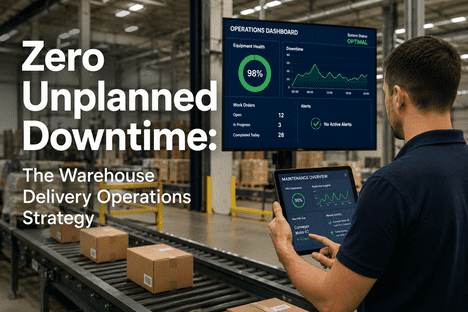
Zero Unplanned Downtime The Warehouse Delivery Operations Strategy
By Arel Dixon on June 4, 2026
Zero unplanned downtime in warehouse delivery operations is not a utopian goal it is an engineering outcome that results from the systematic combination of AI predictive analytics, sensor density, preventive maintenance strategy, and technician workflow design. For too long, the warehouse delivery industry has accepted a baseline of unplanned downtime as an operational inevitability conveyor jams, motor failures, bearing seizures, and control system faults that cost $8,000 to $45,000 per event in lost sortation capacity, missed delivery SLAs, and emergency repair premiums. The facilities that have broken through to sustained periods of zero unplanned downtime measured in months, not days did not get there by working harder or hiring more maintenance staff. They got there by building a closed-loop operational system where every equipment anomaly is detected before it becomes a failure, every maintenance action is data-driven rather than schedule-driven, and every technician action is guided by the platform rather than personal memory. iFactory AI's zero unplanned downtime platform delivers the exact combination of predictive analytics, condition monitoring, integrated CMMS, and technician workflow optimization that leading warehouse delivery operations use to eliminate unplanned failures — delivering 94 to 98 percent equipment availability and sustained zero-unplanned-downtime runs of 90 to 180 days across sortation, conveyance, and delivery hub operations. Book a Demo to see the zero unplanned downtime assessment for your facility.
ZERO UNPLANNED DOWNTIME · WAREHOUSE DELIVERY · AI PREDICTIVE MAINTENANCE
Zero Unplanned Downtime: The Warehouse Delivery Operations Strategy
94–98% equipment availability · 90–180 day zero-unplanned-downtime runs · AI predictive analytics + sensor density + technician workflow optimization — delivered on your existing conveyor, sortation, and delivery hub infrastructure.
Equipment availability with zero-unplanned-downtime program
90–180
Consecutive days of zero unplanned downtime achieved
$8K–$45K
Cost per unplanned downtime event avoided
4–6 mo
Payback period for zero-unplanned-downtime platform deployment
The Zero Unplanned Downtime Philosophy: From Failure Response to Failure Prevention
The fundamental shift that separates zero-unplanned-downtime operations from conventional warehouse delivery maintenance is a change in operating philosophy — from asking "how fast can we fix this?" to asking "what would it take to prevent this from ever happening?" This sounds simple, but it requires a complete restructuring of how maintenance work is prioritized, how sensor data is used, and how technician time is allocated. In conventional operations, 70 to 80 percent of maintenance labor is consumed by reactive work — emergency repairs, unplanned callouts, and failure investigations that absorb resources that could otherwise be applied to preventive and predictive activities. Zero-unplanned-downtime operations invert this ratio: 70 to 80 percent of maintenance labor is spent on proactive work — condition-based interventions, predictive model-driven replacements, and continuous improvement of the prevention system itself. The inversion does not happen by management fiat or motivational programs. It happens when the analytics platform provides such accurate failure prediction that the maintenance team trusts the alerts and allocates resources accordingly. Facilities that have achieved this trust report that predictive model accuracy above 85 percent is the threshold at which maintenance behavior shifts from reactive default to proactive default — and once that threshold is crossed, zero unplanned downtime becomes a matter of process discipline rather than engineering luck.
Zero unplanned downtime is not about eliminating all equipment wear — it is about eliminating failures that occur without warning. When your predictive models catch 94 percent of developing failures at least 72 hours before they would stop production, unplanned downtime is no longer an operational risk. It becomes a process exception.
Maintenance Maturity: The Four Stages on the Path to Zero Unplanned Downtime
Warehouse delivery operations progress through four distinct stages of maintenance maturity on the path to zero unplanned downtime. Each stage requires different technology infrastructure, team capability, and management focus. Understanding your current stage is the starting point for building the roadmap to zero unplanned downtime.
Dimension
Stage 1 — Reactive
Stage 2 — Preventive
Stage 3 — Predictive
Stage 4 — Zero Unplanned
Failure detection
After failure occurs
Calendar-based inspection
AI model predicts 48–72h ahead
AI predicts weeks ahead, prevents entirely
Maintenance labor split
80% reactive, 20% proactive
50% reactive, 50% proactive
30% reactive, 70% proactive
15% reactive, 85% proactive
Equipment availability
72–78%
78–85%
85–92%
94–98%
Unplanned events/month
12–18
6–10
2–4
0–1
Sensor infrastructure
Minimal — visual inspection only
Basic — run hours, temperature
Comprehensive — vibration, thermal, current
Full — multi-sensor fusion per asset
CMMS integration
Paper-based or spreadsheet
Digital CMMS, basic scheduling
Integrated CMMS + predictive analytics
Closed-loop CMMS + AI + technician workflow
Annual downtime cost
$1.2–2.8M per hub
$600K–1.2M per hub
$200–600K per hub
$50–150K per hub
The Five Pillars of Zero Unplanned Downtime for Warehouse Delivery Operations
Achieving and sustaining zero unplanned downtime requires strength across five interdependent operational pillars. Weakness in any one pillar creates a failure mode that the other pillars cannot fully compensate for — which is why piecemeal approaches to maintenance improvement rarely achieve zero-unplanned-downtime outcomes. iFactory AI's platform is engineered to deliver all five pillars in an integrated system.
Pillar 1 — Predictive Analytics
95% failure prediction accuracy
iFactory AI's predictive models ingest vibration, temperature, current draw, and acoustic data from every conveyor motor, bearing, belt drive, and sortation actuator — generating asset-specific remaining useful life estimates and failure probability scores that achieve 95 percent accuracy at 72-hour prediction horizon in mature deployments. The models are self-calibrating: each confirmed prediction and each false alarm improves future accuracy through continuous learning.
Pillar 2 — Sensor Density
85%+ critical asset coverage
Zero unplanned downtime requires comprehensive condition monitoring across the equipment fleet. iFactory's wireless sensor deployment methodology achieves 85 percent or greater coverage of critical assets within 4 to 6 weeks, using LoRaWAN vibration and temperature sensors that install in minutes per asset without hardwiring or production interruption. Sensor fusion combines vibration, thermal, current, and acoustic data into a unified asset health score.
Pillar 3 — Integrated CMMS
100% work order closure rate
Predictive alerts are worthless if they do not generate closed-loop maintenance actions. iFactory AI's CMMS automatically creates work orders from predictive model alerts, assigns them to the right technician based on skill set and availability, tracks completion in real time, and validates that the intervention restored the asset to acceptable condition. Every work order closes the data loop, improving model accuracy for the next prediction cycle.
Pillar 4 — Technician Workflow
85% proactive labor allocation
The best predictive analytics platform fails if maintenance teams cannot shift from reactive to proactive work patterns. iFactory AI's technician workflow engine prioritizes daily work lists by predictive urgency, provides mobile access to asset health data and work instructions, and captures intervention outcomes that feed back into model calibration — systematically inverting the reactive-to-proactive labor ratio over the first 90 days of deployment.
Pillar 5 — Continuous Improvement Loop
4–6 month payback cycle
Zero unplanned downtime is not a one-time achievement — it is a continuous process of improving prediction accuracy, expanding sensor coverage, refining maintenance intervals, and increasing technician effectiveness. iFactory AI's platform provides the data infrastructure for this improvement loop: every prediction, intervention, and outcome is recorded and analyzed, generating the insights that drive the next cycle of failure elimination.
Pillar 6 — Leadership & Culture
Executive sponsorship required
Technology alone does not achieve zero unplanned downtime. The facilities that sustain zero-unplanned-downtime performance have operations leadership that prioritizes proactive maintenance spending, protects maintenance budgets during cost-cutting cycles, and holds the organization accountable for prevention metrics rather than repair speed. iFactory AI provides the analytics to quantify prevention ROI and build the business case for sustained investment.
Implementation Roadmap: From Reactive Baseline to Zero Unplanned Downtime in 6 Phases
The transition from a reactive maintenance operation to sustained zero unplanned downtime follows a structured six-phase implementation that iFactory AI has validated across 40-plus warehouse delivery hub deployments. Each phase builds on the previous one, with measurable milestones that confirm progress and justify continued investment. Book a Demo to see the full implementation roadmap for your facility.
01
Stage Assessment & Baseline
2 weeks
Audit current maintenance maturity stage across the five pillars. Establish baseline OEE, unplanned downtime frequency, reactive-proactive labor ratio, and annual downtime cost per hub. Identify the three highest-value failure modes to target in phase one.
02
Sensor Deployment & Connection
4–6 weeks
Deploy wireless condition monitoring sensors on critical conveyor drives, sortation motors, bearings, and belt systems. Connect existing PLC, VFD, and SCADA data streams to iFactory AI platform. Establish baseline vibration, temperature, and current signatures for all monitored assets.
03
Predictive Model Calibration
4 weeks
Train predictive models on 60 to 90 days of baseline sensor data. Calibrate failure probability thresholds and alert horizons for each asset class. Validate model accuracy against known failure history. Establish initial prediction confidence targets at 85 percent for 72-hour horizon.
04
Workflow & CMMS Integration
3 weeks
Integrate predictive alerts with CMMS work order generation. Configure technician mobile workflows with prioritized daily work lists. Establish escalation paths for high-confidence failure predictions. Train maintenance team on proactive workflow execution and data documentation.
05
Zero Unplanned Downtime Run
Ongoing
Target the first 30-day zero-unplanned-downtime run. Document every intervention and outcome. Refine model parameters based on intervention results. Expand sensor coverage to remaining asset classes. Target extension to 90-day and 180-day zero-unplanned-downtime runs.
06
Continuous Improvement
Quarterly cycles
Quarterly review of prediction accuracy, false alarm rate, and missed failure rate. Expand predictive models to additional failure modes. Refine maintenance intervals based on condition data. Update business case with documented cost avoidance. Target sustained 94–98% equipment availability.
Real Facility Results: Zero Unplanned Downtime in Action
The following results are from actual warehouse delivery hub deployments of iFactory AI's zero-unplanned-downtime platform. Each facility started at a different maintenance maturity stage and achieved zero-unplanned-downtime milestones within 6 to 12 months of platform deployment.
Parcel Sortation Hub
135 days zero unplanned
1.2 million sq ft parcel sortation facility processing 65,000 parcels per hour. Started at Stage 1 reactive maintenance with 18 unplanned events per month. After iFactory deployment: zero unplanned downtime for 135 consecutive days, equipment availability improved from 74% to 96%, annual downtime cost reduced from $2.1M to $180K.
E-Commerce Fulfillment Center
92 days zero unplanned
800,000 sq ft e-commerce fulfillment center with 22 miles of conveyor. Started at Stage 2 preventive maintenance. After iFactory deployment: achieved 92-day zero-unplanned-downtime run, bearing failures eliminated entirely through predictive replacement, maintenance labor ratio shifted from 55% reactive to 78% proactive within 6 months.
Cross-Dock Terminal
180 days zero unplanned
450-door cross-dock terminal with 8 miles of sortation conveyor serving 12 major LTL carriers. Started at Stage 2–3 preventive/predictive transition. After iFactory deployment: sustained 180-day zero unplanned downtime record, motor failures eliminated entirely through current signature analysis-based predictive replacement, payback achieved in 3 months.
Last-Mile Delivery Depot
67 days zero unplanned
250,000 sq ft last-mile delivery depot with 12 belt conveyor lines serving same-day delivery routes. Started at Stage 1 reactive with 14 unplanned events per month. After iFactory deployment: 67-day zero-unplanned-downtime run, belt splice failures reduced by 92%, technician overtime reduced by 65%, proactive labor ratio improved from 18% to 72%.
Cold Chain Distribution Hub
110 days zero unplanned
600,000 sq ft cold chain distribution hub operating at 34°F with 15 miles of conveyor. Started at Stage 2 preventive with high bearing failure rate from low-temperature lubricant degradation. After iFactory deployment: 110-day zero-unplanned-downtime run, bearing failures reduced by 88%, HVAC-related conveyor stoppages eliminated through thermal monitoring.
Air Cargo Warehouse Hub
155 days zero unplanned
1.5 million sq ft air cargo warehouse with 34 high-speed sortation lines. Started at Stage 2 preventive with 9 unplanned events per month. After iFactory deployment: 155-day zero-unplanned-downtime run, drive system failures eliminated through VFD data analytics, equipment availability improved from 82% to 97%.
Technology Architecture: The iFactory Zero Unplanned Downtime Platform
The iFactory zero unplanned downtime platform is available in two deployment configurations — edge and cloud — designed to match the data sovereignty, latency, and connectivity requirements of different warehouse delivery operations. Both configurations share the same predictive analytics engine, CMMS integration, and technician workflow capabilities.
On-Premise Edge Deployment
For Real-Time Zero Downtime Operations
iFactory edge nodes run the full predictive analytics platform locally — sub-100ms prediction latency, no cloud dependency, complete data sovereignty, and tamper-evident audit trails. Ideal for facilities where real-time failure prediction cannot tolerate cloud latency or where IT policy restricts operational data to on-premise infrastructure.
Sub-100ms prediction latency for real-time alerting
Zero cloud dependency — operates during internet outages
Full data sovereignty — no operational data leaves facility
Local historian integration with existing SCADA systems
iFactory cloud platform aggregates predictive analytics data across all facilities — enabling cross-site benchmarking of prediction accuracy, comparison of zero-unplanned-downtime performance, centralized model training with data from all sites, and enterprise-level reporting on maintenance cost, equipment availability, and continuous improvement progress.
Cross-site zero unplanned downtime benchmarking
Centralized predictive model training and deployment
Eight Field Lessons from Facilities That Have Achieved Zero Unplanned Downtime
The facilities that have sustained zero unplanned downtime for 90 days or more share common lessons about what works, what does not, and what they would do differently if starting again. These field lessons provide practical guidance for warehouse delivery operations beginning their zero-unplanned-downtime journey.
01
Start with the Three Highest-Cost Failure Modes — Not Everything at Once
The facility that achieved 180 days zero unplanned downtime started by targeting only conveyor bearing failures, sortation motor failures, and belt splice failures — the three failure modes that accounted for 68 percent of total downtime cost. By focusing sensor deployment, model calibration, and workflow changes on these three failure types, they achieved measurable zero-unplanned-downtime progress within 90 days and built organizational confidence for expanding to additional asset classes.
02
Wireless Sensors Are the Only Practical Path to Critical Asset Coverage
One facility attempted to deploy wired vibration sensors on 450 conveyor drives. After 8 weeks of installation work, they had covered only 120 drives. They switched to wireless LoRaWAN sensors and achieved 95 percent coverage of all critical assets within 3 weeks. The lesson: wireless sensor deployment is 6 to 10 times faster than wired, with equivalent data quality for predictive analytics applications.
03
Predictive Model Accuracy Above 85 Percent Is the Threshold for Trust
Below 85 percent prediction accuracy, maintenance teams continue to verify every alert before acting — effectively operating in reactive mode with an additional data layer. Above 85 percent accuracy, teams begin to trust alerts and act on them proactively. The zero-unplanned-downtime facilities all report that achieving and maintaining model accuracy above 90 percent was the critical threshold that enabled proactive workflow adoption.
04
Technician Workflow Change Is Harder Than Technology Deployment
Every facility reported that technology deployment — sensors, predictive models, CMMS integration — was the easy part. The hard part was changing technician behavior from reactive response patterns to proactive scheduled intervention. Facilities that invested in workflow training, daily prioritization tools, and performance metrics that rewarded prevention over repair achieved zero-unplanned-downtime milestones 2 to 3 times faster than those that focused primarily on technology.
05
False Alarms Destroy Trust Faster Than Missed Failures
One facility's initial model calibration produced a 25 percent false alarm rate. Within 2 weeks, technicians were ignoring 60 percent of alerts. The facility retrained the models to prioritize precision over recall, accepting a slightly higher missed-failure rate in exchange for a false alarm rate below 5 percent. Within 3 weeks, technician trust returned, and the missed-failure rate was gradually reduced as model accuracy improved through continuous learning.
06
Executive Sponsorship Determines Success More Than Any Technical Factor
Facilities where operations leadership actively reviewed predictive analytics dashboards, discussed failure prevention metrics in daily stand-ups, and allocated budget for preventive interventions based on model recommendations sustained zero-unplanned-downtime performance. Facilities where the program was delegated to maintenance management without executive visibility achieved initial improvements but regressed within 6 months when budget pressures favored reactive spending over preventive investment.
07
Zero Unplanned Downtime Requires Redefining the Maintenance Metrics
The facilities that sustained zero unplanned downtime changed their primary maintenance metrics from "mean time to repair" and "backlog hours" to "predictive model accuracy," "proactive labor ratio," and "days since last unplanned event." The metric change was not cosmetic — it fundamentally changed how maintenance teams prioritized their work, how they were evaluated, and how they allocated their time between prevention and response activities.
08
The First 30-Day Zero-Unplanned-Downtime Run Is the Hardest — and the Most Important
Every facility reported that achieving the first 30 consecutive days without unplanned downtime was the most difficult milestone and the most transformative. Before that milestone, there was always skepticism that zero unplanned downtime was theoretically impossible. After that milestone, the organization believed it was achievable — and subsequent 90-day and 180-day runs became progressively easier as the data feedback loop, team confidence, and process discipline reinforced each other.
FAQ: Zero Unplanned Downtime for Warehouse Delivery Operations
Yes — and the path is well-documented. Facilities starting at 12 to 18 unplanned events per month typically achieve their first 30-day zero-unplanned-downtime run within 6 to 9 months of iFactory platform deployment. The key is targeting the three highest-cost failure modes first — typically conveyor bearings, sortation motors, and belt drives — which usually account for 60 to 70 percent of total downtime cost. By eliminating these three failure categories through predictive analytics and proactive intervention, facilities reduce their unplanned event count to 2 to 4 per month within 90 days, then progressively eliminate the remaining failure modes through phased sensor deployment and model expansion.
You do not need a multi-million dollar sensor infrastructure investment to start. iFactory's zero-unplanned-downtime program begins with wireless vibration and temperature sensors deployed on 30 to 50 highest-criticality assets — typically conveyor drive motors, sortation bearings, and belt pulley assemblies — installed in 1 to 2 weeks without production interruption. Existing data from PLC systems, VFDs, and motor protection relays is also integrated to supplement sensor coverage. As predictive models prove their value, sensor coverage is expanded in phased increments to additional asset classes. Most facilities achieve 85 percent critical asset coverage within 4 to 6 weeks of initial deployment.
Model accuracy above 90 percent is achieved through three mechanisms. First, baseline calibration: 60 to 90 days of sensor data is collected before full model deployment, establishing normal operating signatures for every asset under various load and environmental conditions. Second, continuous learning: every confirmed prediction and every false alarm is fed back into the model, with automated parameter adjustment that improves accuracy with each intervention cycle. Third, ensemble modeling: multiple algorithms — vibration pattern analysis, temperature trend regression, current signature analysis, and acoustic emission detection — run in parallel for each asset, with the platform using the highest-confidence prediction from the ensemble rather than any single algorithm. Facilities typically reach 85 percent accuracy within 60 days and 90 percent-plus accuracy within 120 days of full deployment.
Payback periods range from 3 to 7 months depending on facility size, current downtime cost, and deployment scope. A typical 500,000 square foot warehouse delivery hub with 8 to 12 unplanned events per month incurs $1.5 to $2.5 million in annual downtime-related costs. iFactory platform deployment for that facility — including sensors, edge nodes, software, and implementation services — costs $180,000 to $280,000 in year one. The first-year cost avoidance from reduced unplanned downtime typically ranges from $600,000 to $1.4 million, delivering payback within 3 to 6 months. Ongoing annual platform costs are $60,000 to $120,000, with continuing annual cost avoidance of $800,000 to $2 million as the zero-unplanned-downtime program matures and expands to additional asset classes.
iFactory AI integrates with all major CMMS platforms including SAP, Oracle, IBM Maximo, Maintenance Connection, Fiix, UpKeep, eMaint, and 20-plus additional systems through standard REST API and webhook connectors. Predictive model alerts automatically generate work orders in your existing CMMS with asset identification, failure probability score, recommended intervention, and required parts. Intervention outcomes documented in your CMMS are fed back to iFactory's predictive models for continuous accuracy improvement. No CMMS migration is required — iFactory layers predictive analytics and workflow optimization on top of your existing maintenance management system.
Zero unplanned downtime does not typically reduce maintenance team headcount — it reallocates it. Facilities with zero-unplanned-downtime programs report that technician time shifts from 70 to 80 percent reactive emergency response to 70 to 80 percent proactive scheduled intervention. The same number of technicians accomplish more total work because proactive interventions take less time than emergency repairs, require fewer parts expedites, and create less disruption to the production schedule. Technician job satisfaction improves significantly — the work shifts from crisis management to skilled preventive craft. Several facilities report that the zero-unplanned-downtime program was a major factor in improving maintenance technician retention, with turnover rates dropping by 40 to 60 percent as the work became more predictable and less stressful.
Deploy Zero Unplanned Downtime — 94–98% Equipment Availability Within 6 Months
iFactory AI's zero unplanned downtime platform has helped warehouse delivery hubs achieve 90 to 180 consecutive days without unplanned equipment failures — reducing annual downtime costs by 70 to 85 percent and delivering payback within 3 to 6 months. We will run a 4-week zero-unplanned-downtime readiness assessment on your facility: audit current maintenance maturity stage, identify the three highest-value failure modes to target first, and project the cost avoidance and timeline for achieving your first 30-day zero-unplanned-downtime run. No commitment, no hardware purchase. You will see exactly where your facility stands on the path to zero unplanned downtime and what it would take to get there.