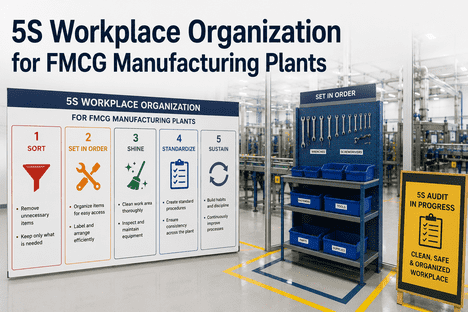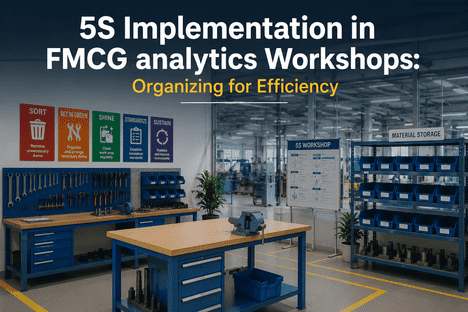
A well-organized analytics workshop in an FMCG plant is the difference between a technician who finds the right tool in 30 seconds and one who spends 15 minutes searching through cluttered drawers and unlabeled shelves. Between a maintenance planner who can locate the calibrated torque wrench for a filler machine overhaul before the line stops and one who discovers the tool was returned to the wrong bin three shifts ago. Between a tool room that supports 95% planned maintenance completion and one where 20% of scheduled work is delayed because tools, parts, or documentation cannot be found when needed. 5S methodology Sort, Set in Order, Shine, Standardize, Sustain — is the foundational lean practice that creates the organized, efficient, and safe work environment that every other operational excellence initiative depends on. iFactory's 5S Audit Checklists and Visual Management module provides a digital platform for implementing, auditing, and sustaining 5S across every analytics workshop, tool room, and maintenance area in the FMCG plant. Book a Demo to see how iFactory digitizes 5S implementation for FMCG maintenance and reliability teams.
Sort Separating the Essential from the Unnecessary in the Analytics Workshop
The first step of 5S — Sort (Seiri) — is the most difficult and the most liberating. In a typical FMCG analytics workshop, 30–50% of the items stored in tool cabinets, workbenches, and storage racks are not needed for the work performed in that area. Obsolete tooling from product lines that were retired three years ago, duplicate hand tools accumulated through years of uncontrolled purchasing, broken instruments that were set aside for repair and forgotten, and spare parts for equipment that no longer exists in the plant all occupying valuable workspace and creating visual noise that makes it harder to find the tools that are actually needed. iFactory's 5S implementation module guides the Sort process with a structured red-tag workflow that ensures every item in the workshop is evaluated against a consistent set of criteria frequency of use, criticality to current operations, condition, and replacement cost before being retained, relocated to a central storage area, or disposed of.
The digital red-tag process captures a photo of each item, records its current location and the evaluating team's classification decision, and generates a disposition log that provides complete traceability for every item removed from the workshop. This disposition log is essential for compliance with quality management system requirements and for protecting the plant against audit findings related to uncontrolled inventory of tooling and consumables. The Sort phase typically removes 25–40% of the items from the target workshop area, freeing up 20–35% of previously occupied storage space and reducing the visual complexity that slows down every tool retrieval task. FMCG plants that complete iFactory-guided Sort events report an immediate 40–60% reduction in time spent searching for tools and materials in the organized areas. Book a Demo to see how iFactory's digital red-tag workflow streamlines the Sort process for your FMCG analytics workshops.
Set in Order Every Tool Has a Home, Every Home Has a Label
Set in Order (Seiton) transforms the workshop from a collection of stored items into an organized system where every tool, part, and piece of documentation has a designated location that is clearly identified and logically arranged for the workflow it supports. The principle is simple: the location of every item should be obvious to anyone who works in the area, and the time required to retrieve any item should be measured in seconds, not minutes. iFactory's Visual Management module provides the digital infrastructure for Set in Order shadow board templates for tool organization, label and sign design tools for storage location identification, and a location-coding system that maps every storage location in the workshop to a searchable digital inventory.
The platform's visual management capabilities include pre-designed templates for common FMCG analytics workshop layouts — tool shadow boards organized by tool type and size, consumables storage organized by frequency of use with minimum/maximum inventory indicators, and documentation racks organized by equipment type and maintenance procedure number. Each storage location is labeled with a QR code that links to the digital inventory record showing the items assigned to that location, the correct quantity, and the reorder point. When a tool or part is used, the QR code scan can trigger a replenishment notification in the inventory management system — ensuring that consumable levels are maintained without manual cycle counting. FMCG plants implementing iFactory's Set in Order module in their analytics workshops report a 60–80% reduction in tool retrieval time and a 25–40% reduction in tool loss and misplacement. Book a Demo to see the visual management templates configured for your FMCG plant's analytics workshop layout.
Shine Cleaning as Inspection in the FMCG Analytics Environment
Shine (Seiso) in a 5S program goes far beyond conventional cleaning. In the FMCG analytics workshop context, Shine means that every surface, every tool, every storage location, and every piece of equipment is cleaned and inspected on a regular schedule and that the cleaning process itself is designed to reveal the early signs of deterioration, contamination, or damage that would otherwise go unnoticed until they cause a failure. A technician cleaning the workbench notices the vise has developed a crack in the base casting. A mechanic wiping down the calibrated torque wrenches discovers one has a bent drive head. A tool room attendant sweeping the floor finds a broken tap that fell from a storage rack that needs repair. These are not cleaning observations they are maintenance findings that prevent future failures and quality incidents.
iFactory's Shine module provides structured cleaning and inspection checklists for every area in the analytics workshop, with cleaning frequency determined by the type of work performed, the level of contamination typical for the area, and the criticality of the equipment stored or serviced there. Each cleaning task on the checklist includes the inspection criteria that the cleaner should evaluate during the cleaning process specific items to check for wear, damage, contamination, or deterioration. Inspection findings discovered during Shine are automatically routed to the appropriate corrective workflow maintenance work orders for equipment defects, quality notifications for contamination issues, and inventory adjustments for damaged stock. FMCG plants implementing iFactory's Shine module typically document 3–5 maintenance findings per week per workshop area that would not have been identified through any other inspection process, preventing an estimated 10–20 unplanned downtime events per year that would have originated from undetected deterioration in workshop tools and equipment. Book a Demo to see how iFactory integrates Shine inspection findings into the corrective maintenance workflow.
Standardize Making 5S Consistency the Default in Every Workshop
Standardize (Seiketsu) is the phase where 5S stops being a series of improvement events and becomes the normal way of working. The challenge in FMCG plants with multiple analytics workshops — a mechanical workshop on the production floor, an instrumentation lab near the quality control area, an electrical workshop in the maintenance building, and a tool crib at the warehouse is ensuring that the same 5S standards are applied consistently across all areas, even when different teams are responsible for each area's daily organization. iFactory's Standardize module addresses this challenge by maintaining a centralized library of 5S standards shadow board layouts, labeling conventions, cleaning frequencies, storage configurations, and audit criteria that are applied consistently across every workshop in the plant.
The platform's standardized 5S templates ensure that a technician moving from the mechanical workshop on Line 3 to the instrumentation workshop on Line 7 can immediately find the tools and documentation they need without asking for directions or searching through unfamiliar storage systems. New team members can be trained on a single set of 5S standards that apply across the entire plant, and cross-functional audit teams can evaluate any workshop against the same scoring criteria. The Standardize module also manages the documentation of 5S standards including visual standard work instructions for each workshop area, cleaning procedure documents, and storage configuration drawings in a centralized digital library that is always accessible from any device on the plant network. FMCG plants with multiple workshops report that iFactory's standardized 5S approach reduces new-hire ramp-up time by 30–50% and eliminates the inconsistency in workshop organization quality across different production areas and shifts.
Sustain Building the Management System That Keeps 5S Alive
Sustain (Shitsuke) is the most challenging phase of 5S implementation because it requires changing the daily habits of every person who works in the workshop and maintaining those habits month after month, year after year, even as team members change, production priorities shift, and the natural entropy of daily work pulls the workshop back toward disorder. The most common reason 5S programs fail in FMCG plants is not that the initial implementation was poor — it is that the sustainment system was not designed to detect and correct deviations before they become the new normal. iFactory's Sustain module provides the digital management infrastructure that keeps 5S performance visible, accountable, and continuously improving.
The platform's 5S audit module enables scheduled and random audits of every workshop area using digital checklists customized for the specific area's 5S standards. Auditors capture photo evidence of 5S compliance and non-compliance directly in the checklist, assign scores for each of the five S categories, and generate an overall 5S score for the area that is automatically trended over time. Non-compliance findings are automatically routed to the area owner with a corrective action deadline, and the audit report is posted to the visual management dashboard that displays the current 5S score for every workshop area in the plant alongside the trend lines showing whether 5S performance is improving or declining. Area 5S scores are integrated into the plant's overall performance dashboard alongside OEE, maintenance cost per unit, and safety incident rate making 5S a visible, measured, and managed dimension of plant performance rather than a program that exists outside the main performance management system. FMCG plants using iFactory's Sustain module maintain 5S audit scores above 90% indefinitely, compared to the typical 6–12 month degradation cycle experienced by plants relying on paper-based 5S programs with no digital sustainment infrastructure. Book a Demo to see how iFactory's 5S audit and sustainment module keeps your analytics workshops organized year after year.
5S Implementation Traditional Manual Approach vs iFactory Digital 5S Platform
- 5S red-tag events managed with paper tags and spreadsheet logs — disposition decisions documented inconsistently; traceability lost within weeks of event completion
- Shadow boards created manually with hand-drawn tool outlines — inconsistent across workshops; tool locations not mapped to inventory system; misplaced tools undetectable until needed
- Cleaning checklists on paper clipboards — completion verification depends on supervisor memory; inspection findings documented on sticky notes lost before corrective action is assigned
- 5S standards documented in binders that become outdated within months — no mechanism for ensuring consistent application across shifts and workshops; training dependent on word-of-mouth
- 5S audits conducted quarterly with paper checklists — scoring inconsistent between auditors; results not trended; corrective actions tracked verbally or not at all
- 5S performance invisible to plant leadership — no connection to OEE, maintenance cost, or safety metrics; 5S treated as housekeeping program rather than operational excellence driver
- Digital red-tag workflow with photo capture, classification criteria, and automated disposition logging — complete traceability for every item evaluated; disposition log exportable for audit and compliance
- Pre-designed shadow board templates with QR-coded location labels — digital inventory mapped to every storage location; misplaced tools detected through location discrepancy; replenishment triggered by QR scan
- Structured digital cleaning checklists with embedded inspection criteria — completion verified through photo evidence; inspection findings auto-routed to corrective workflows with work order generation
- Centralized digital 5S standards library accessible from any device — visual standard work instructions, labeling templates, and storage configuration drawings updated centrally and deployed instantly
- Digital 5S audits with scored checklists, photo evidence, and automated trend analysis — auditor-independent scoring with inter-rater reliability; corrective actions tracked to closure in the platform
- 5S performance dashboard integrated with plant's OEE, cost, and safety metrics — leadership visibility into 5S trends; 5S score correlated with operational performance indicators
Industry Perspective What Maintenance Leaders Say About 5S in FMCG Analytics Workshops
5S Metrics — What Gets Measured Gets Sustained
The most successful 5S programs in FMCG plants are built on data, not enthusiasm. iFactory's 5S Audit Checklists module captures and reports the metrics that separate sustainable 5S performance from the boom-and-bust cycle that plagues manual 5S programs. The table below maps the key 5S metrics to their measurement methods and the business outcomes they drive.
| 5S Performance Metric | Measurement Method | Business Outcome | Manual 5S Baseline | iFactory Digital Target |
|---|---|---|---|---|
| Sort disposition traceability | Red-tag event audit trail completeness | Compliance with quality management system requirements | 40–60% of items traceable | 100% of items traceable |
| Tool retrieval time | Time-based measurement before and after Set in Order | Reduced maintenance labor cost from faster tool access | 45–120 seconds per retrieval | < 15 seconds per retrieval |
| Shine inspection finding rate | Inspection findings documented per workshop per month | Prevention of failures originating from undetected deterioration | 0–1 findings per month (informal) | 3–5 findings per month per workshop |
| 5S standard consistency score | Cross-workshop audit comparing same-criteria scores | Reduced technician time loss from inconsistent workshop organization | 50–65% consistency across workshops | > 90% consistency across workshops |
| 5S audit score trend | Monthly scored audit with photo evidence | Continuously improving workshop organization and efficiency | Degrades 15–25 points in 12 months | Stable above 90% indefinitely |
| Corrective action closure rate | 5S audit finding closure within deadline | Accountability for 5S performance at the area-owner level | 40–60% closed within deadline | > 95% closed within deadline |
Frequently Asked Questions: 5S Implementation in FMCG Analytics Workshops
The initial 5S implementation for a single FMCG analytics workshop typically takes 4–6 weeks using iFactory's digital platform. Weeks 1–2 focus on the Sort phase with digital red-tag events and disposition logging. Week 3 focuses on Set in Order with shadow board template configuration, QR code label generation, and storage location mapping in the platform. Week 4 focuses on Shine with structured cleaning and inspection checklists configured for the specific workshop's equipment and contamination profile. Weeks 5–6 focus on Standardize with 5S standards documentation in the centralized library and Sustain with audit checklist configuration and initial baseline audit. Multi-workshop implementations can be deployed in parallel or sequentially depending on team availability and plant management priorities. Book a Demo to discuss your plant's 5S implementation timeline during the consultation.
Yes. iFactory's 5S Audit Checklists and Visual Management module integrates with major CMMS platforms (SAP PM, Maximo, Infor EAM, UpKeep) and inventory management systems through standard API connections. Shine inspection findings that require corrective action can be automatically converted to work orders in the connected CMMS. QR code scans in Set in Order zones can trigger inventory replenishment requests in the connected inventory system. The platform is designed to complement existing maintenance and inventory management systems rather than requiring replacement — 5S data flows into the systems your plant already uses for work management and inventory control.
5S audits in the iFactory platform are conducted using digital checklists on a mobile device — tablet, smartphone, or ruggedized handheld. The auditor walks through the workshop area and evaluates each criterion on the checklist, capturing photo evidence of compliance and non-compliance directly in the app. Each criterion is scored on a 0–4 scale with standard definitions for each score level to ensure auditor-independent consistency. The platform automatically calculates the overall 5S score for the area and trends it against historical audit results. Non-compliance findings are auto-assigned to the area owner with a configurable corrective action deadline, and the platform generates reminder notifications if the deadline approaches without closure. Audit results are visible on the plant's 5S performance dashboard and can be configured for automatic distribution to plant leadership.
The investment for iFactory's 5S Audit Checklists and Visual Management module ranges from $15,000 to $35,000 per plant depending on the number of workshop areas, the scope of visual management template customization, and integration requirements with existing systems. Most FMCG plants achieve full cost recovery within 6–9 months through three primary value drivers: maintenance labor productivity improvement of 10–20% from reduced tool search time and improved workshop organization (typically $40,000–$120,000 per year for a mid-size FMCG plant), reduction in tool loss and replacement cost of 30–50% from QR-code-tracked tool locations (typically $15,000–$40,000 per year), and reduction in unplanned downtime from undetected workshop equipment deterioration identified through Shine inspection findings (typically $50,000–$150,000 per year). Plants that previously struggled to sustain 5S programs report that the digital platform enables them to maintain the benefits of 5S indefinitely, avoiding the 6–12 month degradation cycle that caused previous 5S initiatives to lose momentum. Book a Demo for a 5S ROI assessment tailored to your FMCG plant's workshop configuration and maintenance productivity targets.
Conclusion: 5S Is Not Housekeeping It Is the Foundation of Operational Excellence in FMCG Analytics
Every operational excellence initiative in an FMCG plant — predictive maintenance, total productive maintenance, lean manufacturing, continuous improvement — depends on a foundation of workplace organization that makes it possible for people to do their best work. A plant where tools cannot be found, where storage locations are inconsistent across workshops, where cleaning is treated as janitorial work rather than inspection, and where 5S standards exist only in a binder that nobody reads — that plant will struggle to sustain any operational excellence program, no matter how well designed. The FMCG plants that achieve world-class OEE, maintenance cost efficiency, and quality performance are consistently the plants that have mastered the fundamentals of workplace organization — and they sustain that mastery through a digital management system that makes 5S performance visible, measured, and continuously improving.
iFactory's 5S Audit Checklists and Visual Management module provides the digital infrastructure that transforms 5S from a manual, paper-intensive, enthusiasm-dependent program into a data-driven, structured, sustainable management process — from Sort events with traceable digital red-tag workflows through Set in Order with QR-coded shadow boards and location mapping to Sustain with automated audits, scored checklists, photo evidence, and performance trend dashboards. For FMCG plant maintenance and reliability leaders who are ready to build the organized, efficient, and safe workshop environment that every other improvement initiative depends on, book a demonstration with iFactory's 5S and visual management engineering team to review your current workshop organization practices and build a 5S digital deployment roadmap for your plant.