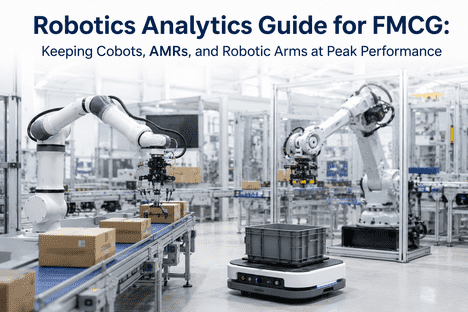
FMCG manufacturing environments depend on robotic systems — cobots on packaging lines, industrial arms in palletizing cells, autonomous mobile robots (AMRs) moving materials between zones, and vision systems inspecting products at line speed. Each robot type demands a structured analytics and maintenance approach to sustain throughput, prevent unplanned downtime, and maintain food-grade hygiene and safety compliance. Without a systematic robot analytics checklist, FMCG plants risk accumulating minor performance degradations that compound into line stoppages, quality deviations, and compressed shelf-life losses. iFactory's Robotics AI module centralizes robot analytics — combining real-time performance monitoring, predictive maintenance triggers, and compliance documentation into a single industrial software platform purpose-built for FMCG operations. Book a Demo to see how iFactory's Robotics AI transforms fragmented robot data into actionable maintenance and production intelligence for FMCG plants.
Cobots, industrial arms, AMRs, and vision systems — with daily, weekly, and monthly PM schedules tailored for food-grade FMCG operations. Centralized robot performance monitoring, predictive maintenance triggers, and compliance-ready documentation in one platform.
Robot types covered: cobot, industrial arm, AMR, vision system
3×
PM schedule cadences: daily, weekly, monthly per robot class
85%
Of unplanned robot downtime predicted with analytics-driven PM
30%
Reduction in FMCG line stoppages from structured robot inspections
Why FMCG Manufacturing Requires a Dedicated Robot Analytics Checklist
FMCG production lines operate under relentless pressure: high-speed packaging, frequent product changeovers, strict hygiene protocols, and near-zero tolerance for downtime. Robots in these environments — cobots handling raw ingredients, industrial arms stacking finished cases, AMRs ferrying pallets across the plant floor, and vision systems inspecting seals and labels — each introduce failure modes that are specific to their kinematics, duty cycles, and environmental exposure. A generic robot PM schedule drawn from automotive or general manufacturing misses the critical FMCG-specific failure patterns: washdown ingress in cobot joints, gripper contamination from food residue, AMR wheel degradation on wet flooring, and vision camera lens fouling from airborne particulates. The robot analytics checklist below organizes maintenance, inspection, and analytics tasks by robot type and cadence so FMCG maintenance teams can systematically eliminate the leading causes of robot-related downtime and quality excursions in food and beverage operations.
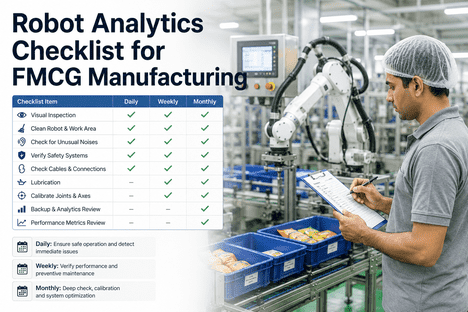
FMCG Robot Analytics Checklist · PM Cadence by Robot Type
Daily
Cobots
Gripper cleanliness, joint seal check, cycle time trend, teach pendant error log review
Every production day begins with a short, structured robot inspection that captures baseline performance metrics and flags anomalies before they escalate. For cobots on primary packaging lines: inspect gripper pads for wear and food residue buildup, verify joint seal integrity (IP rating compliance after washdown cycles), and review the teach pendant error log for intermittent communication faults. For industrial arms in palletizing and case packing: monitor axis drive temperatures against baselines, verify payload within rated capacity, check lubrication levels in gearboxes, and perform a hard-stop emergency test. For AMRs: log battery state-of-charge and discharge curve, inspect wheel treads for wear patterns consistent with wet or oily flooring, review path deviation data from the previous shift, and test obstacle sensor response with a standardized target. For vision inspection cameras: wipe lenses per hygiene protocol, verify LED illumination intensity against reference, run a calibration check with a master part, and track false reject rate against the shift production log. All daily inspection results are recorded in iFactory's Robotics AI module with timestamp, operator ID, and any corrective action taken — creating a searchable daily robot health log that feeds the predictive maintenance engine.
Daily health logBaseline comparisonPredictive feed
Weekly analytics shift from daily health checks to performance trending and deeper maintenance interventions. For cobots: torque audit across all joints using the robot controller's built-in diagnostics, compare actual cycle times against programmed baseline, review grip force trends for degradation, and inspect cable harnesses for flex fatigue near the mounting point. For industrial arms: perform a repeatability test using a calibrated test fixture, analyze servo drive current draw for signs of bearing wear or binding, inspect end-of-arm tooling (EOAT) pneumatic or electrical connections, and review safety zone configuration against current line layout. For AMR fleets: analyze battery cycle count and capacity fade against manufacturer replacement threshold, inspect all four wheels for uneven tread wear indicating alignment issues, clean charging contacts and verify dock alignment, and review fleet dispatch efficiency data from the AMR management system. For vision systems: clean camera housing and lens with approved FMCG-safe solvents, run a full field-of-view calibration check, analyze reject rate trends by SKU to detect drift, and verify network connectivity and image transmission latency. iFactory's platform aggregates these weekly analytics into robot-specific health scorecards that rank each robot's condition relative to fleet baselines, enabling maintenance planners to prioritize interventions by severity and production criticality.
Torque auditRepeatability testHealth scorecards
03
Monthly Robot PM: Deep Inspection, Firmware & Backup Verification
Monthly PM tasks address the deeper mechanical, electrical, and software layers that daily and weekly checks cannot reach. For all robot types: verify firmware version against manufacturer recommendations and review changelogs for safety-critical updates, perform a full system backup (controller parameters, vision recipes, AMR maps) and store a verified copy with timestamp, inspect all safety circuits including light curtains, safety mats, and laser scanners with a documented functional test, and lubricate all grease points per OEM schedule with food-grade lubricant where applicable. For cobots specifically: perform a full joint range-of-motion test under no-load conditions and compare angles against as-built calibration, inspect internal cable routing for chafing, and measure gripper suction or compression force against specification. For industrial arms: check gearbox backlash using a dial indicator, inspect counterbalance springs or gas struts, verify TCP (tool center point) accuracy with a calibration sphere, and inspect all conduit and cable-tracks for wear. For AMRs: deep-clean wheel assemblies and drive motors, replace worn treads, verify SLAM map accuracy against facility layout changes, and test emergency stop from maximum travel speed. For vision systems: clean interior optics and sensor window, verify resolution and field-of-view against factory specification, run a full MRP (material review) on calibration artifacts, and review lighting uniformity across the inspection area using a grayscale reference.
Full backupSafety circuit testOEM lubrication
04
Cobot-Specific Analytics for FMCG Packaging Lines
Cobots in FMCG environments face unique stressors: frequent washdown cycles, exposure to food acids and cleaning chemicals, high-speed repetitive pick-and-place motions, and direct operator interaction in collaborative zones. The analytics checklist must prioritize gripper performance (the highest-failure subsystem in food cobot applications), joint seal integrity (IP69K ratings degrade with thermal cycling), and collision detection sensitivity (excessively high thresholds mask real contact events while low thresholds cause nuisance stops). iFactory's Robotics AI monitors cobot-specific KPIs: average grip force per cycle, collision detection trigger rate per shift, joint torque deviation from learned baseline, and cumulative washdown cycles since last seal inspection. These KPIs feed a cobot health model that predicts remaining useful life for gripper pads, joint seals, and flex cables — enabling just-in-time replacement before failure rather than reactive repair during a production run. The platform also tracks cobot uptime by SKU and product format, revealing which changeovers produce the highest mechanical stress on the robot, so process engineers can optimize gripper design and pick trajectories accordingly.
Grip force KPICollision trigger rateRemaining useful life
05
AMR Fleet Analytics Checklist for FMCG Warehouse & Production Floors
AMRs move between production zones, cold storage, and shipping docks in FMCG plants — navigating wet floors, temperature gradients, narrow aisles, and pedestrian traffic. The analytics checklist for an AMR fleet must cover battery degradation (the primary AMR cost driver, typically replaced at 80% of original capacity), wheel wear (accelerated by oily or wet concrete), navigation accuracy (SLAM drift in repetitive environments), and fleet throughput efficiency (idle time vs active transport time). iFactory's Robotics AI integrates with AMR fleet managers to collect per-robot metrics: battery discharge rate per mission, average path deviation in millimeters, wheel slip events per shift, and charge cycle count. These are aggregated into a fleet health dashboard that highlights underperforming AMRs before they cause material flow disruptions. The platform also tracks AMR utilization by zone and shift, identifying bottlenecks where additional AMRs would reduce production line starvation, and flagging zones where floor conditions are causing elevated wheel wear rates so facilities teams can address drainage or oil leaks at the source rather than repeatedly replacing tires.
Fleet health dashboardBattery degradationZone utilization
06
Vision System Analytics Checklist for FMCG Quality Inspection
Vision inspection systems in FMCG check seals, labels, fill levels, and foreign material at line speed. Degraded vision performance causes false rejects (wasting product) or missed defects (creating recall risk). The analytics checklist includes daily false reject rate tracking against a control limit, weekly calibration drift analysis using master parts, and monthly illumination uniformity verification. iFactory's Robotics AI captures vision system telemetry: reject rate by defect code, false reject rate by SKU, calibration deviation trend, and camera temperature vs baseline (overheating accelerates sensor noise). When a vision system's false reject rate exceeds the configured threshold, the platform generates an inspection recommendation alert — typically lens cleaning, recalibration, or lighting adjustment — before the operator or quality team notices the degradation. Over time, the platform correlates vision system health with upstream robot and process parameters, enabling root-cause identification: for example, a cobot gripper that deposits products slightly off-center on the conveyor is causing a downstream vision false reject spike on that SKU. This cross-robot analytics capability — unique to iFactory's approach — turns individual robot checklists into an interconnected FMCG line health system.
FMCG Robot Analytics Checklist: Head-to-Head by Robot Type
Checklist Item
Cobot
Industrial Arm
AMR
Vision System
Gripper / End Effector
Daily pad wear & residue check
Weekly EOAT connection audit
—
—
Joint / Axis Health
Daily seal check, monthly range-of-motion
Daily temp, monthly backlash
—
—
Battery / Power
—
—
Daily SOC, cycle count analysis
—
Navigation / Path
—
—
Daily path deviation, monthly SLAM
—
Calibration
—
Monthly TCP accuracy
Monthly map alignment
Weekly master part check
Reject Rate / Quality
Weekly cycle time variance
—
—
Daily false reject rate tracking
Safety Systems
Daily e-stop, monthly full circuit test
Daily e-stop, monthly full circuit test
Daily obstacle sensor, monthly e-stop
—
Firmware / Backup
Monthly backup & version check
Monthly backup & version check
Monthly backup & version check
Monthly backup & version check
Real-World Robot Analytics Deployments in FMCG Plants
Cobot
Daily Gripper Analytics Reduced Packaging Line Stops by 40%
Daily check
An FMCG beverage plant operating 12 cobots on a secondary packaging line experienced recurring gripper failures that caused 15–20 minute line stops during peak production. The maintenance team had no systematic way to track gripper pad wear across the fleet — pads were replaced only after failure. iFactory's Robotics AI implemented a daily gripper analytics checklist: operators photograph each gripper pad at shift start, the platform applies computer vision to estimate remaining pad thickness, and the health scorecard flags pads below the replacement threshold. Within 30 days, gripper-related line stops dropped 40%, pad replacement shifted from reactive to planned during scheduled changeovers, and annual gripper consumable spend decreased 22% because pads were used to their full safe life rather than replaced prematurely.
Fleet Battery Analytics Extended AMR Service Life 18 Months
Weekly KPI
A frozen food FMCG facility operated 24 AMRs transporting pallets between blast freezers and the shipping dock. Cold-environment operation accelerated battery degradation, and the facility was replacing AMR batteries at 18-month intervals at significant cost — but without data to determine whether some batteries were being retired prematurely or others were failing before replacement. iFactory's Robotics AI integrated with the AMR fleet manager to collect per-robot battery cycle count, discharge depth, and charge curve data. The analytics dashboard revealed that 30% of batteries could safely operate another 6–8 months based on actual capacity retention, while 15% needed immediate replacement. The fleet adopted data-driven battery replacement scheduling, extending average battery service life from 18 to 36 months and reducing annual battery spend by 40%.
Vision Calibration Analytics Cut False Rejects by 60% on Salad Line
Weekly check
A fresh-cut salad facility operating eight vision inspection systems was experiencing false reject rates exceeding 12% on one SKU, causing thousands of dollars in product waste per shift. The quality team suspected camera drift but had no systematic calibration tracking. iFactory's Robotics AI implemented a weekly vision calibration analytics checklist: operators run a master part through each camera, the platform records calibration deviation and illumination uniformity, and trend lines reveal gradual drift before it reaches the false reject trigger threshold. Within two weeks, the analytics identified a specific camera whose illumination intensity had dropped 18% from baseline due to LED driver degradation — a root cause invisible to daily lens cleaning checks. After LED driver replacement, SKU false reject rate dropped from 12% to 5%. Across all eight cameras, ongoing calibration analytics maintained false reject rates below 4% — saving an estimated $180,000 annually in product waste.
What iFactory Robotics AI Delivers for FMCG Robot Analytics
4×
Robot types covered with unified analytics dashboard
Cobot, industrial arm, AMR, vision — one platform
3
PM cadences (daily, weekly, monthly) per robot type
Structured checklists with guided mobile forms
85%
Unplanned robot downtime predicted via analytics-driven PM
KPI trends, anomaly detection, health scorecards
40%
Reduction in line stoppages from structured robot inspection
Cross-robot correlation, fleet-wide visibility
FAQ: Robot Analytics Checklist for FMCG Manufacturing
Typical deployment takes 1–2 weeks for an initial robot type and PM cadence. iFactory provides pre-configured checklist templates for cobots, industrial arms, AMRs, and vision systems that map to FMCG-specific failure modes. The platform integrates with robot controllers (ABB, FANUC, KUKA, Universal Robots), AMR fleet managers (MiR, OTTO, Locus), and vision systems (Cognex, Keyence, Halcon) to pull real-time telemetry automatically. Maintenance teams access checklists via mobile app or tablet at the robot location, and all results sync to the central analytics dashboard. Training for a shift team takes under 1 hour. Most plants see measurable improvements in robot uptime and inspection compliance within 30 days of deployment.
Yes — iFactory's Robotics AI is manufacturer-agnostic. The platform ingests data from robot controllers via standard protocols (OPC UA, Modbus TCP, MTConnect) and REST APIs where available. Checklist templates can be customized per robot model while maintaining a consistent FMCG analytics framework. The unified dashboard displays KPIs from all robot types in a single view, enabling maintenance and production teams to monitor cobot health, AMR battery degradation, industrial arm payload trends, and vision system false reject rates without switching between OEM-specific interfaces. Cross-robot analytics — such as correlating cobot placement accuracy with downstream vision reject spikes — is a unique capability of iFactory's platform that no single OEM dashboard can provide.
Yes — the iFactory mobile app supports full offline mode for robot inspection checklists. Operators can complete daily, weekly, and monthly checklist items, capture photos of gripper wear or AMR wheel condition, and log corrective actions while disconnected from the plant network. Entries are stored locally with accurate timestamps and auto-sync when connectivity is restored. This is particularly important for FMCG plants with cold storage areas, washdown zones, or outdoor receiving docks where WiFi coverage may be inconsistent. The offline capability ensures that no robot inspection data is lost and the analytics engine has a complete dataset for trend analysis and predictive modeling regardless of connectivity gaps.
iFactory's Robotics AI platform integrates directly with leading CMMS and ERP systems including SAP, Oracle, Infor, and major CMMS platforms. When a robot inspection checklist flags a condition requiring maintenance — for example, a cobot gripper pad below safe thickness — the platform auto-generates a work order in the connected CMMS with the robot ID, inspection finding, operator notes, and attached photo. Spare parts consumed during robot PM (grease, gripper pads, filters) are logged and synced to the ERP inventory module. This closed-loop integration eliminates the manual step of transcribing robot inspection findings from paper checklists into the maintenance system — a task that typically consumes 10–15 minutes per inspection event and introduces data entry errors that degrade analytics accuracy over time.
Most FMCG plants achieve positive ROI within 2–4 months of deployment. The primary ROI drivers are: (1) reduced unplanned robot downtime — typically 30–50% reduction within 60 days as analytics-driven PM catches degradation before failure; (2) extended robot component life — gripper pads, AMR batteries, and vision system components are replaced based on actual condition data rather than fixed calendar intervals; (3) reduced product waste from vision system false rejects — typically 40–60% reduction within 30 days of calibration analytics deployment; (4) elimination of manual paper-based inspection data collection and transcription, recovering 10–15 hours per week for a mid-size FMCG plant with 15–20 robots. The platform deploys in 1–2 weeks, operator training is under 1 hour per shift, and the analytics dashboard begins delivering actionable insights within the first 7 days of data collection.
Deploy Your FMCG Robot Analytics Checklist With iFactory Robotics AI
Structured robot analytics checklists for cobots, industrial arms, AMRs, and vision systems — with daily, weekly, and monthly PM cadences, real-time performance monitoring, predictive maintenance triggers, and direct CMMS/ERP integration. 1–2 week deployment, under 1-hour operator training, positive ROI within 2–4 months.