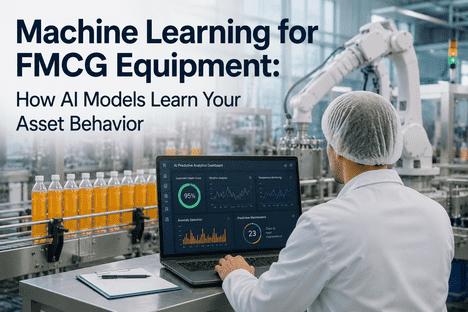
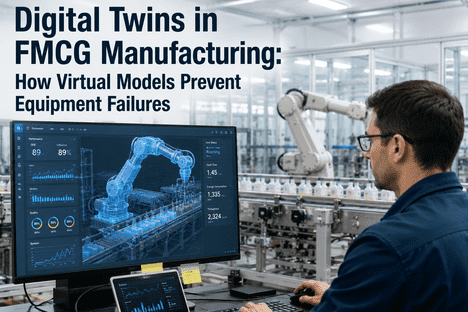
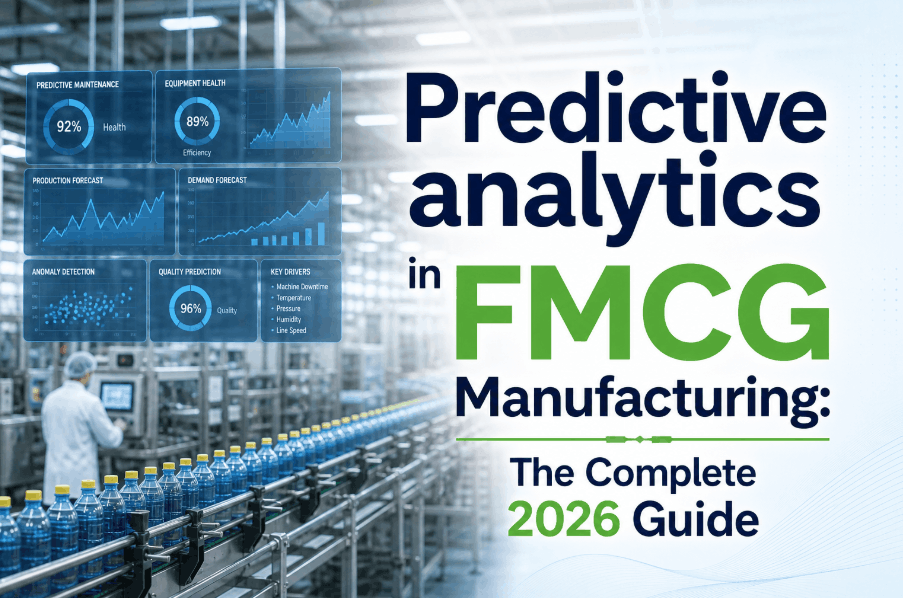
In FMCG manufacturing, every unplanned machine stoppage triggersa chain reaction — halted conveyor belts, delayed packaging runs, spoiled raw ingredients, and frustrated retail partners waiting on delivery windows. The financial damage is staggering: industry analysts consistently estimate that unplanned downtime costs FMCG producers between $10,000 and $50,000 per hour, with larger multi-line facilities crossing the six-figure mark before a maintenance crew even arrives on the floor. What's changed dramatically over the last five years is not the machines themselves — it's how artificial intelligence has transformed the way manufacturers detect, predict, and respond to equipment failure before it happens.
How AI Reduces Equipment Downtime in FMCG Manufacturing
Real-time monitoring. Predictive alerts. Automated work orders. Here's how modern AI platforms are cutting unplanned downtime by up to 50% — and what that means for your bottom line.
Why FMCG Plants Bleed Money at Breakdown
FMCG manufacturing operates on razor-thin margins and high-volume throughput. A single filling machine, labeling station, or sealing unit going offline doesn't just pause one line — it often cascades through an entire production schedule. Ingredient lots have shelf-life windows. Retail contracts carry on-time delivery penalties. And the maintenance team, often stretched thin across dozens of assets, is left reacting instead of preventing.
Traditional preventive maintenance — servicing every machine on a fixed calendar schedule — is both wasteful and unreliable. Some machines get serviced when they didn't need it, burning labor hours and spare parts unnecessarily. Others fail between scheduled windows because no one noticed the subtle vibration spike, the rising motor temperature, or the micro-drops in throughput that silently signaled impending breakdown weeks earlier. This is exactly the gap that AI-powered platforms like iFactory were designed to close. get support and see how intelligent condition monitoring transforms your maintenance strategy.
The AI Stack Behind Downtime Prevention
Modern AI-driven maintenance platforms don't replace your engineers — they give them a nervous system across every asset on the floor. Here's the four-layer architecture that makes it work.
IoT Sensor Network
Vibration sensors, thermal cameras, current transducers, and pressure gauges stream real-time data from motors, pumps, conveyors, and packaging units. Data is captured continuously — not hourly or daily, but every second.
AI Anomaly Detection
Machine learning models trained on historical failure patterns identify deviations from normal operating baselines. A motor running 8°C hotter than its 90-day average gets flagged — not next week, but right now.
Predictive Failure Scoring
Each asset receives a real-time health score. As patterns converge toward known failure signatures, the platform escalates alerts with estimated time-to-failure windows, giving planners days — not minutes — to act.
Automated Work Orders
When thresholds are crossed, the platform auto-generates work orders, pre-loads the correct repair procedure, identifies the nearest available technician, and checks spare parts inventory — without human initiation.
iFactory's AI monitoring layer is purpose-built for high-throughput FMCG environments. get support today to deploy sensor-to-action intelligence across your production lines, or book a demo and see the live dashboard in action.
Real-World Impact: FMCG Case Snapshots
Across food processing, beverage bottling, personal care, and household goods, AI-driven maintenance has consistently delivered measurable results.
A mid-size bread and baked goods manufacturer deployed IoT vibration sensors on 24 mixing and oven units. AI detected bearing wear patterns on three motors six weeks before projected failure. Scheduled replacements during weekend downtime windows eliminated three unplanned shutdowns in the following quarter.
A regional beverage bottler integrated AI health scoring with their ERP system. Predictive alerts on filling valves and capping machines reduced emergency maintenance callouts by 61%, while overall OEE climbed from 71% to 84% within eight months.
A personal care products plant used AI-generated pre-diagnosis reports — delivered to technicians before they reached the machine — to cut mean time to repair by 68%. Technicians arrived with the right tools, parts, and procedure already loaded on their mobile devices.
Beyond Downtime: What AI Actually Unlocks
Overall Equipment Effectiveness improves not just from fewer breakdowns, but from reduced speed losses and quality defects — both of which AI condition data helps identify proactively.
Plants using predictive AI typically shift 30–40% of their maintenance budget from reactive emergency work to planned, lower-cost interventions. The same budget stretches significantly further. Get started with iFactory to begin that shift today.
In FMCG — especially food and pharma-adjacent products — equipment logs and maintenance records are critical for audits. AI platforms generate timestamped, traceable maintenance histories automatically.
Experienced technicians spend less time on firefighting and more time on complex, value-added work. Newer staff benefit from AI-guided repair procedures that encode institutional knowledge into every work order.
iFactory gives FMCG manufacturers the AI layer their production floors have been missing.
From real-time sensor monitoring to automated work order generation, iFactory's platform is built for high-throughput manufacturing environments. See why FMCG plants trust iFactory to protect their uptime — and their margins.
How FMCG Plants Deploy AI Maintenance in 90 Days
The question most plant managers ask isn't "does this work?" — it's "how fast can we get this running?" Here's the typical deployment arc.
Critical assets are identified by failure impact and frequency. Sensor types and placement points are mapped to each machine. No production disruption required during this phase.
Sensors are installed — typically in under four hours per asset. The AI platform begins ingesting live data and establishing normal operating baselines for each machine profile.
AI models calibrate to your specific production patterns, shift schedules, and seasonal load variations. Alert thresholds are tuned to reduce false positives while maintaining early-warning sensitivity.
The platform integrates with your ERP or CMMS for seamless work order flow. Dashboard training rolls out to maintenance leads. First quantifiable downtime reductions typically appear within this window. Book a demo to map this timeline to your facility.
Reactive vs. Predictive: The Maintenance Comparison
| Dimension | Reactive Maintenance | AI Predictive Maintenance |
|---|---|---|
| Failure Detection | After breakdown occurs | Days to weeks before failure |
| Average Repair Cost | 3–5x higher (emergency rates) | Planned cost, minimal premium |
| Production Impact | Full line stoppage | Scheduled maintenance window |
| Parts Availability | Expedited sourcing required | Ordered in advance at standard cost |
| OEE Effect | Unpredictable, erosive | Steady improvement trajectory |
| Audit Trail | Manual logs, gaps common | Automated, timestamped records |
Frequently Asked Questions
Stop losing $10,000–$50,000 per hour to equipment failures you could have predicted.
iFactory's AI-powered maintenance platform gives FMCG manufacturers real-time equipment intelligence, predictive failure alerts, and automated work order systems — all in one platform built for high-throughput production environments.