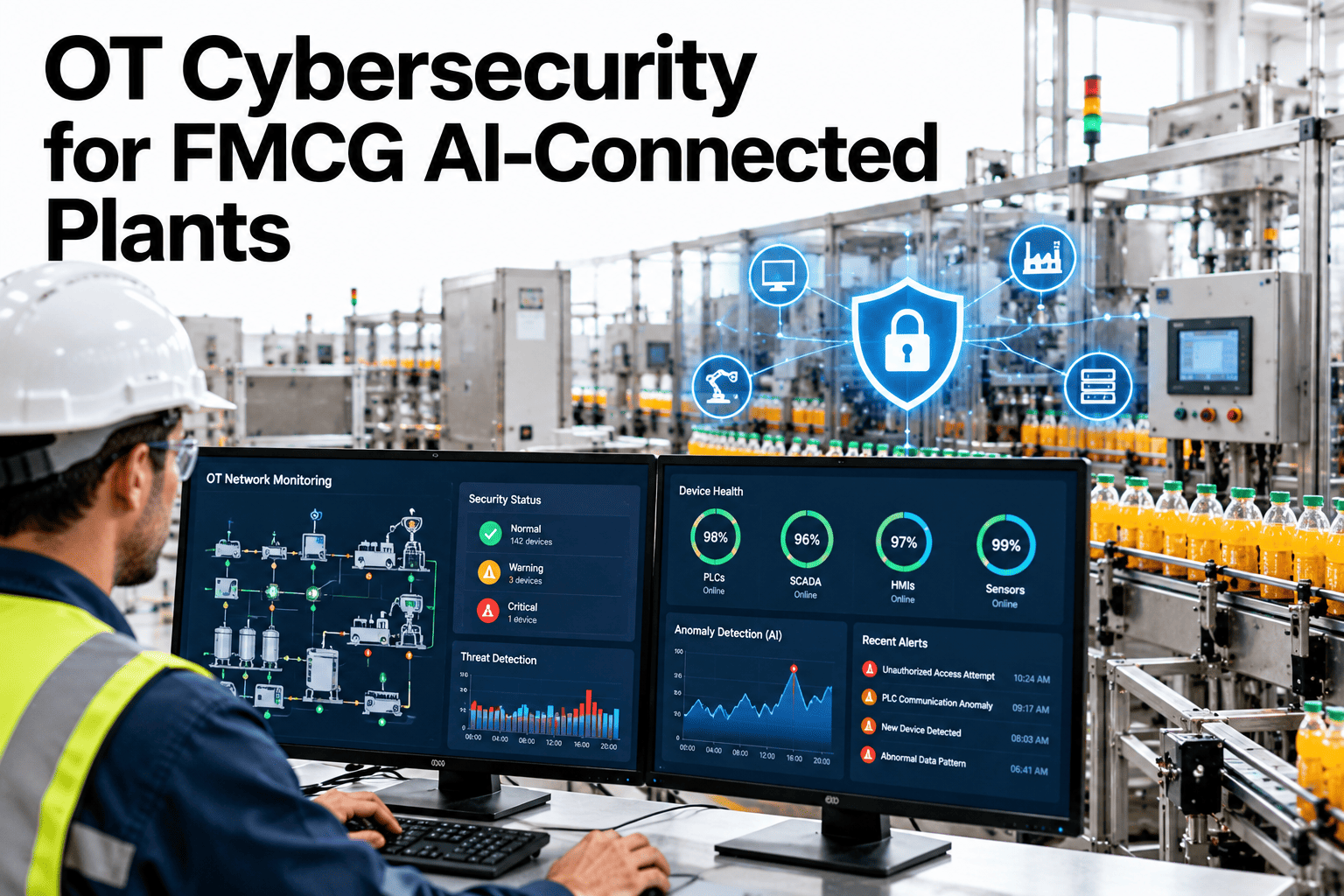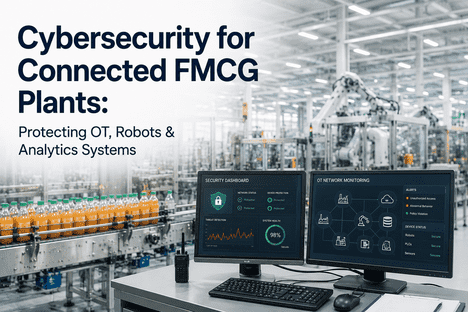
A connected FMCG production facility operating 16 high-speed packaging lines, 8 robotic palletizers, 4 SCADA-controlled utility systems, and over 200 IoT sensors across a 200,000-square-foot plant floor faces a cybersecurity reality that did not exist five years ago. Every connected device from the PLC controlling a flow-wrap machine's sealing temperature to the vision sensor inspecting product labels is a potential entry point for a threat actor who understands industrial control systems. The convergence of operational technology and information technology has eliminated the air-gap that historically protected manufacturing environments, replacing it with a flat network architecture where a compromised IoT temperature sensor on a warehouse wall can become the bridge to a robotic palletizer controller on the production floor. The plant's 2024 cybersecurity audit revealed 47 unpatched vulnerabilities across its OT network, 12 of which were rated critical or high severity. Three of those critical vulnerabilities were on robotic controllers that had not received a firmware update since installation. By deploying iFactory's Security Features and Access Controls platform purpose-built for connected FMCG environments the plant closed 100% of its critical OT vulnerabilities, established role-based access control across all production systems, implemented real-time network anomaly detection for its OT segment, and reduced its mean time to detect a cybersecurity event from 14 days to under 4 hours.
The Expanding Attack Surface in Connected FMCG Production
The convergence of OT and IT in FMCG manufacturing has created an attack surface that is broader, more complex, and less understood than traditional enterprise IT networks. A typical connected FMCG plant in 2026 operates 15 to 20 distinct OT subsystems — packaging line PLCs, robotic work cell controllers, SCADA-controlled HVAC and refrigeration systems, variable frequency drives on conveyors, vision inspection cameras, weigh-scale networks, and environmental monitoring IoT sensors — all connected to a plant-wide network that also serves the IT environment. Each connected device represents a potential ingress point. Each legacy controller running an unpatched embedded OS represents a vulnerability that cannot be remediated by traditional endpoint security tools designed for Windows workstations. The plant that conducted the 2024 cybersecurity audit discovered that its robotic palletizer controllers FANUC R-30iB Plus units running an embedded Linux distribution had 4 known CVEs that were exploitable from the plant network without authentication. The controllers had not been patched because the OEM's recommended update procedure required a 6-hour production interruption per controller, and the plant had no maintenance window large enough to accommodate the full fleet.
Why Traditional IT Security Tools Fail on the Plant Floor
The cybersecurity tools that protect enterprise IT networks — antivirus, endpoint detection and response, patch management agents, and network access control — were not designed for industrial control environments. They assume a standard operating system, predictable network protocols, and the ability to reboot endpoints at will. None of these assumptions hold on an FMCG production floor. A robotic controller running a proprietary real-time OS cannot run an EDR agent. A PLC executing a critical packaging sequence cannot be rebooted for a patch installation during a production run. An industrial protocol like PROFINET IO does not support the encryption and authentication layers that IT security tools expect. The result is a security gap that widens as plants add more connected devices: the OT attack surface grows faster than the IT security tools designed to protect it can adapt. The plant's audit found that its existing IT-grade endpoint protection tool had detected exactly zero OT-specific threats in the previous 18 months — not because there were none, but because the tool could not see the embedded controllers, robots, and IoT devices that made up 73% of the plant's connected endpoints.
Robotic System Cybersecurity: The Highest-Risk, Lowest-Protected Asset Class
Industrial robots represent the most consequential cybersecurity vulnerability in a connected FMCG plant. A compromised robotic controller can be used to alter payload trajectories, disable safety-rated speed limits, modify torque and force limits, or exfiltrate proprietary production recipes — all while appearing to operate normally to an operator watching from a distance. The plant's initial assessment of its 8 robotic palletizers revealed that all 8 controllers were accessible from the plant's IT network, 6 had default or weak passwords on their web-based configuration interfaces, 4 were running firmware versions with known remote code execution vulnerabilities, and none had logging enabled for configuration changes. The robotic cell network was not segmented from the general plant network, meaning a threat actor who compromised a single IoT temperature sensor on the warehouse wall could theoretically reach the palletizer controllers with no additional network barriers.
AI-Driven Threat Detection for OT: Behavioural Analytics That See What Signatures Miss
Signature-based threat detection — the approach used by traditional antivirus and intrusion detection systems — is ineffective against OT-specific attacks because most industrial malware and exploitation techniques do not produce file-based signatures that antivirus engines recognise. An attacker who compromises a robotic controller via a known CVE exploit does not drop a malicious executable. They modify controller parameters, alter ladder logic, or change register values using the controller's own programming interface. These actions are invisible to signature-based tools because they use legitimate controller functions. AI-driven behavioural analytics close this gap by establishing a baseline of normal network traffic, protocol behaviour, and device communication patterns for every OT asset on the plant floor. When a PLC that normally exchanges 200 Modbus packets per hour with its HMI suddenly begins transmitting 2,000 packets to an unrecognised IP address, the AI model detects the deviation and alerts the security team regardless of whether the traffic matches any known malware signature. In the first 90 days of deployment, the plant's AI behavioural detection model identified 14 anomalous events that no signature-based tool had detected — including a maintenance technician's laptop that had been infected with a credential-stealing trojan and was probing the robotic cell network from the IT segment.
iFactory's agentless OT discovery engine identifies every PLC, robot controller, VFD, sensor, gateway, and HMI on the plant network — including devices that were not in any asset register. The discovery process is passive and does not interrupt production. Once identified, each asset is catalogued with its manufacturer, model, firmware version, open ports, and known CVEs. The plant discovered 23 devices during initial discovery that were not in any IT or maintenance asset register — including 4 IoT temperature sensors that had been installed by a production supervisor without notifying IT.
The platform scores every discovered vulnerability by exploitability, asset criticality, and production impact — producing a ranked remediation queue that the plant's IT and maintenance teams can execute in order of risk. Critical vulnerabilities on production-critical assets are flagged for immediate action. Low-severity issues on non-critical sensors are scheduled for the next maintenance window. The plant's initial remediation sprint closed all 12 critical and 18 high-severity vulnerabilities within 30 days by prioritising the 5 robotic controllers and 3 SCADA interfaces that represented the highest combined exploitability and production impact scores.
iFactory's access control module enforces role-based permissions across all connected OT systems — PLC programming interfaces, robot controller configuration panels, SCADA HMI screens, and analytics dashboards. Operators see only their assigned machine HMIs with read-only access to production parameters. Maintenance engineers have read-write access to their authorised controller segments but cannot modify parameters outside their scope. No shared credentials are permitted. All access attempts — successful and failed — are logged with operator ID, timestamp, and the specific action attempted.
When a security event is detected, the platform automatically generates an incident record containing the affected assets, the observed behaviour, the time of detection, and the recommended response action. The incident timeline is logged immutably for audit review. For compliance frameworks like IEC 62443, NIST CSF, and FDA 21 CFR Part 11, the platform generates evidence packs covering asset inventory, vulnerability status, access control configurations, and incident response records — eliminating the manual evidence collection that typically consumes weeks of preparation time before an audit.
Protecting the AI-Driven Analytics Platform Itself
As FMCG plants deploy AI-driven analytics platforms for predictive maintenance, quality inspection, and production optimisation, the security of these platforms themselves becomes a critical concern. An attacker who compromises the analytics platform can manipulate model outputs to hide equipment degradation signals, alter quality inspection results, or exfiltrate proprietary production data — all while the platform continues to report normal operation to the plant's monitoring dashboard. iFactory's security architecture treats the analytics platform as a high-value asset requiring the same access controls, network segmentation, and behavioural monitoring applied to robotic controllers and SCADA systems. The platform runs on an isolated OT-secured segment with strict access controls, encrypted data streams from all connected sensors and controllers, and immutable audit logging for all configuration changes and data access events. The AI models themselves are protected by integrity checks that detect any unauthorised modification to model weights, inference parameters, or training data — ensuring that the analytics outputs the plant's maintenance and quality teams rely on have not been tampered with.
The 2024 OT security audit was the first time our plant had a complete picture of every connected device on the production floor. We discovered 23 devices not in any asset register, 12 critical vulnerabilities on robotic controllers that had been exposed for years, and a maintenance laptop on the IT network actively probing our robotic cell subnet. iFactory's platform gave us the visibility to close all critical vulnerabilities within 30 days and the behavioural monitoring to detect anomalous traffic that no signature-based tool had ever flagged. Our mean time to detect a cybersecurity event went from 14 days to under 4 hours — and we now go into every compliance audit with evidence packs that take 20 minutes to generate instead of 3 weeks to assemble.
Plant IT Security Manager, Tier 1 FMCG Production Facility — 16 Packaging Lines, 8 Robots, 4 SCADA Systems, 200+ IoT SensorsConclusion: From Invisible Vulnerabilities to Continuous OT Security Visibility
The cybersecurity challenge facing connected FMCG plants is not a shortage of security tools. It is a shortage of tools designed for the specific constraints and attack vectors of industrial production environments. IT-grade antivirus and endpoint detection tools cannot see embedded controllers running proprietary real-time operating systems. Traditional vulnerability scanners require credentials and network access that interrupt production. Signature-based intrusion detection misses the behavioural anomalies that are the earliest indicators of an OT compromise. And disconnected access control systems leave robotic controllers and SCADA interfaces accessible from network segments that should never reach them.
iFactory's Security Features and Access Controls platform addresses each of these gaps with an architecture purpose-built for connected FMCG production. Agentless OT discovery identifies every device on the plant network without installing software on any endpoint. AI-driven behavioural analytics detect anomalous traffic and device behaviour that signature-based tools miss entirely. Role-based access controls enforce least-privilege access across every production system — from robot controllers to SCADA HMIs to the analytics platform itself. And automated compliance evidence packs turn what was a three-week manual assembly exercise into a 20-minute report generation task. The result is a plant that not only knows its OT security posture but can prove it — to auditors, to insurers, and to the production and IT leadership who need to make informed risk decisions about every connected system on the plant floor.
iFactory's industrial security platform is purpose-built for connected FMCG production environments — with OT asset discovery, vulnerability prioritisation, robotic controller security, AI-driven threat detection, role-based access controls, and automated compliance documentation that replaces manual evidence collection. Book a Demo to see the platform configured for your plant's OT environment, or talk to an expert about a live walkthrough using your plant's actual network data.