A digital twin of an FMCG production line is not a 3D model of the equipment. It is a live, data-connected simulation that mirrors what the actual line is doing at this moment, at this throughput, with these process parameters and can run what-if scenarios on any variable without interrupting production. For operators and engineers running filling lines, packaging systems, mixing vessels, or conveying networks, the gap between a line running at 78% OEE and one running at 91% is not a mystery. It is a set of configuration decisions and operating parameters that a digital twin can test, validate, and recommend in minutes rather than experimenting with the actual line and losing production time. See a digital twin configured for your line type Book a Demo.
What a Digital Twin Actually Does for FMCG Production Equipment
A digital twin is a virtual representation of a physical production system that is continuously synchronised with its real-world counterpart through live sensor data, PLC signals, and SCADA historian feeds. Unlike a static 3D model or a CAD file, a digital twin behaves the way the actual equipment behaves — responding to parameter changes, simulating throughput under different configurations, and predicting how the line will perform under conditions that have not yet occurred.
For FMCG production, the digital twin's primary value is not visualisation. It is the ability to run what-if scenarios without touching the actual line. Change the filler nozzle diameter in the twin — see the effect on fill weight distribution and line speed. Increase the pasteuriser temperature by 2°C in the twin — see the impact on energy consumption and microbial reduction time. Add a second labeler in the twin — see the bottleneck shift to the next station. All of this happens in simulation, in minutes, with no product wasted and no production time lost. See how simulation-based optimisation works on your line type — Talk to an Expert.
Six FMCG Production Scenarios a Digital Twin Can Simulate Without Touching the Line
Each scenario below represents a common optimisation question that FMCG production teams face. Conventionally, answering these questions requires line trials that consume production time, create waste, and risk unplanned downtime. A digital twin answers all of them in simulation — with results that map directly to the actual line because the twin is calibrated against live production data.
Every FMCG line has a theoretical maximum speed and an actual sustainable speed. The gap is driven by bottleneck interactions that shift as throughput changes — a filler that keeps up at 120 packs/min but becomes the constraint at 135 packs/min. The digital twin simulates the entire line at incremental speed steps, identifies the actual constraint at each throughput level, and recommends the optimal sustained speed that maximises OEE without exceeding any station's capability.
Changeover time on FMCG lines is rarely optimised per SKU — most changeovers follow a fixed sequence regardless of which product is next. The digital twin simulates the changeover process for each specific SKU transition, testing parallel activities, tool pre-staging, and parameter pre-load sequences to identify the shortest possible changeover for each pair of products. Results translate directly to reduced downtime between runs.
Buffer conveyors between FMCG production stations absorb short-duration stoppages — but only if the buffer length, speed, and accumulation settings are matched to the upstream and downstream machine characteristics. The digital twin simulates buffer behaviour under real production variation patterns, identifying where a 2-metre extension or a 15% speed increase on a specific buffer would eliminate 60% of line-stops caused by momentary downstream interruptions.
Fill weight variation and weigher give-away are direct profit drivers on every FMCG filling line. The digital twin simulates how changes in filler nozzle diameter, fill speed profile, and target weight offset affect the final weight distribution — allowing engineers to find the configuration that minimises give-away without increasing underweight risk. A 0.5% reduction in give-away on a high-speed filling line can save hundreds of thousands annually.
Pasteurisers, cookers, and sterilisation tunnels are among the highest-energy consumers in FMCG plants. The digital twin simulates how changes in temperature profile, belt speed, and product loading density affect both microbial reduction efficacy and energy consumption per unit. Engineers can find the temperature-time combination that meets food safety requirements at the lowest energy cost — validated in simulation before any setpoint is changed on the actual equipment.
When a new SKU or packaging format is introduced, the existing line configuration may not be optimal. The digital twin simulates the new product running on the current line — identifying where bottlenecks will move, whether buffer capacity is sufficient, and which changeover sequences need modification. This eliminates the trial-and-error period that typically follows a new product launch, reducing ramp-up time from weeks to days.
The Digital Twin Dashboard: What Engineers and Operators See
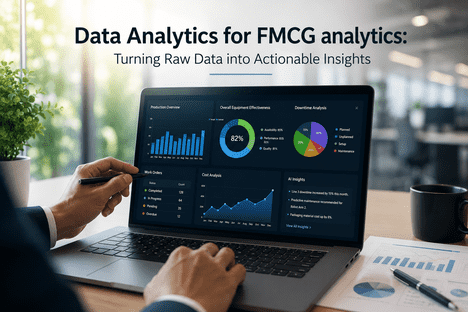
The iFactory digital twin dashboard is designed for the people who make decisions about line configuration and production scheduling — not simulation specialists. Every element on the dashboard answers the question a line engineer needs answered: what is happening on the actual line right now, what would happen if I changed a parameter, and which change will deliver the best result.
The digital twin runs synchronised with the actual line in real time — every PLC tag value, every machine state, every throughput reading is reflected in the twin within sub-second latency. Operators see the twin behaving exactly as the line is behaving, building confidence in the simulation's accuracy.
Any process parameter visible in the dashboard can be adjusted in the twin — line speed, filler pressure, pasteuriser temperature, buffer accumulation settings. The twin recalculates the line performance instantly and shows the projected OEE, throughput, and quality impact without touching the actual line.
The twin continuously identifies which station is the current bottleneck and — critically — which station will become the bottleneck if the current constraint is resolved. This prevents the common trap of fixing one bottleneck only to discover the next one immediately halts any gain.
Multiple what-if scenarios can be run and saved simultaneously, with their projected outcomes displayed side by side. Engineers compare the OEE, throughput, energy consumption, and waste impact of each scenario before selecting the one to implement on the actual line.
When the actual line begins to deviate from the digital twin's expected behaviour — indicating an equipment wear issue, calibration drift, or configuration change — the dashboard alerts the team with the specific parameter that is diverging and the estimated impact on line performance if left uncorrected.
The twin simulates changeover sequences for any product pair, showing the projected downtime for each sequence option and recommending the optimal parallel-activity plan. The simulation runs in seconds — compared to running the actual changeover and measuring the result.
What iFactory Delivers with Digital Twin for FMCG Production
From food and beverage manufacturing deployments. Individual results depend on line configuration and baseline performance. iFactory does not guarantee specific figures — outcomes are documented ranges from deployed installations.
Documented range across FMCG deployments from simulation-driven optimisation of line configuration and parameter settings.
What-if scenarios replace physical line trials — saving production time, reducing waste, and eliminating changeover risk.
All simulation runs on the digital twin without stopping or modifying the actual production line.
PLC connection to live digital twin. Pre-configured AI server. No line modification required.
How the Digital Twin Connects to Your Existing FMCG Line Infrastructure
iFactory does not require new sensors or control system replacement. The digital twin is built from PLC tags and SCADA historian data your line is already collecting — filler encoder signals, conveyor drive currents, pasteuriser zone temperatures, packaging machine servo positions. The pre-configured AI server processes this data on-site at 24x7 without cloud dependency.