At 3:17 PM on a Thursday, the packaging line at a mid-size FMCG plant running 600 cans per minute experiences a filler valve drift that pushes fill weight 3 grams below spec. The cloud-based analytics platform detects the anomaly — 400 milliseconds after the first defective can passes the checkweigher, once the data has travelled from the PLC to the edge gateway, across the WAN, through the cloud inference pipeline, and back with an alert. In those 400 milliseconds, the line has produced 4 more underweight cans. The operator receives the notification, walks to the HMI, and manually adjusts the filler. Total defective units before correction: 37. Total waste: 111 cans at $0.42 COGS each. That scenario plays out 6 to 12 times per shift across filling, sealing, labelling, and packaging stations — and every one of those defects was preventable with edge-deployed real-time analytics that make decisions at machine speed, not cloud speed.
Stop waiting for the cloud to tell you what your production line already knows. Deploy real-time edge analytics that detect defects, predict failures, and adjust processes at machine speed.
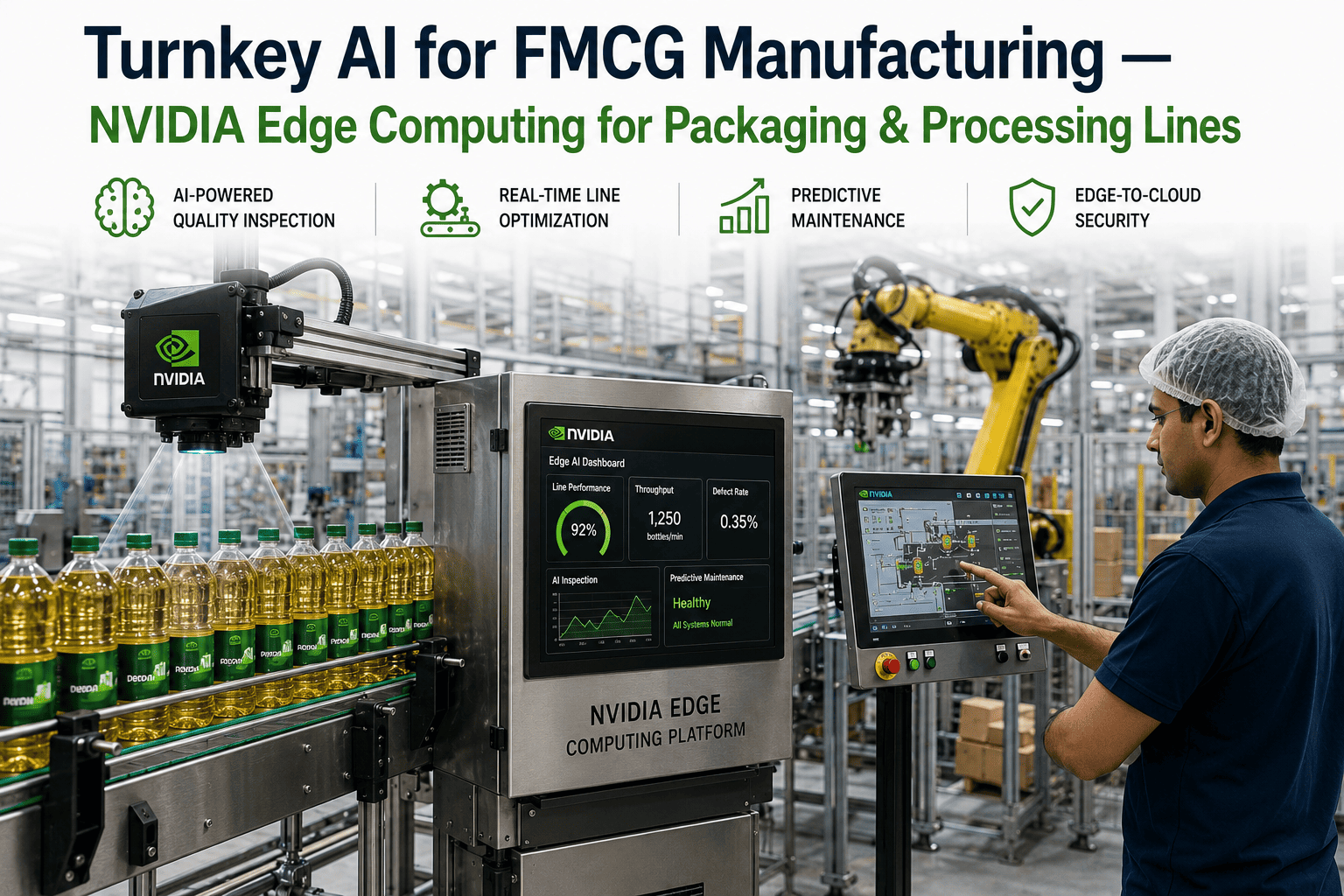
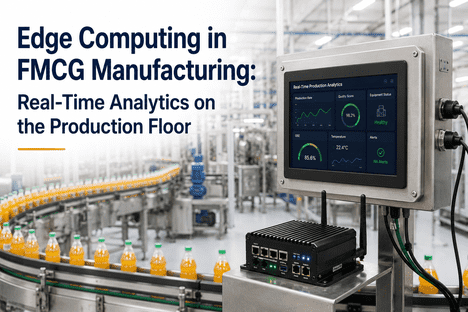
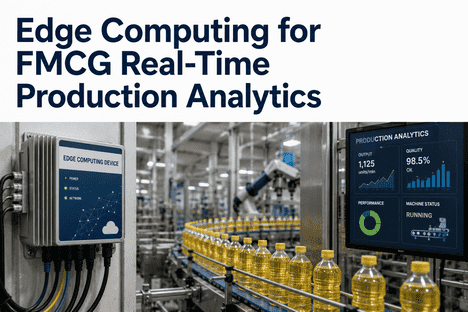
iFactory deploys NVIDIA-powered edge computing on your FMCG production floor — processing sensor data, running AI inference, and triggering corrective actions at sub-50ms latency, fully autonomous during connectivity outages, and continuously learning from every production cycle.
Without iFactory Edge vs. With iFactory Edge
Every second your FMCG production line waits for a cloud round-trip, you are accumulating waste, quality risk, and maintenance delay that edge computing eliminates at the source. Here is what that latency gap costs on both sides of the decision.
Without iFactory Edge
- Cloud inference round-trip adds 200–500ms per decision — at 600 units/min, that is 5–12 defective units before any corrective action
- Predictive maintenance alerts arrive hours after the anomaly signature first appeared — bearing wear, seal degradation, and motor current drift accumulate undetected
- Quality inspection is sampled, not continuous — 1–5% of units checked, leaving 95% of potential defects unseen
- Connectivity outages disable all analytics — remote plants and cold stores run blind during WAN failures
- Proprietary formulation data and process parameters travel to cloud servers — IP exposure that FMCG manufacturers increasingly cannot accept
With iFactory Edge
- Sub-50ms inference at the line — defective units are caught and rejected within the same control loop cycle, before they reach the next station
- Predictive maintenance models run on-premise, detecting vibration, temperature, and current anomalies 7–21 days before failure with 85–94% accuracy
- 100% inline inspection at full line speed — AI vision inspects every unit for fill level, seal integrity, label accuracy, and foreign material
- Full analytics autonomy during outages — work orders, dashboards, and real-time data all run locally, syncing to cloud when connectivity resumes
- Every byte of production data stays inside the plant network — recipe data, process parameters, and product images never leave your fence
Every 100ms of latency costs $127K per line per year — here is where it hides
Cloud latency in FMCG production is not a connectivity issue — it is a cost structure issue. The delay between a sensor reading and a corrective action creates waste that accumulates across every shift, every line, every day. iFactory's edge architecture eliminates that latency at the hardware level. Here is what cloud-dependent analytics are costing your plant every year they remain in place.
Fill weight drift — 200ms cloud delay
A filler valve drifting 0.5g below spec at 600 cans/min with 200ms cloud round-trip produces 5 underweight cans before correction. At $0.42 COGS per can, 3 drift events per shift, 2 shifts per day: $37,800 per line per year in product waste alone.
Seal temperature deviation — missed detection window
A heat sealer running 4°F above nominal for 12 minutes before cloud analytics flags the trend generates 7,200 packages with compromised seal integrity. Rework cost at $0.18 per unit: $1,296 per event. Average 3 events per month: $46,656 per year.
Bearing failure — missed predictive window
A conveyor drive bearing that crosses the vibration threshold during a 45-minute cloud connectivity gap goes undetected until the next cloud sync. Failure during the gap causes 4.2 hours of unplanned downtime at $420/hr line rate: $1,764 per event. Cloud-dependent plants average 6 such events per year.
Label misalignment — downstream rejection cost
Cloud-inspected labels miss 3% of misaligned labels due to sampling rate limitations — 18 defective units per minute reach downstream packaging. At $0.55 per unit repack cost, 2 shifts per day: $57,024 per year in rework labour and materials.
Energy waste — delayed anomaly response
A chiller compressor drawing 22% above nominal current for 6 hours before cloud analytics detects the anomaly wastes 158 kWh at $0.12/kWh. Edge AI catches it in under 3 minutes. Annual energy waste from cloud-latent anomaly detection across HVAC, compressed air, and refrigeration: $28K–$45K per plant.
Total annual cost of cloud latency per production line: $197K+ — eliminated entirely with iFactory edge computing. Book a Demo to see your line-specific savings.
From sensor to decision in under 50ms — deployed in 6–10 weeks
iFactory does not ask you to replace your existing infrastructure, rip out your PLCs, or redesign your production network. We deploy NVIDIA Jetson edge nodes at every critical inspection point on your line — connected to your existing sensors, cameras, and control systems — and deliver real-time analytics that run entirely on-premise, fully autonomous, and ready to integrate with your MES, ERP, and maintenance platforms from day one.
Site survey & edge node placement
Our engineers map your production lines, identify critical inspection points — fillers, sealers, labelers, checkweighers, conveyors — and specify the Jetson module size (AGX, NX, or Nano) and IP69K washdown enclosure for each deployment zone.
Edge node installation & OT integration
We mount and cable each edge node during a scheduled line stoppage — typically 4–6 hours per line. Each node connects to your existing sensors via OPC-UA, Modbus, or direct PLC integration. No changes to your control logic.
Model deployment & line calibration
Pre-trained AI models for defect detection, anomaly prediction, and process optimization are deployed to each edge node. Models are calibrated against your specific SKUs, defect classes, and process parameters during a supervised shadow-mode run.
Closed-loop analytics & continuous improvement
Edge nodes run inference autonomously — triggering reject mechanisms, generating work orders, and adjusting process setpoints in under 50ms. Models improve continuously through on-premise retraining, with OTA updates deployed via staged canary rollout.
Six production use cases — one edge architecture to run them all
iFactory's edge computing platform is purpose-built for the six most impactful real-time analytics use cases in FMCG production. Each use case runs on the same edge hardware, shares the same data pipeline, and integrates with the same plant systems — giving you a unified edge analytics layer across your entire production floor.
Real-time vision QC at 600+ units/min
Edge-deployed computer vision models inspect 100% of product at line speed — detecting fill level deviation, seal defects, label misalignment, and foreign material in under 50ms per frame. Defective units are rejected locally before they reach the next station. No cloud round-trip required.
AI-driven failure prediction at the edge
Vibration, temperature, and current draw analyzed by on-device ML models in real time — detecting bearing wear, motor degradation, and seal deterioration 7–21 days before failure. Work orders are triggered locally from the edge node, not after cloud processing.
Autonomous process adjustment
Edge AI models detect process drift — fill weight trending below spec, sealing temperature rising above nominal — and send corrective setpoint adjustments back to the PLC without operator intervention. Maintains product quality within specification during the window before maintenance intervention.
Real-time energy anomaly detection
Current and power draw monitored at asset level — edge AI identifies motors drawing above-nominal current indicative of mechanical resistance, bearing wear, or misalignment. Energy anomaly triggers a predictive maintenance work order at the earliest possible indicator, cutting energy costs 12–22%.
Line-level pattern detection
The line-level edge gateway correlates data from all assets simultaneously — identifying fault patterns that only appear across multiple machines. Upstream pump cavitation causing downstream filler pressure variation. Cloud analytics cannot achieve this correlation at the required speed or data volume.
Full autonomy during connectivity outages
Remote plants, cold stores, and facilities with unreliable WAN connectivity run the full analytics, work order, and maintenance stack on the local edge server. Technicians raise work orders, access job plans, and close maintenance records without internet — all synced to cloud when connectivity restores.
Your FMCG production line is already generating the data you need to eliminate waste, predict failures, and optimize processes in real time. The only thing standing between that data and a decision is latency — and iFactory edge computing eliminates it. Book a Demo to see your line running on edge analytics.
Turnkey edge computing — from line survey to live analytics in 6–10 weeks
You provide access to your production lines and existing sensor infrastructure. iFactory delivers a fully operational edge analytics deployment — hardware, software, AI models, deployment engineering, and operator training — in a single fixed-price package. No recurring license fees. No cloud dependency. No data leaving your plant.
NVIDIA Jetson edge nodes per inspection point
Each critical point on your line gets a purpose-sized Jetson module (AGX, NX, or Nano) in an IP69K washdown-rated enclosure — running inference at sub-50ms, fully autonomous, zero cloud dependency for real-time decisions.
Pre-trained AI models for FMCG production
Models for vision QC, predictive maintenance, process control, and energy optimization arrive pre-trained on FMCG manufacturing failure signatures and defect classes — calibrated to your specific SKUs and process parameters during a supervised shadow-mode run.
Full OT/IT integration
Each edge node connects to your existing PLCs, sensors, and vision systems via OPC-UA, Modbus, or direct hardware integration. Reject mechanisms, work order generation, and process adjustments are triggered locally — no MES or ERP integration delay.
Staged OTA model updates
Model improvements are deployed through a signed, staged, canary-first OTA pipeline. New models run in shadow mode on one node before rolling to 25%, then 100% of the fleet. Rollback takes under 15 seconds — no line stop, no truck roll.
Unified plant-level dashboard
All edge nodes report to a plant-level dashboard showing real-time quality metrics, asset health scores, energy consumption, and maintenance triggers — accessible from the plant floor, control room, or operations center without cloud dependency.
24×7 remote monitoring & support
iFactory's operations team monitors your edge fleet continuously — model drift detection, hardware health alerts, and performance benchmarks. You get weekly analytics reports and immediate escalation when a model retraining threshold is reached.
What FMCG plant managers ask about edge computing deployment
Your production line's next defect, failure, and waste event is already visible in its data — at sub-50ms latency with iFactory edge computing.
Book a 30-minute walkthrough. iFactory engineers will connect to your FMCG production line data — live or historical — and show you exactly what edge analytics can detect that your current cloud-dependent system is missing. No sales pitch. Just a technical demo with your data, running on our edge hardware.