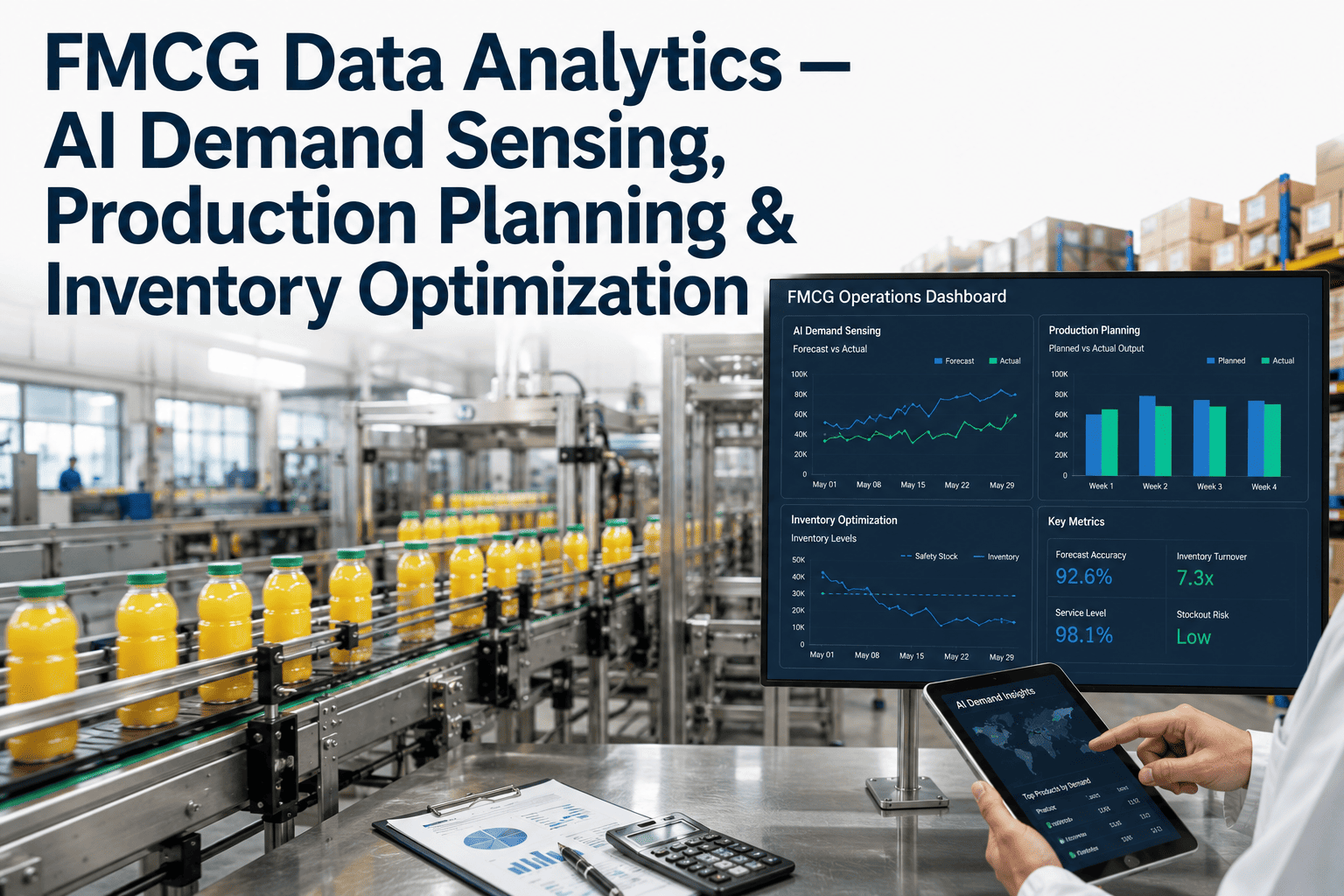
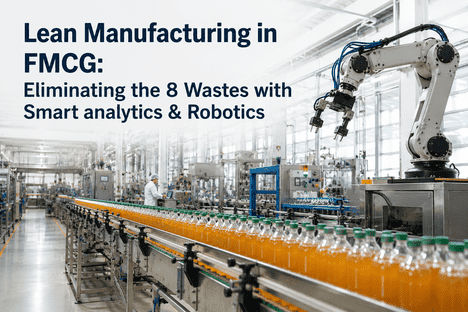
FMCG manufacturing lines operate on razor-thin margins and relentless production schedules. A filling line running at 600 bottles per minute cannot stop for a PM window that was scheduled on a fixed calendar three months ago not when the production plan changed last week and the line is needed for a high-volume SKU launch. The tension between maintenance requirements and production demands is the defining operational challenge of FMCG manufacturing. Just-in-time (JIT) analytics resolves this tension by aligning every repair activity with actual production schedules executing maintenance precisely when it is needed, in the smallest possible window, with zero disruption to throughput. iFactory's AI-driven JIT analytics platform ingests real-time production plans, equipment health data, and resource availability to generate maintenance schedules that fit the production rhythm rather than fighting against it. Book a Demo to see how JIT analytics transforms maintenance in FMCG manufacturing.
Align Maintenance with Production Not the Other Way Around
iFactory's JIT analytics platform connects real-time production schedules with equipment health data and maintenance resources to deliver maintenance exactly when production can afford it not a minute before, not a minute after.
Why FMCG Manufacturing Needs JIT Analytics
FMCG production lines are designed for maximum throughput — filling, capping, labelling, coding, case packing, and palletising run in continuous synchronisation at speeds that leave no room for unscheduled stops. A typical beverage line produces 40,000 to 60,000 bottles per hour. A dairy line fills 200 to 300 yoghurt cups per minute. A snack food line packages 150 to 200 bags per minute. When maintenance interrupts these lines at the wrong time, the cost is measured in thousands of dollars of lost production per hour — plus the ripple effect of delayed downstream orders, missed customer delivery slots, and accelerated depreciation from stop-start operation. Fixed calendar-based PM programs cannot adapt to the dynamic production environment of modern FMCG plants. JIT analytics solves this by making maintenance execution a function of production reality rather than a calendar abstraction. Book a Demo to see how iFactory's JIT analytics engine aligns maintenance with your production rhythm.
The Four Principles of JIT Analytics in FMCG
JIT analytics for FMCG manufacturing rests on four foundational principles that distinguish it from traditional calendar-based or run-time-based maintenance approaches. Each principle addresses a specific structural limitation of conventional maintenance scheduling in the FMCG production environment.
Production-Led Scheduling
Maintenance activities are scheduled based on the production plan, not a calendar. If the production schedule changes, the maintenance schedule changes with it — automatically. The JIT analytics engine ingests the production plan from the MES or ERP system and identifies the optimal maintenance windows within the production rhythm, considering changeover gaps, shift patterns, and seasonal demand variations.
Condition-Based Triggering
Maintenance is triggered by equipment condition — not a fixed interval. The analytics engine continuously monitors equipment health through vibration, temperature, current draw, and cycle count data. When a component shows early-stage degradation, the engine calculates the remaining useful life and schedules the repair within the nearest production window that falls before the predicted failure point.
Resource-Loaded Execution
Every JIT maintenance activity is pre-loaded with the required resources — spare parts, technician skills, tools, and documentation — before the window opens. The engine checks parts availability, technician schedules, and tool calibration status when proposing a window, ensuring that when the production gap arrives, the maintenance team can execute without delay.
Continuous Feedback Loop
Every maintenance event feeds back into the analytics engine — actual repair time, parts consumed, condition of replaced components, and post-repair equipment performance. This data continuously refines the JIT models, improving the accuracy of remaining-useful-life predictions and window duration estimates with each completed maintenance cycle.
Calendar-Based PM vs JIT Analytics — The FMCG Difference
The table below compares the operational impact of traditional calendar-based PM programs against iFactory's JIT analytics approach across the dimensions that matter most in FMCG manufacturing — production alignment, resource utilisation, and cost effectiveness.
| Parameter | Calendar-Based PM | JIT Analytics |
|---|---|---|
| Scheduling driver | Fixed date interval (30/60/90 days) | Production plan + equipment condition + resource availability |
| Production alignment | Static — ignores production schedule changes | Dynamic — adjusts automatically with production plan updates |
| Window identification | Pre-assigned on calendar, often conflicts with production | AI-optimised within actual production gaps and changeovers |
| Resource readiness | Parts/techs checked at window start — delays common | Resources pre-loaded when window is proposed — zero-delay execution |
| Compliance rate | 50–70% in high-variability FMCG environments | 85–95% — windows fit production reality |
| Unplanned downtime impact | High — calendar PM misses developing faults between intervals | Low — condition-based triggers catch faults before failure |
See how JIT analytics transforms maintenance in your FMCG plant — Book a Demo to review your production schedules and maintenance data with iFactory specialists.
How to Implement JIT Analytics in FMCG Manufacturing
Implementing JIT analytics follows a structured five-phase methodology that delivers incremental value at each stage while building toward plant-wide production-aligned maintenance execution.
Production Schedule Integration
Connect iFactory's JIT analytics engine to the plant's MES or ERP system to ingest real-time production schedules. The engine captures planned production runs, changeover windows, shift patterns, maintenance shutdown calendars, and seasonal demand variations. This integration establishes the production-rhythm baseline that all maintenance scheduling will reference.
Equipment Health Baseline and Condition Model Setup
Configure equipment health monitoring for priority assets — filling machines, labelers, coders, case packers, and palletisers. Vibration sensors, temperature probes, and current draw monitors are deployed where not already installed. The analytics engine builds baseline health profiles for each asset during normal operation, establishing the condition thresholds that will trigger JIT maintenance requests.
Window Optimisation Algorithm Deployment
Deploy the JIT window optimisation engine that cross-references production schedules, equipment health conditions, and resource availability. The engine generates optimal maintenance windows ranked by production impact — identifying windows during changeovers, lunch breaks, shift handovers, and planned low-production periods that would otherwise go unused.
Resource Loading and Workflow Automation
Configure automated resource loading for each JIT maintenance event — spare parts reservation, technician assignment based on skill requirements, tool and documentation attachment. When the engine proposes a maintenance window, the required resources are automatically reserved in the CMMS, ensuring zero-delay execution when the window arrives.
Continuous Optimisation and Expansion
Monitor JIT analytics performance metrics — window utilisation rate, PM compliance, unplanned downtime trend, and maintenance cost per unit produced. Feed post-maintenance data back into the engine to refine prediction models and window optimisation algorithms. Expand coverage to additional production lines and asset categories.
Measurable ROI What JIT Analytics Delivers in FMCG
The financial case for JIT analytics in FMCG manufacturing is built on three primary value drivers: elimination of production-disrupting maintenance events, extension of equipment life through condition-based intervention, and reduction in maintenance labour and parts costs through precise window execution.
Production Throughput Protection
- Eliminates maintenance events scheduled during peak production hours
- Reduces unplanned downtime from maintenance conflicts by 40–60%
- Maintenance windows utilise genuine production gaps — changeovers, breaks, shift handovers
- Annual throughput preservation of $250,000–600,000 per production line
Maintenance Cost Optimisation
- Condition-based triggering eliminates unnecessary PMs on healthy equipment
- Pre-loaded resources eliminate window-start delays and emergency parts procurement
- Labour efficiency improves by 20–35% as technicians execute planned work in optimised windows
- Annual maintenance cost reduction of $80,000–200,000 per plant
Equipment Reliability Improvement
- Condition-based maintenance catches degradation earlier than calendar-based intervals
- Equipment operates with optimised maintenance timing — not too early, never too late
- Mean time between failure improves by 15–25% for JIT-managed assets
- Equipment life extension of 1–3 years for high-value production assets
Ready to Align Maintenance with Your Production Schedule?
FMCG manufacturers across North America are deploying iFactory's JIT analytics platform to eliminate production-disrupting maintenance events, improve PM compliance, and reduce maintenance costs — all while keeping production lines running at target throughput.
Conventional vs JIT Analytics Maintenance Approaches
The table below illustrates how JIT analytics transforms every dimension of maintenance execution in FMCG manufacturing — from scheduling philosophy to operational outcomes.
- Fixed maintenance intervals regardless of production schedule changes
- PM windows often conflict with high-volume production runs
- Technicians dispatched to work orders without resource pre-loading
- Spare parts checked at window start — stockouts cause delays
- PM compliance typically 50–70% due to production conflicts
- No feedback loop between maintenance execution and scheduling model
- Maintenance windows dynamically aligned with real-time production plans
- Windows identified in genuine production gaps — changeovers, breaks, shift changes
- Technicians, parts, and tools pre-loaded before window opens
- Parts automatically reserved in inventory when window is proposed
- PM compliance 85–95% — windows fit production reality
- Post-maintenance data continuously refines JIT models and predictions
Industry Perspective JIT Analytics in FMCG Manufacturing
"We operated six high-speed filling lines, and our maintenance team was constantly caught between the production planner who needed every line running and the reliability engineer who needed PM windows. The calendar-based PM schedule would assign a 4-hour window for filler valve maintenance every 30 days — but the production schedule changed weekly based on retailer orders. About 40% of those PM windows ended up being rescheduled or skipped entirely because the line was needed. Then a filler valve would fail at 2 AM on a Saturday during a high-volume run, and we would lose 6 hours of production while the maintenance team sourced parts and executed the repair that should have been done during a planned window. After implementing iFactory's JIT analytics, the engine started looking at the production schedule and finding windows we had never considered — the 45-minute changeover between SKU runs, the 30-minute meal break overlap, the shift handover period. It proposed filler valve maintenance during a 3-hour window between two major production runs that we had not identified as available. The work order was pre-loaded with the valve kit, the technician was assigned, and the work was completed without a single minute of lost production. That one event paid for the entire first year of the platform."
The Future of FMCG Maintenance Is Just-in-Time and AI-Driven
FMCG manufacturing cannot afford the structural inefficiency of calendar-based maintenance in a production environment defined by dynamic schedules, high-speed lines, and razor-thin margins. Every maintenance event scheduled without reference to the production plan is a potential disruption. Every PM skipped because the line was running is a reliability risk. Every hour of unplanned downtime from a maintenance-caused failure is a cost that could have been avoided.
JIT analytics resolves these structural tensions by making maintenance execution a function of production reality — scheduling work when production can afford it, triggering intervention based on equipment condition rather than a date, and pre-loading every resource so that maintenance windows are executed without delay. Book a Demo to start your JIT analytics journey with iFactory.
JIT Analytics for FMCG Manufacturing Frequently Asked Questions
JIT analytics classifies all maintenance requests by urgency and production impact. Emergency maintenance — a safety issue, a major spill, or a complete line stoppage — is executed immediately regardless of the production schedule, just as it would be under any maintenance program. The JIT analytics engine's value is in reducing the frequency of these emergency events by scheduling preventive and predictive maintenance in production windows before conditions escalate to emergency level. The engine also maintains a dynamic prioritisation queue that recalculates maintenance urgency based on real-time equipment health data — if a bearing vibration reading crosses the critical threshold during a production run, the engine escalates the priority and alerts the maintenance manager to make a real-time decision about intervention timing.
The JIT analytics engine continuously monitors the production schedule for changes. When a schedule change occurs — a new customer order, a line reassignment, or a raw material delay — the engine automatically recalculates all affected maintenance windows within seconds. If the original window is no longer available, the engine proposes the next best window based on the updated production plan, equipment health urgency, and resource availability. The maintenance manager and production planner receive automatic notifications of the window change, the reason for the change, and the proposed alternative. In practice, schedule changes cause less disruption under JIT analytics than under calendar-based PM because the engine identifies replacement windows instantly rather than requiring manual rescheduling.
JIT analytics works with any available data. For assets with IoT sensors — vibration, temperature, current draw — the engine runs full condition-based triggering models that predict remaining useful life and optimise intervention timing. For assets without sensors, the engine uses run-time hours, cycle counts, work order history, and age-based degradation curves to estimate health status and recommend JIT windows. The system clearly tags each asset's data confidence level, enabling maintenance managers to make informed decisions. Assets can be upgraded to sensor-based monitoring incrementally, with the engine automatically incorporating new telemetry streams as they become available. Most FMCG plants start with sensor coverage on their highest-criticality assets — fillers, labelers, and case packers — and expand coverage over time based on ROI.
A single-production-line deployment typically requires 8–12 weeks from kickoff to first JIT-optimised maintenance window execution, including production schedule integration, equipment health baseline setup, and window optimisation engine configuration. Multi-line and plant-wide deployments scale with reduced per-line timelines as integration patterns are replicated. The investment ranges from $35,000 to $75,000 per production line depending on sensor infrastructure requirements, MES/ERP integration complexity, and the number of asset categories covered. Most plants achieve full cost recovery within 6–12 months through a combination of reduced unplanned downtime, elimination of unnecessary PMs, and improved maintenance labour productivity.
iFactory's JIT analytics platform integrates with all major MES, ERP, and CMMS systems through standard REST API, OData, and database connectors. The production schedule is ingested from the MES or ERP system, equipment health data from IoT sensors and the CMMS, and resource availability from the CMMS and HR scheduling system. JIT-optimised maintenance windows are written back to the CMMS as work orders with pre-loaded resources, and post-maintenance data flows back to refine the analytics models. The platform also supports OPC-UA and MQTT gateways for direct integration with production line PLCs and SCADA systems, enabling real-time production status monitoring that feeds the window optimisation engine.
Align Maintenance with Production Not the Other Way Around
iFactory's JIT analytics platform connects real-time production schedules with equipment health data and maintenance resources to deliver maintenance exactly when production can afford it not a minute before, not a minute after. Trusted by FMCG manufacturers across North America for production-aligned maintenance, reduced downtime, and improved equipment reliability.