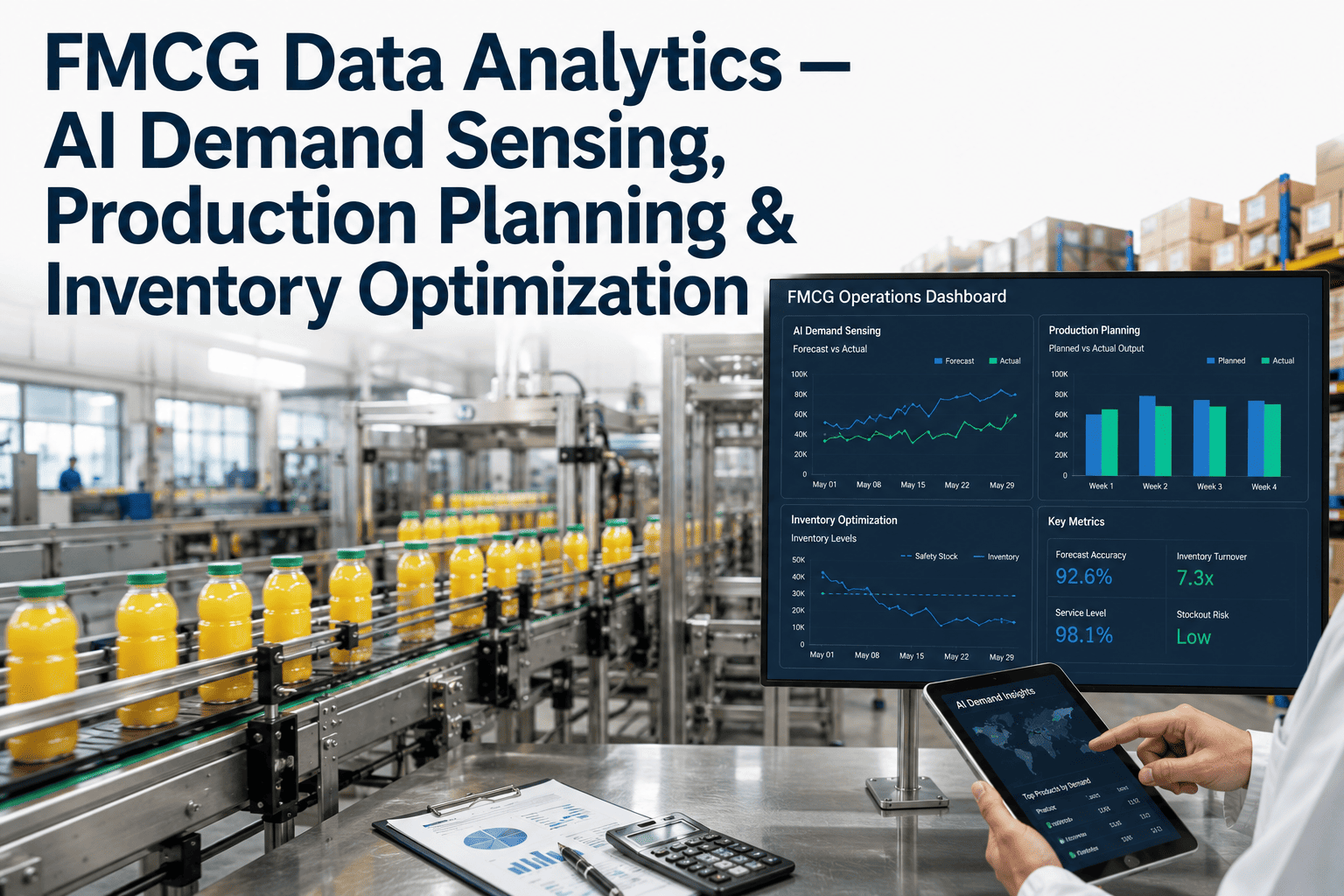
FMCG Data Analytics — AI Demand Sensing, Production Planning & Inventory Optimization
By James Smith on August 25, 2026
A production plan built on a monthly sales forecast is already out of date by the time the second week starts, because consumer demand for fast-moving goods does not move in monthly increments. A single retailer promotion, a heatwave, or a competitor stockout can shift real demand for a SKU within days, while the plant keeps running the schedule that was locked weeks earlier. The result is a familiar pattern: overproduction of slow-moving SKUs sitting in a warehouse and stockouts on the SKUs actually selling. Closing that gap means replacing a static monthly forecast with demand sensing that updates as often as the market does, and that shift is at the center of how ifactory support works with FMCG planning teams.
iFactory Demand Sensing & Analytics
Plan Production Against What Demand Is Doing This Week, Not Last Month
AI-driven demand sensing and production planning that update continuously, so capacity gets allocated to the SKUs actually moving instead of the SKUs a forecast assumed would move.
Why Traditional Forecasting Keeps Missing FMCG Demand
Classic statistical forecasting works reasonably well for products with stable, predictable demand and long planning cycles. FMCG demand rarely behaves that way. Promotions, seasonality, weather, and shifting consumer preference all move faster than a monthly forecast cycle can absorb, and by the time a forecast miss shows up in a sales report, the production window to correct for it has usually already closed. The plants that handle this well are not the ones with the most sophisticated forecasting model, they are the ones that shortened the gap between a demand signal appearing and the production plan reacting to it.
Forecast Accuracy: Monthly Cycle vs Continuous Sensing
Continuous AI sensing
Static monthly forecast
What Demand Sensing Actually Watches
Demand sensing is not one bigger forecast, it is a continuous read of multiple signals that individually would be noise, but together reveal a shift in real demand earlier than a sales report would. The value is in combining these signals automatically rather than asking a planner to manually watch five dashboards at once.
Point-of-Sale Velocity
Real sell-through data from retail partners, read daily instead of waiting for a monthly replenishment cycle to reflect it.
Promotional Calendars
Upcoming retailer promotions mapped against historical uplift patterns for the specific SKU and region involved.
Inventory Position
Current stock levels across distribution centers, so production is planned against real coverage rather than an assumed buffer.
External Factors
Weather patterns and regional events that historically correlate with demand shifts for specific product categories.
See Your Own Forecast Gap
Bring a SKU You Consistently Over- or Under-Produce
We will walk through how continuous demand sensing would have changed the production plan for that SKU over the past few months.
A demand signal is only useful if it actually reaches the production schedule fast enough to matter. The workflow below is how a detected shift moves from raw signal to an adjusted plan on the floor.
How a Demand Shift Becomes a Schedule Change
1
Signals Are Continuously Ingested
Point-of-sale, inventory, and promotional data feed into the model daily rather than at a fixed monthly checkpoint.
2
A Deviation Is Detected
The model flags when actual demand for a SKU is tracking meaningfully above or below the current production plan.
3
Capacity Impact Is Calculated
The system checks what adjusting production for that SKU would mean for other SKUs sharing the same line and changeover capacity.
4
A Revised Plan Is Proposed
Planners review a recommended schedule adjustment rather than starting from a blank sheet every time demand shifts.
5
The Floor Receives the Update
Once approved, the revised plan reaches MES and the floor without the delay of manual re-entry between systems.
How is demand sensing different from the forecasting module already in our ERP?
Most ERP forecasting modules run on a fixed cycle, typically monthly, and rely primarily on historical shipment data. Demand sensing layers in near real-time signals like point-of-sale velocity, current inventory position, and promotional calendars, and updates continuously rather than waiting for the next planning cycle, which is what allows it to catch a demand shift while there is still time to react. Talk to our team about how this would integrate alongside your existing ERP forecast.
Do we need point-of-sale data from every retail partner for this to work?
No, the model improves as more signal sources are added, but it can start delivering value using whatever combination of internal shipment data, inventory position, and available retailer data already exists today. Most FMCG manufacturers do not have complete point-of-sale visibility across every channel, and the sensing model is built to work with partial coverage rather than requiring it. Book a walkthrough to see what your current data sources would support.
How quickly can a detected demand shift actually change the production schedule?
Once a deviation is flagged and a revised plan is approved by planning, the update can reach MES and the floor within the same day in most integrated setups, rather than waiting for the next scheduled planning meeting. The speed of that last step depends heavily on how well MES and ERP are already connected, which is often addressed as part of the same engagement. Reach out to our team to talk through your current planning-to-floor turnaround.
Will this reduce our safety stock requirements, or just improve accuracy?
Both, in practice, because safety stock exists largely to absorb forecast error, and a tighter, more responsive forecast reduces how much buffer is needed to hit the same service level. Most plants that adopt continuous demand sensing see a gradual reduction in required safety stock over the following months as forecast accuracy improves and the team gains confidence in the model. Book a scoping call to model this against your specific inventory targets.
Can this handle a portfolio with dozens of SKUs and frequent new product launches?
Yes, high SKU counts and frequent launches are common in FMCG and the model is designed for exactly that environment rather than a small, stable product line. New SKUs without much historical data initially rely more heavily on category-level patterns and comparable product performance until enough of their own sales history accumulates to sharpen the forecast. Contact our team to discuss how new launches are handled in your portfolio.
Plan Against Reality.
Replace the Monthly Forecast With Continuous Demand Sensing
Bring your current forecast accuracy and inventory numbers to the call. We will show you where continuous sensing would have changed the plan.