New Equipment Commissioning Checklist for FMCG Plants

By Seren on June 19, 2026

new-equipment-commissioning-checklist-fmcg-plants-url.png_optimized_300

FMCG plant managers and maintenance engineers face persistent pressure to commission new equipment rapidly without compromising installation quality, safety compliance, or long-term reliability. When a leading beverage bottling facility operating eight high-speed filling lines across three production halls needed to onboard six new packaging machines while maintaining 95% OEE, their paper-based commissioning checklists and manual data entry proved inadequate for tracking installation milestones, verifying functional tests, and establishing preventive maintenance baselines. The engineering team deployed iFactory's Asset Lifecycle Management platform combining digital commissioning workflows, automated verification protocols, and integrated PM schedule generation to reduce commissioning cycle time by 40% while achieving 100% documentation completeness across all equipment acceptance stages. Maintenance and engineering leaders exploring digital commissioning solutions regularly Book a Demo to review how structured commissioning checklists and asset lifecycle tracking improve equipment reliability and maintenance readiness in FMCG production environments.

40%
Reduction in commissioning cycle time through digital workflow automation, real-time status tracking, and automated approval routing for new equipment installations
100%
Documentation completeness achieved across pre-installation checks, installation verification, functional testing, and baseline recording for every commissioned asset
85%
Faster preventive maintenance schedule generation by automatically deriving PM tasks, frequencies, and spare parts from equipment commissioning data and OEM recommendations
3x
Improvement in audit readiness for equipment qualification records, with structured digital checklists replacing fragmented paper trails and spreadsheet-based tracking
Asset Lifecycle Management · Equipment Commissioning · FMCG Maintenance
Standardise New Equipment Commissioning with Digital Checklists
Deploy structured commissioning workflows, automated verification protocols, and integrated PM schedule generation to reduce cycle time, eliminate documentation gaps, and ensure long-term equipment reliability from day one.

Five Stages of Equipment Commissioning

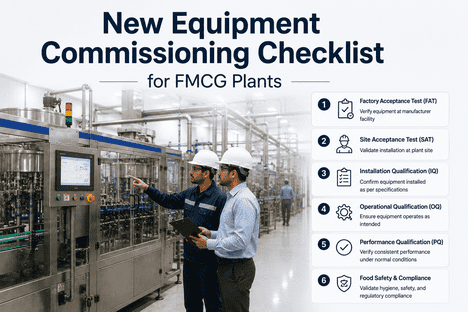
A complete equipment commissioning program for FMCG plants covers five sequential stages, each with specific verification criteria, documentation requirements, and approval gates. Missing or poorly executed stages lead to operational disruptions, safety incidents, and premature equipment failure. Plant managers evaluating digital commissioning platforms Book a Demo to explore how structured stage-gate workflows improve commissioning consistency across multiple equipment types and installation teams.

Pre-Installation & Site Readiness
Verify foundation specifications, utility connections (electrical, compressed air, steam, water), space allocation, and material handling access before equipment arrival. Includes EHS risk assessment, permit-to-work verification, and contractor induction records.
Installation Verification
Document equipment positioning accuracy, leveling and alignment measurements, anchor bolt torque values, electrical termination verification, and piping connection integrity. Includes visual inspection records and sign-off from certified installation technicians.
Functional & Performance Testing
Execute dry run tests, no-load cycle verification, load testing at rated capacity, safety system validation (e-stop, light curtains, interlocks), and HMI/PLC communication checks. Document test results against OEM acceptance criteria with pass-fail disposition.

Commissioning Checklist: Digital vs Traditional Approach

The comparison below highlights the critical differences between paper-based and digital commissioning checklists across the key dimensions that affect equipment reliability, compliance, and maintenance readiness. Review the data and Book a Demo to discuss how iFactory's Asset Lifecycle Management platform can transform your equipment onboarding process.

Criterion Paper-Based Checklist iFactory Digital Commissioning
Checklist Distribution Printed copies; version control issues Real-time digital forms; auto-version updates
Data Entry Handwritten notes; illegible entries Structured fields; photo attachments; barcode scan
Approval Workflow Manual sign-off routing; delays Automated stage-gate approvals; escalation rules
Document Storage Filing cabinets; risk of loss Cloud-based; instant retrieval; audit-ready
PM Schedule Generation Manual data transfer from OEM docs Auto-generated PM tasks from commissioning data
Spare Parts Linkage Separate spreadsheet tracking Integrated parts catalog linked to asset record
Compliance Reporting Manual compilation; 2-3 days per audit One-click reports; real-time compliance status
Commissioning Cycle Baseline: 6-8 weeks average 40% faster: 3-5 weeks average

Step-by-Step Commissioning Workflow

Implementing a structured digital commissioning workflow ensures every new asset meets safety, quality, and reliability standards before entering production. Each step includes specific verification tasks, responsible parties, and documentation requirements.

01
Site Readiness & Pre-Installation Checks
Foundation dimensions and load capacity verified against OEM specifications. Utility connection points (power, compressed air, steam, water, drainage) confirmed with capacity assessments. Material handling access routes and rigging plans reviewed. EHS risk assessment completed with permit-to-work issued. Contractor induction and method statement approval obtained.
02
Equipment Receiving & Physical Installation
Receiving inspection completed with damage assessment and serial number verification. Equipment positioned and leveled with alignment measurements documented. Foundation bolts torqued to specification with calibration certificates attached. Electrical connections verified against wiring diagrams. Piping and ductwork installed with pressure test records.
03
Functional Testing & Performance Validation
Dry run tests completed without product. No-load cycle verification with cycle time measurements. Load testing at rated capacity with performance parameters recorded. Safety system validation including e-stop, light curtains, interlocks, and emergency shutdown. HMI/PLC communication verified with alarm and notification testing. Oil sampling and lubrication system verification.
04
Baseline Recording & Acceptance Sign-Off
Vibration baseline readings at all measurement points. Temperature and pressure baselines under normal operating conditions. Energy consumption baseline (power draw, compressed air usage). Noise level measurements within regulatory limits. Performance parameters documented at rated speed and throughput. Conditional acceptance or final acceptance sign-off with all punch list items resolved.
05
PM Schedule Setup & Asset Lifecycle Integration
Preventive maintenance tasks auto-generated from OEM recommendations and commissioning data. PM frequencies set based on operating hours, calendar intervals, and production cycles. Spare parts linked from commissioning spare parts list to asset record in inventory. Asset hierarchy updated with equipment in iFactory CMMS. Operator training records and SOPs linked to asset. Warranty start date recorded with warranty claim process documented.

How Digital Commissioning Drives Asset Lifecycle Value

Digital commissioning checklists deliver measurable value across the entire asset lifecycle, from installation through decommissioning. The structured data captured during commissioning becomes the foundation for all future maintenance, reliability, and compliance activities. Engineering leaders exploring asset lifecycle management solutions Book a Demo to examine how digital commissioning data integrates with CMMS, condition monitoring, and predictive maintenance systems.

85% Faster
PM schedule generation from commissioning data compared to manual entry from OEM documentation

Digital commissioning captures all OEM-recommended maintenance tasks, lubrication points, inspection intervals, and spare parts requirements at the time of equipment installation. This data flows directly into the iFactory CMMS to auto-generate preventive maintenance schedules, calibration plans, and condition monitoring routes. Maintenance teams receive complete equipment maintenance plans on day one of production rather than spending weeks manually transcribing OEM manuals into their maintenance system. The result is immediate maintenance readiness and elimination of the gap between commissioning and first planned maintenance that often leads to early-life equipment failures.

3x
Audit readiness improvement with structured digital commissioning records versus paper-based documentation

Every commissioning stage generates structured, timestamped records with digital signatures, photo evidence, and measurement data that satisfy ISO 9001, FSSC 22000, and GMP audit requirements. Commissioning records are permanently linked to the asset in the iFactory system, creating a complete equipment qualification trail from factory acceptance through site acceptance testing and operational qualification. Auditors can access commissioning documentation in minutes through the asset record rather than searching filing cabinets. Compliance reports covering equipment qualification status, calibration verification, and maintenance readiness can be generated with a single click for any audit scope or regulatory standard.

Baseline
Vibration, temperature, power, and performance baselines captured during commissioning for trend comparison

Commissioning baseline data — including vibration signatures, thermal images, power draw profiles, throughput rates, and quality parameters — establishes the reference condition for all future condition monitoring and reliability analysis. As the asset ages, maintenance teams compare current measurements against commissioning baselines to detect degradation trends, plan interventions before failure, and extend equipment life. This baseline-to-current comparison is particularly valuable for rotating equipment, conveyor systems, and packaging machines where vibration and temperature trends directly indicate bearing wear, misalignment, or process drift. The iFactory system automatically generates trend charts comparing current readings against commissioning baselines for every condition monitoring point.

What Industry Experts Say

Our paper-based commissioning process was a significant source of operational risk. Checklists were frequently incomplete, approval signatures were missing, and key baseline measurements were not recorded until weeks after equipment startup. When one of our new fillers experienced a bearing failure three months after installation, we had no vibration baseline data to compare against and no documented evidence that proper alignment checks were completed during installation. The iFactory digital commissioning platform transformed our approach. Now every installation follows a structured stage-gate workflow with mandatory photo evidence, digital sign-offs, and automated PM schedule generation. Our average commissioning cycle dropped from seven weeks to four, and we have complete, auditable records for every asset.
Engineering Manager
Multi-National Beverage Bottling Company, Three-Facility Operations

Frequently Asked Questions

A comprehensive FMCG commissioning checklist covers five essential stages: pre-installation site readiness verification, equipment receiving and physical installation verification, functional testing and performance validation, baseline recording and acceptance sign-off, and PM schedule setup with asset lifecycle integration. Each stage includes specific verification tasks, measurement criteria, responsible party assignments, and documentation requirements that must be completed before progressing to the next stage.
Digital commissioning improves reliability by ensuring every installation step is verified against specifications, baseline condition data is recorded for future comparison, and preventive maintenance plans are established before equipment enters production. The structured data captured during commissioning — including vibration baselines, alignment measurements, and performance parameters — provides the reference condition for ongoing condition monitoring and enables early detection of degradation trends before they lead to failure.
Several compliance frameworks require documented equipment commissioning and qualification records, including ISO 9001 for quality management, FSSC 22000 and BRCGS for food safety, GMP for pharmaceutical and food production, IATF 16949 for automotive manufacturing, and OSHA regulations for safety system verification. Digital commissioning platforms like iFactory generate audit-ready records that satisfy documentation requirements across multiple standards simultaneously.
FMCG plants deploying digital commissioning platforms typically achieve ROI within 6 to 10 months, driven by reduced commissioning cycle time, elimination of rework from incorrect installations, decreased early-life equipment failures, reduced audit preparation time, and streamlined PM schedule generation. The beverage bottling facility in this case study recovered their investment within 8 months through commissioning cycle time reduction and improved maintenance readiness alone.
Yes. The iFactory digital commissioning platform allows checklists to be configured for each equipment category — filling machines, conveyors, packaging equipment, labelers, palletizers, CIP systems, and all other FMCG production assets. Each checklist template includes stage-specific tasks, measurement fields, acceptance criteria, and documentation requirements tailored to the equipment type while maintaining the standard five-stage commissioning workflow structure.
Ready to Standardise New Equipment Commissioning?
iFactory's Asset Lifecycle Management platform combines digital commissioning workflows, automated verification protocols, and integrated PM schedule generation to help FMCG plants reduce commissioning cycle time, eliminate documentation gaps, and ensure equipment reliability from day one.
Digital Checklists
Stage-Gate Workflows
Baseline Recording
PM Auto-Generation
Audit Trail

Share This Story, Choose Your Platform!