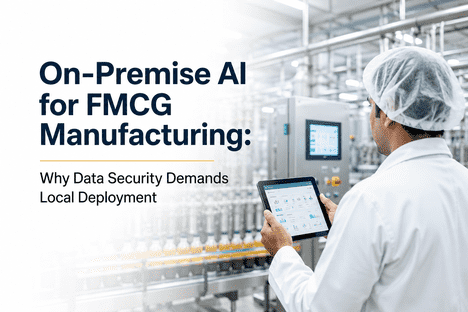
When a global beverage manufacturer's proprietary fermentation algorithm walks out the door inside a cloud breach, it doesn't just cost money — it costs decades of competitive advantage. That single reality is why 62% of FMCG executives, when surveyed in 2025, said on-premise AI deployment was either their current strategy or their top planned investment for 2026. The FMCG sector holds some of the most commercially sensitive data in manufacturing: secret formulations, precise blending ratios, quality thresholds, and process parameters that define a brand's identity. Sending that data to a shared cloud environment is a risk a growing number of manufacturers are no longer willing to accept.
On-Premise AI for Secure FMCG Manufacturing Operations
A complete guide to deploying AI where your most sensitive production data belongs — inside your own walls, under your own control, with zero external exposure.
The Data FMCG Manufacturers Cannot Afford to Expose
Before examining the technology, it's worth being precise about what on-premise AI is protecting. FMCG manufacturers hold multiple categories of data that carry extraordinary competitive and regulatory sensitivity.
Proprietary Formulations
Exact ingredient ratios, sourcing specifications, and additive sequences that define product identity. For food and beverage companies, these are the crown jewels — often protected by trade secret law rather than patent to avoid public disclosure.
Process Parameters
Temperature curves, pressure profiles, mixing durations, and line speeds optimized over years of production. Competitors with access to this data could replicate product characteristics without the R&D investment.
Quality Algorithms
AI models trained to detect defects, classify grades, and predict shelf life are themselves valuable IP. These models encode institutional knowledge built through millions of inspection cycles — knowledge that cannot easily be rebuilt.
Production Capacity Data
Real-time output volumes, shift utilization rates, and throughput metrics reveal strategic capacity that competitors and market actors could exploit for pricing, supply chain, or negotiation purposes.
Supplier and Sourcing Intelligence
Supplier identities, negotiated pricing, lead times, and quality acceptance rates represent hard-won commercial relationships. Exposure through a shared cloud environment creates serious procurement vulnerability.
Regulatory Compliance Records
Batch traceability data, HACCP logs, and audit trails carry regulatory retention requirements. Storing these in environments outside direct organizational control introduces compliance risk under GDPR, FDA 21 CFR Part 11, and similar frameworks.
Why Cloud-First AI Creates Structural Risk for FMCG
Cloud AI platforms offer genuine capabilities, but their architecture creates exposure points that are difficult to fully mitigate in FMCG environments.
Multi-Tenant Infrastructure
Major cloud providers serve thousands of customers on shared infrastructure. Even with logical isolation, vulnerabilities in hypervisors, container runtimes, and shared storage layers create theoretical — and occasionally real — cross-tenant exposure paths that on-premise deployments eliminate entirely.
Data Residency Uncertainty
Cloud providers replicate data across geographic regions for redundancy. FMCG manufacturers operating under EU data protection law, sector-specific regulations, or contractual data residency commitments may find cloud-native AI architectures structurally incompatible with their obligations regardless of provider assurances.
Training Data Exposure
When FMCG manufacturers use cloud AI platforms for model training, production process data — the raw input that makes AI models valuable — must transit to and reside on provider infrastructure during training runs. The model and its training data are now outside direct organizational control.
Connectivity-Dependent Operations
Cloud AI creates an operational dependency on internet connectivity. For manufacturing plants running 24/7, any network disruption — ISP outage, DDoS attack, provider maintenance window — interrupts AI-dependent quality inspection and maintenance functions. On-premise AI continues operating through external network failures.
Deploy iFactory On-Premise and Keep Your Data Inside Your Walls
iFactory's on-premise deployment option gives FMCG manufacturers full AI capability with zero external data exposure — your models, your data, your infrastructure.
Protect proprietary recipes, formulations, and process parameters by running all AI inference and analytics entirely within your own facility network. No third-party cloud access. No data residency risk. Full compliance with FDA, GDPR, and ISO 27001 requirements — all from a single on-premise platform built for FMCG operations.
On-Premise AI Architecture for FMCG: Four Deployment Models
Not all on-premise deployments are equivalent. FMCG manufacturers can choose from four distinct architectural approaches based on their security requirements, existing infrastructure, and operational complexity tolerance.
Fully Air-Gapped Deployment
AI servers are physically isolated from all external networks. Data ingestion occurs through secure, one-way data diodes or manual transfer protocols. Ideal for manufacturers with the most sensitive formulations or operating in regulated environments where external connectivity is prohibited. Highest security posture with maximum operational complexity.
Private On-Premise with Managed Updates
AI infrastructure operates entirely on-site with controlled, scheduled outbound connections for model and security updates only. No production data ever leaves the facility. This model balances strong security with the operational benefit of receiving AI model improvements and security patches without manual intervention. Sign up for iFactory to explore this deployment configuration for your facility.
On-Premise Core with Secure Cloud Analytics
Sensitive production data and AI inference remain on-premise. Aggregated, anonymized performance metrics — stripped of identifiable process parameters — are shared with a cloud analytics layer for benchmarking and cross-facility reporting. A carefully defined data governance policy determines exactly which data elements may traverse the boundary.
Hybrid Inference at the Edge
AI models are trained centrally (on secure on-premise infrastructure) and deployed as lightweight inference models directly on edge devices at each production line. No centralized data collection occurs — each edge node processes and responds locally. Book a demo to see how iFactory supports edge inference deployments across FMCG production environments.
Regulatory Frameworks That Drive On-Premise AI Adoption in FMCG
For many FMCG manufacturers, on-premise AI isn't a preference — it's a compliance requirement. Understanding which frameworks apply to your operations is foundational to AI infrastructure planning.
How iFactory Delivers On-Premise AI for FMCG Operations
iFactory is designed from the ground up to support on-premise deployment for FMCG manufacturers who cannot — or will not — route sensitive production data through external cloud infrastructure. The platform provides full AI capability within a deployment architecture you control entirely. Sign up for iFactory and request the on-premise deployment package for your team.
The platform covers predictive maintenance across production assets, quality inspection AI, batch traceability, OEE analytics, and work order management — all running within your facility's network perimeter. Model updates, when required, are delivered through controlled, verified packages that your IT team can review before deployment.
For FMCG manufacturers with multiple plants, iFactory supports a hub-and-spoke architecture where each facility maintains its own on-premise AI node while aggregating operationally relevant (non-sensitive) performance data to a corporate-level dashboard. Book a demo to see how multi-site on-premise management works in practice.
Ready to Secure Your FMCG AI Operations On-Premise
Speak with an iFactory specialist about on-premise deployment options tailored to your facility's security and compliance requirements.
Whether you need a fully air-gapped setup, a private on-premise deployment with managed updates, or a hybrid edge inference model — iFactory adapts to the security architecture your FMCG operation demands. Keep your secret formulations, quality algorithms, and production data permanently inside your own walls while gaining the full power of AI-driven predictive maintenance and quality intelligence.
Frequently Asked Questions
What does on-premise AI mean for a manufacturing facility
On-premise AI means that all AI software, data processing, and model inference run on computing hardware physically located within your facility or on infrastructure you own and directly control — as opposed to cloud AI where data is transmitted to and processed on remote servers owned by a third-party provider. In a manufacturing context, this means your production data, quality inspection results, and process parameters never leave your network.
Is on-premise AI less capable than cloud AI for FMCG applications
No. Modern on-premise AI platforms like iFactory deliver the same core capabilities as cloud-based alternatives: predictive maintenance, quality inspection, OEE analytics, batch traceability, and anomaly detection. The difference is architectural, not functional. In some respects, on-premise AI outperforms cloud AI in FMCG environments because inference latency is dramatically lower — the AI model responds in milliseconds because it runs locally rather than requiring a network round-trip to a remote server.
How do we keep on-premise AI models updated if the system is air-gapped
Air-gapped on-premise deployments receive model updates through secure, controlled delivery processes — encrypted update packages transferred via verified removable media or one-way data diodes after IT security review. This process is admittedly more involved than cloud-based automatic updates, but it gives manufacturers full visibility into what changes are being made to their AI systems before those changes go live — a meaningful security and compliance benefit in its own right.
What hardware is required to run on-premise AI in an FMCG plant
Hardware requirements depend on the scale and complexity of the AI workloads. For predictive maintenance and quality inspection across a mid-size FMCG facility, a modern GPU-equipped server with 64–128GB RAM and NVMe storage is typically sufficient. iFactory's technical team conducts a facility assessment during onboarding to specify hardware requirements precisely based on the number of monitored assets, inspection throughput, and data retention requirements.
Can on-premise AI work across multiple FMCG production sites
Yes. iFactory supports multi-site on-premise deployments through a hub-and-spoke model where each facility maintains its own independent AI node. Aggregated, non-sensitive performance data can be synchronized to a corporate analytics layer for cross-site benchmarking. Critically, this synchronization is controlled and configurable — manufacturers define precisely what data elements are shared and what remains siloed at the facility level.
How does on-premise AI protect proprietary recipes and formulations specifically
On-premise AI protects formulation data through a combination of architectural and access controls. Because no production data transits to external networks, formulation parameters used in AI-driven quality and process optimization are never exposed to third-party infrastructure. Within the on-premise system, role-based access controls restrict formulation data visibility to authorized personnel only. Encrypted storage ensures that even physical access to the server hardware does not expose readable data without cryptographic keys.