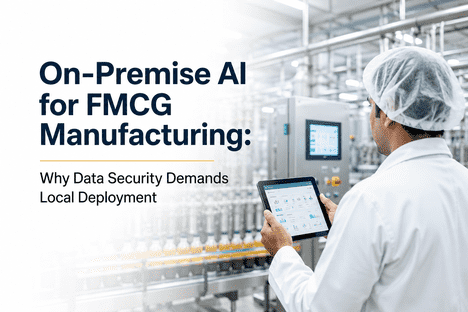
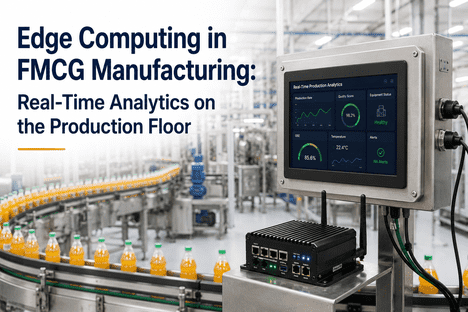
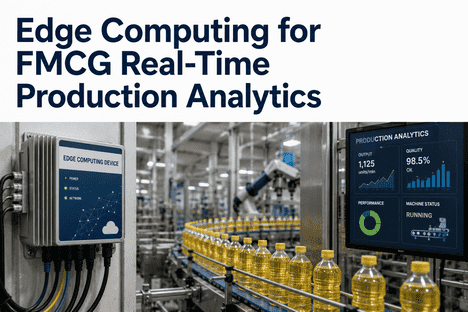
Edge AI and on-premise deployment have fundamentally changed the calculus for FMCG manufacturers weighing factory intelligence against data sovereignty. In 2026, food and consumer goods plants processing thousands of SKUs daily cannot afford the latency, connectivity dependency, or IP exposure that comes with cloud-only AI architectures. On-premise AI for FMCG — deployed at the machine edge, inside air-gapped networks, running local inference models — delivers real-time predictive maintenance, process optimization, and quality control without a single byte of proprietary recipe data leaving the plant boundary. Book a demo with iFactory to see how a purpose-built on-premise AI platform integrates with your compliance workflows and delivers actionable factory intelligence from day one.
Deploy iFactory's On-Premise AI Copilot in Your FMCG Plant
iFactory runs fully on-premise or in a hybrid edge-cloud model — protecting proprietary FMCG process data while delivering AI-driven predictive maintenance, quality control, and compliance intelligence.
Why On-Premise AI Is the FMCG Industry's Non-Negotiable in 2026
FMCG manufacturers operate with intellectual property that is irreplaceable — proprietary formulations, process parameters, blend ratios, and heat treatment profiles that define competitive advantage built over decades. Sending that data to a public cloud for AI inference is not a technical risk calculation; it is a business continuity risk that legal, operations, and supply chain leadership consistently reject.
Beyond IP protection, edge AI addresses the three structural limitations that cloud-dependent factory intelligence cannot solve: network latency that delays real-time control decisions, connectivity gaps in remote or underground processing environments, and regulatory data residency requirements that mandate local data storage under GDPR, India's DPDP Act, and similar frameworks. Manufacturers evaluating on-prem FMCG software platforms should book a demo with iFactory to see how a purpose-built edge deployment eliminates all three constraints simultaneously.
67% of FMCG manufacturers surveyed in 2025 cited data sovereignty and proprietary recipe protection as the primary barrier to cloud AI adoption — ahead of cost and integration complexity combined. On-premise and hybrid edge architectures are resolving this at scale.
Edge AI Architecture Models for FMCG Factories
Effective edge AI deployment in food and consumer goods manufacturing is not a single architecture — it is a layered model that places compute capacity at the point where data is generated, with intelligence tiers matched to decision latency requirements.
Device-Level Edge Inference
AI models run directly on sensor nodes, PLCs, or embedded compute modules attached to individual machines. Inference latency under 10ms enables real-time control loop adjustments — critical for filling, sealing, and mixing processes where 100ms delays create quality defects.
Latency-CriticalOn-Premise Edge Server
A local server rack — typically GPU-accelerated — aggregates data from all line-level sensors and runs heavier AI workloads: predictive maintenance models, multi-variable process optimization, and vision inspection inference. All data stays within the plant boundary.
Plant-Wide AIAir-Gapped Network Deployment
Fully isolated network segments where no external connectivity exists. AI model updates, configuration changes, and audit exports transfer via verified removable media or dedicated data diode hardware — eliminating all remote attack surfaces and satisfying the strictest FMCG data security requirements.
Maximum SecurityHybrid Edge-Cloud Model
Sensitive process data and real-time inference stay on-premise. Anonymized, aggregated model training data — stripped of proprietary process signatures — optionally syncs to cloud for cross-site benchmarking. A governance layer enforces what leaves the edge boundary and in what form.
Flexible GovernanceFMCG Data Security: What Proprietary Recipe Protection Actually Requires
The term "data security" in FMCG AI deployments is often used loosely. In practice, protecting proprietary recipe and process data requires five specific technical controls — not just encryption in transit. FMCG manufacturers evaluating on-prem AI platforms should verify all five are present before any deployment proceeds. Book a demo with iFactory to see exactly how each control is enforced in a live FMCG plant environment.
Data Residency Enforcement
All raw sensor readings, process parameters, and recipe-correlated quality data must be stored exclusively on plant-controlled hardware. No automatic cloud sync, no telemetry callbacks to vendor infrastructure, no shadow data egress. iFactory's on-premise deployment enforces strict data residency with network-layer controls and audit logging of all outbound connection attempts.
Encrypted Local Storage and Inference
At-rest encryption of all operational databases using AES-256, combined with encrypted inference pipelines that prevent model extraction attacks. AI models trained on proprietary process data must be stored in hardware-secured enclaves where even platform vendor support staff cannot access model weights or training data.
Role-Based Access with OT/IT Segmentation
Operational technology networks running PLCs and SCADA systems must remain segmented from IT networks. Edge AI platforms must integrate with both without bridging the security boundary — using one-way data diodes or approved DMZ architectures that satisfy IEC 62443 requirements for industrial cybersecurity.
Immutable Audit Trails
Every AI-generated work order, every predictive alert, every process recommendation must be logged in a tamper-evident audit trail stored locally. This satisfies FDA 21 CFR Part 11, FSMA electronic records requirements, and BRCGS documentation mandates — without relying on cloud-hosted log aggregation services.
Vendor Access Governance
Platform vendor support access — if permitted at all — must require explicit plant authorization, operate through time-limited credential windows, and generate complete session audit logs. Zero standing access to production systems. FMCG IP protection demands that vendor SLAs contractually prohibit use of operational data for model training or benchmarking outside the plant's explicit written consent.
Edge Computing Hardware for FMCG Manufacturing Environments
FMCG production environments impose hardware requirements that standard enterprise edge compute platforms routinely fail to meet. Food-grade facilities operate with IP65–IP69K washdown requirements, temperature cycling between cold storage and ambient zones, and electromagnetic interference from high-power motors and VFDs that degrades standard industrial compute. Book a demo with iFactory to understand which edge hardware class fits your specific plant zones and production environment.
| Deployment Zone | Environment Conditions | Hardware Class | AI Workload Handled | iFactory Integration |
|---|---|---|---|---|
| Processing Line (Zone 1) | IP69K washdown, 0–40°C cycling, high EMI | Stainless-enclosed edge node, fanless CPU | Sensor anomaly detection, fill-level inference | Direct PLC and SCADA integration |
| Packaging and Secondary | IP65, ambient temp, vision camera arrays | GPU-accelerated edge appliance | Vision inspection, seal integrity, label QC | Work order auto-creation on defect events |
| Utility and Engineering | Controlled, standard rack environment | On-prem server rack (GPU cluster) | Predictive maintenance, process optimization | Central AI Copilot orchestration layer |
| Cold Storage and Blast Freeze | -30°C to -5°C, humidity extremes | Low-temp rated embedded compute | Refrigeration anomaly detection, door seal monitoring | Alert routing to CMMS work orders |
| Air-Gapped OT Network | No external connectivity permitted | Isolated on-prem server with data diode | Full AI model suite, offline inference | Offline-mode iFactory with sync via diode |
Local AI Models for FMCG: What Runs On-Premise and How
The operational value of on-premise AI in FMCG manufacturing comes from five model categories that collectively deliver the intelligence once promised by cloud AI — without the data sovereignty trade-offs. Each model category runs inference locally, trains on plant-specific historical data stored on-premise, and improves continuously without requiring external connectivity.
Predictive Maintenance
Detects vibration, current, and thermal anomalies 7–21 days before failure with 85–94% accuracy — fully on-premise. Book a demo to see it live.
Process Optimization
Auto-adjusts temperature, speed, and pressure setpoints based on raw material variability — keeping product in spec without manual intervention. Recipe data stays on-site.
Vision Quality Inspection
Inspects 100% of product at line speed with sub-50ms latency — catching seal defects, fill variance, label errors, and foreign material locally on GPU edge hardware.
Energy Optimization
Balances compressed air, steam, and chilled water demand in real time — cutting energy costs 12–22% with zero external data exposure.
Sanitation and Hygiene AI
Flags high-risk zones before EMP swabbing by reading production history, equipment condition, and cleaning records — feeding directly into HACCP workflows on-premise.
Demand-Driven Scheduling
Resequences production orders dynamically using live OEE and maintenance data — respecting allergen changeovers and CIP windows without any cloud dependency.
See iFactory's On-Premise AI Models in a Live FMCG Plant Environment
iFactory deploys all six AI model categories on-premise, with full data sovereignty, air-gapped network support, and integration into HACCP, FSMA, and BRCGS compliance workflows.
Air-Gapped Food Plant Networks: Deployment Considerations and Trade-Offs
Air-gapped network deployment — where no external data path exists between the plant OT network and any outside system — is the most secure configuration for FMCG AI. Manufacturers holding patented formulations or processing under retailer confidentiality agreements frequently require full air-gap as a non-negotiable. Model updates arrive via cryptographically signed packages on verified removable media or data diode hardware. Book a demo to see how iFactory supports full air-gap deployment without reducing any operational capability.
- Zero external attack surface on OT network
- Complete recipe and process IP containment
- Satisfies strictest FMCG retailer data requirements
- No dependency on vendor cloud infrastructure availability
- Full regulatory data residency compliance
- Dedicated IT resource for update package management
- On-site model retraining capability or vendor on-premise support
- Local SMTP or alerting infrastructure for notifications
- Planned change management process for software updates
- Offline backup and disaster recovery procedures
FMCG Data Sovereignty: Regulatory Frameworks Driving On-Premise AI Adoption
Data sovereignty is no longer a concern limited to financial services. FMCG manufacturers operating across jurisdictions face regulations that directly mandate where operational and quality data must be stored — making on-premise AI a compliance requirement, not a preference. The EU's GDPR, India's DPDP Act, and the NIS2 Directive for critical food infrastructure all create legal exposure for manufacturers who deployed cloud AI without classifying their operational datasets. Process parameters correlated to batch records can qualify as regulated data in multiple regions simultaneously. Book a demo with iFactory to see how multi-jurisdictional data governance is handled across a multi-site FMCG deployment.
Implementation Roadmap: On-Premise Edge AI Deployment in FMCG
Data Classification and Network Architecture Audit
Classify all operational data by IP sensitivity and regulatory jurisdiction. Map existing OT/IT network topology. Identify air-gap requirements, data diode placement, and edge compute deployment zones. Produce a data governance framework document signed by legal, IT, and operations leadership before any hardware procurement begins.
Edge Infrastructure Deployment and iFactory On-Prem Installation
Deploy hardened edge hardware per zone specifications. Install iFactory AI Copilot on-premise with configured data residency controls, encrypted storage, and OT/IT segmentation validated. Establish initial sensor connectivity from priority assets to the edge inference layer. Complete network security validation against IEC 62443 baseline.
AI Model Initialization and Baseline Training
Load historical maintenance, quality, and process data into on-premise training pipelines. Initialize predictive maintenance models per asset class with plant-specific failure history. Deploy vision inspection models and calibrate on live production. Establish baseline KPIs: OEE, mean time between failure, first-pass quality rate.
Continuous On-Premise Model Improvement and Compliance Integration
AI models retrain continuously on new on-premise data, improving prediction accuracy as more operational history accumulates. HACCP, FSMA, and BRCGS documentation workflows receive AI-generated records directly from on-premise inference outputs. Multi-site FMCG deployments add additional plants under the same data governance framework, with no central cloud aggregation of sensitive process data.
Frequently Asked Questions: Edge AI and On-Premise Deployment in FMCG
The On-Premise FMCG Plant of 2026: Intelligence Without Compromise
The choice between factory intelligence and data sovereignty is no longer a real trade-off. On-premise AI and edge computing now deliver the full suite — predictive maintenance, process optimization, vision quality control, and compliance intelligence — entirely within your plant boundary. The manufacturers pulling ahead are those running every robotic, quality, and maintenance workflow through a single on-premise intelligence layer. Book a personalized demo to see how iFactory deploys fully on-premise in your FMCG plant, protecting your IP while delivering measurable OEE and quality improvements from week one.
Edge AI. Air-Gapped Networks. Full FMCG IP Protection.
iFactory deploys entirely on-premise in FMCG plants — protecting proprietary recipes and process data while delivering AI-driven predictive maintenance, quality control, and compliance intelligence. Live in 10–14 weeks.