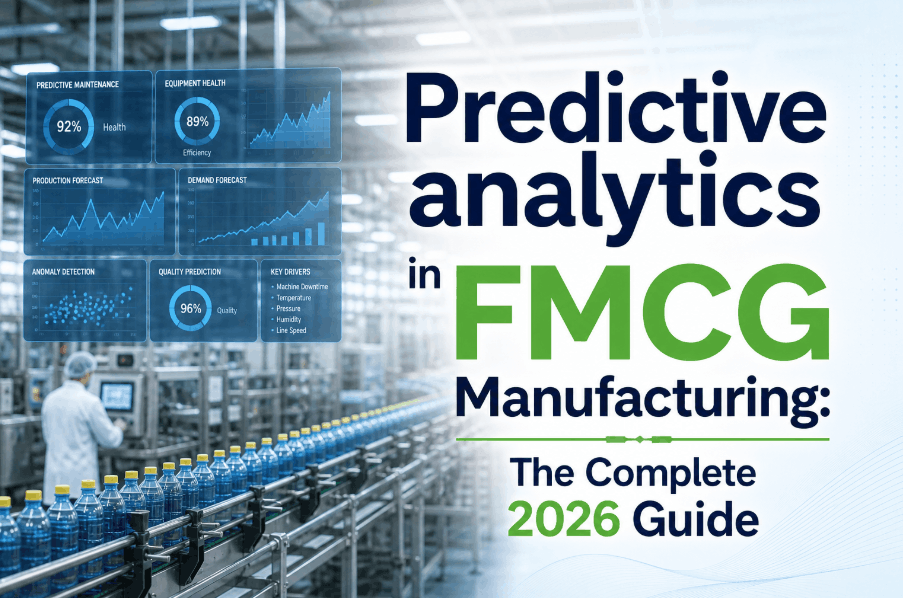
The factory floor of 2026 does not wait for the cloud. When a filling line is running at 800 packs per minute and a seal-head bearing begins showing early signs of fatigue, the window between detectable anomaly and production failure can be measured in seconds — not the minutes it takes for sensor data to travel to a central server, get processed, and return an alert. This is the fundamental challenge that edge AI and 5G connectivity solve together: bringing the computational power of machine learning directly to the machine, and connecting it to the broader plant intelligence network with wireless bandwidth fast enough to match the speed of modern FMCG production. The result is a new class of factory maintenance capability — one that detects failures at the source, responds in real time, and learns continuously from every machine on every line.
Why Latency Is the Defining Problem in FMCG Factory Maintenance
Traditional cloud-based IoT monitoring works well for applications where a few seconds of data processing delay is inconsequential. FMCG production is not that application. A high-speed packaging line produces a new unit every 75 milliseconds. A conveyor running at full speed moves product through a sealing station 12 times per second. In this environment, the latency introduced by sending sensor data to a remote cloud, processing it through an analytics pipeline, and returning an alert — a cycle that typically takes 8 to 15 seconds — is not a minor inconvenience. It is the difference between catching a seal failure at its first detectable signature and discovering it after 6,000 defective units have passed through.
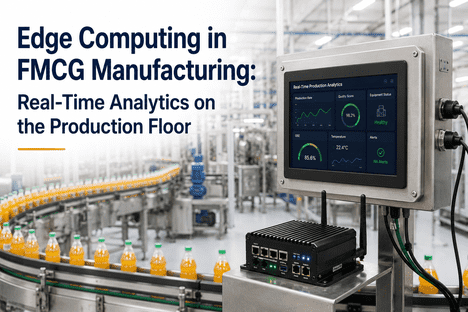
Edge AI eliminates this latency gap by running the AI inference models directly on processors installed at line level — inside the machine enclosure, on the panel, or in a nearby rack. The AI does not wait for the cloud. It processes sensor streams locally, detects anomalies within milliseconds, and fires production alerts before the fault has had time to cause damage. Factory operations teams who get support gain this edge-level intelligence across their production lines from the first week of deployment.
Response Time Comparison: Cloud vs Edge vs 5G+Edge
Cloud-Only IoT
Too slow for high-speed lines
Edge AI Only
Fast local detection
5G + Edge AI
Real-time at production speed
Sensor anomaly to maintenance alert — measured end-to-end in live FMCG environments
What Edge AI Actually Means on the FMCG Factory Floor
Edge AI is not a single device or a software platform — it is an architectural approach that places AI inference capability as close as possible to the data source. In FMCG factory maintenance, this means AI processors embedded in or mounted near production line equipment: a compact compute module attached to a filling machine's control panel, a DIN-rail mounted edge gateway in the conveyor motor control cabinet, or a ruggedized edge server in the line-side electrical room serving a cluster of 8–12 machines.
These edge nodes run machine learning models — vibration anomaly detectors, thermal baseline comparators, speed variance analyzers — that were trained in the cloud on large datasets of FMCG equipment operating signatures and then deployed to the edge for local inference. The edge node does not need to ask the cloud whether the vibration pattern it just observed is abnormal. It already knows. It has the model. It makes the determination in under a millisecond and fires the appropriate alert. Production managers responsible for high-throughput lines who book a demo with iFactory can see exactly how this edge deployment architecture maps to their specific equipment layout and production speed requirements.
01
Edge AI: The Intelligence Layer
What it does: Runs ML inference models locally on embedded processors at machine level — no cloud required for detection
Latency: Sub-millisecond detection; independent of network connectivity
Key advantage: Never blind — continues operating even during network outages or connectivity interruptions
FMCG use: Vibration, temperature, current, torque anomaly detection on filling, sealing, conveyor, and capping equipment
Model updates: AI models retrained in cloud, then pushed to edge nodes as OTA updates without production interruption
02
5G: The Connectivity Layer
What it does: Provides ultra-low latency, high-bandwidth wireless connectivity between edge nodes, control systems, and plant management platforms
Latency: 1–5ms end-to-end across the factory network
Key advantage: Eliminates wired infrastructure requirements — sensors and edge nodes communicate wirelessly without trenching or cable runs
FMCG use: Connects mobile technician devices, AGVs, smart tools, and distributed edge nodes across large multi-line FMCG facilities
Private 5G: Many FMCG plants deploy private 5G networks for complete control over bandwidth allocation and data security
See Edge AI Deployed on Your FMCG Production Lines
iFactory's edge-first architecture delivers sub-millisecond fault detection without replacing your existing control systems or requiring extensive IT infrastructure.
Five Ways Edge AI and 5G Transform FMCG Maintenance Operations
The combined impact of edge AI and 5G connectivity extends well beyond faster fault detection. Together, they enable a fundamentally different model of factory maintenance — one where intelligence, connectivity, and action are all operating at production speed rather than at human or network speed. Maintenance engineers at FMCG facilities who get support report that this shift changes not just their response times but the entire character of their maintenance operation.
1
Real-Time Failure Detection at Production Speed
Edge AI nodes monitor vibration, temperature, current, and acoustic signatures at 1,000+ samples per second per sensor channel. Anomalies are detected within the same production cycle they occur in — not minutes or hours later. On a line running 600 units per minute, this means a sealing fault is caught within the first 3–5 affected units rather than after thousands.
2
Wireless Sensor Deployment Without Infrastructure Overhaul
5G eliminates the need for extensive cabling when adding sensors to existing production lines. Smart wireless sensors — vibration nodes, thermal cameras, acoustic monitors — attach to equipment and communicate directly over the 5G network. New monitoring points can be added to any machine in hours rather than the days or weeks required for wired sensor installation.
3
Offline-Resilient Maintenance Intelligence
Because edge AI inference runs locally, production line monitoring continues without interruption even during network outages or connectivity drops. The edge node buffers fault data locally and synchronizes with the central platform when connectivity is restored. This is critical for FMCG plants where maintenance monitoring must be continuous regardless of IT system availability.
4
Mobile Technician Augmentation via 5G
5G connectivity enables technicians to access full diagnostic context — live sensor data, fault history, repair instructions, parts inventory — on mobile devices anywhere on the factory floor with zero lag. Augmented reality guided repair workflows, which require high-bandwidth low-latency connectivity, become practical across the entire plant rather than only in wi-fi coverage zones.
5
Continuous Model Improvement via Cloud Sync
Edge nodes stream non-time-critical performance data to the cloud continuously via 5G. The central AI platform uses this data to retrain and improve its fault detection models, then pushes updated models back to all edge nodes as over-the-air updates. The factory's edge AI gets smarter over time without any manual intervention or production interruption.
Private 5G vs Public 5G for FMCG Factory Maintenance
FMCG manufacturers deploying 5G for factory maintenance face a key architectural decision: build a private 5G network on licensed or shared spectrum, or rely on a public 5G carrier network. Each approach has distinct implications for performance, data security, and total cost of ownership. Large FMCG facilities with high equipment density, strict data sovereignty requirements, and mission-critical monitoring needs are increasingly choosing private 5G networks, where the plant has full control over spectrum allocation, bandwidth prioritization, and data routing.
Private 5G guarantees dedicated bandwidth to maintenance-critical applications — ensuring that a large file transfer or software update on the corporate network cannot compete with the real-time sensor streams feeding the edge AI maintenance platform. It also keeps all maintenance and production data on-premises, which matters for FMCG manufacturers operating under food safety data regulations and proprietary process protection requirements. Smaller facilities or those in the early stages of 5G adoption can begin with public carrier 5G while evaluating the business case for private network investment. To explore which connectivity architecture fits your FMCG plant's scale and requirements, book a consultation with iFactory's deployment team.
Private 5G
Public 5G Carrier
Latency
1–2ms guaranteed
5–20ms (variable)
Data Security
On-premises, full control
Carrier-managed
Bandwidth Priority
Dedicated, configurable
Shared with other users
Coverage
Full factory, indoor-optimized
Dependent on carrier towers
Upfront Cost
Higher initial investment
Lower initial cost
Best For
Large multi-line FMCG facilities
Pilot deployments or smaller plants
Edge AI + 5G Maintenance Outcomes in FMCG Facilities
<1ms
Detection Latency
Fault signature identified within the same production cycle it develops — before any downstream impact
50%
Downtime Reduction
Unplanned production stoppages cut in half through real-time edge AI failure prediction
72%
Fewer Defect Batches
Process parameter drift caught at the edge before it produces off-specification product runs
30%
Sensor Deployment Cost Saving
Wireless 5G sensor connectivity eliminates cabling infrastructure cost for new monitoring points
99.9%
Monitoring Continuity
Edge-local inference maintains fault detection even during cloud connectivity interruptions
iFactory AI · Edge + 5G FMCG Maintenance
Bring Sub-Millisecond Maintenance Intelligence to Your FMCG Lines
iFactory's edge-first AI platform connects to your production equipment, runs fault detection at line speed, and delivers actionable maintenance intelligence to your team in real time.
Frequently Asked Questions
What is the difference between edge AI and cloud AI in FMCG factory maintenance
Cloud AI processes sensor data on remote servers, introducing 8–15 seconds of round-trip latency. Edge AI runs inference models locally on processors at line level, detecting faults in under a millisecond. iFactory uses both: edge for real-time detection and local resilience, cloud for model training, historical analysis, and portfolio-level insights.
Does deploying edge AI require replacing existing production line control systems
No. iFactory's edge nodes are additive — they attach to existing equipment and read sensor data without interfacing with or modifying PLC or SCADA controls. The edge AI layer operates independently alongside existing control infrastructure, adding predictive intelligence without disrupting any current automation.
Is a private 5G network necessary for FMCG factory maintenance, or can existing Wi-Fi work
Wi-Fi can support basic IoT monitoring but introduces latency variability and coverage gaps unsuitable for high-speed lines. 5G — public or private — provides the consistent low-latency connectivity that edge AI maintenance requires at production speed. Private 5G is recommended for large facilities; public 5G carrier networks are viable for smaller plants or initial pilots.
What happens to fault monitoring when the 5G network or internet connection goes down
Edge AI nodes continue detecting and alerting on faults locally even without network connectivity. Alerts are delivered to technicians on the local plant network, and fault data is buffered on the edge node. Full synchronization with the iFactory platform resumes automatically when connectivity is restored — with no data loss and no monitoring gaps.
How are edge AI models kept accurate as equipment ages or production formats change
iFactory retrains models continuously using data streamed from all deployed edge nodes. Updated models are pushed over the air to edge hardware as silent background updates — no production interruption required. When production formats change, the platform automatically activates the appropriate format-specific baseline model on the relevant line's edge nodes.
What types of FMCG equipment benefit most from edge AI monitoring
Highest value is on high-speed equipment whose failure stops the line immediately: filling machines, primary conveyor drives, sealing stations, and capping units. Secondary value comes from monitoring labeling, coding, and wrapping equipment. Edge AI is particularly impactful on any machine running faster than 200 units per minute, where cloud latency would be too slow to prevent defect production after fault onset.