On-premise AI for FMCG is no longer a niche deployment strategy reserved for defense contractors and financial institutions—it has become the data security standard for food and beverage manufacturers protecting proprietary formulations, process intelligence, and consumer data from cloud-based exposure. As AI adoption accelerates across FMCG plants worldwide, the question is no longer whether to deploy machine learning in production environments, but where that infrastructure must live to satisfy regulatory mandates, competitive secrecy requirements, and network reliability constraints that cloud-dependent systems simply cannot meet.
Deploy AI On-Premise Across Your FMCG Facilities — Without Compromising Proprietary Data
iFactory's on-premise AI platform delivers private-cloud analytics, air-gapped network support, and HIPAA-grade data security purpose-built for food and beverage manufacturers operating at enterprise scale.
Why FMCG Manufacturers Are Choosing On-Premise AI Over Cloud Deployment
The FMCG sector generates some of the most commercially sensitive operational data on the planet. Proprietary recipes developed over decades, precise fermentation parameters, supplier blend ratios, and yield optimization algorithms represent billions in intellectual capital. Sending this data to a third-party cloud infrastructure—even an encrypted one—introduces legal exposure, competitive risk, and compliance complexity that on-premise AI deployment eliminates entirely.
Food manufacturers who book a demo with iFactory consistently identify three non-negotiable requirements driving their on-premise mandate: data sovereignty over production intelligence, network independence at remote plant locations, and the ability to operate analytics workloads during internet outages without disrupting production.
Beyond competitive secrecy, regulatory frameworks including FSMA 204, EU AI Act compliance obligations, and sector-specific HIPAA-grade data handling requirements increasingly require manufacturers to demonstrate explicit control over where AI inference occurs and how training data is stored. On-premise FMCG AI deployment addresses all three simultaneously.
Proprietary Recipe Protection
Formulation data processed by on-premise AI never leaves the plant network. No cloud egress means no exposure surface—period. Competitive intelligence remains behind air-gapped walls where it belongs.
Air-Gapped Network Compatibility
Remote FMCG facilities with unreliable internet connectivity require AI inference engines that run entirely locally. On-prem deployment ensures production analytics continue uninterrupted regardless of network status.
Regulatory Compliance Control
FSMA, GDPR, and emerging AI governance frameworks require auditability of where data is processed. Self-hosted AI food systems give compliance teams the documentation chain that cloud solutions structurally cannot provide.
Latency-Sensitive Process Control
Real-time FMCG process adjustments—temperature control, fill-weight correction, CIP cycle optimization—require millisecond-level AI response times achievable only when inference runs on local hardware, not over WAN connections.
On-Premise AI Deployment Architecture for FMCG Plants
Designing a secure on-premise AI architecture for FMCG manufacturing requires more than installing servers in a plant. It demands an integrated approach that connects OT sensor networks, MES systems, and ERP data flows to a local AI inference layer—all while maintaining the security posture, redundancy, and scalability that enterprise food operations require. Manufacturers who book a demo to assess their current infrastructure typically find their existing data is deployment-ready; what is missing is the local intelligence layer above it.
Fully Air-Gapped On-Premise AI — Maximum Security Deployment
Air-gapped food plant AI deployments are the gold standard for manufacturers processing classified formulation data or operating under strict government-adjacent supply chain requirements. In this architecture, the AI server stack—including training infrastructure, inference engines, and data historians—operates on a physically isolated network with zero external connectivity. Model updates and system patches are delivered via secure physical media or authenticated one-way data diodes. For FMCG enterprises managing trade-secret-level process data, this architecture eliminates every external attack vector.
Private Cloud FMCG Deployment — Controlled Connectivity with Full Data Ownership
Private cloud FMCG AI architectures sit between fully air-gapped systems and public cloud deployments. The AI inference layer and data storage remain on manufacturer-owned infrastructure—either on-site or in a dedicated colocation facility—while controlled, encrypted connectivity allows remote model management and cross-facility analytics aggregation. This approach suits food enterprises managing multiple plants who need centralized AI governance without surrendering data to third-party cloud providers. The private cloud model supports HIPAA-grade data management protocols and satisfies most regulatory audit requirements while preserving the operational flexibility of connected infrastructure.
Hybrid Edge-to-On-Prem AI — Distributed Intelligence with Central Control
For FMCG enterprises operating geographically distributed facilities—each with unique connectivity profiles—a hybrid edge-to-on-prem AI architecture distributes inference workloads to plant-level edge nodes while consolidating model management and cross-facility analytics on a centralized on-premise server. Edge nodes handle real-time process control AI at the line level; the central on-prem stack handles training, benchmarking, and enterprise intelligence. This architecture maximizes coverage while keeping all sensitive FMCG AI server workloads within the manufacturer's physical control boundary.
FMCG AI Data Security: HIPAA-Grade Standards for Food Manufacturing
The term "HIPAA-grade" has migrated from healthcare into advanced manufacturing to describe a specific tier of data handling discipline: end-to-end encryption at rest and in transit, role-based access controls with full audit logging, data residency guarantees, and breach notification protocols. Applying these standards to secure AI food deployments is not regulatory theater—it reflects the genuine sensitivity of FMCG process data and the material consequences of its unauthorized disclosure. Food manufacturers who book a demo for a security architecture review often discover their current data handling practices would not survive a formal AI governance audit.
| Security Layer | Standard Requirement | FMCG On-Premise Implementation | Risk Addressed |
|---|---|---|---|
| Data Encryption | AES-256 at rest, TLS 1.3 in transit | Hardware-accelerated encryption on local AI server stack | Unauthorized data interception |
| Access Control | Role-based with MFA enforcement | Plant-level and enterprise-level RBAC with AD/LDAP integration | Insider threat and credential compromise |
| Data Residency | Documented physical data location | All training and inference data remains on manufacturer hardware | Regulatory non-compliance, sovereignty risk |
| Audit Logging | Immutable access and inference logs | Tamper-evident logs with cryptographic chaining on local storage | Undetectable data misuse |
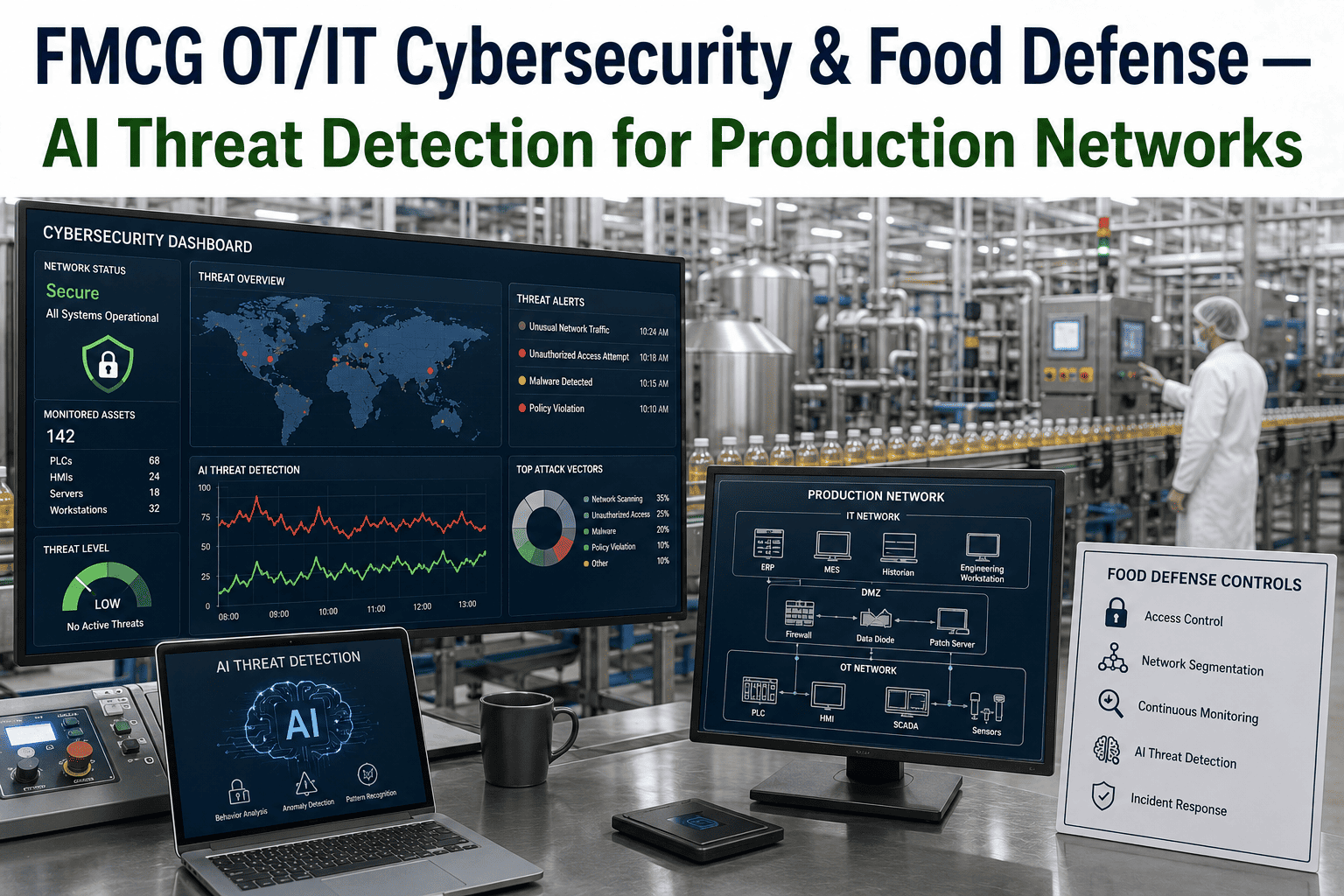
| Network Segmentation | OT/IT separation with defined DMZ | Air-gapped OT network with controlled data diode to IT analytics layer | Cross-network lateral movement attacks |
| Model Integrity | Cryptographic model signing | Signed AI model packages with verification on deployment | Adversarial model tampering |
Three-Phase On-Premise AI Deployment Roadmap for FMCG Plants
Deploying secure on-premise AI in an FMCG environment requires a phased approach that builds infrastructure integrity before activating intelligence workloads. Rushing to deploy AI models before the underlying security architecture is validated produces systems that are simultaneously underperforming and overexposed. FMCG enterprises should book a demo to receive a plant-specific infrastructure readiness assessment before committing to hardware procurement timelines.
Infrastructure Audit & Network Segmentation Design
Conduct a full OT/IT network topology audit across all target FMCG facilities. Map existing MES, SCADA, and sensor network connections. Design the OT/IT segmentation architecture with appropriate DMZ and data diode configurations. Specify on-premise AI server hardware requirements based on local inference workload projections. Establish data classification framework distinguishing proprietary formulation data from non-sensitive operational telemetry.
Secure Server Deployment & AI Platform Installation
Deploy and harden on-premise AI server infrastructure at each facility according to the approved network segmentation design. Install the self-hosted AI food analytics platform with HIPAA-grade encryption, RBAC configuration, and audit logging activated. Connect MES and sensor data feeds through validated data pipelines. Conduct penetration testing and security validation before activating any AI workloads in production environments.
AI Model Activation & Continuous Intelligence Deployment
Activate AI model workloads including predictive maintenance, process optimization, and quality deviation detection on validated on-premise infrastructure. Deploy cross-facility analytics aggregation for private cloud FMCG configurations. Establish model update and retraining protocols consistent with air-gapped or controlled-connectivity deployment architecture. Initiate ongoing compliance monitoring and security posture reporting.
On-Premise AI Applications Across FMCG Operations
The performance value of local AI food deployment extends across every major FMCG operational function. Critically, on-premise architecture does not limit AI capability—it redirects it toward the use cases where data sensitivity is highest and latency tolerance is lowest. Here are the primary applications delivering measurable ROI in secure FMCG AI deployments.
AI-Driven Recipe Optimization With Zero Data Egress
On-premise AI models analyze formulation performance data—ingredient ratios, processing parameters, yield outcomes—entirely on local infrastructure. Proprietary recipe intelligence is generated, stored, and applied without any data leaving the plant network, eliminating the competitive exposure inherent in cloud-based AI optimization platforms.
Real-Time Process Adjustment at Millisecond Latency
Local FMCG AI inference engines deliver real-time closed-loop process control for temperature regulation, fill-weight correction, and CIP cycle optimization. At sub-12ms response times achievable on local hardware, these applications require on-premise deployment—cloud round-trip latency makes them technically infeasible in dynamic production environments.
FSMA-Ready Compliance Monitoring on Local Infrastructure
On-premise FMCG AI continuously monitors quality deviation events, traceability chain integrity, and regulatory parameter adherence—generating audit-ready documentation stored entirely on manufacturer-controlled infrastructure. Compliance teams gain a continuous digital compliance log that eliminates distributed audit prep burden while satisfying FSMA 204 data location requirements.
The Financial Case for On-Premise AI in FMCG Manufacturing
Intellectual Property Risk Elimination
A single proprietary formulation leak to a competitor or through a cloud security breach can cost FMCG enterprises $50M–$500M in market position erosion. On-premise AI deployment eliminates this exposure category entirely—an ROI calculation that dwarfs infrastructure investment costs across any reasonable time horizon. Enterprises evaluating this case can book a demo for a data exposure risk assessment specific to their formulation portfolio.
Cloud Cost Elimination at Scale
FMCG AI workloads generating terabytes of daily sensor and production data face escalating cloud egress and storage costs that compound with every additional facility. Self-hosted AI food infrastructure converts variable cloud consumption costs into predictable CapEx—with break-even periods typically in the 18–30 month range depending on facility count and data volume.
Regulatory Penalty Avoidance
Failure to demonstrate data residency compliance under FSMA 204, emerging EU AI Act provisions, or customer-mandated data sovereignty requirements can disqualify FMCG manufacturers from major retail contracts. The revenue exposure from a single lost retailer relationship—often $10M–$100M annually—makes on-premise FMCG AI a straightforward compliance investment.
On-Premise FMCG AI — Security & Performance Benchmarks
Average security and performance outcomes achieved within 12 months of full on-premise AI platform deployment across iFactory's FMCG manufacturing customer base.
On-Premise AI for FMCG — Frequently Asked Questions
What is on-premise AI for FMCG and how does it differ from cloud AI?
On-premise AI for FMCG means deploying machine learning models, inference engines, and training infrastructure on manufacturer-owned hardware within the plant or a controlled facility—rather than on third-party cloud servers. All data processing occurs within the manufacturer's physical control boundary. This eliminates cloud egress risk, ensures data sovereignty, and enables operation in air-gapped or low-connectivity environments that cloud AI cannot serve.
Is on-premise AI capable of the same performance as cloud-based AI platforms?
Yes—and for latency-sensitive FMCG applications, on-premise AI significantly outperforms cloud alternatives. Local inference eliminates network round-trip latency, enabling sub-12ms response times for real-time process control applications. For analytics workloads, modern on-premise AI server hardware delivers performance equivalent to mid-tier cloud instances at a fraction of the long-term cost for high-data-volume FMCG environments.
What does HIPAA-grade data security mean for FMCG AI deployments?
HIPAA-grade applied to FMCG AI describes a specific security standard: AES-256 encryption at rest and in transit, role-based access controls with multi-factor authentication, immutable audit logging, documented data residency with physical access controls, and defined incident response protocols. This standard addresses the sensitivity of proprietary FMCG process data with the same rigor healthcare organizations apply to protected patient health information.
Can on-premise FMCG AI support multiple plants from a single deployment?
Yes. Private cloud FMCG AI architectures consolidate model management and cross-facility analytics on centralized on-premise infrastructure while distributing inference workloads to plant-level edge nodes. This hybrid architecture provides enterprise-wide AI governance without requiring full server stacks at every facility—and without sending data to external cloud providers.
How does on-premise AI handle model updates without cloud connectivity?
Air-gapped FMCG AI deployments use secure physical media or authenticated one-way data diodes for model updates. Cryptographically signed model packages are verified upon deployment to prevent tampering. For private cloud configurations with controlled connectivity, model updates are delivered through encrypted, authenticated channels over dedicated management networks that are logically separated from production data flows.
What is the typical timeline for deploying on-premise AI across a multi-plant FMCG enterprise?
Full multi-plant on-premise AI deployment typically spans 16–24 weeks depending on facility count, existing infrastructure maturity, and the chosen architecture (fully air-gapped versus private cloud). Enterprises with existing OT sensor networks and structured MES data achieve initial AI workload activation within 10–14 weeks. iFactory's pre-deployment infrastructure assessment significantly reduces integration complexity and hardware specification time.
Secure Your FMCG AI Deployment — Keep Proprietary Data Where It Belongs
iFactory's on-premise AI platform delivers HIPAA-grade data security, air-gapped network compatibility, and private cloud FMCG analytics—purpose-built for food and beverage enterprises that cannot afford data exposure.