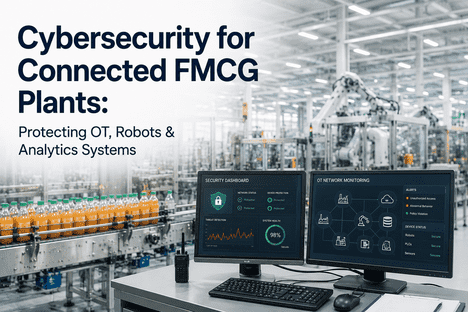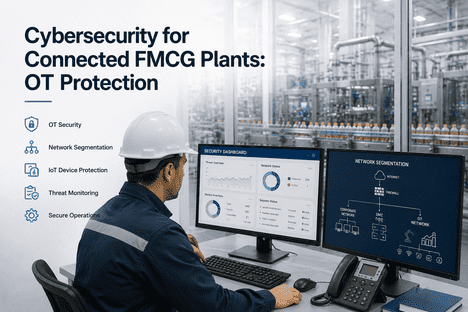
Ten years ago, the SCADA network running a bottling line and the corporate IT network that handled email were about as connected as two different buildings — physically separate, running different protocols, and invisible to each other's security tools. That separation is gone now. MES systems talk to ERP, IIoT sensors report to cloud dashboards, and remote vendor access into production networks has become routine, which means a phishing email that used to be strictly an IT problem can now be a path straight into the systems controlling product safety. See how AI-based threat detection monitors converged OT/IT production networks and ties cybersecurity into FDA food defense requirements.
Your Production Network and Your IT Network Aren't Separate Anymore
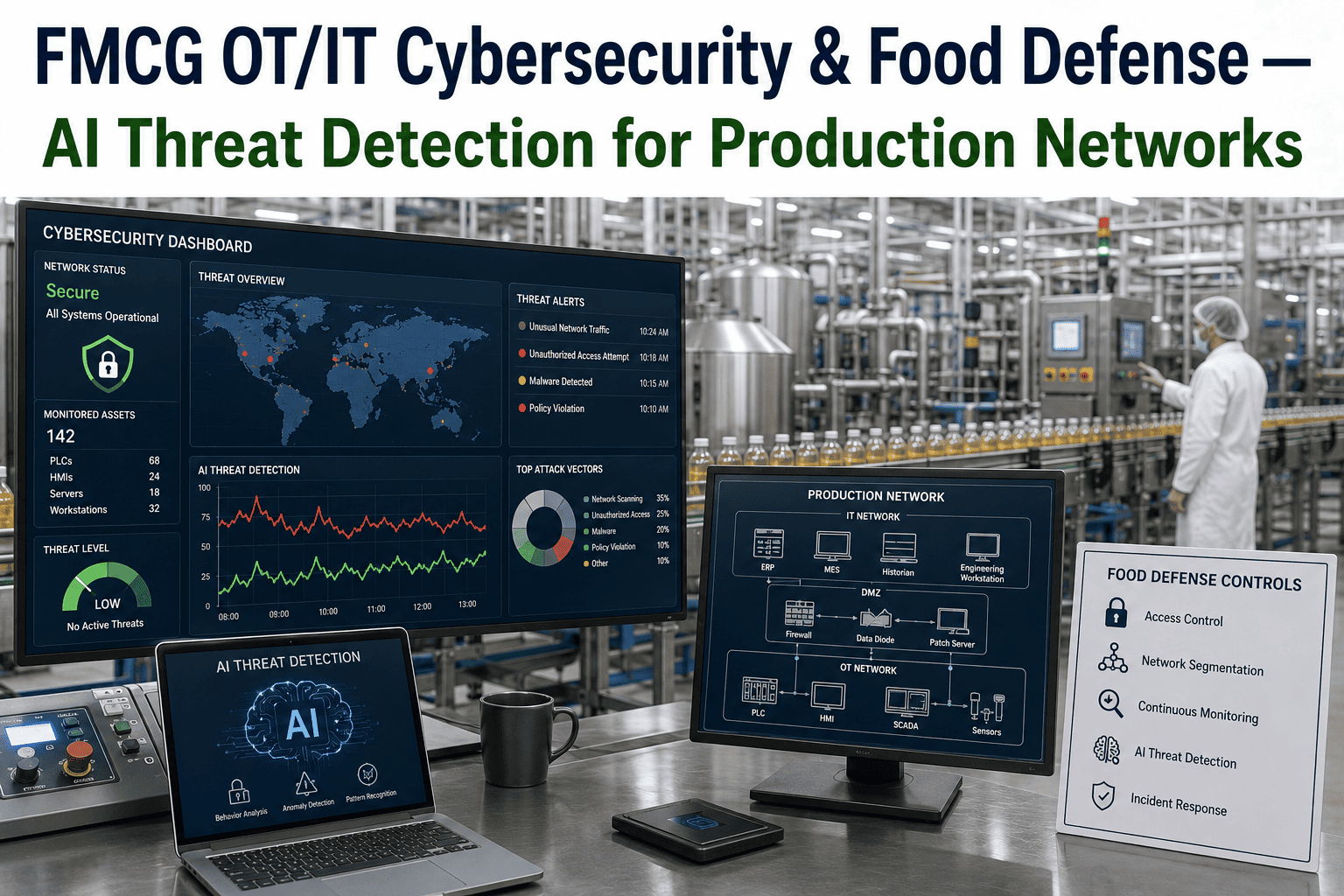
AI cybersecurity monitoring built for converged OT/IT production networks, connecting SCADA, MES, and IIoT threat detection directly into FDA food defense compliance.
The Attack Surface That Didn't Exist a Decade Ago
Traditional OT security relied heavily on the idea of an "air gap" — production networks physically isolated from corporate IT and the internet, making most conventional cyberattacks irrelevant to a plant floor. That air gap has been closing for years as MES systems needed direct data exchange with ERP, as remote diagnostics and vendor support required internet-connected access into control systems, and as IIoT sensors reporting to cloud analytics platforms became standard equipment on new production lines. Every one of those integrations is operationally valuable, and every one of them is also a path an attacker on the corporate network side didn't have five years ago.
Threat Detection Built for Where OT and IT Actually Meet
iFactory monitors SCADA, MES, and IIoT traffic together, catching threats that cross between corporate and production networks before they reach control systems.
Why Early OT Detection Matters More Than IT Detection
Why FDA Food Defense Now Has a Cybersecurity Dimension
FDA food defense requirements have historically focused on physical and personnel vulnerabilities — controlling access to processing areas, screening for intentional adulteration risk, and managing insider threat. As production systems have become network-connected and remotely accessible, the same intentional adulteration risk that food defense programs were built to address can now, in principle, be reached through a cyber pathway rather than only a physical one. A compromised recipe management system or a manipulated batch control parameter represents the same category of risk food defense plans are designed to prevent, just arriving through a different door.
That overlap means cybersecurity monitoring for converged OT/IT networks increasingly functions as an extension of a plant's existing food defense program rather than a separate IT initiative. Threat detection that specifically watches for anomalous access to recipe, formulation, and batch control systems addresses a risk category that traditional IT security tools, built around data theft and ransomware, were never designed to flag as a food safety concern.
What Changes With Converged Network Monitoring
How Monitoring Gets Layered Onto an Existing Network
Most plants don't need to redesign their network architecture to add converged OT/IT threat monitoring. The typical starting point is passive traffic monitoring at the boundary points where IT and OT segments already connect — the MES-ERP data exchange, remote vendor access gateways, and IIoT cloud connections — since these are the specific points where an attacker moving from IT toward OT would have to pass. Passive monitoring means production traffic isn't touched or delayed; the system observes and analyzes copies of network traffic rather than sitting inline in a way that could introduce latency into control communications.
From there, coverage typically expands to include specific production systems most relevant to food defense — recipe management, batch control, and formulation systems — with monitoring tuned to flag access patterns outside each system's established normal behavior. This phased approach lets VP Operations teams get boundary-level visibility quickly while building toward the deeper, system-specific monitoring that ties directly into food defense documentation over a longer rollout.
Frequently Asked Questions
Bring Threat Detection to Where OT and IT Actually Meet
iFactory monitors converged production networks and ties detection directly into food defense documentation, closing a gap traditional IT security tools were never built to cover.