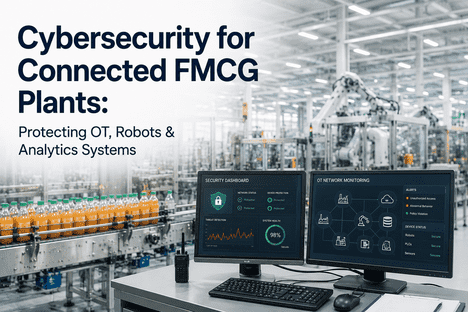
The plant IT and OT manager at a 750-employee multi-line FMCG facility in the Midwest reviews the quarterly cybersecurity risk assessment and confronts a vulnerability landscape that has expanded faster than the plant's defense-in-depth strategy can address — the plant's OT network now connects 4,700 industrial IoT devices across 12 production lines, including 230 PLCs controlling filling, sealing, and packaging operations, 86 variable frequency drives on conveyors and pumps, 42 CIP automation controllers, 18 temperature data loggers on cold storage rooms, 14 metal detectors and X-ray inspection systems with network-connected quality databases, 11 weigh belt controllers on ingredient feed systems, and 7 PLCs managing the ammonia refrigeration system that serves as the plant's primary food safety critical control point. Each connected device represents a potential entry point for a threat actor who could manipulate process parameters, disable safety systems, or exfiltrate proprietary product formulation data. The plant's most recent third-party penetration test identified 38 exploitable vulnerabilities across the OT environment — including 12 PLCs with factory-default passwords unchanged since installation, 6 HMI panels with unpatched remote code execution vulnerabilities (CVE-2023-26984 and CVE-2024-1934 in the plant's specific HMI platform versions), 4 unsegmented network segments that allow any compromised device to communicate directly with ammonia refrigeration controllers, and 2 direct internet-facing HVAC controllers installed by a third-party contractor without the plant's cybersecurity team's knowledge or approval. The plant's food safety plan under FSMA's Food Defense requirements requires that all critical control points be protected against intentional adulteration — yet the cybersecurity program that protects the OT systems monitoring those CCPs relies on the same IT-patched schedule that leaves Windows-based HMIs unpatched for 90-day windows while production continues 24/7. iFactory's OT Cybersecurity and Asset Management module gives FMCG plant IT, OT, and food safety teams the digital infrastructure to discover, monitor, and protect every connected device on the OT network — with automated asset inventory, vulnerability correlation, network segmentation monitoring, and incident response workflows purpose-built for industrial control system environments. Book a Demo to see iFactory's OT cybersecurity platform configured for your FMCG plant's connected production environment.
Cybersecurity for Connected FMCG Plants — Protecting Operational Technology Networks from Cyber Threats
Every connected PLC, HMI, VFD, and IoT sensor on an FMCG production line is a potential entry point for cyber threats targeting operational technology networks. iFactory's OT cybersecurity platform provides automated asset discovery, vulnerability management, network segmentation monitoring, and incident response workflows purpose-built for food and beverage manufacturing environments.
Why Connected FMCG Plants Are Increasingly Vulnerable to OT Cyber Attacks — and Why Traditional IT Security Approaches Cannot Protect Them
FMCG plants are undergoing a digital transformation that connects production equipment to enterprise networks, cloud platforms, and third-party service providers at an accelerating pace — bringing undeniable benefits in OEE visibility, predictive maintenance, quality analytics, and supply chain integration, but also expanding the attack surface for cyber threats targeting operational technology. The consequences of an OT cyber attack in an FMCG plant extend beyond data theft to include production stoppages, product quality deviations, food safety recalls, ammonia refrigeration system manipulation, and physical safety risks to production workers. The five dimensions below represent the most critical OT cybersecurity vulnerabilities specific to FMCG manufacturing environments — and the specific gaps that iFactory's platform addresses through automated asset management, vulnerability prioritization, and OT-specific incident response.
OT asset visibility gap — most FMCG plants do not know what is connected to their OT network
FMCG plant OT networks grow organically over years of equipment upgrades, third-party integrator installations, and ad-hoc network connections — creating an asset inventory that is almost never complete. Third-party penetration tests at FMCG plants consistently find that 85-95% of OT devices discovered by automated network scanning were not listed in any existing IT-managed asset inventory. A filling line PLC installed by a packaging equipment integrator, a temperature data logger connected by a cold storage contractor, and a CIP controller configured by an automation vendor all represent devices that the plant's cybersecurity team does not know exist and therefore cannot monitor, patch, or protect.
IT-centric patch management that leaves OT devices exposed for months
Enterprise IT patch management cycles of 60-90 days are incompatible with OT device patching requirements. A Windows-based HMI on a filling line cannot be taken offline for patching during a 24/7 production schedule, and the HMI vendor may not have validated the security patch against its proprietary runtime environment. The result is HMIs, PLC programming workstations, and OT data historians running Windows 10 IoT or Windows Embedded versions that have accumulated 12-24 months of unpatched vulnerabilities — including remote code execution vulnerabilities that can be exploited from any device on the same network segment.
Insufficient network segmentation between IT and OT — and between OT zones
Most FMCG plants have implemented basic IT-OT network segmentation through a firewall at the plant floor demilitarized zone (DMZ), but internal OT network segmentation between production zones is almost always absent. A compromised ingredient batching PLC on line 2 should not be able to communicate directly with the ammonia refrigeration PLC serving the entire facility — yet in the absence of OT-internal segmentation, any device on the OT network can potentially reach any other device. The Purdue Enterprise Reference Architecture (PERA) model recommends five levels of OT network segmentation for industrial environments; most FMCG plants operate with two or fewer.
Third-party and contractor network access without OT security controls
FMCG plants regularly grant network access to equipment OEMs for remote diagnostics, packaging machine integrators for programming support, refrigeration contractors for chiller monitoring, and automation vendors for PLC firmware updates. These third-party connections are often established through unsecured VPN connections, shared credentials, or direct internet-facing remote access tools that bypass the plant's firewall and monitoring infrastructure. A compromised contractor credential is the entry vector for the majority of OT ransomware incidents at manufacturing plants.
Food safety and food defense regulatory requirements with cybersecurity gaps
FSMA's Intentional Adulteration (IA) rule requires that every food facility have a food defense plan that protects vulnerable processes from intentional acts of contamination. When a PLC controlling a CIP system, a temperature data logger on a cold storage room, or a metal detector quality database can be manipulated remotely through an unpatched vulnerability, the food defense plan has a gap that the facility may not have identified. iFactory's OT cybersecurity module provides the asset inventory, vulnerability assessment, and network monitoring data that food safety teams need to address the cybersecurity dimension of their food defense plans under the IA rule's requirement for actionable process steps.
Five OT Cybersecurity Capabilities iFactory Delivers for Connected FMCG Plants
The following five capabilities represent the highest-impact applications of iFactory's OT cybersecurity platform for FMCG manufacturers. Each capability addresses a specific vulnerability or operational gap identified in the NIST SP 800-82 Guide to Industrial Control System (ICS) Security and the SANS ICS CIS Controls for manufacturing environments. Each capability is deployed as a read-only monitoring layer that does not require agent installation on OT devices, changes to PLC programming, or modifications to the plant's existing control system configuration.
Automated OT Asset Discovery and Inventory Management
iFactory's passive network discovery engine continuously identifies every device connected to the OT network — including PLCs, HMIs, VFDs, RTUs, sensors, data loggers, and engineering workstations — without agent installation or active scanning that could disrupt production operations. The discovery engine captures device manufacturer, model number, firmware version, open ports, running services, and network connections for each device, building a comprehensive OT asset inventory that includes devices that no IT-managed inventory system has ever recorded. The asset inventory feeds the vulnerability management, network segmentation monitoring, and incident response workflows.
OT Vulnerability Management with Production-Aware Patch Prioritization
iFactory correlates each discovered OT device against the National Vulnerability Database (NVD), ICS-CERT advisories, and vendor-specific security bulletins to identify known vulnerabilities affecting the specific make, model, and firmware version of every device on the OT network. Vulnerability severity is scored using CVSS v4.0 with OT-specific context — a vulnerability that allows remote code execution on an ammonia refrigeration PLC receives a higher priority than the same CVSS score on a non-production monitoring device. iFactory generates patch recommendations with production-aware scheduling that accounts for planned maintenance windows, production schedules, and vendor patch validation requirements.
OT Network Segmentation Monitoring and Anomaly Detection
iFactory monitors OT network traffic continuously to map the communication patterns between every device on the OT network — identifying devices that are communicating outside their expected zone, protocols that should not be present on OT segments (such as SMB, RDP, or HTTP), and connections to external IP addresses that may indicate unauthorized remote access. The platform compares actual traffic patterns against the expected communication matrix defined by the plant's OT architecture and generates alerts for each deviation that may indicate a segmentation bypass, an unauthorized device, or an active threat actor moving laterally across the OT network.
Third-Party Remote Access Monitoring and Access Control
iFactory monitors all remote access connections to the OT network — including VPN sessions, remote desktop connections, and vendor remote support tools — tracking connection source, device accessed, duration, and activity. The platform maintains an approved vendor access schedule and alerts when remote access occurs outside scheduled windows, from unapproved source IP addresses, or with expired credentials. Vendor access sessions are recorded with full audit trail for compliance documentation, industry standard, and food defense plan requirements for third-party OT network access.
OT Incident Response Workflow and Playbook Automation
iFactory provides OT-specific incident response playbooks aligned with the NIST SP 800-82 incident response framework for industrial control systems — including playbooks for PLC manipulation detection, HMI compromise, ransomware containment on OT networks, and supply chain cyber event response. When an OT security alert is generated, iFactory automatically creates an incident response ticket with the relevant device information, network traffic capture, vulnerability data, and recommended response actions from the applicable playbook.
OT Device Classification and Risk Assessment for FMCG Production Environment
The table below presents the OT device classification framework that iFactory uses to assess cybersecurity risk across connected devices in FMCG production environments — mapping each device category to its OT function, its food safety impact if compromised, its typical vulnerability profile, and the specific iFactory cybersecurity capability that protects it.
| Device Category | OT Function | Food Safety Impact if Compromised | Common Vulnerability Profile | iFactory Protection Capability |
|---|---|---|---|---|
| Process PLCs | Filling, sealing, CIP, cooking, blending control | High — parameter manipulation can cause under-processing, allergen cross-contact, or chemical residue | Default passwords, unpatched firmware, unauthenticated programming access via Ethernet/IP or Modbus TCP | Asset discovery · vulnerability scanning · network segmentation monitoring |
| HMIs and Operator Workstations | Production monitoring, recipe management, alarm response | High — screen manipulation can hide alarms or display incorrect process values | Unpatched Windows OS vulnerabilities, unsecured remote desktop access, shared admin accounts | Vulnerability management · patch prioritization · remote access monitoring |
| Quality Inspection Systems | Metal detectors, X-ray, checkweighers, vision systems | Critical — disabling quality inspection can allow contaminated product to reach consumers | Network-connected quality databases with default credentials, unencrypted data transmission | Asset discovery · network traffic monitoring · vulnerability correlation |
| Refrigeration and Utility Controllers | Ammonia refrigeration, HVAC, compressed air, boiler controls | Critical — refrigeration manipulation can cause temperature abuse of perishable products | Legacy controllers on unsegmented OT network, no authentication on control protocols | Network segmentation monitoring · anomaly detection · incident response playbooks |
| IoT Environmental Sensors | Temperature, humidity, pressure data loggers in cold storage, processing areas | High — sensor manipulation can hide temperature excursions that compromise food safety | Wireless sensors with unencrypted communication, cloud-connected gateways outside OT security scope | Asset discovery · network traffic monitoring · third-party connection audit |
OT Cybersecurity Use Cases Across FMCG Production Environments
Complete OT Asset Inventory for Food Safety and Cybersecurity Compliance
iFactory's passive discovery engine identifies every connected device on the OT network, building a comprehensive asset inventory that serves both cybersecurity and food safety compliance requirements. The inventory records device manufacturer, model, firmware version, network location, and food safety criticality classification for each device. The asset inventory feeds the vulnerability management program, the network segmentation monitoring system, and the food defense plan documentation required under FSMA's Intentional Adulteration rule.
Production-Aware Patch Prioritization and Remediation Tracking
iFactory correlates discovered device firmware and software versions against NVD, ICS-CERT, and vendor bulletins to identify known vulnerabilities with OT-specific severity scoring. Patch recommendations include production-aware scheduling that aligns with planned maintenance windows, production schedule constraints, and vendor validation requirements. Remediation tracking provides the IT-OT governance team with visibility into patch status, vulnerability closure rate, and remaining risk exposure across the OT environment.
OT-Specific Incident Response Playbooks for FMCG Production Environments
iFactory provides OT incident response playbooks specifically developed for FMCG manufacturing environments — covering PLC manipulation detection and containment, HMI compromise response, ransomware spread prevention on OT networks, and ammonia refrigeration system threat response. Playbooks are aligned with NIST SP 800-82 ICS incident response guidelines and include step-by-step procedures for isolating affected devices, preserving forensic data, and restoring safe production operations.
OT Cybersecurity Readiness — What Your FMCG Plant Needs for Deployment
Phase 1: Discover and Inventory
Passive OT network discovery deployed on the plant's OT network; all connected devices identified and inventoried; asset criticality classification applied; baseline OT network traffic map established. Duration: 2-3 weeks.
Phase 2: Assess and Prioritize
Vulnerability correlation against NVD, ICS-CERT, and vendor bulletins for all discovered devices; CVSS v4.0 scoring with OT context; patch prioritization based on exploitability and food safety impact. Duration: 1-2 weeks.
Phase 3: Monitor and Detect
Continuous network traffic monitoring active; OT network segmentation map established; anomaly detection thresholds configured; third-party remote access monitoring active. Duration: 1-2 weeks.
Phase 4: Respond and Remediate
OT incident response playbooks configured for FMCG-specific scenarios; automated alert-to-ticket workflow active; vulnerability remediation tracking dashboard live; food defense plan gap analysis complete. Duration: 2-3 weeks.
Continuous Improvement
Quarterly OT asset inventory audit; monthly vulnerability scanning cycle; continuous network traffic monitoring with AI-driven anomaly detection model refinement; annual tabletop exercise using OT-specific incident scenarios. Duration: ongoing.
What FMCG IT-OT Cybersecurity Leaders Say About Protecting Connected Production Environments
I have led IT and OT cybersecurity programs at two major FMCG companies over the past decade — a $4 billion beverage company operating 12 production facilities across North America and a $2.8 billion prepared-foods company operating 8 facilities. The most persistent cybersecurity challenge I have managed across both companies is not the sophistication of the threat actors targeting our OT environments. It is the fundamental asset visibility gap — we cannot protect devices we do not know exist on our OT networks. At the beverage company, our initial OT asset discovery deployment identified 3,800 connected devices across 12 plants. Our IT-managed asset inventory at the time listed 1,200 devices. We were operating with 68 percent blind spots across our OT attack surface — devices that had been installed by equipment integrators, refrigeration contractors, and packaging OEMs without any notification to the IT or cybersecurity team. Those 2,600 unknown devices included 400+ PLCs, 200 HMIs running unpatched Windows versions, and 80+ direct connections to equipment OEM remote support networks. Every one of those devices was a potential entry point for a threat actor who could move laterally from an unpatched HMI on a filling line to the ammonia refrigeration controller serving the entire facility — because there was no network segmentation between the filling line OT segment and the refrigeration OT segment. The iFactory OT cybersecurity platform gave us the visibility to find every device, close the segmentation gaps, and reduce our exploitable vulnerability count by 68 percent within 90 days of deployment. We moved from asking what might be connected to knowing exactly what was connected — and that knowledge is the foundation of every other OT cybersecurity capability.
— Former Director of IT-OT Cybersecurity, North American FMCG Manufacturing — 10+ Years Industrial Cybersecurity Leadership — CISSP, GICSP, GRID Certifications — Member of SANS ICS Cybersecurity Advisory BoardFrequently Asked Questions About OT Cybersecurity for Connected FMCG Plants
No. iFactory's OT cybersecurity platform uses passive network monitoring that does not require agent installation on any OT device. The platform connects to a SPAN port or network tap on the OT network switch infrastructure and analyzes network traffic to discover devices, map communication patterns, and detect anomalies — without sending any packets to OT devices that could disrupt production operations. No changes to PLC programming, HMI configuration, or control system architecture are required.
iFactory prioritizes vulnerabilities and generates patch recommendations with production-aware scheduling that accounts for the plant's production schedule, planned maintenance windows, and vendor patch validation requirements. For vulnerabilities that cannot be remediated through patching within the desired timeframe, iFactory recommends compensating controls such as network segmentation isolation, access control restriction, or enhanced monitoring to reduce the risk until the device can be patched during the next scheduled maintenance window.
Yes. iFactory integrates with major SIEM and SOAR platforms through standard API and syslog data export capabilities — sending OT asset inventory data, vulnerability findings, network anomaly alerts, and incident response events to the plant's existing security operations platform. The integration enables the IT security operations team to monitor OT security events alongside IT security events in a single console while maintaining the OT-specific context required for accurate incident response.
iFactory provides the OT asset inventory, vulnerability assessment data, and network monitoring evidence that food safety teams need to address the cybersecurity dimension of their food defense plans under FSMA's Intentional Adulteration rule. The platform documents every OT device that monitors or controls an actionable process step (such as refrigeration temperature control, cooking time-temperature parameters, and CIP chemical concentration) and tracks the cybersecurity protections applied to each device — providing the food defense plan documentation that demonstrates the facility has identified and protected the connected devices that could be exploited for intentional adulteration.
iFactory's OT cybersecurity platform is typically deployed in 4 to 6 weeks for a single FMCG plant — including passive network discovery appliance installation at the OT network switch infrastructure, initial asset discovery and inventory generation, vulnerability correlation and baseline assessment, network segmentation mapping, anomaly detection threshold configuration, and team training. Multi-plant deployments with 5 to 15 facilities are typically completed in 8 to 14 weeks. Book a Demo for a site-specific deployment scope and timeline.
OT Cybersecurity for Connected FMCG Plants Is Not Optional — It Is a Requirement for Safe, Reliable, and Compliant Production
Every PLC, HMI, VFD, sensor, and data logger connected to an FMCG plant's OT network is a potential entry point for a cyber threat that could disrupt production, compromise food safety, or endanger workers. The accelerating digital transformation of FMCG production environments — driven by OEE analytics, predictive maintenance, quality data integration, and supply chain connectivity — is expanding the OT attack surface faster than most plants' cybersecurity programs can address. The consequences of an OT cyber attack at an FMCG plant extend far beyond IT system downtime to include production stoppages measured in days rather than hours, product quality holds that require destruction of millions of units, food safety recalls triggered by manipulated process parameters, and regulatory enforcement actions under FSMA's food defense and food safety plan requirements.
iFactory's OT Cybersecurity and Asset Management module gives FMCG plant IT, OT, and food safety teams the digital infrastructure to discover, monitor, and protect every connected device on the OT network — with automated asset discovery that identifies the 85 to 95 percent of OT devices that are not in existing IT-managed inventories, vulnerability correlation with production-aware patch prioritization, network segmentation monitoring that detects unauthorized communication between OT zones, third-party remote access controls, and OT-specific incident response playbooks aligned with NIST SP 800-82. The 30 to 50 percent reduction in exploitable vulnerabilities, the 60 to 80 percent reduction in incident response time, and the comprehensive OT asset inventory that serves both cybersecurity and food defense compliance are not theoretical targets — they are the operational outcomes that FMCG plants achieve when they deploy OT cybersecurity with the right visibility, the right tools, and the right processes. Book a Demo to see how iFactory's platform discovers and protects every connected device on your FMCG plant's OT network in 4 to 6 weeks.
Your FMCG Plant's OT Network Already Has Devices You Do Not Know About — iFactory Finds Them Before a Threat Actor Does
Every connected PLC, HMI, and sensor is a potential entry point for OT cyber attacks. iFactory discovers every device on your OT network within days of deployment — no agents, no production disruption, no blind spots. See the platform running on an FMCG plant's OT network and calculate the risk reduction for your facility.