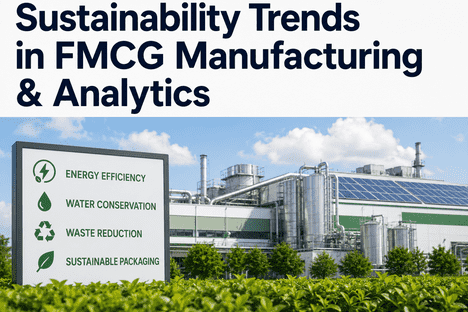
The sustainability director at a mid-size FMCG company operating six production facilities across Germany, France, and Poland reviews the quarterly ESG data package assembled for the EU Corporate Sustainability Reporting Directive (CSRD) disclosure and confronts a compliance gap that has consumed 1,400 hours of engineering, quality, and finance team time over the past 12 months — Scope 1 and Scope 2 emissions data is compiled from utility invoices entered manually into a spreadsheet by the finance team at each plant, with a 47-day lag between month-end and data availability. Waste generation data is aggregated from waste hauler manifests that arrive in paper format and require manual data entry by the environmental coordinator at each site. Water consumption data from production processes is estimated rather than metered at the process level because the plant's water meters measure total facility intake without sub-metering by production line or cleaning operation. Energy intensity per ton of production — a mandatory CSRD metric under ESRS E1 — cannot be calculated at the product category level because the plant's energy management system tracks total facility kWh without allocating consumption to individual production lines or SKUs. The company's CSRD readiness assessment reveals that 60 percent of the required ESRS datapoints cannot be populated from existing data systems with the audit-ready data quality required for mandatory assurance under the European Single Electronic Format (ESEF) taxonomy. iFactory's ESG Analytics and Sustainability Reporting module gives FMCG sustainability, engineering, and finance teams the digital infrastructure to collect, validate, and report CSRD-mandated sustainability data from production-level energy, water, waste, and emissions sources — with automated data ingestion from utility meters, waste management systems, and production databases, audit-ready data lineage for every datapoint, and direct ESRS taxonomy mapping for regulatory submission. Book a Demo to see iFactory's CSRD and ESG reporting platform configured for your FMCG company's sustainability compliance program.
EU CSRD · ESG REPORTING · FMCG · 2026
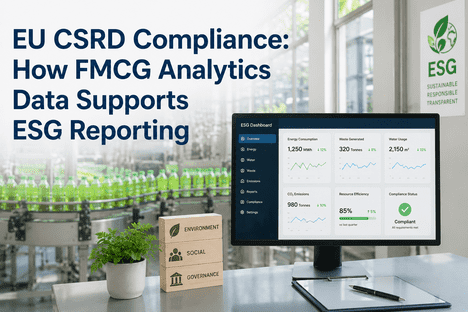
EU CSRD and ESG Reporting Using FMCG Analytics Data
Energy · water · waste · emissions · all mapped to ESRS taxonomy with audit-ready data lineage from production-level sources via iFactory's ESG analytics platform.
◉
Energy & Emissions
Scope 1, 2, 3 · energy intensity · renewable share · ESRS E1
⌹
Water & Effluent
Water intensity · discharge quality · water stress · ESRS E3
▤
Waste & Circular Economy
Waste generation · diversion rate · packaging · ESRS E5
⟐
Supply Chain
Scope 3 · supplier ESG · raw material footprint · ESRS E2
Why the EU CSRD Creates an Urgent Data Infrastructure Requirement for FMCG Manufacturers
The EU Corporate Sustainability Reporting Directive (CSRD), effective for the 2025 reporting year for the first wave of in-scope companies and phased in through 2029 for smaller entities, represents a fundamental shift in sustainability reporting requirements for FMCG manufacturers operating in or selling into the European Union. Unlike the previous Non-Financial Reporting Directive (NFRD), which allowed qualitative descriptions and estimated data for most environmental metrics, the CSRD requires quantitative datapoints reported under the European Sustainability Reporting Standards (ESRS) with mandatory limited assurance — progressing to reasonable assurance by 2028. For FMCG companies, the ESRS standards that have the most significant data infrastructure implications include ESRS E1 (climate change and energy), ESRS E2 (pollution), ESRS E3 (water and marine resources), ESRS E4 (biodiversity and ecosystems), and ESRS E5 (resource use and circular economy). Each of these standards requires datapoints that must be derived from production-level source data — energy consumption by fuel type and process, water withdrawal and discharge at the facility level, waste generation by type and disposal method, and emissions calculations based on activity data from production operations.
CSRD DATA CHALLENGES SPECIFIC TO FMCG MANUFACTURING
1
Production-level energy allocation — CSRD requires energy intensity per unit of production activity (ESRS E1-5), but most FMCG plants measure energy at the facility level without sub-metering by production line, cleaning operation, or HVAC system
2
Waste data fragmentation — Waste generation data exists across multiple waste hauler platforms, manifests, and internal tracking systems with inconsistent categorization that prevents accurate ESRS E5 reporting
3
Scope 3 data gaps — FMCG supply chains involve hundreds of raw material suppliers, co-packers, and logistics providers, each with different data maturity and reporting capabilities for Scope 3 emissions (ESRS E1-6)
4
Assurance-ready data lineage — The CSRD's mandatory assurance requirement means every reported datapoint must have documented data lineage from source system to disclosure — impossible with spreadsheet-based data collection
Five CSRD and ESG Data Capabilities iFactory Delivers for FMCG Manufacturers
The following five capabilities represent the highest-impact applications of iFactory's ESG analytics platform for FMCG companies preparing for CSRD compliance. Each capability addresses a specific data challenge identified in the ESRS disclosure requirements and delivers audit-ready data with automated collection, validation, and taxonomy mapping.
01
Automated Energy and Emissions Data Collection with Production-Level Allocation
iFactory connects to utility meters, production equipment power monitors, and facility energy management systems to collect energy consumption data at the production line, process, and facility level — automatically allocating energy consumption to production volume, product category, and shift for ESRS E1 energy intensity calculations. The platform calculates Scope 1 emissions from on-site fuel combustion (natural gas, propane, diesel for generators and forklifts) using EPA or IPCC emission factors and Scope 2 emissions from purchased electricity and steam using location-based and market-based methods per the GHG Protocol. Emissions data is mapped directly to the ESRS E1 taxonomy datapoints with full audit trail from meter reading to disclosure value.
ESRS E1Scope 1, 2, 3Energy intensity
02
Water Consumption and Discharge Monitoring with ESRS E3 Mapping
iFactory's water analytics module collects water consumption data from facility and process-level water meters, cooling tower make-up and blowdown monitoring, CIP system water usage tracking, and wastewater discharge monitoring — calculating water intensity per ton of production and per product category as required by ESRS E3-4. The platform tracks water withdrawal by source (municipal, groundwater, surface water) and discharge by receiving water body and treatment level, with automated alerts for consumption anomalies that may indicate leaks or equipment inefficiencies. Water data is mapped to ESRS E3 taxonomy datapoints with full audit trail.
ESRS E3Water intensityDischarge quality
03
Waste Generation and Circular Economy Analytics with ESRS E5 Mapping
iFactory integrates with waste hauler management platforms, on-site waste tracking systems, and production yield data to collect waste generation data by type (organic, plastic, paper, metal, hazardous), by disposal method (recycling, composting, incineration, landfill), and by production source (raw material waste, production scrap, packaging waste, finished product waste). The platform calculates waste diversion rates, waste intensity per ton of production, and circular material usage rates as required by ESRS E5-2 through E5-5, with automated waste data validation against hauler manifests and production records.
ESRS E5Diversion rateCircularity
04
Supply Chain and Scope 3 Emissions Data Management with Supplier Engagement Workflows
iFactory's supply chain ESG module manages Scope 3 emissions data collection across the FMCG company's supplier network — tracking upstream emissions from raw materials (category 1), purchased goods and services (category 2), upstream transportation (category 4), waste generated in operations (category 5), and downstream emissions from distribution and retail (category 9). The platform provides supplier-facing data collection portals, automated emission factor application based on spend data or supplier-specific data, and supplier ESG scorecards that track data submission compliance and emissions reduction progress.
Scope 3Supplier engagementESRS E1-6
05
Integrated CSRD Report Generation with ESRS Taxonomy Mapping and Audit Trail
iFactory's CSRD reporting module automates the generation of sustainability statements mapped to the ESRS taxonomy — populating each required datapoint from the platform's validated data sources, documenting the data lineage from source system to disclosure value, and maintaining the audit trail required for limited assurance under CSRD. The platform produces reports in ESEF-compliant XHTML format with XBRL tagging per the ESRS taxonomy, ready for submission through the designated national electronic reporting system.
ESEF XHTMLXBRL taggingAudit trail
ESRS Taxonomy Mapping for FMCG Manufacturing — Standards, Datapoints, and iFactory Coverage
The table below presents the ESRS standards most relevant to FMCG manufacturing operations, the key datapoints required under each standard, and the iFactory platform capability that delivers the source data required for each datapoint with audit-ready data lineage.
ESRS E1 Climate
Scope 1, 2, 3 emissions · energy consumption · energy intensity · renewable energy share · GHG reduction targets
Utility meters · production equipment · fuel logs · purchased electricity data · supplier Scope 3 portal
Full audit trail from meter to ESRS datapoint
ESRS E3 Water
Water withdrawal by source · water discharge by receiving body · water intensity · water stress analysis
Process water meters · wastewater monitoring · CIP system usage · cooling tower monitoring
Full audit trail from meter to ESRS datapoint
ESRS E5 Circularity
Waste generation by type and disposal · waste intensity · circular material usage · packaging waste · product durability
Waste hauler data · production yield · packaging line data · recycling program tracking
Full audit trail from manifest to ESRS datapoint
ESRS E2 Pollution
Emissions to air, water, soil · microplastics · hazardous substances · chemical consumption
CIP chemical usage · wastewater quality · air emission monitoring · chemical inventory system
Full audit trail from sensor to ESRS datapoint
CSRD and ESG Reporting Use Cases Across FMCG Operations
iFactory collects energy consumption data from utility meters, production equipment power monitors, and facility EMS systems at 15-minute intervals — allocating kWh consumption to individual production lines, cleaning operations, HVAC systems, and facility services. The platform calculates energy intensity (MWh per ton of production) at the facility level, production line level, and product category level as required by ESRS E1-5. Energy data is automatically validated against production volume data to identify anomalies — a 15 percent increase in energy consumption with no corresponding increase in production volume triggers an investigation alert for the plant engineering team.
Data SourceUtility meters · power monitors · EMS
ESRS MappingE1-4 · E1-5 · E1-6
Talk to an Expert
iFactory monitors water consumption across all production processes — ingredient water, CIP system water, cooling tower make-up, boiler feed water, and facility sanitation water — with sub-metering at the process level where installed and engineering estimation models where sub-meters are not available. The platform calculates water intensity per ton of production, tracks water withdrawal by source category, and monitors wastewater discharge quality parameters for ESRS E3-4 disclosure. Water consumption trends are correlated with production schedules and CIP cycle frequency to identify optimization opportunities.
Data SourceProcess meters · CIP system · wastewater monitoring
ESRS MappingE3-4 · E3-5 · E3-6
Talk to an Expert
iFactory integrates with waste hauler management platforms and on-site waste tracking systems to collect waste generation data by type, source, and disposal method — enabling ESRS E5-2 through E5-5 disclosure on waste generation, waste diversion, and circular material usage. The platform tracks waste generation at the production line level, correlating waste data with production schedules, raw material lots, and product changeover events to identify the root causes of waste spikes. Packaging waste is tracked separately for ESRS E5-4 packaging disclosure.
Data SourceWaste hauler platforms · production yield · packaging data
ESRS MappingE5-2 · E5-3 · E5-4 · E5-5
Talk to an Expert
What iFactory Delivers for EU CSRD and ESG Compliance
60-80%
Reduction in manual ESG data collection effort
Automated data ingestion from production-level sources
100%
Audit-ready data lineage for every datapoint
Source system to ESRS disclosure with full traceability
90%+
CSRD datapoint coverage from existing data systems
Production data infrastructure leveraged for ESG reporting
12-16 wk
Typical deployment time for CSRD-ready ESG analytics
Multi-site FMCG company with 3-8 production facilities
FAQ
Deploy iFactory for EU CSRD and ESG Reporting in Your FMCG Company
Production-level ESG data collection, validation, and reporting platform connecting energy, water, waste, emissions, and supply chain data to ESRS taxonomy datapoints — with automated data ingestion, audit-ready data lineage, ESEF-compliant report generation, and multi-site deployment support for FMCG manufacturers.
ESRS E1
ESRS E3
ESRS E5
Scope 1, 2, 3
ESEF XHTML