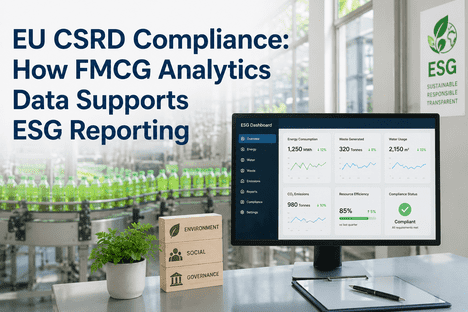
EU CSRD Compliance: How FMCG analytics Data Supports ESG Reporting

By Seren on June 9, 2026

eu-csrd-compliance-fmcg-analytics-esg-reporting-url.png_optimized_300

The sustainability director at a mid-size FMCG manufacturer reviewed the first draft of the EU CSRD compliance report. The company had invested in energy-efficient motors, solar panels, and a wastewater treatment plant. The facility had reduced energy consumption by 18 percent over three years and cut landfill waste by 34 percent. But the CSRD report required something more than aggregate annual numbers. It required documented evidence linking specific equipment analytics data to Scope 1 and Scope 2 emissions calculations, with auditable methodologies for each data point. The facility had the data — energy meters, waste tracking records, equipment efficiency logs — but the data was scattered across disconnected systems and had never been structured for ESG reporting. Without a systematic analytics program that maps equipment data directly to CSRD disclosure requirements, the sustainability director faced the prospect of manual data compilation across dozens of spreadsheets, with the risk that the auditor would reject the methodology as insufficiently documented. This guide covers how FMCG manufacturers can use existing equipment analytics data — energy consumption tracking, waste reduction metrics, and equipment efficiency monitoring — to meet EU CSRD compliance requirements, and how iFactory AI's ESG reporting and energy tracking modules automate the data collection, methodology documentation, and disclosure report generation that the regulation demands.

EU CSRD COMPLIANCE · ESG REPORTING · FMCG ANALYTICS
How FMCG Analytics Data Supports EU CSRD ESG Reporting Compliance
EU CSRD mandates detailed, audited ESG reporting for FMCG manufacturers. Learn how existing equipment analytics data on energy consumption, waste reduction, and equipment efficiency can be structured to meet CSRD disclosure requirements — and how iFactory AI automates the data collection, methodology documentation, and report generation burden.
The EU CSRD Mandate and Its Impact on FMCG Manufacturers

The EU Corporate Sustainability Reporting Directive (CSRD) came into force in January 2024, with phased implementation beginning in 2025 for the first wave of companies and extending to all large EU and non-EU companies operating in the EU by 2029. For FMCG manufacturers, CSRD represents a fundamental shift in ESG reporting. The directive replaces the voluntary, narrative-based sustainability reporting of the past with mandatory, audited, and data-driven disclosure across the European Sustainability Reporting Standards (ESRS). Each disclosure requirement demands specific, documented data points with auditable methodologies, known as data point mapping. For Scope 1, 2, and 3 emissions, this means linking every reported tonne of CO2 equivalent to a specific calculation methodology and the underlying equipment or process data that generated it. For energy consumption, it means disaggregating total energy use by source, by production line, and by efficiency metric. For waste reduction, it means demonstrating that reported waste diversion rates are calculated from verified weight data rather than estimates.

The challenge for FMCG manufacturers is not that they lack the data. Modern FMCG facilities collect energy consumption data from production line meters, waste tracking data from weigh stations, and equipment efficiency data from CMMS and OEE systems. The challenge is that this data exists in operational systems designed for production management, not for ESG reporting. The CSRD auditor will not accept aggregate annual energy consumption figures pulled from utility bills. They require documented evidence that the reported energy data is accurate, complete, and calculated using a methodology that meets ESRS requirements — with granularity down to the production line, shift, and equipment level where material.

CSRD Readiness Gap: Current State vs iFactory AI Enabled
Data Granularity
Annual aggregates vs Per-equipment, per-shift
Manual
Gap
iFactory AI
Methodology Documentation
25% vs 100%
Manual
Gap
iFactory AI
Audit Evidence Retrieval
Weeks vs Minutes
Weeks
Gap
Min

CSRD Non-Compliance Risk
40-60% vs Below 5%
Manual
Gap
AI

ESG Data Architecture for CSRD Compliance

CSRD compliance requires an ESG data architecture that connects operational equipment data to disclosure requirements through a documented, auditable chain. iFactory AI's ESG reporting and energy tracking modules provide this architecture across four layers — from physical data collection at the equipment level through to auditor-ready CSRD disclosure reports. Each layer generates the documented methodology evidence that CSRD auditors require.

Layer 4
CSRD Disclosure Reports
Structured disclosure reports mapped to ESRS E1 (climate), E2 (pollution), E5 (circular economy), and S1 (workforce) requirements. Auditable data point mapping with methodology documentation. Exportable in auditor-ready format with supporting evidence logs.
Layer 3
Methodology and Calculation Engine
Pre-configured calculation methodologies for Scope 1 and 2 emissions per ESRS, energy intensity calculations per product category, waste diversion rate calculations per EU Waste Framework Directive, and water consumption intensity metrics. Each calculation documented with methodology reference, assumptions, and data source traceability.
Layer 2
ESG Data Aggregation and Validation
Automated ingestion from energy meters, production line sensors, waste tracking systems, water meters, and refrigerant monitoring systems. Data validation rules applied per data stream. Missing data flags and estimation methodology triggers per ESRS data point completeness requirements.
Layer 1
Equipment and Sensor Data Collection
Continuous data collection from energy meters, production equipment PLCs, waste weigh stations, water flow meters, refrigerant leak detectors, and HVAC systems. Data collected via OPC-UA, Modbus, MQTT, and native cloud APIs. All data timestamped with equipment ID and production context.
ESRS Data Point Mapping for FMCG Equipment Analytics

Each ESRS disclosure requirement demands specific data points with documented calculation methodologies. The table below maps FMCG equipment analytics data to the most material ESRS disclosure requirements for food and beverage manufacturers, showing how existing operational data can satisfy CSRD reporting obligations without manual rework.

ESRS
Disclosure
Data Point Requirement
Equipment Analytics Source
E1-1
Energy consumption
Total energy consumption disaggregated by fossil, nuclear, and renewable sources. Energy intensity per net revenue.
Production line energy meters, equipment-level power monitors, HVAC energy tracking, compressed air system power consumption
E1-3
Scope 1 emissions
Gross Scope 1 GHG emissions in tCO2eq. Percentage from regulated emission trading schemes.
Natural gas meter data for boilers and ovens, refrigerant leak detection system data, fleet fuel consumption from telematics
E1-4
Scope 2 emissions
Gross Scope 2 GHG emissions in tCO2eq. Location-based and market-based methodology.
Purchased electricity meter data at facility and production line level. Renewable energy certificate tracking.
E2-2
Pollution emissions
Emissions of air pollutants, water pollutants, and soil pollutants by type and quantity.
Wastewater treatment system monitoring data, stack emission monitoring data, chemical usage tracking from CIP systems
E5-2
Waste reduction
Total waste generated by type and disposal method. Waste diversion rate. Circular material usage rate.
Scrap tracking from production lines, packaging waste weigh station data, recycling and composting diversion records
S1-6
Workforce health
Health and safety metrics including injury rates, absenteeism, and occupational disease incidents.
Near-miss and incident reporting data from safety management system, equipment safety inspection records
Energy Consumption Analytics for CSRD Scope 1 and Scope 2 Reporting

Energy consumption data is the foundation of Scope 1 and Scope 2 emissions reporting under ESRS E1. The regulation requires that energy data be disaggregated by source type, verified against metered consumption, and calculated using a methodology that is documented and auditable. Most FMCG facilities collect energy data at the facility level from utility meters, but CSRD requires granularity at the production line and equipment level where energy consumption is material to the disclosure. A facility that operates three production lines with different energy intensity profiles must report each line's consumption separately if the difference affects the overall energy intensity calculation.

iFactory AI's energy tracking module automates this granular energy data collection by connecting directly to production line energy meters, equipment-level power monitors, and facility HVAC and compressed air systems. The platform automatically disaggregates total facility energy consumption by production line, by equipment category, and by shift, matching each energy data point to the production output data required for the energy intensity calculation. The methodology for each allocation — whether based on measured consumption, submeter allocation, or engineering estimation — is documented automatically with the data point, providing the auditable methodology trail that ESRS requires. When the CSRD auditor requests evidence that the reported Scope 2 energy consumption of 12,400 MWh is accurate, the platform provides the meter data, the allocation methodology, and the calculation within minutes rather than the weeks that manual compilation would require.

Before deploying iFactory AI for CSRD compliance, our sustainability team spent approximately six weeks per year compiling energy data from utility bills, production line meters, and equipment logs into a format that could be used for ESG reporting. The first CSRD-level audit identified three methodology gaps — our Scope 1 emissions calculation for refrigerant leakage was using estimated rather than metered data, our energy allocation between production lines was based on production hours rather than measured consumption, and our waste diversion rate calculation was not fully documented. iFactory AI's platform addressed all three gaps within the first quarter. The energy tracking module connected directly to our line-level meters, the refrigerant monitoring system integrated with the emissions calculation engine, and the waste tracking module automated the diversion rate calculation with complete methodology documentation. Our next CSRD audit closed with zero findings.

Sustainability Director, Confectionery Manufacturer, Germany
Waste Reduction Analytics for ESRS E5 Circular Economy Disclosures

ESRS E5 requires detailed disclosure of waste generation, waste diversion, and circular material usage. For FMCG manufacturers, this means tracking waste at each production stage — raw material waste, packaging waste, process waste, and finished product waste — and reporting diversion rates by disposal method. The equipment analytics data that supports waste reduction reporting comes from multiple sources that most facilities already monitor but have never integrated for ESG purposes.

01
Production Scrap Tracking
Automated scrap data collection from production line sensors, checkweighers, and quality inspection stations. Scrap categorised by type, product, and cause code with timestamp and quantity.
02
Packaging Waste Monitoring
Packaging waste weigh station data integrated with production scheduling system. Waste categorised by material type for recycling diversion reporting per ESRS E5 requirements.
03
Diversion Rate Calculation
Automated diversion rate calculation per ESRS methodology. Waste disposal method tracked by weight and category. Recycling, composting, and energy recovery diversion documented separately.
Equipment Efficiency Analytics for CSRD Impact Reporting

CSRD requires not just disclosure of ESG metrics but also disclosure of how the company is managing the transition to a sustainable economy — including the role of technology and operational improvements. Equipment efficiency analytics provides the documented evidence that the facility is actively reducing its environmental impact through operational improvements. OEE tracking demonstrates that the facility is increasing productive output per unit of energy consumed. Preventive maintenance analytics show that equipment is maintained to operate at peak efficiency, reducing energy waste and unplanned downtime. CIP analytics demonstrate that cleaning processes are optimised for minimum chemical and water consumption while maintaining food safety standards. Each of these analytics streams generates data that directly supports the CSRD requirement to disclose how the company is managing material sustainability impacts.

iFactory AI's ESG reporting module connects equipment efficiency analytics directly to the CSRD disclosure framework. OEE trends are mapped to the energy intensity calculation — when OEE improves by 5 percent, the platform automatically recalculates the energy intensity per unit of production, documenting the methodology and the data sources used. Preventive maintenance completion rates are reported as evidence of operational management of sustainability impacts under ESRS E1. Water and chemical consumption trends from CIP analytics are mapped to E2 pollution disclosure requirements. The platform generates a complete CSRD evidence package that includes the equipment analytics data, the calculation methodology, and the data source traceability for every disclosed metric.

Before vs After: CSRD Compliance Preparation Metrics

The transition from manual CSRD compliance preparation to automated analytics-driven reporting is measurable across five key metrics that sustainability directors track. Each metric reflects a direct operational improvement from deploying iFactory AI's ESG reporting and energy tracking modules.

CSRD Report Preparation Time
6-8
Weeks Manual
->
1
Week Automated
Data Granularity
Annual
Facility-level Aggregates
->
Per Shift
Equipment-level Granularity
Methodology Documentation
25%
Methodology Gap
->
100%
Full Documentation
Audit Evidence Retrieval
2-3
Weeks Retrieval
->
5
Minutes On-Demand
Deployment Timeline to CSRD-Ready ESG Reporting

iFactory AI's ESG reporting and energy tracking modules deploy on existing equipment and sensor infrastructure without new meters, controllers, or data collection systems. The first CSRD-ready ESG reports are typically available within four to six weeks of deployment.
Week 1-2
Data source identification and connection. Energy meters, waste tracking systems, refrigerant monitoring, and production data connected to platform. Data validation rules configured.
Connected
Week 3-4
ESRS data point mapping configured. Calculation methodologies applied per disclosure requirement. Historical data baseline established. Shadow validation against prior ESG reports.
Mapped
Week 5-6
First CSRD disclosure report generated from live data. Methodology documentation complete. Data point traceability verified. Report exported in auditor-ready format.
Audit-ready
Week 7+
Continuous ESG data monitoring. Quarterly and annual CSRD reports generated automatically. New disclosure requirements incorporated as ESRS standards evolve.
Continuous
Start Your CSRD Compliance Journey
Turn Your Equipment Analytics Data into CSRD-Compliant ESG Reports
iFactory AI's ESG reporting and energy tracking modules connect to your existing equipment analytics data to automate CSRD compliance — from data collection through methodology documentation through auditor-ready disclosure reports.
Frequently Asked Questions

CSRD replaces the Non-Financial Reporting Directive (NFRD) with significantly expanded requirements. The key differences are mandatory third-party audit of sustainability information, detailed data point mapping to European Sustainability Reporting Standards (ESRS), digital tagging of reported information for the European Single Access Point, and materiality assessment requirements that include both financial materiality and impact materiality. Under NFRD, many FMCG companies provided narrative sustainability reports with limited quantitative data. Under CSRD, every material disclosure must be supported by auditable quantitative data with documented calculation methodologies. The equipment analytics data that powers iFactory AI's ESG reporting module directly addresses this requirement by providing the granular, documented data that CSRD auditors require. Book a Demo to see how the platform maps your facility's equipment data to specific CSRD disclosure requirements.

Yes, provided the meter data meets CSRD requirements for accuracy, completeness, and methodology documentation. Most FMCG facilities have utility-grade electricity meters at the facility level and submeters on major production lines and equipment. The key requirement for CSRD is that the consumption data can be disaggregated by source type, matched to the correct emission factors, and audited back to the original meter reading. iFactory AI's energy tracking module connects to existing meters via OPC-UA, Modbus, and cloud APIs, automatically ingests consumption data, applies the appropriate emission factors based on the facility's location and utility provider, and documents the methodology for each data point. For facilities without submetering on specific production lines, the platform supports engineering estimation methodologies with documented assumptions as permitted by ESRS. Talk to an Expert to assess your existing metering infrastructure for CSRD readiness.

Scope 3 emissions reporting under ESRS E1 requires disclosure of upstream and downstream value chain emissions, including purchased goods and services, transportation, and product end-of-life treatment. iFactory AI's platform supports Scope 3 data collection through integration with supplier data portals, transportation management systems, and lifecycle assessment databases. For FMCG manufacturers, the most material Scope 3 categories are typically purchased raw materials and packaging (Category 1), upstream transportation (Category 4), and product end-of-life treatment (Category 12). The platform allows suppliers to submit emissions data through a secure portal, applies emission factor calculations where supplier-specific data is not available, and documents the data quality rating per ESRS requirements. The platform also integrates with iFactory AI's delivery operations management module for transportation-related Scope 3 data from owned and contracted fleets. Book a Demo to see the Scope 3 data collection workflow configured for your specific supply chain structure.

CSRD does not require that facilities have submetering on every production line. The standard requires that the reported data is accurate, complete, and that the methodology for any allocation or estimation is documented and auditable. For facilities without granular energy metering, iFactory AI supports allocation methodologies based on production hours, equipment power ratings, and production throughput. These estimation methodologies are permitted under ESRS provided the assumptions are documented and the estimation uncertainty is disclosed. The platform also supports phased sensor deployment, starting with facility-level meter data and progressively adding submetering as the facility's ESG data infrastructure matures. Each methodology change is documented in the platform's methodology log, providing the auditor with a complete history of how the ESG data infrastructure has evolved. Talk to an Expert to discuss a phased CSRD data infrastructure plan for your facility.

Data quality for CSRD audit purposes is ensured through four mechanisms built into the ESG reporting module. Automated validation rules check each data stream for completeness, range validity, and consistency against historical baselines. Missing data is flagged automatically and the estimation methodology is documented per ESRS requirements. Methodology documentation is generated for each data point, including the data source, calculation method, assumptions, and any allocation or estimation applied. Data point traceability is maintained from the ESG disclosure report back to the original meter reading or sensor data point. Audit trail immutability is ensured through encrypted storage with cryptographic timestamps and role-based access control. The platform also generates a data quality assessment report that the CSRD auditor can review as part of the audit evidence package. Book a Demo to see the data quality dashboard and audit trail functionality in action.

CSRD Compliance Is Not Optional. Turn Your Equipment Analytics Data Into Audit-Ready ESG Reports.
iFactory AI's ESG reporting and energy tracking modules connect to your existing equipment analytics data — energy meters, waste tracking, production monitoring — and automate the data collection, methodology documentation, and disclosure report generation required for EU CSRD compliance. Purpose-built for FMCG manufacturers.

Share This Story, Choose Your Platform!