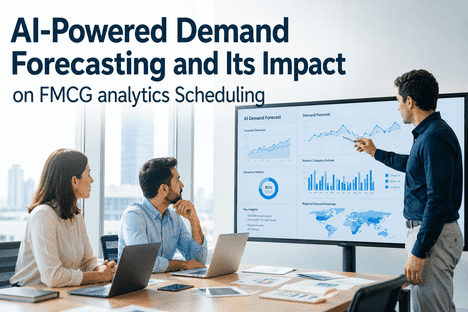
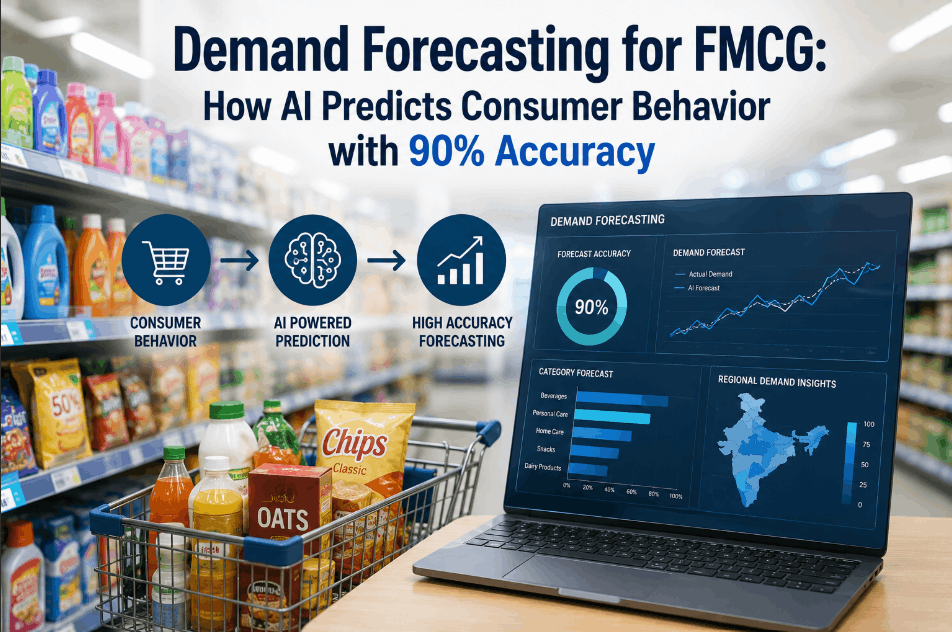
In the fast-moving consumer goods industry, the difference between profit and loss often comes down to one question: how accurately can you predict what customers will buy next week? Traditional forecasting methods have served FMCG companies for decades — but in today's volatile, data-saturated markets, they are quietly failing. AI-powered demand forecasting is rewriting the rules, and the gap between early adopters and late movers is already widening fast.
The Structural Limits of Legacy Forecasting
Most traditional FMCG forecasting relies on historical sales data, moving averages, and seasonal patterns. These models assume that the future will largely resemble the past — an assumption that is increasingly unsafe. A sudden promotional spike, a competitor's price cut, a weather event, or a viral social media trend can invalidate months of baseline planning overnight. When your forecasting tool cannot ingest these signals in real time, you are always reacting instead of anticipating.
Traditional models rely almost exclusively on historical sales figures, ignoring promotions, economic indicators, and market shifts.
Forecast revisions happen on weekly or monthly cycles — far too slow for FMCG supply chains where demand can shift in hours.
Planners spend excessive time manually correcting forecasts, introducing human bias and compounding errors across the supply chain.
Sales, inventory, and logistics data often live in separate systems — preventing a unified view that accurate forecasting demands.
If your planning team is spending more time correcting forecasts than acting on them, it may be time to explore how AI can change that picture. Get support from the iFactory team to understand where AI can close your forecasting gap.
AI Forecasting vs. Traditional Methods
What Better Forecasting Delivers for FMCG Brands
The numbers behind AI adoption in demand planning are compelling. According to McKinsey research, AI-driven forecasting translates directly into operational and financial outcomes that matter to every FMCG manufacturer and distributor.
Beyond the numbers, AI forecasting changes how production scheduling works. When demand signals are accurate and updated in real time, manufacturers can align raw material procurement, line capacity, and logistics planning weeks ahead — reducing last-minute scrambles, overtime costs, and waste from expired or unsold stock. Get support to see how iFactory integrates demand intelligence into your production workflows.
AI Demand Intelligence Built for Manufacturing
iFactory brings AI demand forecasting directly into the manufacturing intelligence layer — where forecast data should always have lived. Instead of managing demand signals in a separate planning tool and manually translating them into production schedules, iFactory connects forecast outputs to shop floor execution in real time.
iFactory processes historical sales, promotional calendars, seasonal patterns, and external market signals together — not just last quarter's numbers.
Forecasts are generated at individual product, region, and channel level — giving planners actionable granularity rather than broad category estimates.
When demand signals shift, iFactory automatically flags production schedule adjustments, helping teams respond before shortages or surpluses occur.
Every new data point — a promotional outcome, a supply disruption, a seasonal deviation — is fed back into the model, improving accuracy with every cycle.
Stop Reacting. Start Predicting.
See how iFactory's AI-powered demand intelligence can reduce your forecast errors, optimize production scheduling, and cut inventory waste — in one connected platform.
Book a Free DemoWhy Seasonality Demands More Than Spreadsheets
FMCG is defined by seasonal volatility — festival surges, weather-driven category spikes, school calendars, and promotional windows that compress and expand demand in unpredictable ways. Traditional models handle seasonality by applying fixed multipliers from prior years. AI models handle it by continuously reading current signals: what is trending on social media, how similar weather conditions affected sales historically, and how current promotional spend compares to baseline.
AI models factor in regional festival calendars, year-over-year purchasing behavior shifts, and promotional uplift to build event-specific forecasts that are far more precise than multipliers alone.
For beverages, personal care, and food categories, weather correlation is significant. AI incorporates forecast weather data directly into demand predictions weeks in advance.
AI quantifies historical promotional uplift by SKU, channel, and region — allowing planners to build production buffers that match actual expected volume, not conservative guesses.
Managing seasonal complexity across hundreds of SKUs and multiple channels is where traditional spreadsheet-based forecasting simply breaks down. Get support from iFactory to explore AI-driven seasonal demand solutions built for FMCG scale.
What FMCG Teams Ask Most
From Forecast to Factory Floor — In One Platform
iFactory connects AI demand intelligence with production scheduling, inventory planning, and supply chain execution. Book a demo and see the full picture in 30 minutes.
Book a Free Demo