Unified namespace for FMCG plants: the infrastructure that makes real AI possible
By Riley Quinn on March 20, 2026
Your FMCG plant has dashboards showing OEE at 68%. It has sensors on every filling line. It has an MES that tracks batch records and an ERP managing production schedules. Yet when you ask your team why Line 3 had micro-stoppages during last night's shift, the answer takes three days and four spreadsheets to assemble. The dashboards are real-time. The insights are not. This is the silent killer of AI in food and beverage manufacturing: data lives in silos across PLC, SCADA, MES, and ERP systems that don't share a common language. A Unified Namespace (UNS) fixes this at the architecture layer—creating a single real-time data broker that every AI model, dashboard, and operator reads from simultaneously.
68%
Rank data silos as top challenge
70%+
Industrial data remains trapped
95%
Say integration blocks AI adoption
10.3x
ROI with strong data integration
The Data Spaghetti Problem in FMCG Plants
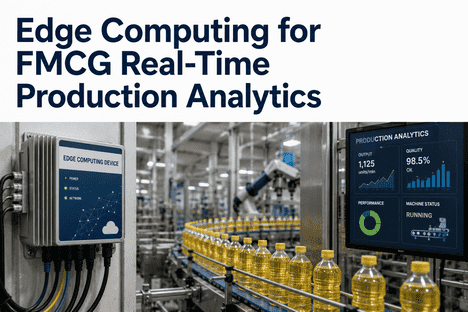
Walk into any food manufacturing plant built before 2015, and you'll find the same architecture: PLCs talking to SCADA, SCADA reporting to MES, MES syncing with ERP—each connection a custom point-to-point integration. Add a new quality system? Build another bridge. Want AI to predict equipment failures? Good luck getting vibration data from the PLC and maintenance history from the CMMS into the same model. This is what industry experts call "data spaghetti," and it's why 74% of companies struggle to achieve and scale AI value despite widespread adoption.
Current State
Point-to-Point Integration
N×(N-1)/2 connections needed
Data locked in each system
New integrations take months
Unified Namespace
Hub-and-Spoke Architecture
Only N connections needed
Single source of truth
Add systems in hours
Struggling with disconnected systems blocking your AI initiatives? Schedule an architecture assessment to see how UNS can unify your plant data.
What Is a Unified Namespace?
A Unified Namespace is a centralized data architecture that acts as a single source of truth for all operational and business data in your plant. Instead of each system maintaining its own data store with custom connections to other systems, every device, application, and AI model publishes and subscribes to a central message broker—typically using MQTT protocol. The UNS isn't just a database; it's a real-time representation of your entire operation's current state, organized in a semantic hierarchy that mirrors your physical plant structure.
The UNS Architecture Stack
How data flows from sensors to AI in a unified architecture
05
Intelligence Layer
AI/ML models, predictive analytics, digital twins consume real-time data
AI ModelsAnalyticsDigital Twins
04
Application Layer
MES, ERP, CMMS, and dashboards subscribe to relevant topics
MESERPCMMSDashboards
03
Unified Namespace
MQTT broker organizes all data in semantic hierarchy
MQTT BrokerTopic StructureReal-Time State
02
Edge Layer
Protocol converters bridge legacy PLCs to modern MQTT
Edge GatewaysProtocol ConvertersOPC-UA
01
Physical Layer
Sensors, PLCs, SCADA systems generate operational data
SensorsPLCsSCADAEquipment
Why FMCG Plants Need UNS for AI
Food and beverage manufacturing presents unique challenges that make unified data architecture essential. Frequent SKU changeovers, strict food safety requirements, and tight margins mean every minute of downtime and every quality deviation has immediate financial impact. AI can help—but only if it has access to the complete picture.
Real-Time OEE
Without UNS:OEE calculated from shift reports 24+ hours later
With UNS:Live OEE from PLC cycle times + MES schedules + quality data
Predictive Maintenance
Without UNS:Vibration data in one system, work orders in another
With UNS:AI correlates sensor data + maintenance history in real time
Quality Traceability
Without UNS:Batch records require manual correlation across systems
With UNS:Complete batch genealogy auto-linked from raw materials to shipment
Energy Optimization
Without UNS:Energy meters not linked to production schedules
With UNS:AI optimizes energy use based on real-time production state
iFactory's platform integrates with your existing PLC, SCADA, MES, and ERP systems to create a unified data layer—enabling real-time AI predictions without ripping and replacing your infrastructure.
Organizations with strong data integration achieve dramatically better outcomes from their AI investments. The difference isn't the algorithms—it's the data foundation underneath them.
When predictive AI has access to complete equipment data
62% to 78%
OEE improvement range
Food manufacturers with integrated real-time monitoring
Hours to Days
New system integration time
Versus months with point-to-point connections
100%
Data accessibility for AI
Versus 30% with typical siloed architecture
Expert Perspective
"OT has a mess. IT needs data right now. There has to be a common ground between both of them. A Unified Namespace is that bridge—OT decides what type of data is going to get pushed and how it is going to get organized. IT decides how it's going to get consumed, how it is going to be secure, and how it is going to have proper context that all of the smart applications require."
iFactory helps FMCG manufacturers build unified data foundations that make AI work—from predictive maintenance to quality vision to real-time OEE optimization.
What is a Unified Namespace (UNS) in manufacturing?
A Unified Namespace is a centralized data architecture that creates a single source of truth for all operational and business data in a manufacturing facility. It uses an MQTT message broker to organize data from PLCs, SCADA, MES, ERP, and other systems into a semantic hierarchy that mirrors your plant structure. Instead of point-to-point integrations between systems, every device and application publishes and subscribes to this central hub—enabling any person, device, or AI model to access data from anywhere in the organization in real time.
Why do data silos prevent AI from working in FMCG plants?
AI and machine learning models require comprehensive, high-quality data to make accurate predictions. In a typical FMCG plant with siloed systems, over 70% of industrial data remains trapped and inaccessible. For example, predictive maintenance AI needs vibration data from sensors, maintenance history from CMMS, and production context from MES—but if these systems don't share data, the AI only sees a partial picture. Research shows companies with strong data integration achieve 10.3x ROI from AI versus 3.7x for those with poor connectivity.
How long does it take to implement a Unified Namespace?
Implementation timelines vary based on facility complexity, but the modular nature of UNS allows for phased deployment. Initial pilots connecting critical equipment to an MQTT broker can be completed in weeks. The key advantage over traditional integration is speed: once the UNS is established, adding new systems takes hours to days rather than months. Most manufacturers start with high-value use cases like real-time OEE or predictive maintenance and expand from there.
Does UNS require replacing our existing PLC and SCADA systems?
No. A Unified Namespace works alongside your existing infrastructure through edge gateways and protocol converters. These devices translate data from legacy protocols (Modbus, Profinet, OPC-UA, etc.) into MQTT format and publish it to the central broker. Your PLCs, SCADA, MES, and ERP systems continue operating normally—UNS simply creates a unified layer on top that makes all data accessible to modern AI applications without requiring expensive rip-and-replace projects.
What's the difference between UNS and a traditional data historian?
A historian stores time-series data for retrospective analysis—it's a database of what happened. A Unified Namespace is a real-time representation of what's happening right now across your entire operation. UNS uses a publish-subscribe model where data flows instantly whenever changes occur, while historians typically poll systems at intervals. In a complete architecture, the historian becomes one node in the UNS ecosystem, storing historical data while AI models consume the live feed for real-time predictions.