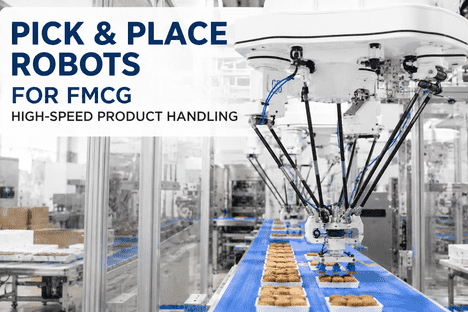
The FMCG (Fast-Moving Consumer Goods) industry operates at a production tempo that few manufacturing sectors can match — high-volume production lines running multiple SKUs per shift, changeover times measured in minutes rather than hours, and throughput targets that leave zero margin for equipment underperformance. At the center of this operational intensity is the pick and place operation: the repetitive, high-speed transfer of products from primary processing to packaging that has historically been the most labor-intensive and ergonomically punishing task on the FMCG plant floor. Pick and place robots — delta robots, SCARA robots, collaborative robots, and high-speed articulated arms — have transformed this bottleneck into a competitive advantage at facilities that have deployed them effectively, delivering sustained pick rates of 150–180 picks per minute for delta robots in confectionery and bakery applications, 60–120 ppm for SCARA in case packing, and 20–60 ppm for cobots in flexible mixed-SKU lines. iFactory AI's next-gen industrial software platform — including Shift Logbook, CMMS, production monitoring, and IoT sensor integration — provides the operational intelligence layer that ensures pick and place robots deliver their rated performance consistently across every shift, every SKU changeover, and every production day. This guide covers the four primary pick and place robot architectures deployed in FMCG today, the economics of robotic automation at FMCG scale, the vision and integration infrastructure that separates high-performing lines from underperforming ones, and how iFactory AI's maintenance and production analytics platform keeps robotic picking operations running at peak OEE.
Pick and Place Robot Architectures: Delta, SCARA, Collaborative, and High-Speed 6-Axis
Each pick and place robot architecture is optimized for a specific region of the FMCG performance envelope — defined by pick rate, payload, reach, cleanliness requirements, and changeover flexibility. Selecting the right architecture for a given application is the single highest-impact decision in any FMCG robotic automation project, and the choice depends on understanding the fundamental mechanical and kinematic tradeoffs that differentiate each platform.
| Parameter | Delta Robot | SCARA Robot | Collaborative Robot | 6-Axis Articulated |
|---|---|---|---|---|
| Sustained Pick Rate | 150–180 ppm | 60–120 ppm | 20–60 ppm | <60 ppm |
| Payload Range | 1–6 kg (specialist up to 15 kg) | 1–20 kg (up to 60 kg) | 3–20 kg | 3–800 kg |
| Repeatability | ±0.10–0.20 mm | ±0.01–0.02 mm | ±0.02–0.05 mm | ±0.03–0.10 mm |
| Acceleration | 10–15 G | 3–5 G | 1–3 G | 1–3 G |
| Working Envelope | 800–1,600 mm diameter | 300–1,200 mm radius | 500–1,300 mm radius | 500–4,200 mm radius |
| Hygiene Rating | IP65–IP69K, stainless steel | IP54–IP67, food-grade options | IP54–IP67 | IP54–IP67 |
| Best FMCG Application | Primary packaging, sorting | Case packing, assembly | Mixed-SKU lines, palletizing | Palletizing, bin picking |
| Capital Cost (Turnkey) | $95K–$205K per cell | $50K–$136K per cell | $30K–$80K per unit | $80K–$250K per cell |
Speed and Throughput Benchmarks: What Pick and Place Robots Actually Deliver in FMCG Production
Published manufacturer specifications for pick and place robots — 200–300 theoretical picks per minute for delta robots — represent peak performance under laboratory conditions. Real-world sustained throughput in FMCG production environments is approximately 75% of theoretical maximum after accounting for product spacing on the conveyor, vision system latency, misfire recovery, and minor pauses. Understanding the gap between rated and sustained throughput is essential for accurate production planning and capital justification. The performance data below reflects sustained production rates documented at operating FMCG facilities rather than manufacturer laboratory specifications.
The efficiency factor — the ratio of sustained production throughput to rated maximum — is a critical design parameter that varies by application and operating conditions. Delta robots in standard confectionery applications typically achieve 75% efficiency (180 ppm sustained from 240 ppm rated). Vision system latency accounts for 8–25 ms per pick cycle, conveyor tracking window constraints reduce available pick time at higher belt speeds, and product position variability on the conveyor adds 3–8% cycle time margin. The practical implication for FMCG facility managers is that line speed targets should be set against sustained throughput benchmarks rather than manufacturer maximum ratings — a delta cell rated at 200 ppm that sustains 150 ppm in production is not underperforming; it is operating exactly as the application physics dictate.
Vision Integration and Conveyor Tracking: The Infrastructure That Enables High-Speed Picking
The mechanical performance of pick and place robots is meaningless without the vision and tracking infrastructure that tells the robot what to pick, where it is, and when it will arrive in the picking window. At FMCG speeds — conveyor belt rates of 30–60 m/minute with products spaced at 50–150 mm intervals — the vision and control system must execute a complete detect-track-pick sequence in 50 ms or less. The architecture that achieves this combines high-speed area-scan cameras, rotary encoders on the conveyor drive, and real-time robot trajectory calculation that intercepts each product at its precise position without stopping the belt.
iFactory AI's platform connects to vision system controllers and robot controllers through standard OPC-UA and REST API protocols — ingesting pick rate data, misfire events, vision rejection rates, and robot utilization into the same production monitoring dashboard that tracks line OEE. When vision calibration drift reduces pick accuracy or robot cycle time degradation extends pick duration, the platform generates maintenance alerts that reach the technician team before the line suffers a throughput-impacting event.
The Economics of Pick and Place Robot Deployment in FMCG: Capital Cost, Payback, and Total Cost of Ownership
The capital justification for pick and place robots in FMCG has shifted dramatically over the past five years. Turnkey deployment costs have dropped 30–40% since 2021 as Chinese OEMs have entered the market with CE/ISO-certified delta and SCARA robots at a 35%+ cost advantage over established brands, while vision system costs have declined as AI-based picking algorithms have reduced the need for custom mechanical tooling and precision fixturing. At current pricing, a single delta cell at $95K–$205K turnkey delivers payback in under 8 months on a three-shift FMCG line and 8–12 months on a double-shift line — making robotic pick and place one of the highest-ROI automation investments available to FMCG facility managers.
Maintenance Strategy for Pick and Place Robots: From Calendar-Based to Condition-Based with iFactory AI
The maintenance profile of pick and place robots in FMCG is fundamentally different from general industrial equipment. Robots accumulate wear as a function of cycles and operating hours, not calendar time — a delta robot that runs 20 hours per day on three shifts accumulates 500,000–1,000,000 pick cycles per month, and each of those cycles stresses timing belts, servo motors, vacuum systems, and joint bearings in a predictable but cumulative pattern. Calendar-based PM schedules that service robots every N months regardless of cycle count either over-servic low-utilization robots or — more critically — under-servic high-utilization robots whose wear accumulation outpaces the calendar schedule. iFactory AI's CMMS platform manages robot maintenance by cycle count and operating hours, with condition-based triggers from torque trending and servo load monitoring that detect developing problems 2–4 weeks before they produce fault codes or throughput degradation. Book a Demo to see how iFactory AI structures robot maintenance programs for multi-vendor FMCG fleets.
Timing Belt and Mechanical Drive Inspection
Delta and SCARA robot timing belts are the single most critical wear component in high-speed pick and place applications — and the most common source of catastrophic unplanned downtime. Timing belt replacement intervals are specified by manufacturers at 6,000–10,000 operating hours, but actual wear rate depends on acceleration profiles, payload utilization, and operating speed. Monthly tension inspection with iFactory AI's CMMS-scheduled work orders ensures belt condition is verified within the interval window. Servo motor bearing degradation is detected through drive current trending — a 10–15% increase in motor current at constant load is a reliable leading indicator of bearing wear that produces a planned replacement event rather than a motor failure during production.
Vacuum System and End-Effector Maintenance
Vacuum cup replacement at 300,000–380,000 cycles is a consumable cost that varies with product surface texture, dust exposure, and cup material selection. iFactory AI's Shift Logbook tracks vacuum cup installation dates and cycle counts — generating replacement work orders at the right interval and maintaining a spare parts inventory with minimum stock alerts that prevent the stockout scenarios that extend downtime. End-effector changeovers for different product SKUs are managed through digitized changeover checklists that verify gripper alignment, vacuum pressure, and pick-point calibration before the line releases for production — eliminating the first-run quality escapes that occur when changeover verification is done from memory rather than from a documented procedure.
Vision System Calibration and Conveyor Tracking
Vision camera calibration drift and conveyor encoder degradation are the most common causes of robotic pick accuracy degradation that does not trigger a fault code — the robot continues picking, but misfire rates climb from 0.2% to 2–3%, and product damage increases as the picking window misalignment causes edge-contact picks or gripper collisions. Monthly camera calibration verification and encoder signal integrity checks — scheduled and tracked through iFactory AI's PM module — prevent the throughput tax that deferred calibration produces. 71% of first-run quality escapes in robotic pick and place operations are traced to TCP (Tool Center Point) calibration drift, which should be verified at every changeover event.
Predictive Analytics and Multi-Vendor Fleet Management
iFactory AI's predictive maintenance module ingests real-time telemetry from robot controllers — joint torque, servo load, motor current, cycle time — and establishes baseline operating profiles for each robot in the fleet. When torque deviation exceeds 8% from baseline or cycle time degrades by more than 5%, the platform generates a condition-based work order automatically, before the degradation produces a throughput-impacting event. For multi-vendor FMCG fleets that include Fanuc, ABB, KUKA, and Universal Robots on the same production floor, iFactory AI provides a unified asset register that applies different PM protocols to each robot brand while presenting a single dashboard view of fleet health, maintenance backlog, and spare parts availability.
How iFactory AI's Platform Manages Pick and Place Robot Operations, Maintenance, and OEE
iFactory AI's platform delivers the operational intelligence layer that FMCG facilities need to ensure pick and place robots deliver their rated performance consistently across every shift. The platform connects to robot controllers, vision systems, and conveyor PLCs through standard industrial protocols — OPC-UA, REST API, and Modbus TCP — ingesting real-time production and maintenance data into a unified dashboard that tracks robot OEE, pick rate trends, misfire rates, maintenance compliance, and spare parts inventory in one place. For facilities running multi-vendor robot fleets — Fanuc deltas alongside ABB FlexPickers alongside Universal Robots cobots — iFactory AI provides a single asset register and PM scheduling engine that applies different maintenance protocols to each robot brand while surfacing a consolidated fleet health view.
Real-Time OEE and Pick Rate Analytics per Robot Cell
iFactory AI's production monitoring module tracks Availability, Performance, and Quality metrics for each pick and place robot cell — with shift-level granularity that distinguishes planned downtime (changeovers, PM) from unplanned stoppages (misfire events, jam recovery, vision system faults). Pick rate trends are displayed in real time against target thresholds: when a delta robot that typically sustains 155 ppm drops to 130 ppm, the platform alerts the production supervisor and maintenance team simultaneously — enabling root cause investigation during the shift rather than after the production loss has accumulated. Vision system rejection rate tracking identifies calibration drift patterns, and multi-robot line balancing analytics highlight utilization disparities across cells on the same conveyor.
Condition-Based and Predictive Maintenance for Robot Fleets
iFactory AI's CMMS module manages robot maintenance on the metrics that actually correlate with wear — cycle counts, operating hours, torque deviation from baseline, and servo load trending — rather than calendar intervals that ignore utilization differences. PM templates for each robot brand (Fanuc, ABB, KUKA, Universal Robots) are configured with brand-specific maintenance tasks, lubricant specifications, and spare part numbers. When a robot controller detects an alarm condition, the platform generates a work order automatically within 90 seconds, assigns it to the appropriate technician based on skill set and availability, and attaches the robot's service history and spare parts list.
Digitized Changeover Management and Spare Parts Optimization
FMCG facilities running 10–50+ SKUs per line per week depend on rapid, error-free changeovers to maintain OEE targets. iFactory AI's Shift Logbook digitizes the changeover process with recipe-based checklists that guide operators through each step — gripper change, vacuum cup inspection, TCP calibration verification, vision system recipe load, and first-article inspection — with mandatory completion fields that prevent the changeover verification gaps that produce first-run quality escapes. Spare parts inventory management tracks robot-specific consumables — vacuum cups, gripper pads, timing belts, servo motors, and encoder batteries — with minimum stock alerts, automatic reorder triggers, and vendor lead time tracking that prevents the stockout scenarios that extend unplanned downtime from hours to days.
Expert Review: Pick and Place Robotics at FMCG Scale — From the Plant Floor
I have been managing packaging operations in FMCG for 18 years — confectionery, snacks, and frozen foods across five facilities — and I have watched pick and place robotics evolve from a technology that required dedicated engineers and custom integration into a standard production tool that any well-organized maintenance team can deploy and sustain. The change that made the difference was not the robot hardware — ABB and Fanuc have been making excellent deltas for years — it was the software infrastructure that connects robot performance data to production planning, maintenance scheduling, and spare parts management. In 2023 we deployed four Fanuc DR-3iB cells on a biscuit line and managed them with paper logs and spreadsheet PM schedules. Pick rates degraded from 165 ppm to 130 ppm over six months, and we could not tell whether the cause was gripper wear, vision calibration drift, or timing belt tension loss — because we had no trend data. In 2025 we deployed the same robot model on a new confectionery line with iFactory AI's platform managing the PM scheduling, OEE tracking, and condition monitoring. The difference is night and day. We see pick rate trends in real time. When torque deviation hits 7%, we get a work order. When a vacuum cup approaches 300,000 cycles, the system orders a replacement before it fails. Our robot OEE on that line has held at 92% for 10 months. The previous line, same robot model, no iFactory platform: 78% OEE. That 14-point gap is worth about $420,000 per year in throughput at that line alone. The platform paid for itself in the first three months.
— Director of Packaging Operations, Multi-National FMCG Company — 18 Years in Confectionery, Snacks, and Frozen Foods — iFactory Reference Customer 2026Frequently Asked Questions
Sustained pick rates for delta robots in FMCG production typically range from 150–180 ppm for standard confectionery and bakery applications, 100–130 ppm for IQF frozen food handling (where heavier payloads and product variability reduce throughput), and 120–160 ppm for beverage case packing. These numbers represent approximately 75% of manufacturer-rated maximum throughput after accounting for product spacing, vision system latency, misfire recovery, and minor production pauses. The efficiency factor is a critical design parameter: a delta cell rated at 200 ppm that sustains 150 ppm in production is operating within normal application parameters. iFactory AI's production monitoring dashboard tracks sustained pick rate per cell in real time, giving you the data to set realistic throughput targets and identify degradation trends before they impact line output.
Payback periods vary by shift configuration and labor market. A single delta cell at $95K–$205K turnkey delivers payback in under 8 months on a three-shift FMCG line, 8–12 months on double-shift, and 14–22 months on single-shift operations. Cobot deployments at $30K–$80K per unit typically pay back in 12–18 months on double-shift case packing. The primary value driver is labor displacement (6–8 workers per shift for a typical high-speed line), with secondary contributions from quality improvement (damage rate reduction from 1–3% to under 0.2%), throughput gains, and reduced ergonomic injury costs.
iFactory AI's platform connects to robot controllers through standard industrial communication protocols — OPC-UA for KUKA, Yaskawa, and Stäubli; FOCAS2 and OPC-UA for Fanuc; OmniCore API for ABB; RTDE and REST API for Universal Robots; ROS 2 DDS topics for ROS-native robots. The platform ingests real-time telemetry (joint torque, servo load, alarm history, cycle counts) and production data (pick rates, misfire events, vision system status) into a unified dashboard. For multi-vendor fleets, iFactory AI provides a single asset register with brand-specific PM protocols, spare parts lists, and maintenance documentation — eliminating the need to train maintenance teams on separate systems for each robot brand.
The four most critical maintenance tasks for pick and place robots are: timing belt inspection and tension verification (belt failure is the most common catastrophic downtime event); TCP (Tool Center Point) calibration verification at every changeover (71% of first-run quality escapes trace to calibration drift); vacuum cup replacement at 300,000–380,000 cycles (failed picks are the most common micro-stop event); and vision camera calibration verification (calibration drift increases misfire rates from 0.2% to 2–3% without triggering a fault code). iFactory AI's CMMS schedules all four tasks on cycle-count or operating-hour triggers, with automatic work order generation and spare parts inventory linkage.
Documented OEE improvement from pick and place robot deployment combined with iFactory AI's CMMS and production monitoring platform is typically 15–25 percentage points over baseline manual operations. The improvement comes from three sources: robotic pick speed and consistency (150–180 ppm sustained versus 40–60 ppm per operator) eliminates the throughput constraint; predictive maintenance and condition monitoring reduce unplanned robot downtime by 41% within 6 months of platform deployment; and digitized changeover management reduces changeover time by 30–45%, recovering productive time on high-SKU-mix lines. Facilities that deploy iFactory AI's platform on existing robot cells (without new robot capital investment) typically see 8–12 percentage point OEE improvement from maintenance optimization and changeover reduction alone.
Conclusion
Pick and place robots are no longer a future automation investment for FMCG manufacturing — they are a present competitive requirement for facilities that need to sustain high-volume production across multiple SKUs with shrinking labor availability and rising quality expectations. Delta robots delivering 150–180 sustained ppm in primary packaging, SCARA robots handling case packing at 60–120 ppm, and collaborative robots providing changeover flexibility for mixed-SKU lines are each proven technologies with documented payback periods that make the capital justification straightforward at current pricing.
The differentiator between facilities that achieve full robotic ROI and those that leave 10–20 percentage points of OEE on the table is the operational intelligence platform that manages the robots. iFactory AI's unified platform — combining Shift Logbook, CMMS, production monitoring, and IoT sensor integration — provides the real-time performance visibility, condition-based maintenance scheduling, digitized changeover checklists, and multi-vendor fleet management that separates high-performing robotic lines from underperforming ones. Deployable in 1–2 weeks without replacing existing robot controllers or vision systems, and delivering documented OEE improvements of 15–25 percentage points at reference facilities. Book a Demo to see iFactory AI's pick and place robot management platform configured for your specific FMCG line profile, robot fleet composition, and production targets.