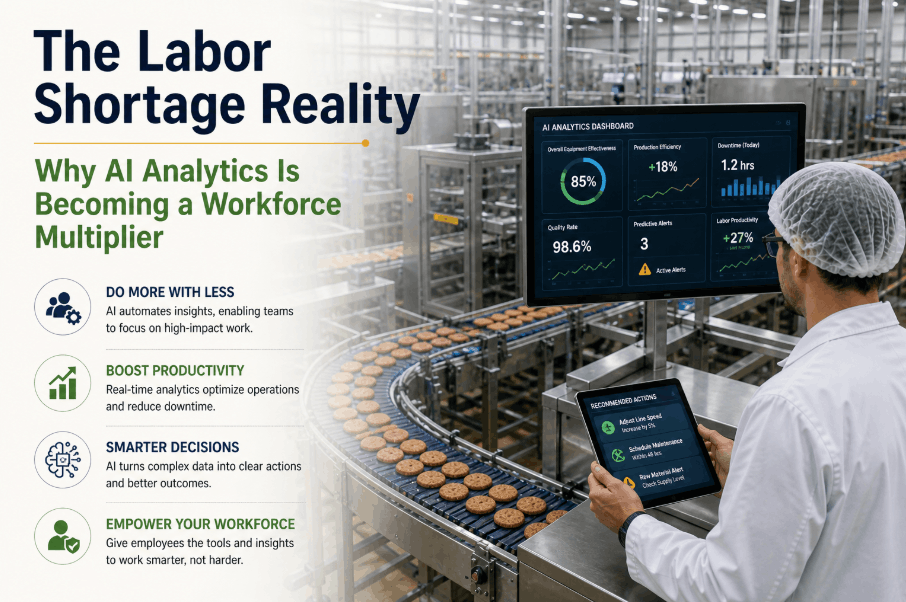
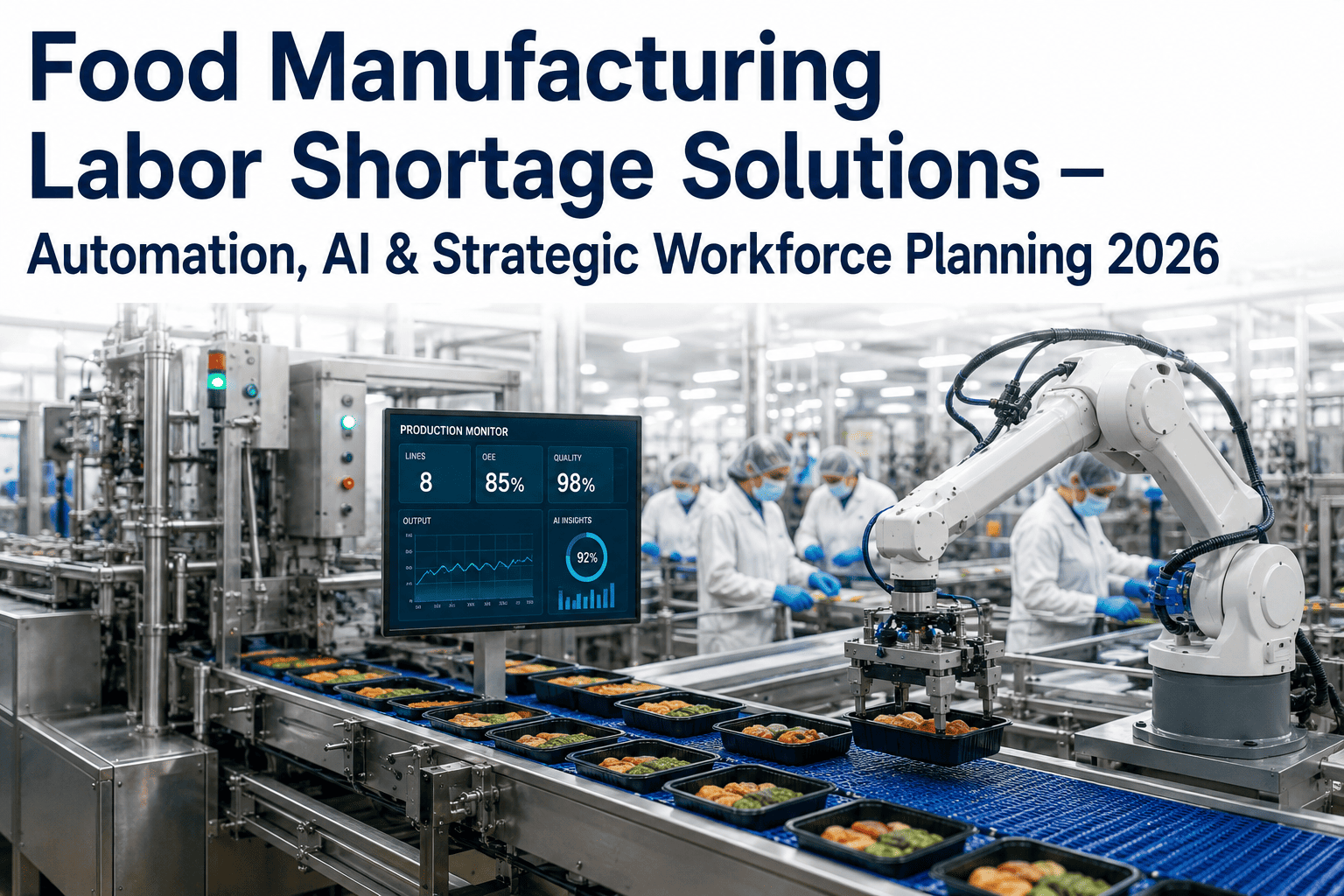
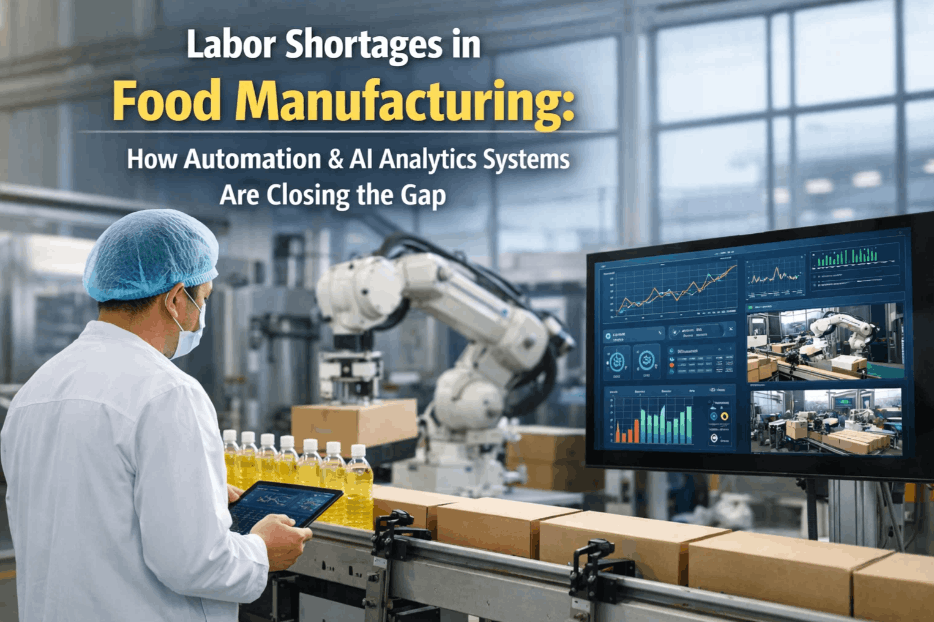
The food manufacturing industry is facing a labor crisis that is not temporary. Retirement waves, workforce attrition, and a shrinking pipeline of skilled maintenance technicians have converged to create a structural gap that cannot be solved by hiring alone. For multi-plant food manufacturers, this means every remaining technician carries more responsibility than ever — and every unplanned failure, missed inspection, or reactive work order costs more than the equipment downtime itself. AI analytics for workforce optimization has emerged as the defining solution: not to replace people, but to multiply the output, precision, and impact of the workforce that exists. Manufacturers who deploy manufacturing workforce analytics platforms are achieving the operational capacity of 30–40% larger teams — without the headcount. Book a demo to see how AI analytics is redefining what a lean maintenance team can accomplish.
AI WORKFORCE ANALYTICS
·
LABOR OPTIMIZATION
·
SMART FACTORY SOFTWARE
Turn Every Technician Into a High-Output Operator — AI Analytics Built for Lean Manufacturing Teams
iFactory's AI-powered workforce optimization platform gives food manufacturers the predictive intelligence, task prioritization, and operational visibility to do more with the team they have — reducing reactive workloads by 40%+ and unlocking capacity without increasing headcount.
The Labor Shortage Is Not a Hiring Problem — It Is an Intelligence Problem
Food manufacturers have spent the last three years attempting to solve the technician shortage through recruitment, compensation increases, and training investments. These efforts have produced modest returns because they are addressing a symptom, not the systemic cause. The deeper problem is that existing technicians are operating without the tools, data, and predictive intelligence that would allow them to work at maximum effectiveness. A technician responding to alarms, manually logging equipment inspections, and prioritizing work orders from a spreadsheet is not the same technician empowered with AI workforce optimization software that surfaces exactly what needs attention, in what order, with the diagnostic context to act fast and accurately.
The shift from reactive to predictive operations is the most powerful workforce multiplier available to food manufacturers today. When industrial IoT analytics detects a developing motor fault before it fails, that technician's 45-minute planned intervention replaces a 6-hour emergency repair, a production shutdown, and the coordination overhead of an unplanned event. Across a facility with 200 critical assets, this multiplier compounds into a fundamentally different operational reality — one where a team of 12 technicians delivers what previously required 18. That is not a technology claim. It is the documented outcome of manufacturers who have deployed purpose-built technician productivity software in food processing environments. To understand how this applies to your specific facility, book a demo with our operations team.
42%
reduction in reactive maintenance workload after AI predictive analytics deployment
3.1x
increase in technician output per shift with AI-driven work order prioritization
67%
faster fault diagnosis when technicians operate with AI-assisted diagnostic tools
$2.3M
average annual labor efficiency value unlocked per facility through AI workforce analytics
Root Causes
Why Skilled Technicians Are Underperforming — And How Workforce Analytics Fixes It
The productivity gap in food manufacturing maintenance teams is rarely a skills problem. It is a systems problem. Talented technicians are spending the majority of their shift on activities that do not require their expertise — administrative logging, chasing parts, attending non-critical alarms, and navigating outdated paper-based workflows. Workforce management software built for manufacturing environments eliminates these drains and redirects technician time toward the high-value diagnostic and corrective work that actually requires their expertise.
Reactive Work Orders Dominate the Shift
Without predictive intelligence, technicians spend 55–70% of shift time responding to failures that could have been prevented. Reactive work is inefficient, stressful, and requires more time per event than planned interventions — degrading both productivity and technician retention.
No Intelligent Work Order Prioritization
Technicians without AI-assisted prioritization make manual triage decisions under pressure. Critical assets get delayed while non-critical tasks consume capacity. This is not a judgment failure — it is a data access failure that labor management software solves directly.
Institutional Knowledge Lives in People, Not Systems
When experienced technicians retire or leave, they take irreplaceable diagnostic knowledge with them. Without a digital workforce management platform that captures and codifies fault patterns, repair histories, and asset behaviors, every departure is a knowledge loss event.
Manual Data Entry Kills Shift Productivity
Time studies in food manufacturing facilities consistently show technicians spending 18–25% of every shift on documentation, logging, and reporting. Production optimization software with automated data capture returns this time directly to productive maintenance activity.
Supervisors Lack Real-Time Workforce Visibility
Maintenance supervisors operating without operational analytics platforms cannot see where technicians are, what they are working on, or whether the highest-priority assets are receiving the right attention. Blind supervision produces misaligned effort at scale.
Training Gaps Slow Newer Technicians
Newer technicians without AI-assisted diagnostic guidance take 3–5 times longer to diagnose complex equipment faults than experienced peers. AI-driven fault analysis closes this gap rapidly — allowing newer staff to perform at near-expert levels within their first months on the floor.
Strategic Framework
How AI Analytics Functions as a Workforce Multiplier in Food Manufacturing
The concept of AI as a workforce multiplier is not abstract. It operates through five specific mechanisms that directly expand what each technician, supervisor, and operations manager can accomplish per shift. Each mechanism addresses a documented productivity drain and replaces it with an intelligence-driven capability that compounds across the entire team. Food manufacturers who have implemented smart factory software with these capabilities report workforce output improvements that rival adding two to four additional full-time technicians — at a fraction of the cost and in a fraction of the time. Book a demo to see each mechanism demonstrated in a live food manufacturing environment.
01
Predictive Work Order Generation — Eliminate Reactive Emergencies
AI models trained on equipment sensor data, vibration analysis, and historical failure patterns generate predictive work orders before failures occur. Technicians receive scheduled interventions with full context — asset history, likely fault cause, required parts — instead of reacting to unexpected breakdowns. This single capability reduces unplanned events by 35–45% and is the foundation of every effective AI workforce optimization program in food manufacturing.
02
AI-Assisted Fault Diagnosis — Cut Mean Time to Repair
When a fault occurs, technicians with AI-assisted diagnostics receive immediate context: probable root cause, similar past events, resolution steps that worked, and parts required. This collapses mean time to repair (MTTR) by 50–65% and eliminates the diagnostic wandering that consumes experienced technician hours on complex failures.
Book a demo to see AI fault diagnosis in action on real food processing equipment.
03
Intelligent Work Order Prioritization — Align Effort With Asset Criticality
Not all work orders are equal, but without AI prioritization, triage relies on supervisor judgment made without real-time asset health data. Manufacturing execution system integrations combined with AI-driven criticality scoring ensure every technician's next task is the one that delivers the most production value — automatically, in real time, without manual decision-making overhead.
04
Automated Documentation and Compliance Logging
AI-powered mobile workflows capture maintenance records, inspection results, and CCP compliance data automatically at point of work — eliminating manual back-office logging. In food manufacturing environments where regulatory documentation is non-negotiable, this capability returns 18–22% of technician shift time to productive maintenance activity while improving data quality and audit readiness simultaneously.
05
Knowledge Capture and Institutional Memory Preservation
Every completed work order, resolved fault, and documented repair decision feeds an AI knowledge base that makes institutional expertise accessible to every technician on the floor. When a 25-year veteran retires, their diagnostic patterns and asset-specific knowledge persist in the platform — making newer technicians permanently more capable and dramatically reducing the operational impact of turnover that previously threatened production continuity.
Workforce Performance: Traditional Operations vs. AI-Powered Analytics
How food manufacturing maintenance teams perform across critical productivity and operational metrics without versus with AI-driven workforce analytics and technician optimization tools.
Food Manufacturing Workforce Analytics Benchmark — 2026
Implementation Insight
What Workforce Optimization Software Actually Looks Like on the Plant Floor
The practical impact of operational efficiency software on daily technician workflows is often underestimated in strategic discussions. The transformation is not theoretical — it reshapes every hour of every shift in specific, measurable ways that compound across the team and across every operating day.
Start-of-Shift Intelligence Briefing
Instead of reviewing paper work orders or verbal shift handoffs, technicians receive AI-generated priority lists ranked by asset criticality, failure probability, and production impact. Every technician starts the shift with a clear, intelligence-driven agenda — not a stack of undifferentiated tasks.
Mobile-First Fault Resolution Guidance
When a technician encounters an unfamiliar fault, the industrial automation software platform surfaces relevant historical repairs, likely root causes ranked by probability, and step-by-step resolution guidance — all accessible on a mobile device at the equipment. Expertise becomes infrastructure, not a person.
Automated Parts and Resource Coordination
Predictive work orders trigger parts availability checks and procurement workflows automatically. Technicians arrive at jobs with the right materials — eliminating the walk-back-to-stores delays that consume 12–18 minutes per unplanned event and cascade into shift-wide productivity losses.
Real-Time Supervisor Operations Dashboard
Maintenance supervisors managing 8–15 technicians across a large food processing facility gain live visibility into work order status, asset health, and team productivity — without walking the floor or interrupting technicians mid-task. Resource planning software at this level transforms supervision from reactive management to proactive optimization.
Enterprise Outcome
AI Workforce Analytics in Practice — A Multi-Plant Food Manufacturer Case
Real-World Result
A mid-size protein processing company operating four facilities across the Midwest deployed iFactory's AI analytics platform after losing eleven experienced maintenance technicians to retirement in a 14-month period. The company faced a functional workforce gap that recruiting could not fill quickly enough. Within 60 days of platform deployment, AI-generated predictive work orders reduced unplanned maintenance events by 38% across all four facilities. The AI fault diagnosis engine reduced average MTTR from 4.8 hours to 1.7 hours — immediately recovering 64 labor hours per week that had been consumed by reactive troubleshooting. Automated documentation workflows eliminated 22% of administrative shift time per technician. The net result: a 13-person maintenance team delivered output equivalent to the 18-person team that had existed before the retirement wave — without a single additional hire. Annual labor efficiency value generated by the platform across all four facilities reached $3.1M in the first operating year.
Selection Guide
Choosing the Right AI Workforce Analytics Platform for Food Manufacturing
The market for workforce management software serving food manufacturers has expanded significantly — but not all platforms deliver the same workforce multiplication effect. The distinction between platforms built for food manufacturing environments and generic industrial tools becomes critically important when evaluating five key capability dimensions. Manufacturers who overlook these distinctions consistently underachieve the ROI that purpose-built platforms deliver, and booking a demo with iFactory's team is the fastest way to see these differences demonstrated against your specific operational requirements.
1
Food-Specific AI Training Data and Failure Pattern Libraries
AI models trained on generic industrial equipment data significantly underperform on food processing assets — mixers, fillers, packaging lines, conveyors, and refrigeration systems have distinct failure signatures. Purpose-built platforms with food manufacturing training data generate prediction accuracy that generic platforms cannot approach.
2
Mobile-Native Technician Interface with Offline Capability
Technicians on the plant floor need access to AI guidance at the point of work — often in areas with limited connectivity. Platforms without offline-capable mobile interfaces fail at adoption, because technicians who cannot access the system at the equipment simply stop using it within weeks of deployment.
3
Integration with Existing CMMS, ERP, and Food Safety Systems
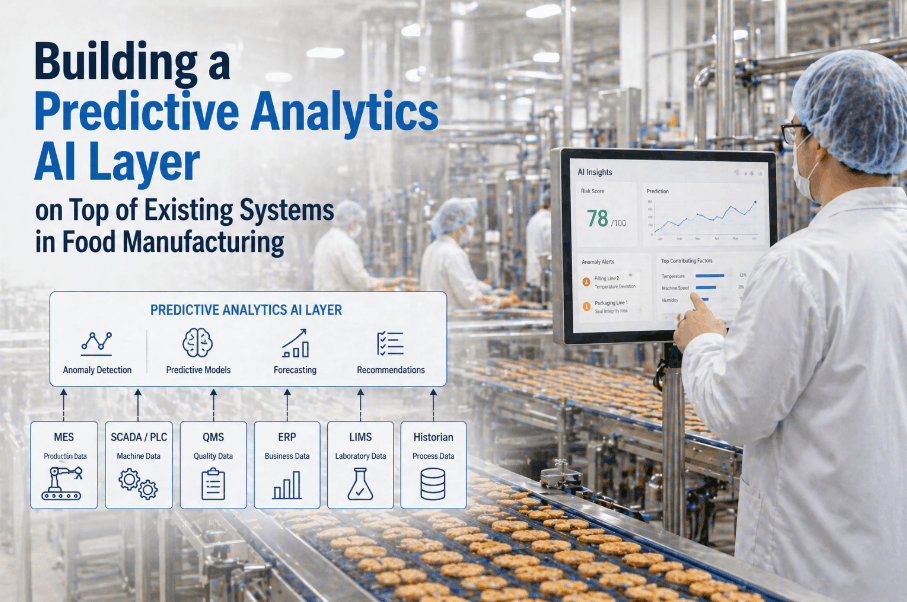
A manufacturing workforce analytics platform that requires replacing existing CMMS or ERP systems faces adoption resistance and extended deployment timelines. Platforms with pre-built connectors for SAP, Oracle, IBM Maximo, and food safety systems deploy in weeks and deliver ROI before systems with replacement requirements even go live.
4
Knowledge Capture Architecture That Scales With Tenure Changes
Platforms that capture diagnostic decisions, repair outcomes, and asset-specific knowledge in structured, searchable formats build institutional intelligence that grows over time. This capability is specifically designed for the labor shortage reality — where knowledge continuity cannot depend on workforce stability that no longer exists.
5
Multi-Plant Workforce Visibility for Enterprise Operations
For food manufacturers operating multiple facilities, enterprise-level workforce analytics visibility — comparing team productivity, reactive work ratios, and MTTR across plants — surfaces optimization opportunities that plant-level tools make invisible. Cross-facility benchmarking of workforce performance is a capability unique to enterprise-architected platforms.
Book a demo to see cross-plant workforce analytics in a live multi-facility environment.
Implementation Roadmap
Deploying AI Workforce Analytics in Food Manufacturing — 90-Day Activation Plan
The most effective deployments of AI workforce optimization platforms in food manufacturing follow a structured activation sequence that delivers measurable technician productivity gains within the first 30 days — building confidence and adoption momentum before full platform capabilities are engaged. This 90-day model has been validated across food manufacturing environments ranging from single-facility operations to twelve-plant enterprise networks.
1
Workforce and Asset Intelligence Baseline (Days 1–21)
Audit current reactive-to-planned work ratios, average MTTR by asset class, and technician shift time allocation. Integrate with existing CMMS and sensor infrastructure. Define AI model training priorities based on highest-impact failure modes and most critical production assets.
Outcome: Baseline workforce metrics established and AI model training initiated
2
Predictive Work Order Activation and Technician Onboarding (Days 22–55)
Deploy AI-generated predictive work orders for the top 20% of critical assets. Onboard technicians on mobile-first diagnostic workflows and automated documentation. Capture early knowledge from experienced technicians to seed the institutional knowledge base with high-value fault resolution data.
Outcome: First measurable MTTR reductions and reactive work order decline visible in data
3
Full Asset Coverage and Workforce Performance Optimization (Days 56–90)
Extend AI coverage to the full asset network. Activate enterprise workforce visibility dashboards for maintenance supervisors and operations leadership. Begin cross-shift performance benchmarking and identify optimization opportunities from accumulated workforce analytics data. Measure and document ROI against baselines set in Phase 1.
Outcome: Full workforce multiplier effect operational, ROI documented and growing
Frequently Asked Questions
AI Analytics as a Workforce Multiplier — Food Manufacturing FAQ
How does AI analytics serve as a workforce multiplier in food manufacturing?
AI analytics multiplies workforce output by eliminating reactive work through predictive maintenance, accelerating fault diagnosis with AI-assisted guidance, automating documentation, and intelligently prioritizing work orders. The result is a team of 12 technicians delivering the output of 16–18 — without additional headcount.
What is the ROI timeline for AI workforce optimization software in food manufacturing?
Most food manufacturers see measurable MTTR reductions and reactive work order decline within 30–45 days of deployment. Full ROI, including labor efficiency value, downtime reduction, and documentation savings, typically materializes within 6–9 months for facilities with 100+ critical assets.
Can AI workforce analytics integrate with existing CMMS and food safety systems?
Purpose-built platforms maintain pre-built connectors for SAP PM, IBM Maximo, Oracle EAM, and food safety systems — deploying on top of existing infrastructure without disruption. Integration depth, not just API compatibility, is the key evaluation criterion for food manufacturing deployments.
How does AI address institutional knowledge loss from technician retirements?
AI platforms capture fault resolution decisions, repair histories, and asset-specific diagnostic knowledge as structured data with each completed work order. This creates an institutional knowledge base that persists independently of workforce tenure — making the organization's collective expertise accessible to every technician indefinitely.
Is AI workforce analytics relevant for smaller food manufacturers with limited budgets?
The workforce multiplier effect of AI analytics actually delivers proportionally higher value for smaller manufacturers, where losing one or two experienced technicians represents a larger percentage of total team capacity. Platform ROI at facilities with 50–200 critical assets consistently exceeds 4–6x annual investment.
How quickly can new technicians reach full productivity with AI-assisted diagnostics?
Food manufacturers report new technician ramp time dropping from 12–18 months to 3–5 months with AI-assisted fault diagnosis and knowledge base access. This acceleration directly addresses the labor shortage impact by making newer hires productive far faster than traditional training programs allow.
AI-POWERED
·
WORKFORCE MULTIPLIER
·
FOOD MANUFACTURING READY
Stop Managing the Labor Shortage. Start Multiplying the Workforce You Have.
iFactory's AI analytics platform gives food manufacturers the predictive intelligence, diagnostic acceleration, and workforce visibility to operate at peak productivity — regardless of headcount constraints. Deploy in 90 days, deliver ROI in under 9 months, and build a maintenance organization that compounds in capability with every passing quarter.