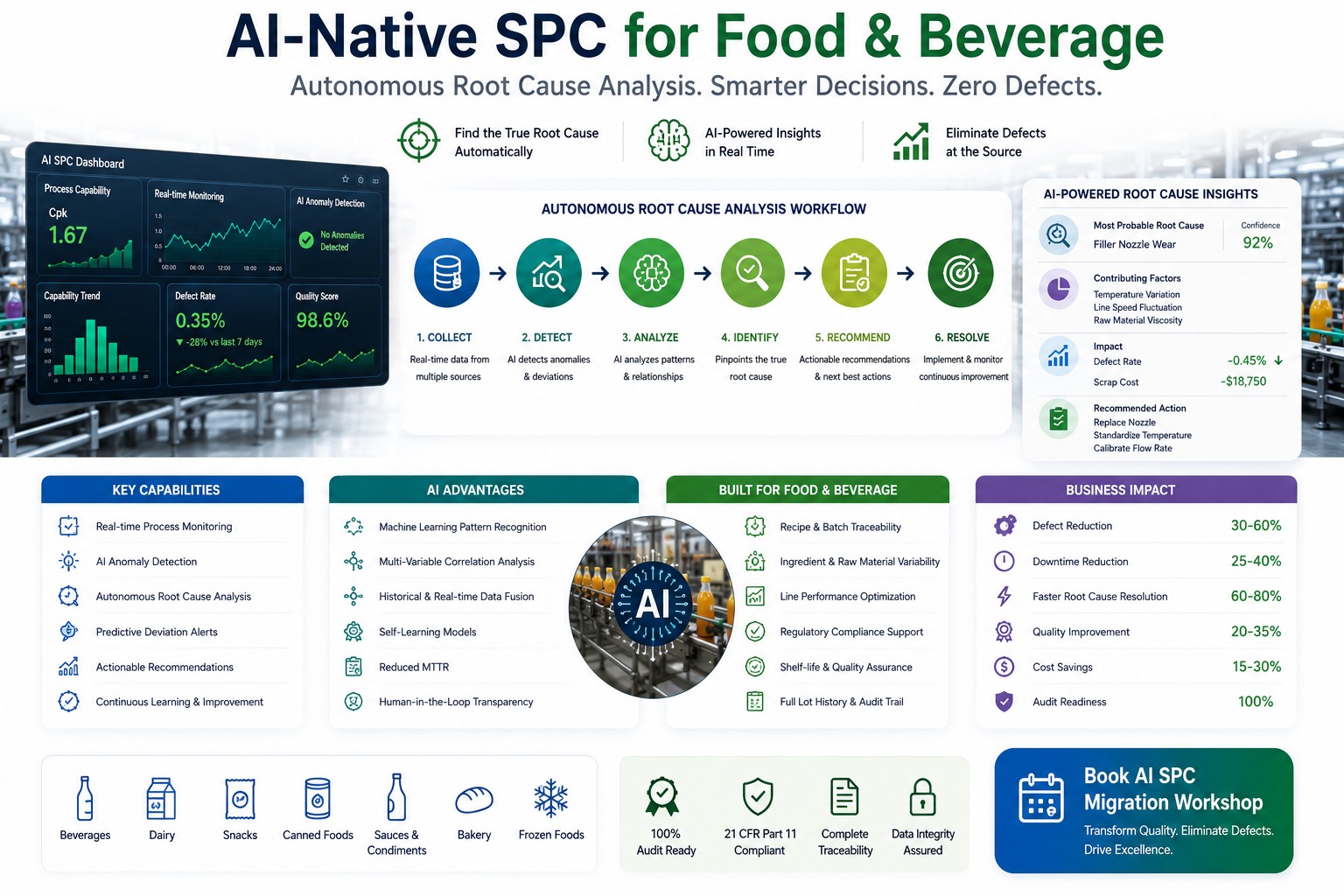
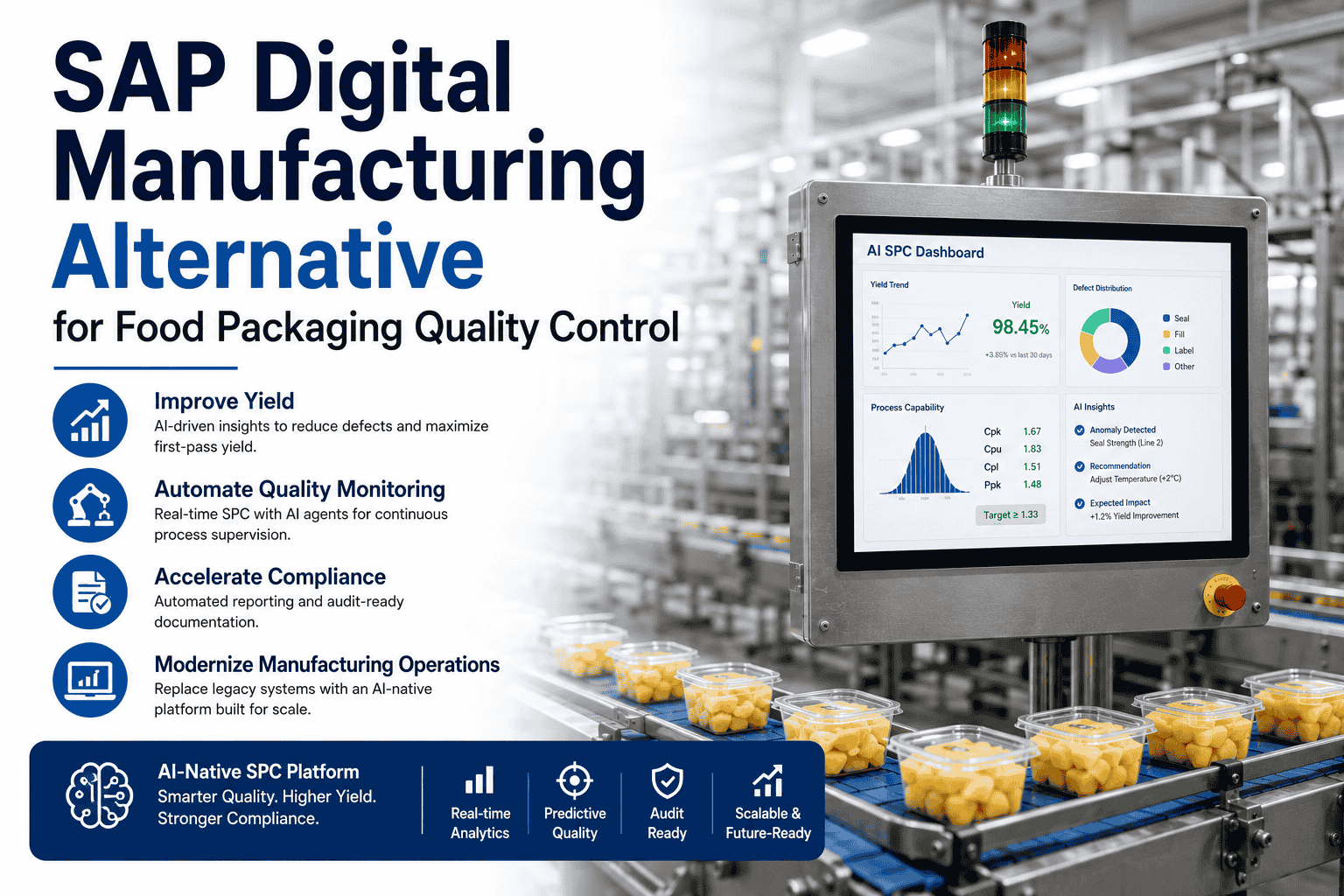
Human root cause analysis is a 5-day investigation. Autonomous root cause analysis is a 30-second pipeline. That gap is why 60% of recurring F&B defect patterns survive in plants running traditional 5-Whys methodology — the investigation simply can't keep up with how fast modern food & beverage lines run, how many variables interact, or how often defects recur before the last CAPA closed out. A modern AI-native SPC platform analyzes 1,000+ variables simultaneously, correlates upstream process signals with downstream defect events, ranks top probable causes by statistical confidence, validates via causal inference, and auto-generates the CAPA — typically in under 30 seconds from anomaly detection. The result for F&B operations: 40-60% reduction in recurring defects in year one, 5-10x more defect patterns detected than human investigators surface, and CAPA closure time compressed from weeks to hours. This guide breaks down the 5-stage autonomous RCA pipeline, where it excels for F&B defect categories, how it differs from traditional 5-Whys methodology, and the 8-12 week implementation roadmap. Book an AI SPC migration workshop for your plant.
Stage 01
Detect
Anomaly identified from sensor stream
< 1 sec
→
Stage 02
Correlate
1,000+ variables analyzed in parallel
< 5 sec
→
Stage 03
Rank
Top 3 probable causes by confidence
< 15 sec
→
Stage 04
Validate
Causal inference confirms root cause
< 30 sec
→
Stage 05
Act
CAPA auto-generated + dispatched
Instant
For Reference
Traditional human-led 5-Whys RCA on the same defect: typically 3-5 days end-to-end · multiple meetings · single hypothesis per round · often misses interaction effects
Why Manual RCA Misses Most F&B Defect Patterns
Traditional 5-Whys methodology and fishbone diagrams were designed for slower manufacturing environments with fewer variables. Modern F&B operations have outpaced them in five specific ways. The result: plants running manual RCA close individual CAPAs but watch the same root patterns generate new defects week after week.
01
Lines Generate More Variables Than Humans Can Track
Modern F&B lines emit 500-2,000 process variables per minute. A 5-Whys team holds 5-7 variables in working memory. The interaction effects that drive 60% of recurring defects live in the variables humans can't track.
02
RCA Speed Can't Keep Up With Defect Speed
A 3-5 day human investigation runs alongside lines producing the same defect for that entire window. By the time the CAPA closes, hundreds of batches have shipped with the unsolved root cause embedded.
03
Human RCA Anchors on Single Hypotheses
5-Whys methodology forces narrowing to one cause per "Why" branch. Autonomous RCA ranks the top 3-5 probable causes by confidence — surfacing the interaction effects single-hypothesis investigation misses.
04
Tribal Knowledge Walks Out the Door
When the experienced operator who knew "this defect always means valve V3 is drifting" retires, that pattern disappears from the plant. AI-native RCA captures patterns in the model — they persist across shifts and generations.
05
Recurring Defects Look Like New Defects
Without pattern-matching across history, the same root pattern returning in slightly different form gets investigated as a brand new defect. AI sees the pattern recurrence; humans see a "new" problem each time.
The 5-Stage Autonomous RCA Pipeline · Detailed
Each stage of the autonomous pipeline replaces what used to be a manual investigation step. The detail below shows what happens at each stage, what data feeds it, and what makes the autonomous version qualitatively different from its human equivalent.
Stage 01
Detect · Real-Time Anomaly Identification
AI-native SPC continuously monitors every sensor and lab data stream. Adaptive control limits detect anomalies in real time — not just threshold breaches, but multivariate pattern deviations that single-variable SPC misses entirely. Detection happens within milliseconds of the actual process event.
Stage 02
Correlate · 1,000+ Variable Analysis
For each anomaly, the pipeline correlates the defect signal against every other process variable in the relevant context window — typically 1,000+ variables across upstream equipment, ingredients, environmental conditions, and operator interactions. Statistical correlation surfaces candidate causes in parallel.
Stage 03
Rank · Top 3 Probable Causes
Correlations filter through a probability ranking model that accounts for historical defect-pattern matches, equipment context, and operator workflow. Output: the top 3 most likely root causes ranked by statistical confidence, with the underlying signal evidence attached for human verification.
Stage 04
Validate · Causal Inference Confirms
Correlation isn't causation. Stage 4 applies causal inference techniques (counterfactual analysis, time-lag verification, intervention modeling) to confirm which candidate root cause is most likely actually responsible. Eliminates spurious correlations that would mislead a CAPA.
Stage 05
Act · CAPA Auto-Generated
CAPA pre-populated with root cause, evidence trail, recommended corrective action, recommended preventive action, and affected batches for hold/disposition. Routed to the right owner with FDA Part 11-compliant time stamps. Quality engineer reviews and approves rather than starts from blank.
Replace 5-Day Investigations With 30-Second Autonomous RCA
iFactory's F&B AI SPC practice deploys the full 5-stage autonomous RCA pipeline — real-time anomaly detection, 1,000+ variable correlation, causal inference validation, and auto-generated CAPA — on existing line infrastructure in 8-12 weeks. Built for 40-60% recurring defect reduction in year one.
F&B Defect Categories · Where Autonomous RCA Excels
Not every defect type benefits equally from autonomous RCA. The categories below are where the human-vs-AI gap is widest — multi-variable interactions, time-lag effects, and recurring patterns that mask as one-off events. These are the defects where 5-Whys consistently underperforms.
Category 01
Fill Weight / Volume Variation
Multivariate causes — pump pressure, valve timing, viscosity, temperature, headspace control. Human RCA tends to anchor on one variable; autonomous RCA surfaces the interaction effects driving recurring drift.
Best for: beverage filling · liquid dosing · portion control
Category 02
Seal Integrity Failures
Heat, pressure, dwell time, film tension, alignment — all interact. Failures often correlate with environmental conditions (humidity, ambient temp) that human investigators don't tag in initial analysis. AI sees the correlation across hundreds of seal events.
Best for: vacuum packs · MAP · pouches · cans
Category 03
Off-Flavor / Off-Aroma Batches
Hardest defect category for human RCA — sensory failures often trace back through ingredient lots, fermentation conditions, cleaning cycles, or trace contamination. Autonomous RCA matches lab sensory scores to upstream process variables across months of batches.
Best for: beverages · dairy · fermented products · sauces
Category 04
Recurring Defect Patterns
The class where AI delivers the biggest lift — defects that recur across batches in slightly different forms and get investigated as new each time. Pattern matching identifies the underlying root pattern, often eliminating dozens of "new" defects with one CAPA.
Best for: any plant with monthly defect repeats
Want to know which defect categories autonomous RCA would impact most in your plant? Book a defect category review with our F&B quality team.
Traditional 5-Whys vs Autonomous Correlation
The 5-Whys methodology has served quality teams for decades — and still has a role in coaching root-cause thinking. But for F&B plants running modern high-throughput lines, autonomous correlation outperforms it on every operational dimension. The comparison below shows where each approach wins.
Dimension
Traditional 5-Whys
Autonomous Correlation
Operational Impact
Investigation Time
3-5 days end-to-end
< 30 sec per anomaly
Defects stop recurring before next batch
Variables Considered
5-7 (working memory limit)
1,000+ in parallel
Captures interaction effects humans miss
Hypotheses Tested
One per "Why" branch
Top 3-5 ranked by confidence
Surfaces multi-cause defects
Pattern Recognition
Operator memory (volatile)
Model-resident (persistent)
Tribal knowledge captured permanently
Causal Inference
Not explicit · correlation = cause
Counterfactual + time-lag verified
Fewer wrong-target CAPAs
CAPA Generation
Manual document creation
Pre-populated with evidence
Quality engineer reviews vs starts
Best Use Today
Operator coaching · culture-building
Production-line RCA · recurring patterns
Both have a role · use each for what fits
Want to map which RCA approach fits which defect class in your operations? Connect with our quality team for a tailored framework.
Implementation · From Manual RCA to Autonomous in 8-12 Weeks
The autonomous RCA layer deploys on existing line infrastructure with on-premise edge AI. Four phases take a plant from manual 5-Whys-only RCA to a continuously running autonomous pipeline. Most plants see meaningful defect reduction starting in week 6.
Phase 1
Data Mapping
Inventory sensors, lab feeds, MES events · map historical defect log to data · identify Tier-1 defect categories
Weeks 1-3
→
Phase 2
Pipeline Training
Edge appliance install · correlation models trained on 6-12 mo of historical data · baseline accuracy validated
Weeks 3-6
→
Phase 3
Parallel Operation
Autonomous RCA runs alongside human RCA · quality team validates · tunes model on disagreements
Weeks 6-10
→
Phase 4
Production Rollout
Autonomous RCA becomes primary investigation engine · CAPA workflow integrated · defect reduction measured
Weeks 10-12
Need a tailored implementation roadmap for your plant? Book a roadmap planning session with our F&B AI team.
Expert Perspective
The F&B plants getting the biggest defect reduction from autonomous RCA aren't the ones that abandoned 5-Whys methodology — they're the ones that figured out where each approach actually wins. Human-led 5-Whys is still the right tool when you're coaching a new operator, when you want a quality culture moment, or when the defect is so unusual that pattern-matching has nothing to compare it to. Autonomous RCA is the right tool for the 80% of defects that recur in slightly different forms across months — the ones where a human investigator opens a CAPA on what looks like a new problem and the AI immediately recognizes it as the same root pattern from six weeks ago. The plants that win this transition keep both. They use autonomous RCA as the primary investigation engine for production-line defects and they use 5-Whys as the coaching ritual. The two approaches don't compete — they cover different parts of the quality system. The plants treating it as one-or-the-other are leaving 40-60% of recurring defect reduction on the table.
— F&B Quality Engineering Best Practice, 2026
40-60%
Recurring defect reduction · year one
5-10x
More defect patterns vs human RCA
8-12 wks
Implementation timeline per line
1,000+
Variables analyzed per anomaly
Bottom Line · Investigations in Seconds, Not Days
Modern F&B production lines generate more variables, recur more defect patterns, and ship faster than 5-Whys methodology was ever designed for. The autonomous RCA pipeline compresses what used to take three to five days of meetings, hypotheses, and hunch-checking into a 30-second sequence that runs continuously on every batch — detection, 1,000+ variable correlation, ranked probable causes, causal inference validation, and auto-generated CAPA. The plants that deploy it see 40-60% recurring defect reduction in year one, 5-10x more defect patterns captured than manual investigation, and tribal knowledge that survives operator retirements. Keep 5-Whys for coaching and culture moments. Run autonomous RCA on the production line where the defects actually live. The combination is what wins — not one-or-the-other thinking that leaves most of the available defect reduction unrealized.
Run a 30-Second Autonomous RCA Pipeline on Every Defect
iFactory's F&B AI SPC practice deploys the autonomous RCA pipeline in 8-12 weeks per line — real-time detection, 1,000+ variable correlation, causal inference, and auto-CAPA workflows. Sovereign on-premise AI keeps recipe IP and batch data inside the plant. Built for 40-60% recurring defect reduction in year one.
Frequently Asked Questions
What is autonomous root cause analysis in F&B SPC?
A 5-stage AI pipeline that runs continuously on production data: Detect (real-time anomaly), Correlate (1,000+ variables analyzed in parallel), Rank (top 3 probable causes by confidence), Validate (causal inference confirms), Act (CAPA auto-generated). End-to-end typically under 30 seconds vs 3-5 days for manual 5-Whys investigation. Compresses days of human RCA into a continuous background process.
How does autonomous RCA differ from traditional 5-Whys?
5-Whys investigates one hypothesis per branch, holds 5-7 variables in working memory, and takes 3-5 days. Autonomous RCA analyzes 1,000+ variables in parallel, ranks the top 3-5 probable causes by statistical confidence, applies causal inference to confirm, and completes in under 30 seconds. 5-Whys still has value for coaching and quality culture; autonomous RCA wins for production-line defect investigation where speed and pattern recognition matter most.
Which F&B defect categories benefit most from autonomous RCA?
Fill weight / volume variation (multivariate causes), seal integrity failures (heat / pressure / film / environment interaction), off-flavor / off-aroma batches (hardest for humans, ingredient + process variable correlation), and recurring defect patterns (the biggest lift category — defects that look "new" each time but share an underlying root pattern). These categories deliver the strongest year-one ROI.
How long does autonomous RCA implementation take?
8-12 weeks per line across 4 phases: Data Mapping (Wk 1-3, inventory sensors and historical defects), Pipeline Training (Wk 3-6, edge appliance install and correlation model training on 6-12 months of historical data), Parallel Operation (Wk 6-10, validated alongside human RCA), Production Rollout (Wk 10-12, primary investigation engine). Defect reduction measurable from week 6 onward.
Does autonomous RCA replace quality engineers?
No — it augments them. The pipeline pre-populates CAPAs with evidence, ranked causes, and recommended actions. Quality engineers review and approve rather than start from blank, freeing capacity from routine investigations to focus on engineering improvements, supplier development, and complex one-off cases that benefit from human judgment. Most plants report higher engineering throughput, not fewer engineers.
Book a workshop to see the workflow live.