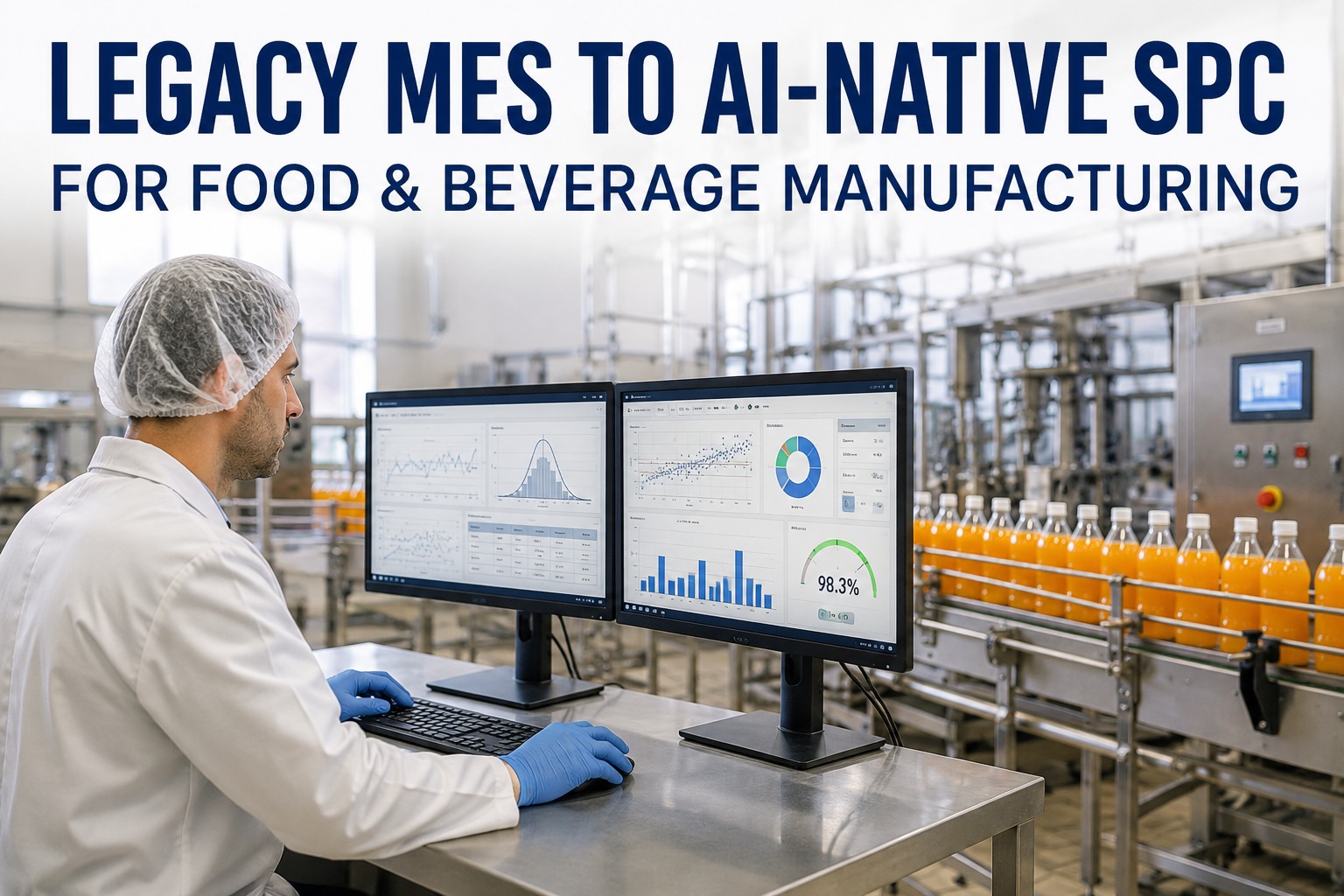
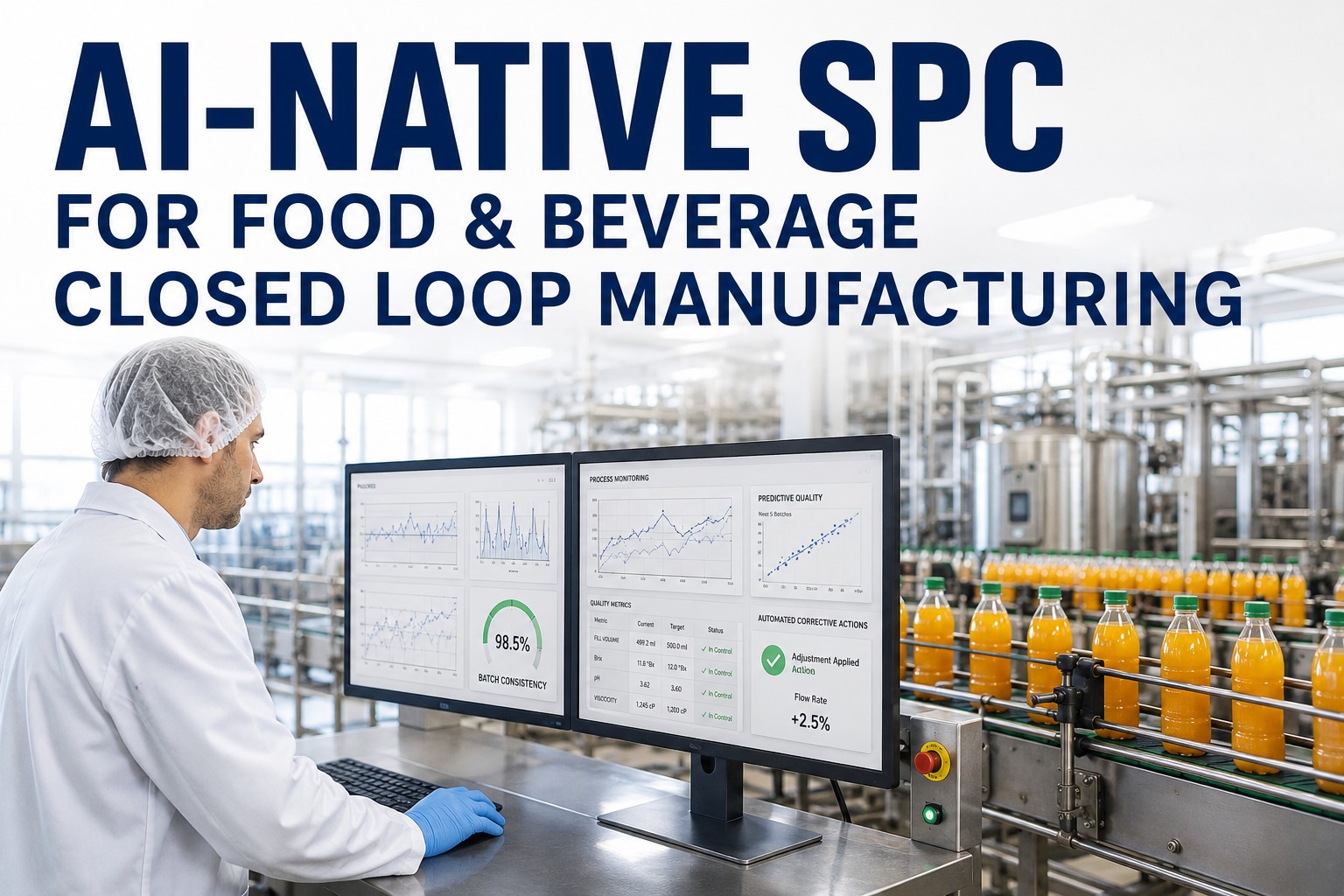
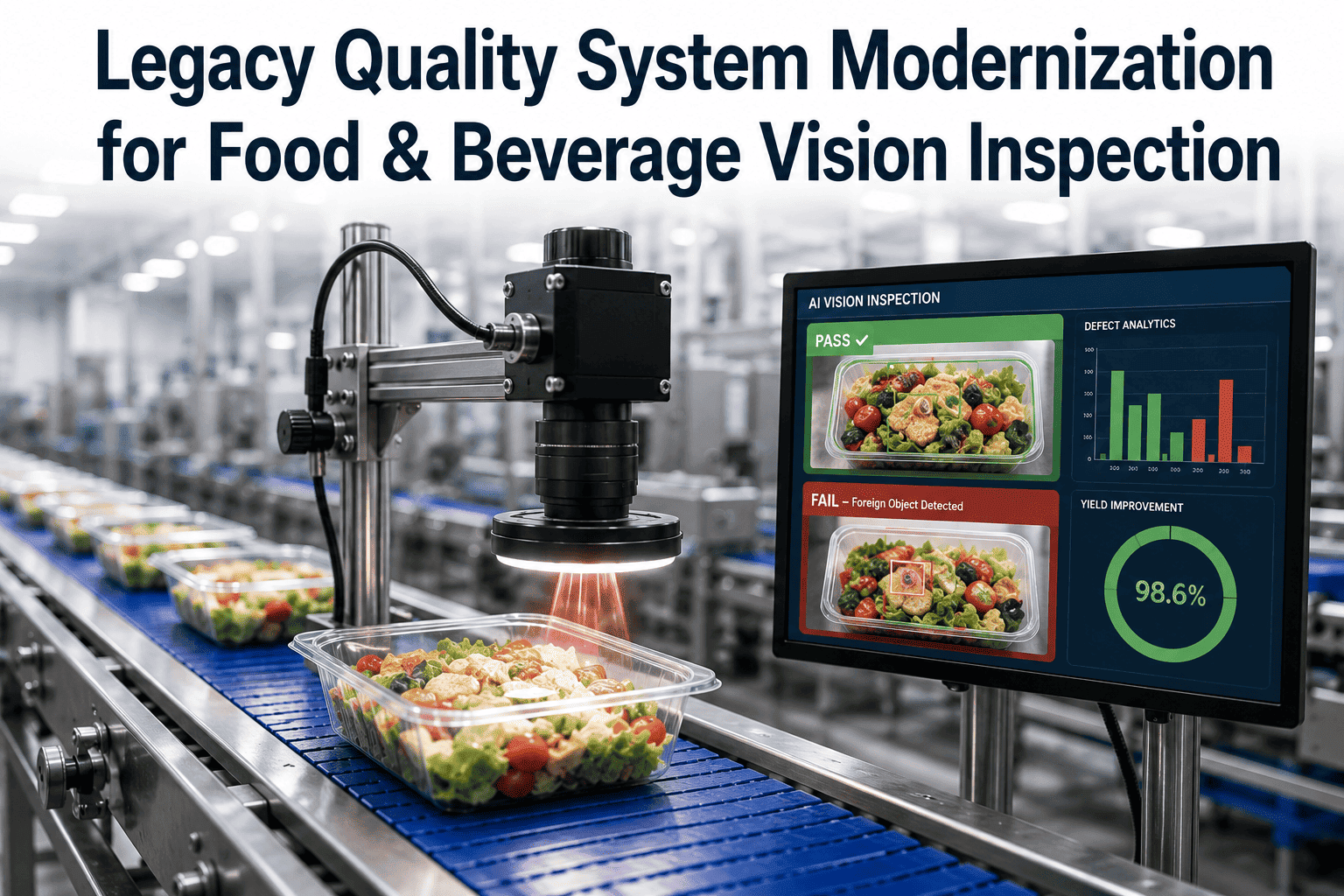
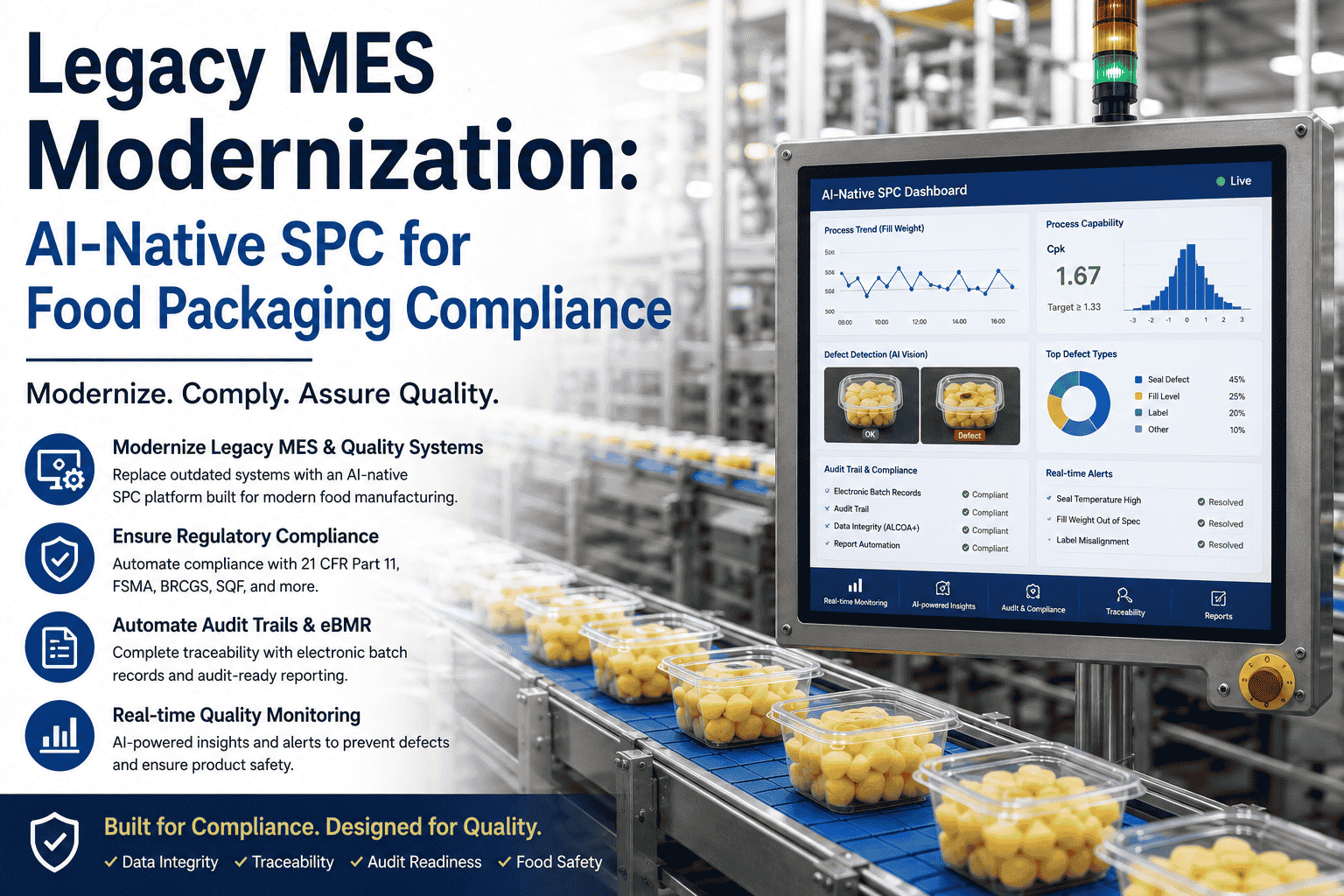
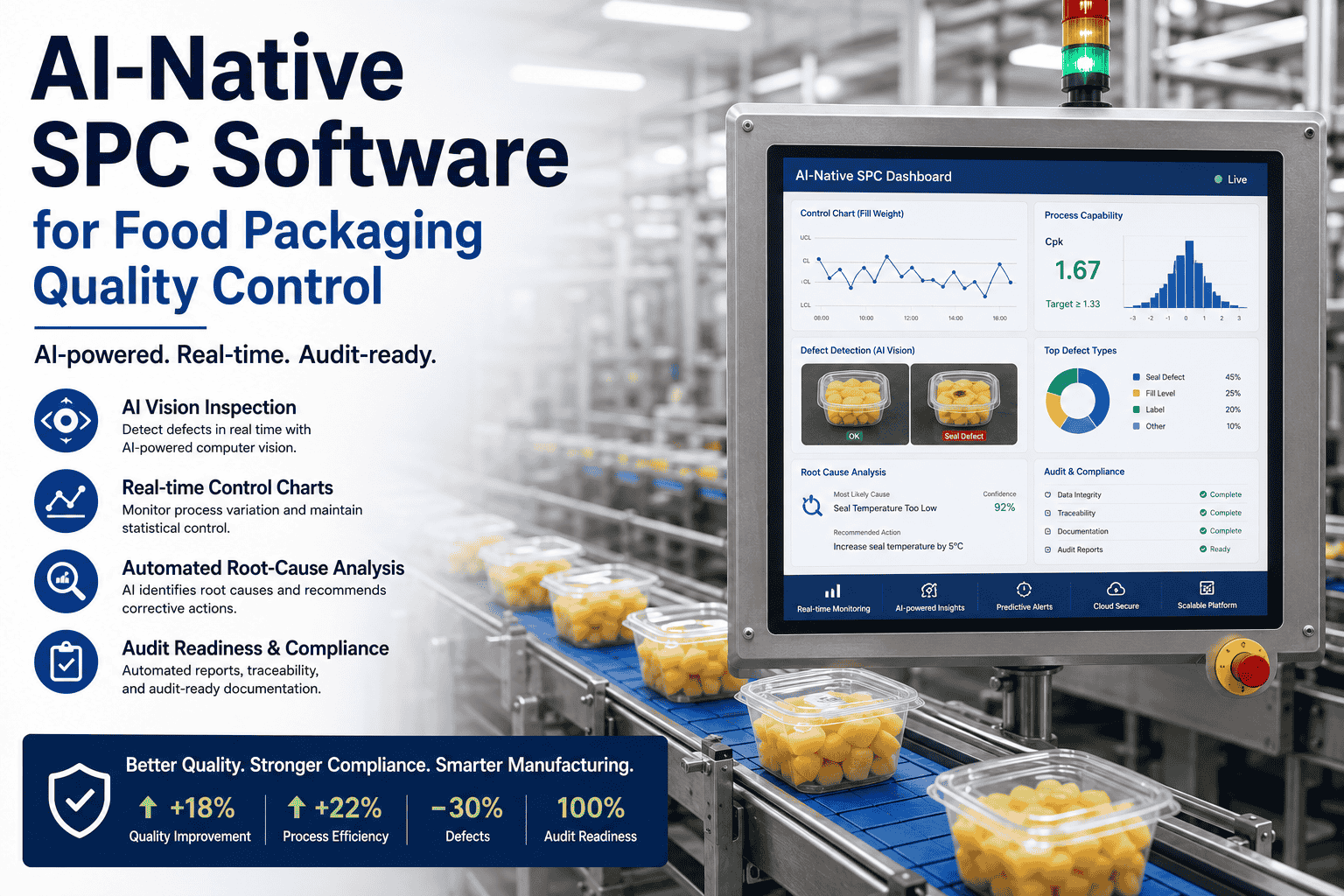
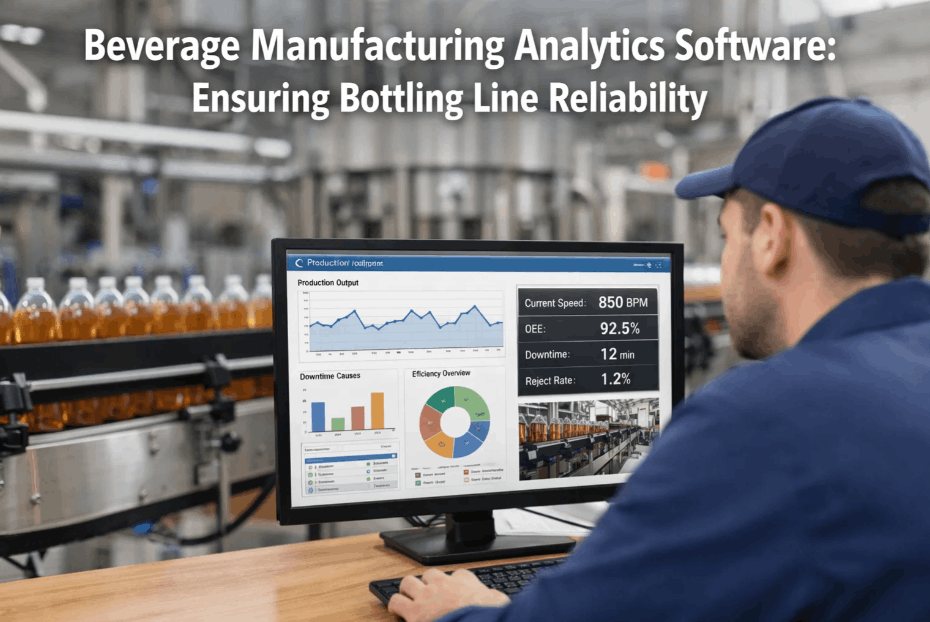
Legacy MES platforms detect downtime at T+0 — the precise moment production stops. By that point, the bearing has failed, the seal has degraded, the quality drift has produced 200 bad units, and the line is already down. AI-native SPC detects the same failure across four progressively earlier horizons: 2-4 weeks ahead (equipment failure prediction from sensor patterns), 2-7 days ahead (component degradation signals), 4-24 hours ahead (process drift warnings), and 1-30 minutes ahead (quality deviation predictions). Each horizon turns a different class of downtime from a reactive event into a prevention opportunity. The result for F&B operations: 30-50% reduction in unplanned downtime, 2-4 weeks of advance warning on equipment failures, micro-stoppages (30-40% of total downtime hidden from legacy MES) finally surfaced and addressed, and downtime cost — $50-150K per hour in beverage and dairy operations — moved from inevitable to preventable. This guide breaks down the 4 detection horizons, where legacy MES capability gaps live, the visible-vs-hidden downtime cost anatomy, and the 8-12 week implementation roadmap. Book an AI SPC migration workshop for your plant.
2-4 weeks ahead
Horizon 01
Equipment Failure Prediction
Bearing wear · motor degradation · pump cavitation patterns
Schedule maintenance · planned window
2-7 days ahead
Horizon 02
Component Degradation
Vibration anomalies · thermal drift · current shifts
Dispatch CMMS work order · proactive
4-24 hours ahead
Horizon 03
Process Drift Warnings
SPC trending toward limits · recipe variation
Adjust process parameters mid-shift
1-30 minutes ahead
Horizon 04
Quality Deviation Prediction
Micro-anomalies before product fails spec
Operator intervention before first defect
Legacy MES
Detection window: at T+0 (the failure event itself) · zero advance warning · investigation begins after production is already stopped
Why Legacy MES Always Reacts, Never Predicts
Legacy MES platforms were architected before machine learning was viable on industrial data. They report what happened; they don't model what's about to happen. Five structural reasons why even the best legacy MES platform — Wonderware, FactoryTalk, GE Proficy classic, Werum, AVEVA, Honeywell, SAP xMII — can't deliver predictive downtime prevention without an AI-native layer on top.
01
Designed for Reporting, Not Prediction
Legacy MES architecture optimized for transaction logging and historical reporting. The data model assumes you query what already happened — not that you train models to forecast what will happen next.
02
Rule-Based, Not Pattern-Based
Static thresholds and IF-THEN rules catch obvious violations and miss everything that doesn't fit the rule. Pattern-based ML detects subtle leading indicators rule engines were never designed to see.
03
Single-Variable Alarming
Legacy MES alarms on one variable at a time. The multivariate interactions that drive most F&B downtime (heat + dwell + viscosity + alignment) are invisible to single-variable threshold logic.
04
No Micro-Stoppage Visibility
Most legacy MES platforms ignore stoppages under 5 minutes. Yet micro-stoppages account for 30-40% of total downtime in F&B operations. The losses are hidden until they compound into OEE shortfalls.
05
Historian-Heavy, Real-Time Light
Legacy MES historians excel at storing 10 years of process data. They're not engineered for real-time inference on streaming data — the exact capability predictive downtime prevention requires.
The 4 Detection Horizons · Detailed
Each horizon catches a different class of failure pattern, with a different lead time, and enables a different operator response. The detail below shows what AI-native SPC actually detects at each horizon and what action it enables — turning each horizon into a separate downtime prevention layer.
Horizon 01 · 2-4 Weeks
Equipment Failure Prediction
Machine learning correlates long-term sensor signatures (vibration spectra, thermal trends, motor current curves) against the equipment's historical failure-precursor patterns. Detects developing failures weeks before traditional condition monitoring fires its first alarm.
Horizon 02 · 2-7 Days
Component Degradation Signals
Mid-horizon detection of accelerating degradation — vibration crossing energy thresholds, thermal anomalies under specific load conditions, current draw drift correlated with output quality. Provides enough lead time to source replacement parts and schedule intervention.
Horizon 03 · 4-24 Hours
Process Drift Warnings
Short-horizon detection of process variables trending toward control limits within a shift or two. Multivariate SPC catches drift patterns single-variable charts miss. Operators get specific guidance on which parameter to adjust before the line trips.
Horizon 04 · 1-30 Minutes
Quality Deviation Predictions
Real-time inference detects the micro-anomalies that precede a quality failure — sub-spec fill weight trending, seal heat starting to drift, vision system noise increasing. Operator gets the alert before the first defective unit reaches the inspector.
Add 4 Detection Horizons to Your Legacy MES
iFactory's F&B AI SPC practice layers predictive detection across all four horizons — equipment failure prediction, component degradation, process drift, and quality deviation — on existing MES infrastructure. Deployed in 8-12 weeks per line. Built for 30-50% unplanned downtime reduction in year one.
F&B Downtime Cost Anatomy · Visible vs Hidden
Legacy MES reports the visible downtime — the equipment failure events long enough to log. But 60-70% of true downtime cost lives in the hidden tier that legacy MES wasn't designed to capture. The breakdown below shows where every dollar of downtime cost actually goes — and which category each platform surfaces.
Cost Category
Typical Share
Legacy MES Visibility
AI-Native SPC Visibility
Direct Lost Production
35-40%
Captured · primary metric
Captured + predicted
Micro-Stoppages (under 5 min)
25-30%
Not logged · hidden
Auto-captured + aggregated
Speed Losses (slow running)
10-15%
Partial · manual analysis
Continuous OEE monitoring
Quality-Driven Stops
10-12%
Captured · cause unclear
Captured + root cause linked
Changeover Overruns
8-10%
Captured · no benchmarking
Benchmarked + optimization
Compliance Holds / HACCP
3-7%
Manual workflow · slow
Predictive CCP forecasting
Want a downtime cost audit for your plant? Book a downtime anatomy review with our F&B operations team.
Legacy MES vs AI-Native SPC · Downtime Prevention Capability
Across every downtime-prevention dimension that matters, legacy MES and AI-native SPC sit on opposite sides of the architectural divide. The capability comparison below maps each dimension to operational impact — and shows why layering AI-native SPC on top of legacy MES is the dominant 2026 pattern.
Capability
Legacy MES
AI-Native SPC
Downtime Impact
Detection Window
T+0 (after failure)
T-2 weeks to T-1 min
Schedule maintenance vs respond to outage
Alarm Logic
Single-variable thresholds
Multivariate ML patterns
Catches interaction-effect failures
Micro-Stoppages
Below 5 min ignored
All events auto-captured
Recovers 25-30% of hidden downtime
Root Cause Analysis
Manual 5-Whys (3-5 days)
Autonomous pipeline (under 30 sec)
CAPA closure before next batch
Speed Losses
Partial · manual analysis
Continuous OEE attribution
Slow-running losses surface continuously
Operator Guidance
Static SOPs in binder
Context-aware GenAI copilots
Faster shift-to-shift troubleshooting
Operating Model
Reactive · firefighting
Predictive · continuous
30-50% unplanned downtime cut
Need a capability-gap diagnostic for your current MES stack? Connect with our F&B architecture team for a tailored assessment.
Implementation Roadmap · 4 Phases / 8-12 Weeks
The AI-native SPC layer deploys on existing legacy MES infrastructure with on-premise edge AI. Four phases take a plant from reactive legacy-only operation to a continuously running predictive downtime prevention layer. Most plants see meaningful downtime reduction starting in week 6.
Phase 1
Downtime Inventory
Audit legacy MES downtime data · identify hidden micro-stoppage losses · baseline OEE · quantify Year 1 opportunity
Weeks 1-2
→
Phase 2
Edge Layer Install
On-prem AI appliance connects to PLCs and existing MES · sensor signals tagged · historical patterns ingested
Weeks 2-5
→
Phase 3
Horizon Training
All four detection horizons trained on plant data · operator dashboards configured · CMMS integration tested
Weeks 5-9
→
Phase 4
Production & Tuning
Predictive alerts live · operator training · quality team validates · downtime metrics tracked
Weeks 9-12
Want a tailored 4-phase roadmap for your operations? Book a roadmap planning session with our F&B AI team.
Expert Perspective
The F&B plants getting the biggest downtime reductions in 2026 aren't ripping out their legacy MES. They're keeping it for the transactional layer it was always good at — work order dispatch, batch records, ERP integration — and adding an AI-native SPC layer on top for the predictive horizons legacy was never designed to deliver. That split lets the plant get the 30-50% downtime reduction without taking on a 12-36 month MES replacement project that would itself cause downtime during cutover. The discovery that surprises every operations team going through this exercise is how much downtime cost lives in the micro-stoppages legacy MES never logged. When a beverage line shows 6% recorded unplanned downtime in the legacy system, the real number once you instrument every sub-5-minute stoppage is often 15-18%. That's not a metric problem — that's hidden cost that compounds into OEE shortfalls and customer scorecard slippage. AI-native SPC surfaces it, attributes it, and turns it into a target the plant can actually work on. Keep the legacy MES for what it does well. Layer AI-native SPC for what legacy can't see.
— F&B Operations Engineering Best Practice, 2026
30-50%
Unplanned downtime reduction · year one
15-18%
Real downtime vs 6% legacy MES reported
8-12 wks
Implementation per line
10-15 pt
OEE improvement typical at 12 mo
Bottom Line · Keep the MES, Add the Predictive Layer
Legacy MES platforms — Wonderware, FactoryTalk, Werum, AVEVA, Honeywell, SAP xMII, GE Proficy — were architected for transaction reporting, not predictive prevention. They detect downtime at T+0 because that's when their event-logging fires. AI-native SPC adds the four predictive horizons that turn downtime from inevitable into preventable: 2-4 weeks ahead on equipment failures, 2-7 days on component degradation, 4-24 hours on process drift, 1-30 minutes on quality deviation. The deployment doesn't require ripping out legacy MES — it layers on top in 8-12 weeks per line and surfaces the 30-40% of hidden downtime cost that legacy was never instrumented to capture. The plants getting 30-50% unplanned downtime reduction and 10-15 point OEE improvements in year one are running both: legacy MES for transactional reliability and AI-native SPC for predictive prevention. That's the architecture pattern that delivers downtime prevention as a continuous capability — not a quarterly reactive scramble.
Add Predictive Downtime Prevention to Your Legacy MES Stack
iFactory's F&B AI SPC practice deploys the 4-horizon predictive prevention layer in 8-12 weeks per line — without ripping out legacy MES. On-prem edge AI keeps recipe IP sovereign while surfacing the micro-stoppages and hidden downtime cost legacy was never designed to see. Built for 30-50% unplanned downtime cut and 10-15 OEE points in year one.
Frequently Asked Questions
What are the 4 detection horizons of AI-native SPC?
Horizon 01 (2-4 weeks ahead): equipment failure prediction from sensor pattern recognition. Horizon 02 (2-7 days ahead): component degradation signals via vibration and thermal anomalies. Horizon 03 (4-24 hours ahead): process drift warnings as SPC trends toward limits. Horizon 04 (1-30 minutes ahead): quality deviation prediction before the first defective unit reaches inspection. Together they turn downtime from reactive to preventable.
Do I have to replace my legacy MES to add AI-native SPC?
No. AI-native SPC layers on top of existing legacy MES (Wonderware, FactoryTalk, Werum, AVEVA, Honeywell, SAP xMII, GE Proficy). The legacy MES keeps doing transactional work it does well — work orders, batch records, ERP integration. The AI layer adds predictive horizons legacy was never designed for. This avoids the 12-36 month MES replacement timeline while delivering predictive downtime prevention in 8-12 weeks per line.
How much downtime does AI-native SPC prevent in F&B operations?
30-50% reduction in unplanned downtime within year one is the typical range. The biggest single contributor is surfacing micro-stoppages (sub-5-minute events legacy MES doesn't log) — these account for 25-30% of total downtime cost. Combined with 2-4 week equipment failure prediction and quality-driven stop prevention, plants commonly see 10-15 point OEE improvement at the 12-month mark.
Why does legacy MES miss so much downtime cost?
Legacy MES was architected for transactional reporting on long-duration events. Three structural gaps drive most missed cost: micro-stoppages under 5 minutes are typically not logged (25-30% of downtime hidden), single-variable threshold alarms miss multivariate interaction failures, and the platform reports historical data without modeling predictive lead time. A plant showing 6% recorded downtime in legacy MES often has 15-18% real downtime once everything is instrumented.
How long does AI-native SPC implementation take?
8-12 weeks per line across 4 phases. Downtime Inventory (Wk 1-2, audit legacy MES gaps and baseline OEE), Edge Layer Install (Wk 2-5, on-prem AI appliance connects to PLCs and MES), Horizon Training (Wk 5-9, all four detection models trained on plant data), Production & Tuning (Wk 9-12, predictive alerts live and operators trained). Downtime reduction measurable from week 6 forward.
Book a workshop for your specific lines.