Sixty-nine percent of food and beverage companies still rely on manual or legacy systems to manage critical quality processes — even though 82% say they are prioritizing new technology implementation. That gap has a name: digital drag. It is the accumulated weight of SAP QM customizations, SAP xMII rule-based SPC, AVEVA Wonderware dashboards, and Excel-based control charts that were built for a different operational era and now consume more resource to maintain than to replace. Book a demo to see what AI-driven SPC delivers when the legacy maintenance burden is replaced with a self-learning quality platform that improves process stability continuously — without the technical debt.
Legacy Quality System Modernization — Food & Beverage
Does Your Quality Stack Show These Legacy Symptoms?
Check which of these apply to your current quality system — each one is a measurable drag on process stability and operator productivity.
SPC alerts fire after a defect occurs — not before
Root cause analysis takes 45 to 75 minutes per event
Control charts monitor one parameter at a time
Audit prep requires days of team effort before each inspection
Quality data is collected manually or entered into spreadsheets
SAP xMII or QM mainstream support ends December 2027
Ingredient lot variability not modeled in SPC thresholds
IT team spends 60% or more of budget maintaining legacy systems
Scrap and yield data reviewed weekly — not in real time
The Legacy Quality Stack in F&B — What Most Plants Are Actually Running
Food and beverage manufacturers running quality operations in 2025 and 2026 typically have a layered legacy stack that accumulated over two decades of platform additions, customizations, and workarounds. Each layer was rational when added. The combined architecture is now a structural drag on process stability, operator productivity, and audit readiness — because none of those layers were designed to predict, correlate across variables, or learn from production history.
Which platforms are in your current quality stack? Book a legacy quality system assessment demo — we will map your current architecture and identify exactly which layers AI-native SPC replaces, integrates with, or augments.
The Hidden Cost of Staying on Legacy — What the Numbers Actually Show
The perceived cost of legacy quality systems is the maintenance invoice. The real cost is spread invisibly across engineering time, process stability losses, compliance exposure, and the technical debt that compounds at roughly 20% annually if left unaddressed. For food and beverage manufacturers, that compounding effect is accelerated by the 2027 SAP xMII support deadline — after which, every ERP upgrade becomes an unpatched integration risk.
Legacy Quality System — Where the Real Costs Hide
Visible Costs (on invoices)
SAP xMII / QM license and support fees
Historian and SCADA maintenance contracts
IT infrastructure operations and upgrades
Hidden Costs (not on invoices)
Process stability losses from reactive-only SPC
Engineer hours on manual RCA — 45 to 75 min per event
Pre-audit compilation — days of team effort each cycle
Scrap from defects detected too late to prevent
Technical debt compounding at 20% annually
Organizations that modernize from legacy quality systems typically see 25 to 35% reduction in infrastructure costs and recover 40 to 65% of cost of quality within 12 months — because the hidden costs above are eliminated, not just the invoice items.
What AI-Driven SPC Delivers That Legacy Systems Structurally Cannot
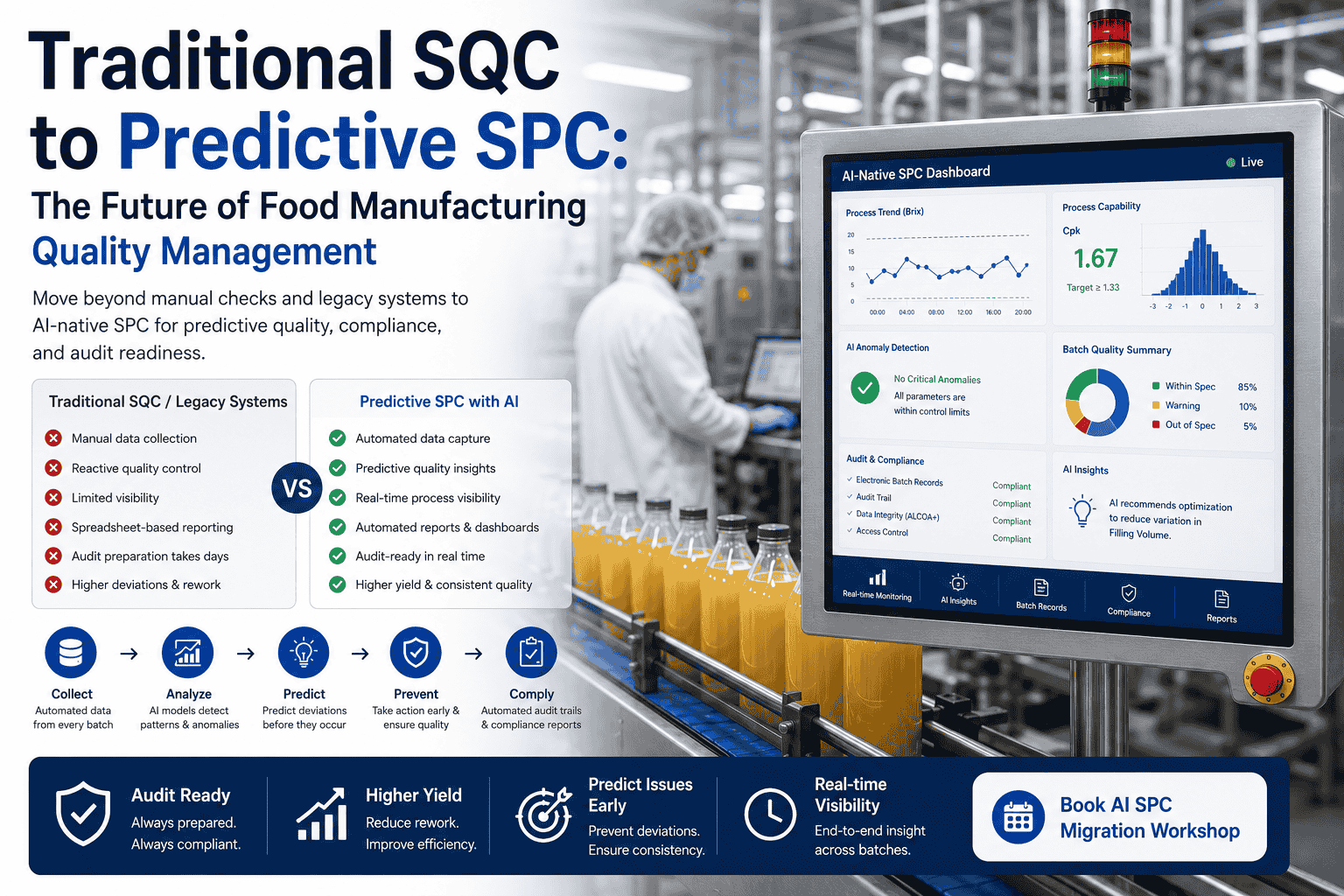
AI-driven SPC is not a better dashboard on top of SAP xMII. It is a different operating model for quality intelligence. Where legacy systems monitor individual parameters against fixed thresholds set by engineers, AI-native SPC learns what good looks like for the current product, shift, ingredient lot, and equipment state — and continuously refines that understanding as production conditions change. The capability gap is not incremental. It is architectural.
| Quality Capability |
Legacy Stack (SAP xMII / QM / Excel) |
AI-Native SPC Platform |
| Defect Detection |
After control limit breach — damage in progress |
4 to 24 hours before limits breach — intervention before scrap |
| Variable Analysis |
Single-parameter control charts — one variable at a time |
Multivariate correlation across all process variables simultaneously |
| Ingredient Lot Variability |
Not modeled — fixed thresholds applied to all lots equally |
Lot history correlated in real time — thresholds adapt to lot profile |
| Process Capability (Cpk) |
Calculated periodically — backward-looking snapshot |
Recalculated continuously on every incoming data point |
| Root Cause Analysis |
Manual investigation: 45 to 75 min — often inconclusive |
Pre-computed multivariate RCA: 3 to 5 min — evidence-backed |
| Audit Documentation |
Manual compilation — days of effort before each audit |
Continuous tamper-evident record — always audit-ready |
| System Learning |
Static — thresholds set once, manually updated |
Self-learning — improves continuously as production data accumulates |
| Platform Longevity |
SAP xMII support ends Dec 2027 — compliance risk accelerates |
Ongoing AI model updates — no platform sunset date |
See Every Capability Above Running Live on F&B Scenarios
iFactory's AI SPC Migration Workshop demonstrates all eight capabilities above on representative food and beverage scenarios — predictive drift alerts, multivariate RCA, real-time Cpk monitoring, and continuous audit documentation — paired with a documented ROI model against your specific quality baseline.
Three Modernization Paths — Choosing the Right One for Your F&B Operation
Legacy quality system modernization is not a single decision — it is a portfolio of decisions about which layers to replace, which to retain, and which to augment with an AI intelligence layer. The three paths below represent the realistic options for F&B manufacturers in 2025 and 2026, with concrete tradeoffs for each.
Full SAP Migration
xMII to SAP Digital Mfg
18 to 36 months
Rule-based SPC — still Era 2
Partial — SAP ecosystem only
Limited — cloud-first architecture
Marginal — same detection model
High effort, no quality leap
Cloud MES + SPC Module
Third-party platform
12 to 24 months
Varies — often still threshold-based
Yes — platform transition
No — cloud latency for OT data
Moderate — depends on vendor
Cloud lock-in risk for F&B OT
Recommended
AI-Native On-Premise Layer
iFactory on NVIDIA appliance
6 to 12 weeks
Era 3 Predictive SPC — full leap
Yes — independent of SAP timeline
Yes — plant-resident, no cloud dependency
5 to 10 pt yield improvement typical
Fastest path to process stability
Process Stability Outcomes: What Changes After Modernization
Process stability is the primary KPI that AI-driven SPC moves. Legacy quality systems catch deviations — AI-native systems prevent them. The outcomes below are documented from F&B operations that completed AI-native SPC deployments within 6 to 12 weeks, across beverage, bakery, snack, and protein processing lines.
Scrap Rate
4 to 8% average — reactive detection only
1 to 3% — predictive prevention cuts drift-driven scrap
6 to 9 months
Cpk Performance
Calculated weekly or monthly on batch samples
Monitored continuously — drift detected before breach
From day 1
RCA Cycle Time
45 to 75 minutes per event — manual investigation
3 to 5 minutes — autonomous pre-computation
From week 1
Yield Improvement
Baseline — yield losses from undetected drift
5 to 10 percentage point improvement typical in year 1
3 to 6 months
Audit Readiness
Days of preparation before each inspection
Continuous — any record retrievable in seconds, any time
From week 2
OEE Impact
Weekly OEE review — reactive to completed production
12 to 22% OEE improvement within 12 months of deployment
9 to 12 months
Expert Perspective: Why F&B Is the Right Industry to Make This Move Now
The F&B manufacturers handling quality modernization best in 2026 are the ones who recognize that the question is not whether to modernize — the 2027 SAP xMII deadline makes that decision for them. The question is whether to treat modernization as a compliance exercise or as a quality philosophy upgrade. Organizations that choose the compliance path — moving from xMII to SAP Digital Manufacturing — get a newer platform with the same rule-based SPC limitations. Organizations that choose the quality philosophy path — deploying an AI intelligence layer that predicts rather than reacts — get process stability gains that compound as the model learns. For F&B specifically, ingredient lot variability, product changeover frequency, and allergen compliance requirements make multivariate AI SPC the natural fit. The on-premise deployment model is the right architecture for operations where food safety records, recipe IP, and allergen tracking have data residency requirements that cloud-hosted platforms handle less cleanly.
— iFactory AI SPC Migration Research, F&B Quality Operations 2025 to 2026
69%
of F&B companies still rely on manual or legacy systems for critical quality processes
20%
Annual technical debt compounding rate if legacy modernization is delayed
6 to 12 wk
Time to live on AI-native on-premise appliance — vs. 18 to 36 months for SAP migration
Ready to size the modernization ROI for your specific operation? Book a demo and legacy quality system assessment — we will model process stability gains, RCA time recovery, and audit cost reduction against your current baseline.
Modernize Your Legacy Quality System — Live in 6 to 12 Weeks
iFactory's AI SPC Migration Workshop covers your current legacy quality stack assessment, AI-driven SPC demonstration on representative F&B scenarios, three-path modernization comparison with cost and timeline projections, deployment roadmap, and a documented ROI model against your process stability, scrap rate, and audit compliance baseline.
Frequently Asked Questions
What is the difference between modernizing SAP QM and deploying an AI-native SPC platform?
SAP QM modernization typically means migrating to S/4HANA with updated inspection lot and CAPA workflows — it addresses the platform support risk but does not change the quality intelligence model. The SPC capability remains rule-based and reactive. An AI-native SPC platform is a separate intelligence layer that learns your process patterns, predicts drift before defects fire, and provides autonomous RCA in 3 to 5 minutes. These are complementary decisions: SAP QM handles quality management records and ERP integration; the AI SPC layer handles real-time process intelligence and predictive quality.
How does AI-driven SPC improve process stability specifically in food and beverage manufacturing?
F&B process stability is challenged by ingredient lot variability, frequent product changeovers, temperature and humidity sensitivity, and sanitation cycle interactions that legacy single-parameter SPC cannot model. AI-native SPC runs multivariate correlations across all of these variables simultaneously — ingredient lot history, recipe parameters, equipment state, CIP cycle completion, and environmental conditions — and identifies drift patterns 4 to 24 hours before control limits breach. This predictive window allows process adjustments before scrap is produced, producing the 5 to 10 percentage point yield improvements documented in F&B deployments.
Does iFactory's AI-native platform replace SAP xMII entirely or work alongside it?
iFactory functions as an AI intelligence layer that can replace xMII's SPC and dashboard functions while your SAP ERP and underlying historian infrastructure remain in place. For plants approaching the 2027 xMII support deadline, iFactory can be deployed in 6 to 12 weeks — independently of your broader SAP migration timeline — so the quality intelligence layer is upgraded before the deadline, regardless of whether the MES decision has been made. This decouples the AI quality decision from the ERP migration decision, which is typically the cleaner economic choice.
What is the typical ROI and timeline for legacy quality system modernization in F&B?
Organizations modernizing from legacy quality systems to AI-native SPC typically see 25 to 35% reduction in infrastructure costs, 5 to 10 percentage point yield improvement within 6 to 9 months, 40 to 65% cost of quality reduction in year one, and 30 to 50% reduction in audit preparation time. ROI payback periods for AI-native SPC deployments in F&B cluster around 6 to 14 months, driven by scrap reduction and RCA time recovery. Technical debt that compounds at 20% annually is also eliminated — so the cost of delay is measurable, not theoretical.
How do we begin a legacy quality system modernization assessment for our F&B plant?
The most effective starting point is iFactory's AI SPC Migration Workshop — a half-day session that covers your current legacy quality stack assessment across SAP QM, xMII, historian, and manual layers, an AI-driven SPC demonstration on representative F&B scenarios for your product types, three-path modernization comparison with cost and timeline projections, deployment roadmap with milestone dates, and a documented ROI model against your specific process stability, scrap rate, and audit compliance baseline.
Register your team for the AI SPC Migration Workshop here.