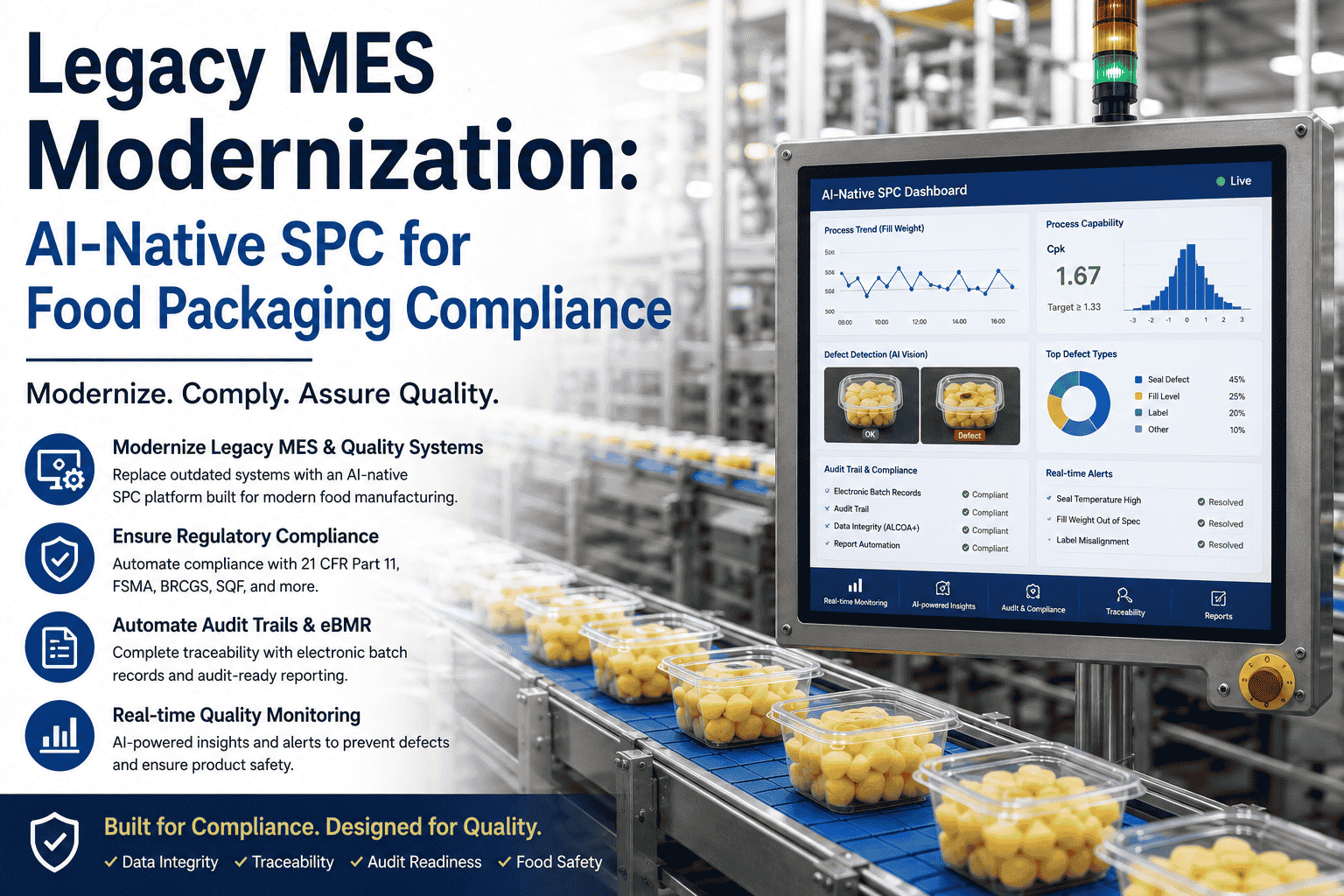
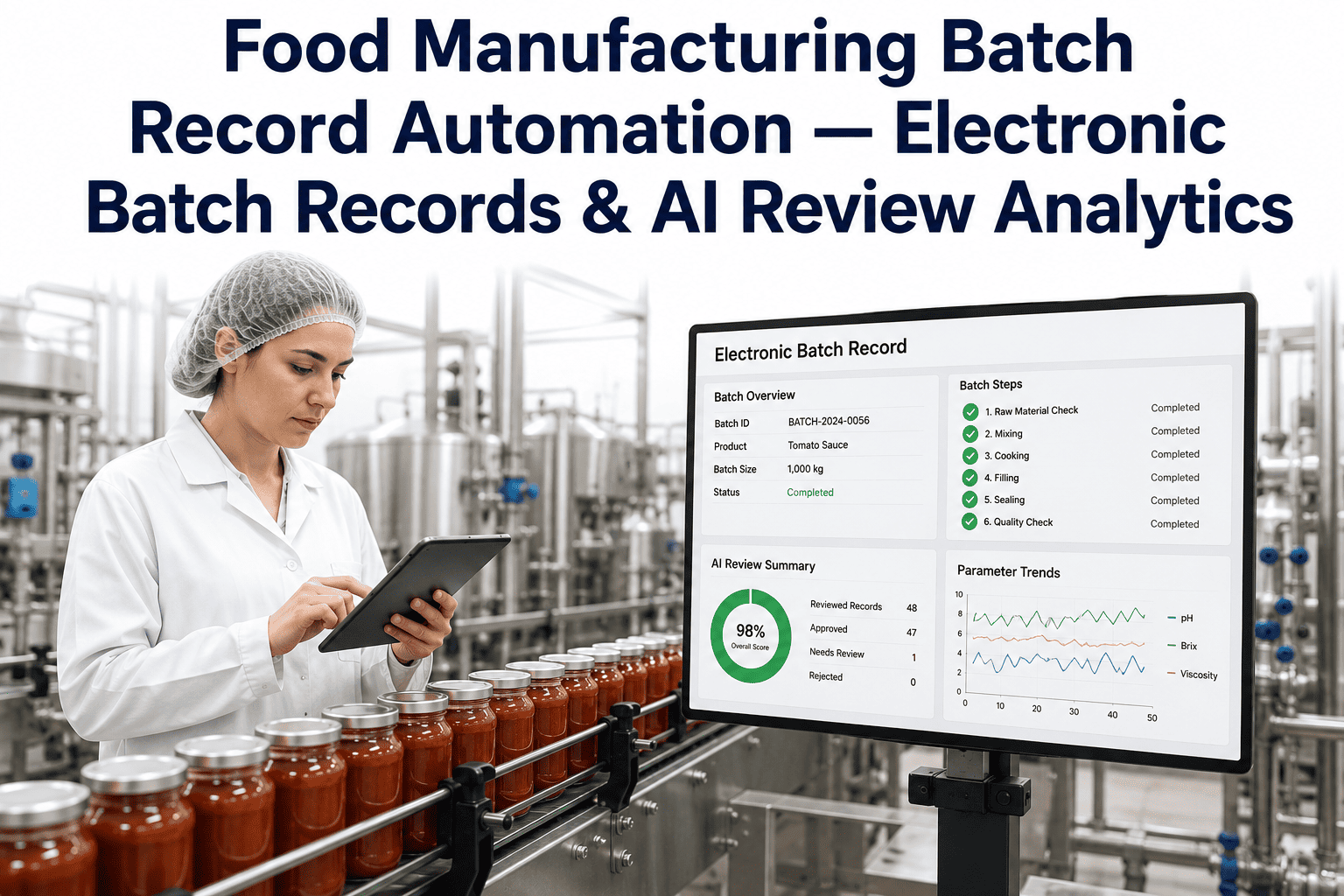
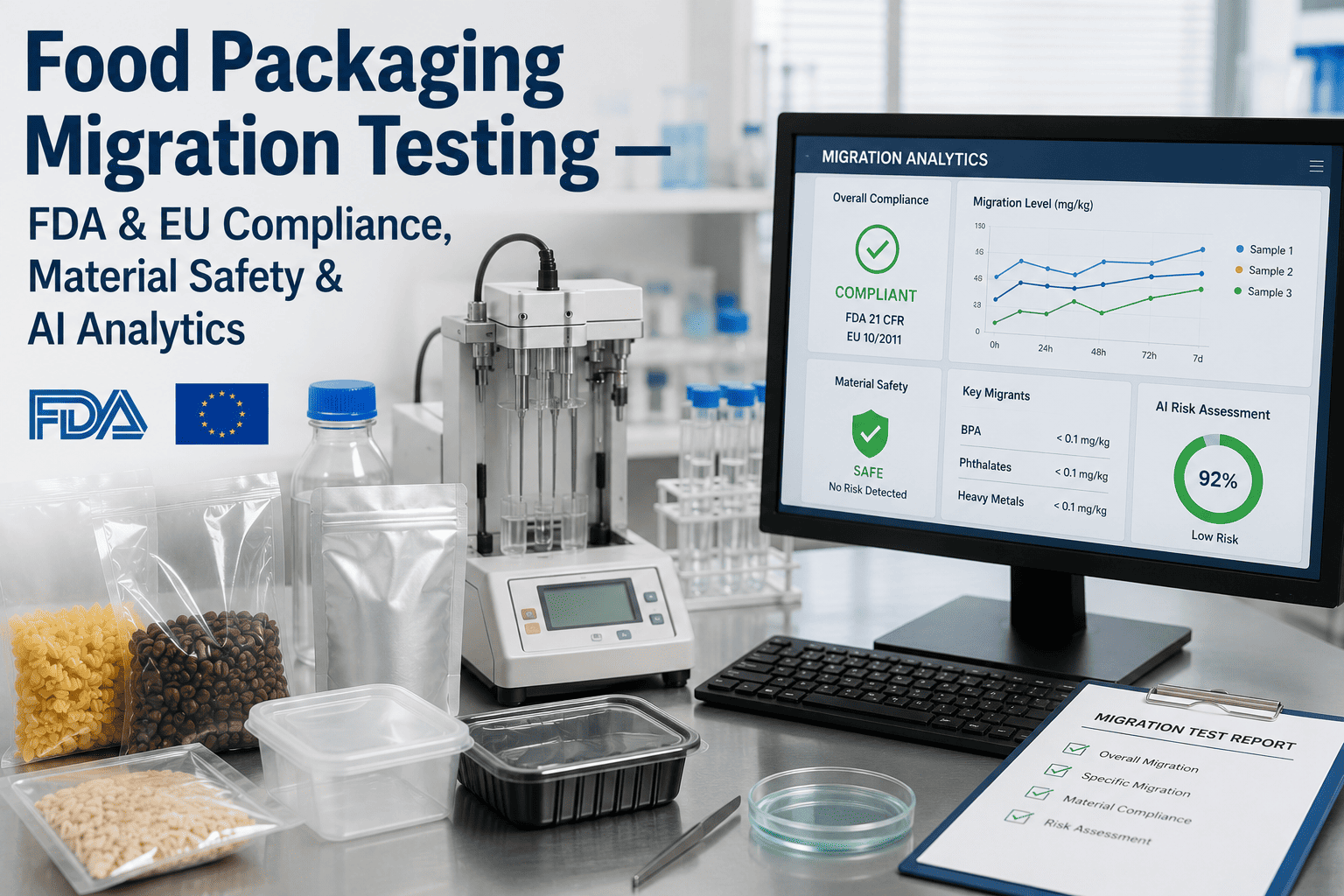
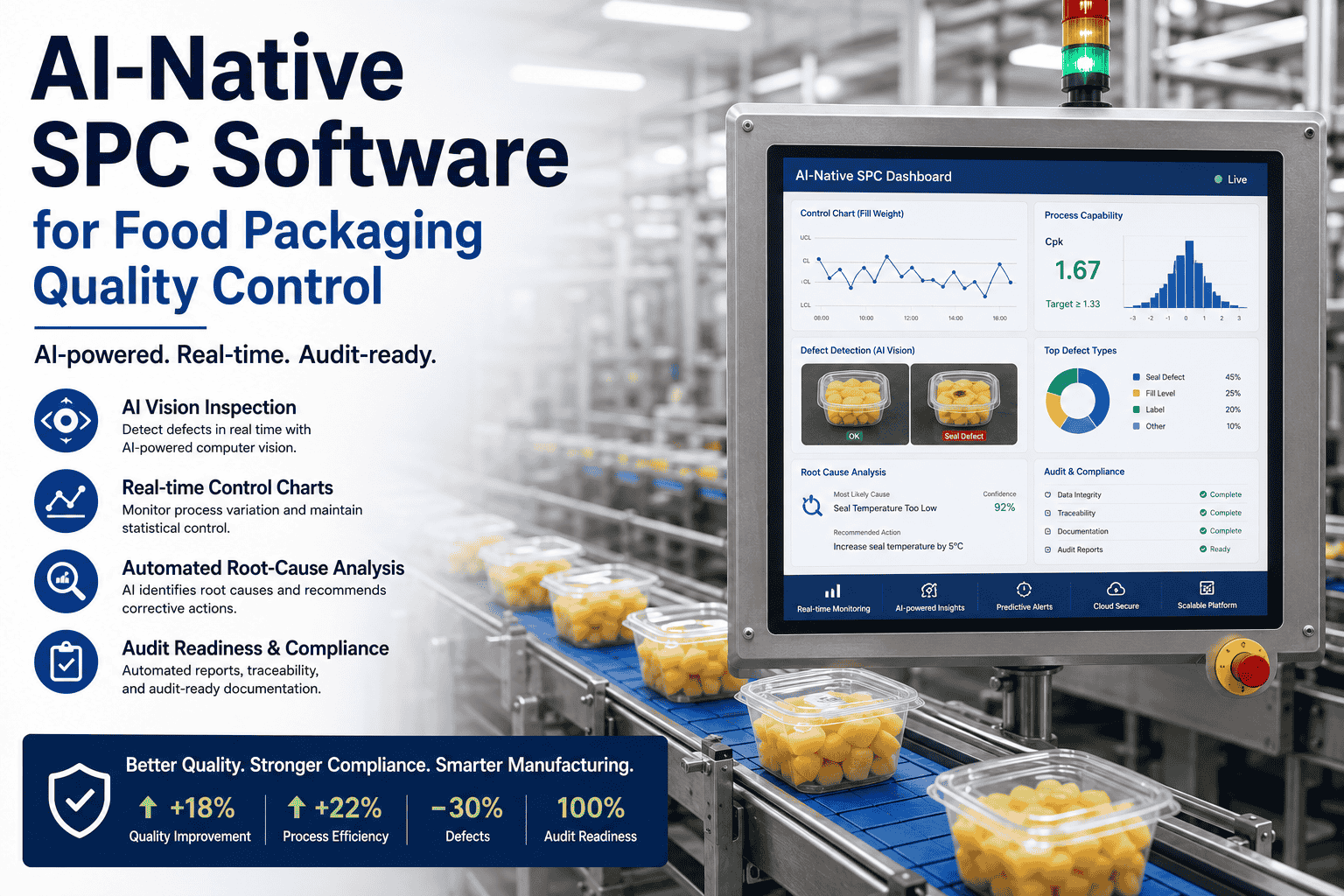
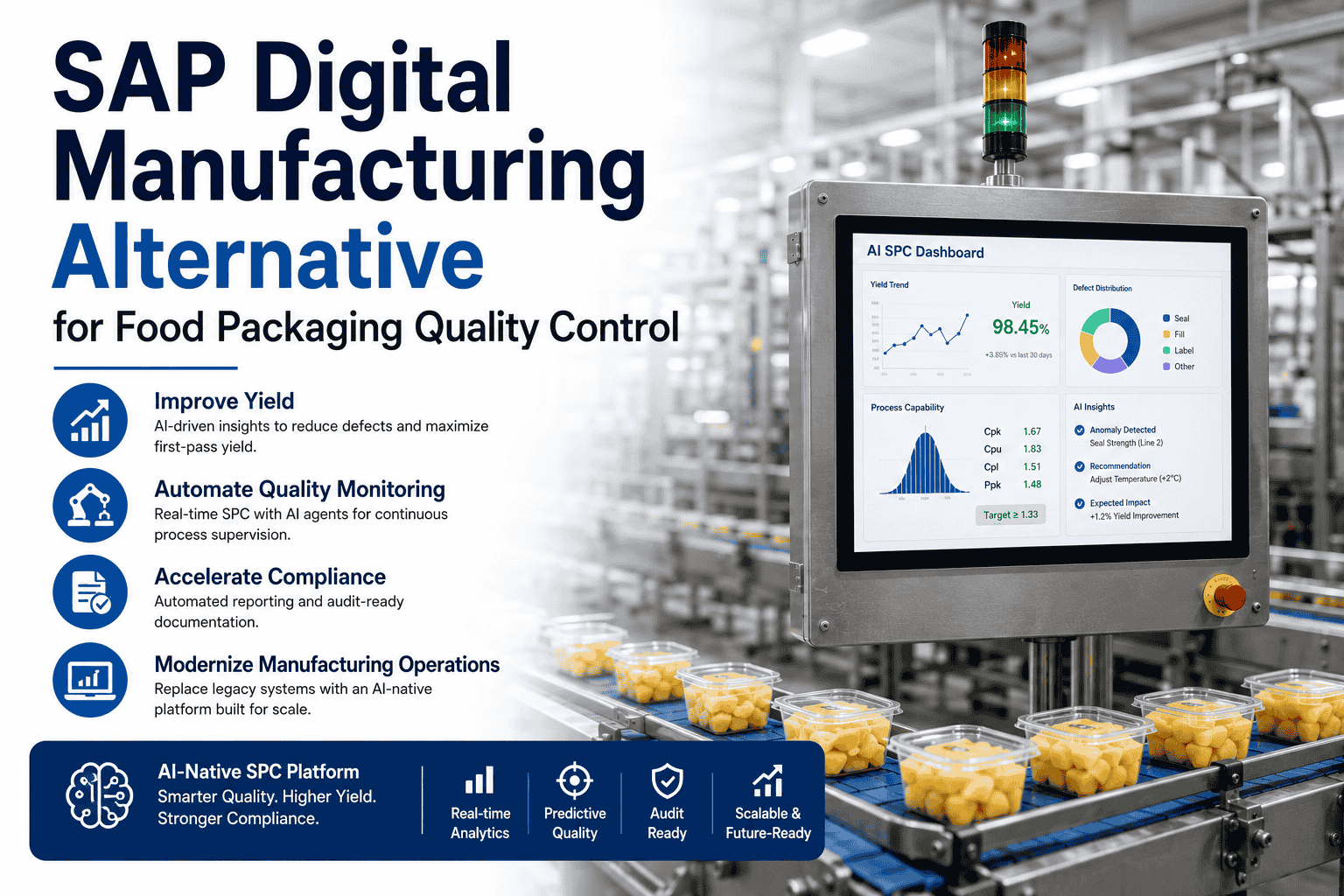
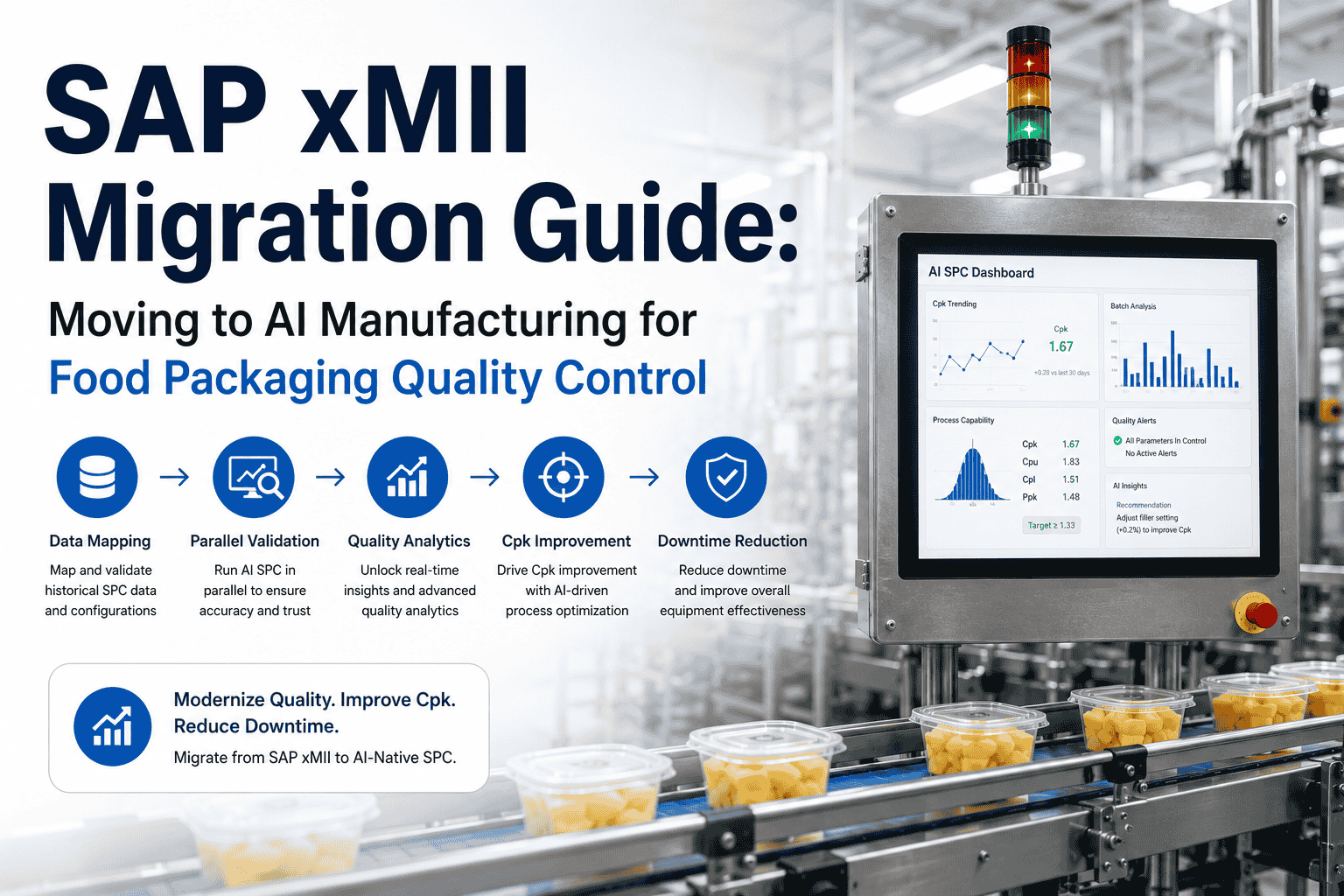
Legacy MES modernization is no longer a question of if — FSMA Rule 204 enforcement, 21 CFR Part 117 audit pressure, and aging Wonderware/Rockwell/GE/Siemens platforms running on Windows infrastructure approaching end-of-support are forcing food & beverage operations to act. The question is what to modernize toward. AI-native SPC platforms have emerged as the dominant target architecture for plants modernizing legacy MES specifically for food packaging quality, regulatory compliance, and audit readiness. This guide covers the legacy MES landscape, what modernization actually delivers for regulatory compliance, and the path-dependent migration strategies that work for different starting points. Book an AI SPC migration workshop to scope your modernization against your specific legacy footprint and compliance requirements.
LEGACY MES PLATFORMS (FROM)
SAP MII / xMII
EOL Dec 2027
AVEVA / Wonderware MES
Aging architecture
Rockwell FactoryTalk
Limited AI capability
GE Proficy / Digital
Roadmap uncertainty
Siemens SIMATIC IT
Opcenter transition
Custom / Spreadsheets
No predictive capability
MODERN DESTINATION (TO)
AI-Native SPC Platform
Continuous AI monitoring, predictive scrap prevention, autonomous RCA, line-rate AI vision inspection, GenAI Copilots, auto-generated regulatory compliance documentation.
FSMA Rule 204
21 CFR Part 11
21 CFR Part 117
SQF / BRCGS
The Legacy MES Problem in Food Packaging
Legacy MES platforms in food & beverage operations share a common set of problems regardless of vendor. They were designed for the manufacturing world of 2005–2010 — batch reporting, basic SPC against pre-set limits, manual recordkeeping, and ERP integration. They were not designed for the regulatory landscape of 2026 (FSMA Rule 204 24-hour traceability), the throughput requirements of modern packaging lines (200–1000+ units/min requiring sub-50ms inspection), or the AI capabilities customers and competitors now expect. The five problems below compound across all major legacy MES platforms and increasingly drive modernization decisions.
01
No Predictive Quality Intelligence
Legacy MES platforms across vendors (SAP MII, AVEVA, Rockwell, GE, Siemens) use rule-based SPC that detects violations after they occur. None ship deep AI capability for predicting drift 4–24 hours before defects fire. The single highest-leverage capability for yield and compliance is uniformly absent from legacy MES.
02
Manual Traceability Assembly
FSMA Rule 204’s 24-hour source-to-shelf traceability requirement is operationally challenging when batch genealogy must be assembled manually from legacy MES queries, spreadsheets, paper batch records, and ERP data. Legacy MES architectures produce traceability data; humans assemble it into compliance documentation.
03
Aging Infrastructure Burden
Wonderware InTouch, GE Proficy, and SAP MII often run on Windows Server 2012/2016 or older Linux distributions. Custom integrations layered over years require maintenance with each adjacent system upgrade. Maintenance overhead grows continuously while platform investment is shrinking or absent.
04
Limited Line-Rate Inspection
High-speed F&B packaging lines (200–1000+ units/min) require sub-50ms inspection decisions. Legacy MES rule-based engines cannot meet this latency. Vision inspection is typically handled by separate third-party systems with limited integration to MES quality data — producing fragmented quality intelligence.
05
No Conversational Quality Interface
Operators and supervisors interact with legacy MES through pre-built dashboards, rigid reports, and configuration screens. Modern GenAI Copilots that answer ad-hoc plant questions in natural language are uniformly absent from legacy platforms — and not on most legacy MES roadmaps in any near-term sense.
06
Compliance Documentation as Project
FSMA, 21 CFR Part 11, SQF, BRCGS, and customer scorecard documentation are built manually before each audit cycle using legacy MES exports as raw material. Quality teams pulled from regular work for days. Compliance is a recurring project, not a default operational state.
Six Legacy MES Platforms F&B Plants Are Modernizing
The legacy MES landscape in food & beverage operations is concentrated across six platforms, with smaller installations on niche or custom-built systems. Modernization patterns differ by starting platform — some require more migration work than others, and the AI-native SPC integration approach varies by what data the legacy MES exposes. The platform breakdown below reflects the F&B operations we’ve evaluated in 2025–2026 for modernization workshops.
Running one of these legacy MES platforms and evaluating modernization? Book an AI SPC migration workshop — we’ll walk through the specific modernization path for your legacy footprint and demonstrate integration with your existing infrastructure.
What "Modernizing to AI-Native SPC" Actually Means
Modernization is a term that gets overused, so it’s worth being specific about what it means in this context. Modernizing legacy MES to AI-native SPC for food packaging is not about replacing every MES function — it’s about adding the quality intelligence and regulatory compliance layer that legacy MES architectures cannot deliver, while integrating with whatever execution layer continues to operate. The four operational shifts below describe what changes day-to-day in F&B operations after modernization is complete.
LEGACY MES
Quality measurements logged to MES at sample intervals. Drift detected at shift-end review. Anomalies fire alerts requiring manual investigation. Compliance documentation built before audits from MES query exports.
→
MODERNIZED (AI-NATIVE SPC)
Continuous monitoring of every parameter. Predictive alerts 4–24 hours before drift produces defects. Autonomous RCA pre-computes root cause. Compliance documentation continuously generated — not assembled.
LEGACY MES
Vision inspection separate from MES, with integration limitations. Defects categorized after-the-fact through quality team review. Packaging line throughput limited by inspection sampling capability.
→
MODERNIZED (AI-NATIVE SPC)
Line-rate AI vision inspection integrated with quality intelligence. Sub-50ms inference on every unit. Defect taxonomy learned from plant-specific examples. Inspection coverage 100% rather than statistical sampling.
LEGACY MES
Recall events trigger days of investigation: which batches used affected ingredient lot, what distribution did they enter, which customers received them. Manual queries across MES, ERP, distribution systems.
→
MODERNIZED (AI-NATIVE SPC)
Continuous batch genealogy maintained automatically. Recall scope identified in minutes via natural language query. FSMA Rule 204 24-hour source-to-shelf traceability automatic.
LEGACY MES
Operator and supervisor questions answered by opening multiple legacy MES reports, exporting data, building pivot tables. 15–30 minutes per question. Many questions go unasked because of effort required.
→
MODERNIZED (AI-NATIVE SPC)
GenAI Copilot interface answers plant questions in seconds via natural language. Evidence-backed answers grounded in continuous plant data. Sub-second response. Operators ask more questions because answers are easy.
Want to see the modernization shifts in operation? Book a workshop — we’ll demonstrate the before/after scenarios using your specific F&B packaging operation context.
Regulatory Compliance Through Modernization
Regulatory compliance is the primary KPI for food packaging operations modernizing legacy MES. The regulations themselves have evolved faster than legacy MES platforms have evolved — FSMA Rule 204 (Food Traceability Final Rule), expanding FDA 21 CFR Part 117 enforcement, and customer compliance pressure that didn’t exist when legacy MES platforms were designed. The five regulatory frameworks below represent what food & beverage packaging operations face in 2026, and how AI-native SPC modernization addresses each.
Framework 01
FSMA Rule 204
FDA · Food Traceability Final Rule
24-hour source-to-shelf traceability for high-risk foods on the Food Traceability List. Critical Tracking Events at specific supply chain points.
Modernization: Continuous batch genealogy auto-maintained. Source-to-shelf query in seconds. CTE events captured automatically.
Framework 02
21 CFR Part 11
FDA · Electronic Records & Signatures
Electronic records with audit trails, electronic signatures with non-repudiation, access controls, system validation, change control documentation.
Modernization: Built-in compliant infrastructure replaces custom legacy workflows. Audit trails inherent.
Framework 03
21 CFR Part 117
FDA · Current Good Manufacturing Practice
HARPC food safety plans, preventive controls, supplier verification, allergen control, recall plan documentation, monitoring records.
Modernization: HARPC monitoring continuous and documented automatically. Allergen control via AI vision verification.
Framework 04
SQF & BRCGS
GFSI Recognized Certifications
Safe Quality Food and Brand Reputation Compliance Global Standard. Comprehensive food safety, quality, and operational management evidence.
Modernization: Continuous evidence trails replace pre-audit assembly. Auditors review current documentation.
Framework 05
USDA FSIS
USDA · Food Safety and Inspection Service
For meat, poultry, egg products: HACCP plans, sanitation, pathogen testing, recordkeeping, recall procedures, inspection cooperation.
Modernization: HACCP monitoring continuous. CCPs tracked in real-time. Recordkeeping automatic.
Framework 06
Customer Audits
Private · Retailer & Brand Standards
Customer-specific quality and food safety requirements from major retailers and brand owners. Scorecards, audits, compliance reporting.
Modernization: Customer scorecard tracking real-time. Audit-ready documentation continuously current.
Modernize for Regulatory Compliance
A migration workshop maps regulatory compliance requirements specific to your operation against AI-native SPC modernization capabilities. Output: a documented compliance coverage plan with framework-by-framework evidence trails and the modernization timeline that delivers them.
The Modernization Strategy: Path-Dependent Migration
Legacy MES modernization paths vary by starting platform. The migration from SAP MII looks different from the migration from AVEVA Wonderware, which looks different from the migration from a spreadsheet-based custom system. The four path patterns below cover the dominant modernization approaches across F&B operations we’ve evaluated. Each path delivers AI-native SPC as the destination but follows different migration mechanics determined by the legacy starting point.
01
Path A: SAP-Centric Modernization
Starting from SAP MII or SAP MII + early SAP DM deployment. AI-native SPC deploys in parallel with continued SAP execution layer (SAP DM for new implementations or remaining MII for transition period). Integration via REST API to SAP, OPC-UA to line PLCs. Typical timeline: 22 weeks for 4–8 line F&B operation. AI yield improvement begins during SAP DM migration rather than after.
02
Path B: Wonderware/AVEVA Layered Approach
Starting from AVEVA Wonderware MES with established HMI/SCADA infrastructure. Wonderware InTouch continues for operator HMI and SCADA. AI-native SPC layers on top via OPC-UA from existing PLC layer. No Wonderware migration required for the modernization phase — AI-native SPC captures the data flow Wonderware already exposes. Typical timeline: 12–16 weeks for 4–8 line F&B operation.
03
Path C: Rockwell / GE / Siemens Coexistence
Starting from Rockwell FactoryTalk, GE Proficy, or Siemens SIMATIC IT. AI-native SPC deploys alongside existing platform via standard protocols (EtherNet/IP, OPC-UA, MQTT). Legacy platform continues for execution layer; AI-native SPC owns quality intelligence layer. Typical timeline: 14–18 weeks for 4–8 line F&B operation. Coexistence approach minimizes change to existing automation infrastructure.
04
Path D: Greenfield Modernization (Custom/Spreadsheet)
Starting from custom Access/Excel systems, paper records, or fragmented point solutions. No legacy MES to migrate FROM — direct AI-native SPC deployment without coexistence integration burden. Fastest path: 8–12 weeks for 4–8 line F&B operation. Largest capability gap to bridge but also largest immediate benefit since starting baseline is lowest.
Need to scope the modernization path for your specific legacy footprint? Book an AI SPC migration workshop — we’ll walk through your current MES landscape and produce a documented modernization plan with realistic timeline and integration approach.
Expert Perspective
"Legacy MES modernization conversations in food & beverage in 2026 are not the same as they were in 2022. The combination of FSMA Rule 204 enforcement, expanding 21 CFR Part 117 audit pressure, and aging Windows infrastructure approaching support boundaries has shifted modernization from strategic option to operational necessity. What’s different now is that the AI-native SPC target architecture has matured to the point where F&B operations can deploy it as a quality intelligence layer over almost any legacy MES via standard protocols. Plants don’t have to choose between ripping out their automation infrastructure or staying with legacy quality systems — they can keep what works for execution and add modern quality intelligence where the legacy gaps are. For regulatory compliance specifically, the modernization shifts compliance from a recurring project to a continuous operational state. FSMA Rule 204 traceability becomes automatic. 21 CFR Part 11 electronic records are inherent. SQF and BRCGS evidence trails build continuously. The plants we work with consistently report that modernization changes the audit experience more than any other operational dimension — from days of pre-audit assembly to current documentation that auditors simply review."
— F&B AI Manufacturing Practice, 2026 perspective
6
major legacy MES platforms in F&B
24 hr
FSMA Rule 204 traceability requirement
12–22 wks
modernization timeline by path
Modernize Your Legacy MES to AI-Native SPC
The half-day AI SPC Migration Workshop assesses your specific legacy MES footprint (any platform), evaluates regulatory compliance requirements for your operation, demonstrates AI-native capabilities against your representative F&B scenarios, and produces a path-specific modernization plan with realistic timeline and integration approach.
Frequently Asked Questions
Do we have to replace our legacy MES to deploy AI-native SPC?
No. AI-native SPC deploys as a quality intelligence layer that integrates with existing legacy MES via standard protocols (OPC-UA, MQTT, REST API, EtherNet/IP). Most F&B operations modernizing in 2026 keep their existing execution layer (whether that’s SAP MII transitioning to SAP DM, AVEVA Wonderware, Rockwell FactoryTalk, GE Proficy, or Siemens SIMATIC IT) and add AI-native SPC for quality intelligence and regulatory compliance. The coexistence approach minimizes change to existing automation infrastructure while capturing AI capabilities the legacy MES cannot deliver natively. Full legacy MES replacement is typically driven by SAP MII end-of-life timing (December 2027) or aging Wonderware/Proficy infrastructure decisions, not by AI-native SPC deployment specifically.
How does modernization specifically address FSMA Rule 204?
FSMA Rule 204 (Food Traceability Final Rule) requires 24-hour source-to-shelf traceability for foods on the Food Traceability List, with Critical Tracking Events captured at specific supply chain points. Legacy MES architectures produce data that humans must assemble into FSMA-compliant traceability documentation manually before audits or after recall events. AI-native SPC maintains continuous batch genealogy automatically: every batch’s ingredient lots, equipment state, operator actions, quality measurements, and distribution data are captured and indexed in real-time. CTE events are captured automatically as they occur. When traceability is required — for audit, recall, or compliance verification — the data is queryable in seconds rather than assembled in days.
Schedule a workshop to see FSMA Rule 204 traceability in operation.
What’s the modernization timeline for our specific legacy MES?
Timeline varies by starting platform. Path A (SAP-centric): 22 weeks for typical 4–8 line F&B operation, including SAP DM coexistence considerations. Path B (Wonderware/AVEVA layered): 12–16 weeks since Wonderware infrastructure continues operating during modernization. Path C (Rockwell/GE/Siemens coexistence): 14–18 weeks with legacy platform continuing for execution. Path D (custom/spreadsheet greenfield): 8–12 weeks — fastest because no legacy migration friction. The specific timeline for your operation depends on legacy custom logic complexity, line count, regulatory requirements, and integration depth needed. The honest scoping happens in the migration workshop assessment phase.
What happens to our existing automation infrastructure?
In most modernization paths, existing automation infrastructure continues operating unchanged. PLCs (Allen-Bradley, Siemens, Rockwell, Schneider), HMIs (Wonderware InTouch, FactoryTalk View, WinCC), and SCADA systems remain in place. AI-native SPC reads from these systems via standard protocols (OPC-UA primarily, also EtherNet/IP, Modbus TCP, MQTT) without requiring changes to the automation layer. The modernization happens at the quality intelligence layer above the automation layer. Plants with aging automation infrastructure may choose to modernize that separately, but the AI-native SPC modernization doesn’t require it. This minimizes change management burden during modernization.
How does this compare to modernizing to SAP DM or AVEVA System Platform?
SAP DM and AVEVA System Platform are execution layer modernizations — they replace legacy MES production execution capabilities (work instructions, order execution, resource orchestration, basic in-process quality checks). AI-native SPC is a quality intelligence layer modernization — it adds capabilities legacy MES (including the modern SAP DM and AVEVA System Platform) don’t ship deeply: predictive scrap prevention, autonomous RCA, line-rate AI vision inspection, GenAI Copilots, auto-generated regulatory compliance documentation. The two modernization scopes are complementary, not competing. F&B operations modernizing both layers typically deploy them in parallel, with AI-native SPC capturing quality intelligence value during the longer execution layer migration timelines.