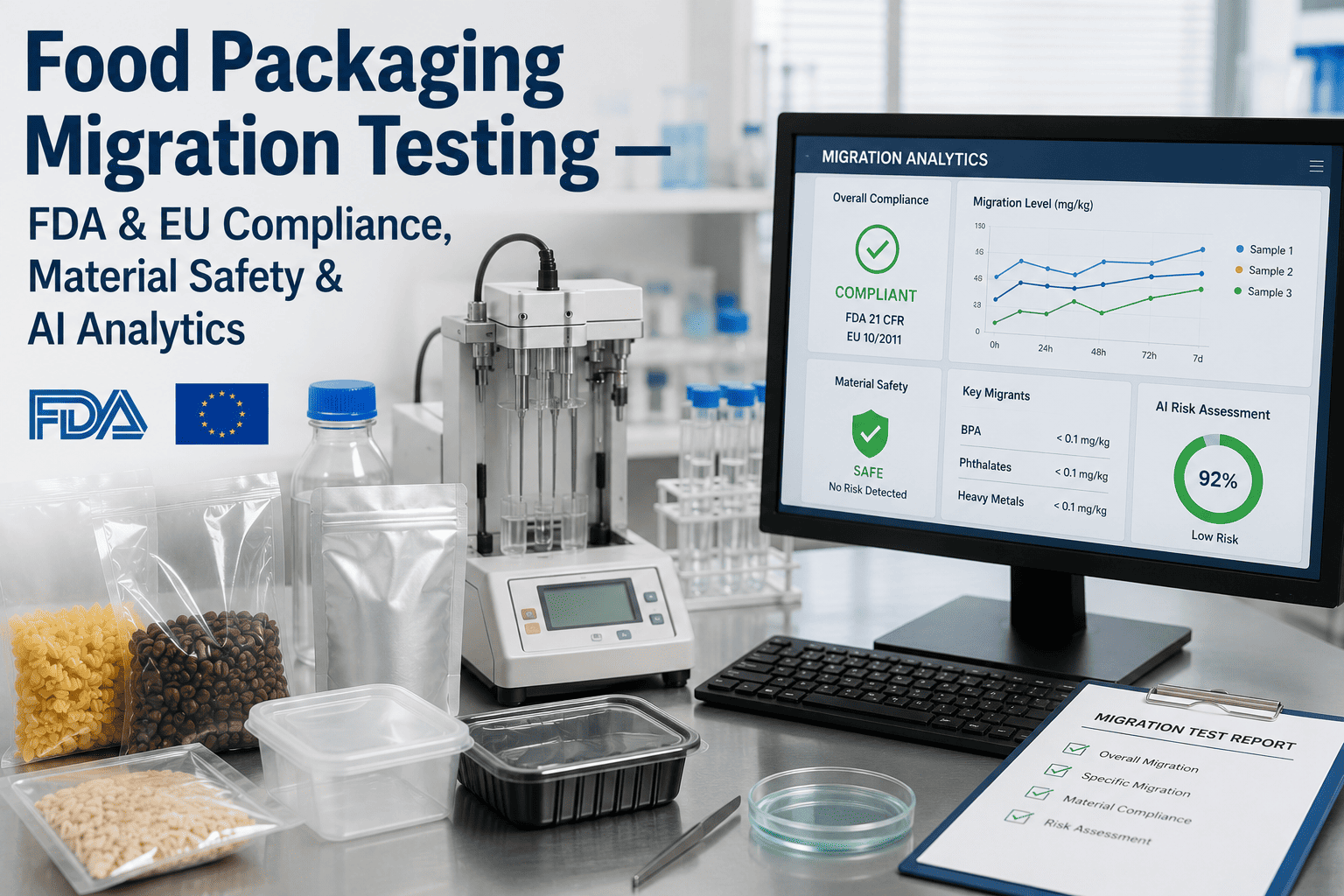
Food packaging migration testing is a critical regulatory and safety requirement for manufacturers supplying the global food industry. With stringent standards from the U.S. FDA (21 CFR) and the European Union (EU Regulation 10/2011), ensuring that no harmful substances migrate from packaging materials into food products is non-negotiable. Failure to comply can lead to product recalls, legal penalties, and severe brand damage. This comprehensive guide provides an in-depth analysis of migration testing protocols, extractable and leachable (E&L) studies, and the transformative role of AI-driven analytics in predictive material risk assessment. Whether you are a Quality Manager overseeing compliance or a packaging engineer optimizing material selection, this resource equips you with the technical knowledge to navigate the complex landscape of food contact material safety. Book a Demo to see how iFactory's AI platform can streamline your compliance workflows.
Ensure Food Packaging Safety with Advanced Migration Testing
Achieve full compliance with FDA 21 CFR and EU Regulation 10/2011 through rigorous testing and AI-powered analytics.
The Science of Migration Testing
Migration testing evaluates the transfer of chemical substances from packaging materials into food simulants under controlled conditions. This process is essential for verifying that packaging does not introduce contaminants that could compromise food safety or quality. The testing involves selecting appropriate food simulants (e.g., ethanol, acetic acid, or olive oil) based on the food type, then exposing the packaging to these simulants at specific temperatures and durations to mimic real-world scenarios. Analytical techniques such as gas chromatography-mass spectrometry (GC-MS) and liquid chromatography-tandem mass spectrometry (LC-MS/MS) are used to detect and quantify migrants. The results are compared against regulatory limits to determine compliance. This rigorous methodology ensures that packaging materials are safe for their intended use, protecting consumers and brand reputation.
FDA 21 CFR & EU Regulation 10/2011 Compliance
FDA 21 CFR
The U.S. FDA requires that packaging materials comply with 21 CFR parts 170-199, which specify acceptable components and migration limits. Testing must demonstrate that overall migration (OML) does not exceed 10 mg/dm² and specific migration limits (SML) for individual substances are not surpassed. Compliance involves rigorous testing of all intended use conditions, including microwave and oven heating.
EU Regulation 10/2011
The EU framework mandates that plastic materials and articles comply with overall migration limits of 10 mg/dm² and specific migration limits for over 400 listed substances. The regulation also requires a declaration of compliance and supporting documentation. Testing must be performed using standardized food simulants and conditions that reflect worst-case scenarios.
Global Harmonization
While FDA and EU regulations are the most prominent, other markets like China, Japan, and Mercosur have their own standards. A robust migration testing program should be designed to meet the most stringent requirements globally, ensuring market access and consumer safety.
Step-by-Step Migration Testing Protocol
Material Characterization
Identify all components of the packaging material, including polymers, additives, adhesives, and coatings. Obtain safety data sheets and formulation details from suppliers.
Food Simulant Selection
Choose simulants that represent the food types the packaging will contact. Common simulants include 10% ethanol for aqueous foods, 3% acetic acid for acidic foods, and olive oil for fatty foods.
Exposure Conditions
Define time and temperature conditions based on intended use. For example, retort packaging may require 121°C for 30 minutes, while refrigerated storage may use 40°C for 10 days.
Analytical Testing
Use validated methods like GC-MS or LC-MS/MS to quantify migrants. Perform overall migration determination gravimetrically and specific migration analysis against regulatory limits.
Data Evaluation & Reporting
Compare results with SML and OML limits. Generate a compliance report with detailed findings, including chromatograms and statistical analysis. Implement corrective actions if needed.
Common Migrants and Regulatory Limits
| Substance | Source | FDA SML (mg/kg) | EU SML (mg/kg) |
|---|---|---|---|
| Bisphenol A (BPA) | Epoxy resins, polycarbonate | 0.05 | 0.05 |
| Phthalates (DEHP) | Plasticizers | 1.5 | 1.5 |
| Primary Aromatic Amines | Polyurethane adhesives | Not detectable (DL 0.01 mg/kg) | Not detectable (DL 0.01 mg/kg) |
| Formaldehyde | Melamine resins | 15 | 15 |
| Lead | Contaminants | 0.01 | 0.01 |
AI-Driven Risk Assessment for Packaging Materials
Predictive Modeling
Machine learning algorithms analyze historical migration data and material compositions to predict potential non-compliance before physical testing begins. This reduces the need for extensive laboratory trials and accelerates time-to-market.
Real-Time Monitoring
IoT sensors embedded in production lines capture process parameters (temperature, pressure, dwell time) and feed them into AI models. Any deviation from safe conditions triggers an alert, enabling immediate corrective action.
Automated Documentation
AI systems automatically generate compliance reports, declarations of conformity, and technical dossiers required by regulators. This eliminates manual data entry errors and ensures audit-ready documentation.
Transform Your Compliance Workflow
Integrate AI-driven migration testing into your quality management system. Reduce testing costs by 40% while achieving 100% regulatory compliance.
Best Practices for Migration Testing Programs
Supplier Qualification
Require all packaging material suppliers to provide certified migration test reports and declarations of compliance. Implement a supplier audit program to verify their testing capabilities.
Batch Testing
Conduct migration testing on every production batch to account for variability in raw materials and manufacturing processes. Statistical sampling plans (e.g., ANSI/ASQ Z1.4) can reduce testing frequency without compromising safety.
Accredited Laboratories
Partner with ISO/IEC 17025 accredited laboratories for all migration testing. Ensure they use the latest analytical methods and participate in proficiency testing programs.
Continuous Improvement
Establish a continuous improvement loop where migration data is analyzed to identify trends and drive material reformulations. AI analytics can highlight recurring issues and suggest alternative materials.
Case Study: Reducing Non-Compliance by 70%
A global food packaging manufacturer faced frequent non-compliance issues with phthalate migration in flexible films. By implementing iFactory's AI platform, they were able to predict which material combinations would exceed limits and reformulate their adhesives accordingly. Within six months, non-compliance rates dropped from 12% to 3.6%, saving $2.3 million annually in rework and recall costs. The platform also automated their compliance documentation, reducing audit preparation time by 80%.
Frequently Asked Questions
What is the difference between overall migration and specific migration?
Overall migration (OML) measures the total mass of all substances that migrate from the packaging material into the food simulant, expressed in mg/dm² or mg/kg. It is a general indicator of the material's inertness. Specific migration (SML) focuses on individual substances, such as bisphenol A or phthalates, and compares their concentration to regulatory limits. Both tests are required by FDA and EU regulations. For detailed guidance, refer to the iFactory support page on migration testing protocols.
How often should migration testing be performed?
Migration testing frequency depends on the stability of the packaging material and the manufacturing process. For new materials or after any formulation change, initial full testing is mandatory. For established products, a risk-based schedule is recommended. Many companies test every production batch for critical migrants and perform full OML/SML analysis quarterly. AI-driven risk assessment can optimize this frequency by identifying low-risk materials that require less frequent testing. Book a Demo to learn how AI can optimize your testing schedule.
What food simulants are used in migration testing?
Food simulants are chosen based on the type of food the packaging will contact. Common simulants include: 10% ethanol (aqueous foods), 3% acetic acid (acidic foods), 20% ethanol (alcoholic foods), and olive oil or other fatty simulants (fatty foods). For dry foods, modified polyphenylene oxide (MPPO) is used as a simulant for Tenax. The selection must follow regulatory guidelines to ensure representative testing. The iFactory platform can automatically suggest simulants based on your product portfolio. Contact support for a detailed simulant selection guide.
How can AI improve the accuracy of migration testing?
AI enhances accuracy by analyzing large datasets from historical tests to identify patterns and predict migration levels for new material combinations. Machine learning models can account for variables like polymer type, additive concentration, and processing conditions to provide highly accurate predictions. This reduces the reliance on trial-and-error testing and minimizes the risk of false negatives. Additionally, AI can detect anomalous results in real-time, flagging potential errors in the testing process. Book a Demo to see AI in action.
What are the consequences of non-compliance with migration regulations?
Non-compliance can lead to severe repercussions, including product recalls, import bans, fines, and legal liability. In the U.S., the FDA can issue warning letters, seize products, or pursue criminal charges. In the EU, non-compliant products are barred from the market, and companies may face penalties under national enforcement laws. Beyond regulatory actions, non-compliance damages brand reputation and consumer trust. Proactive migration testing and AI-driven compliance management are essential to avoid these risks. Contact iFactory support for a compliance risk assessment.
Ready to Achieve Zero-Defect Compliance?
Partner with iFactory to deploy AI-powered migration testing and documentation. Our platform helps you meet FDA and EU standards with confidence.