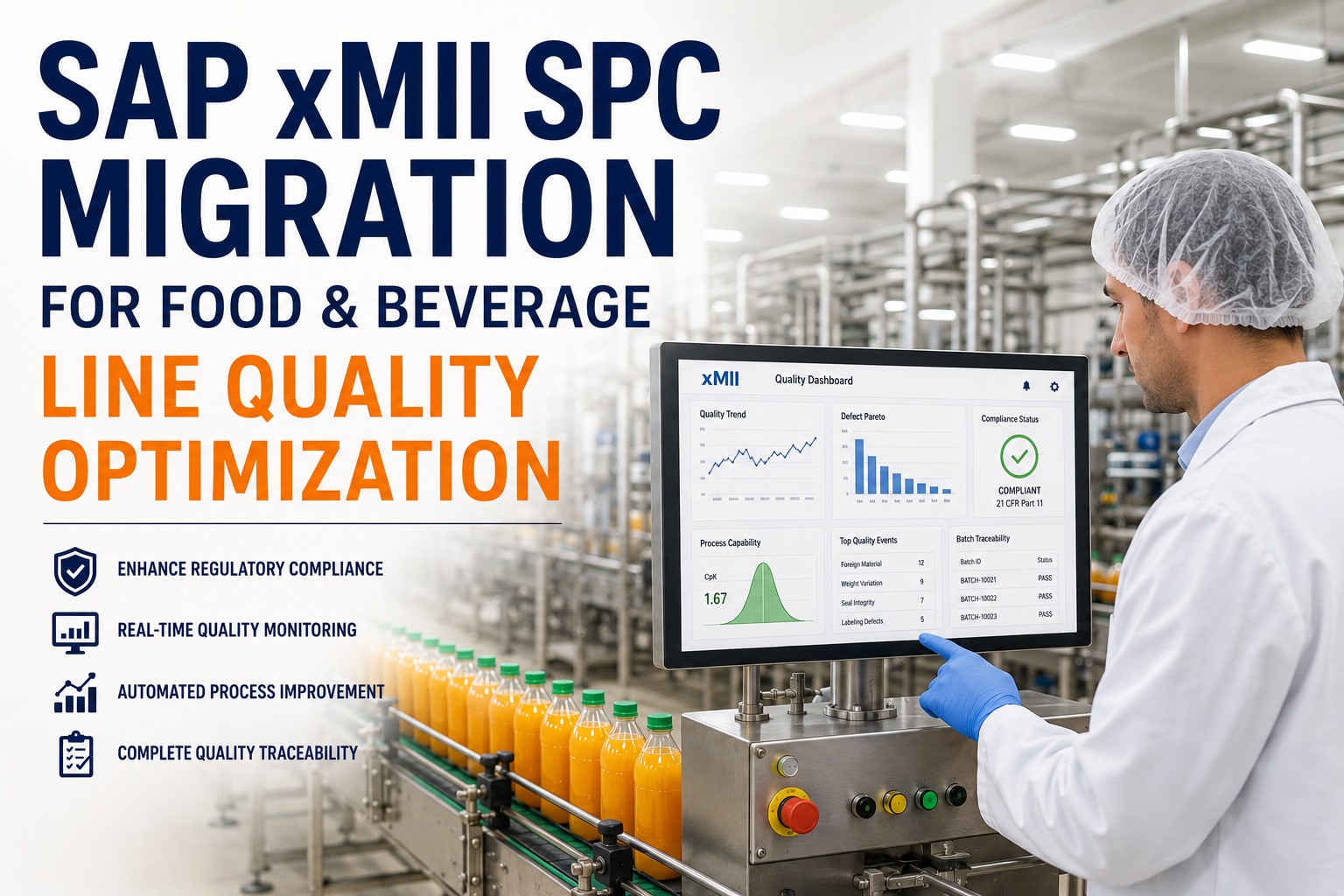
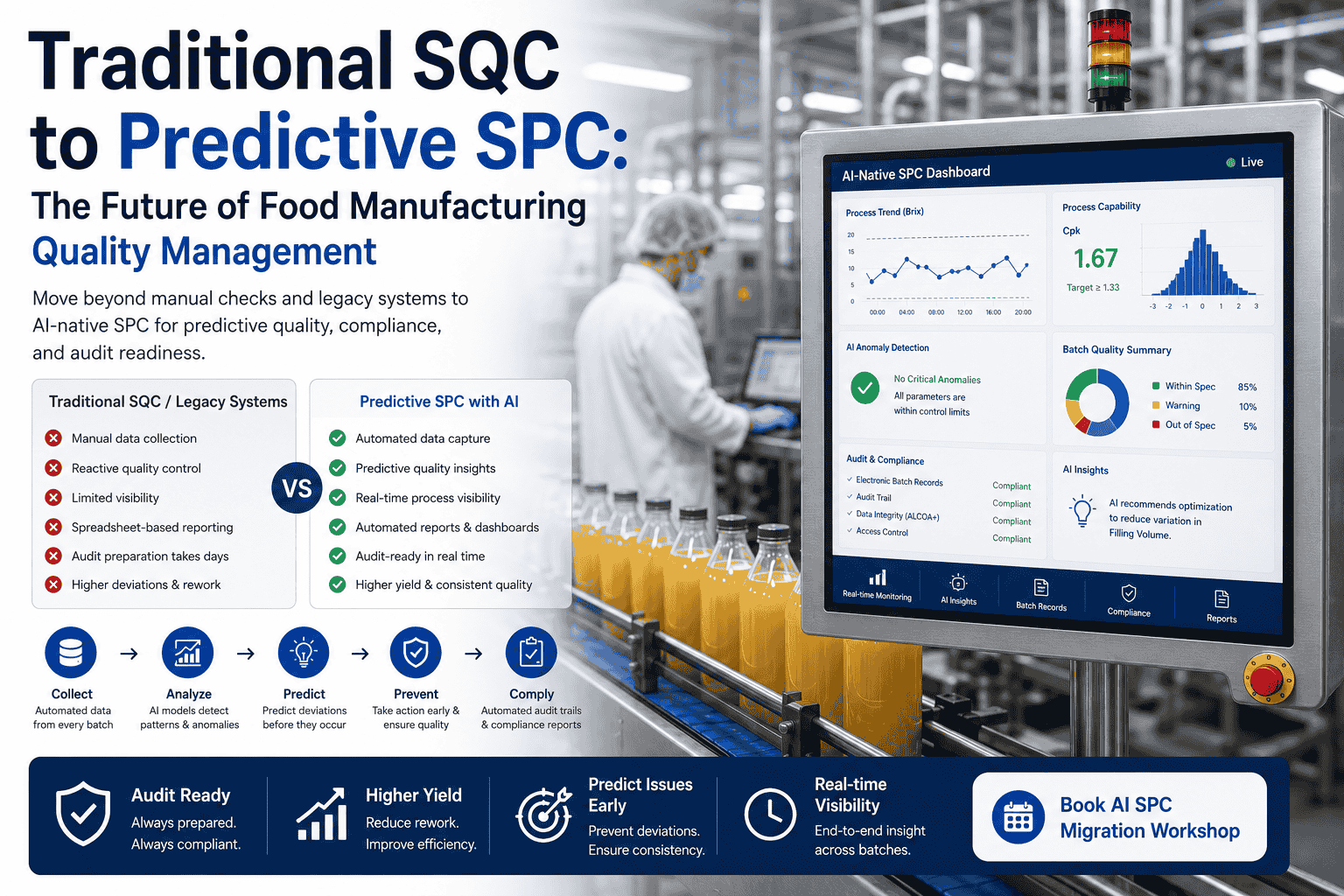
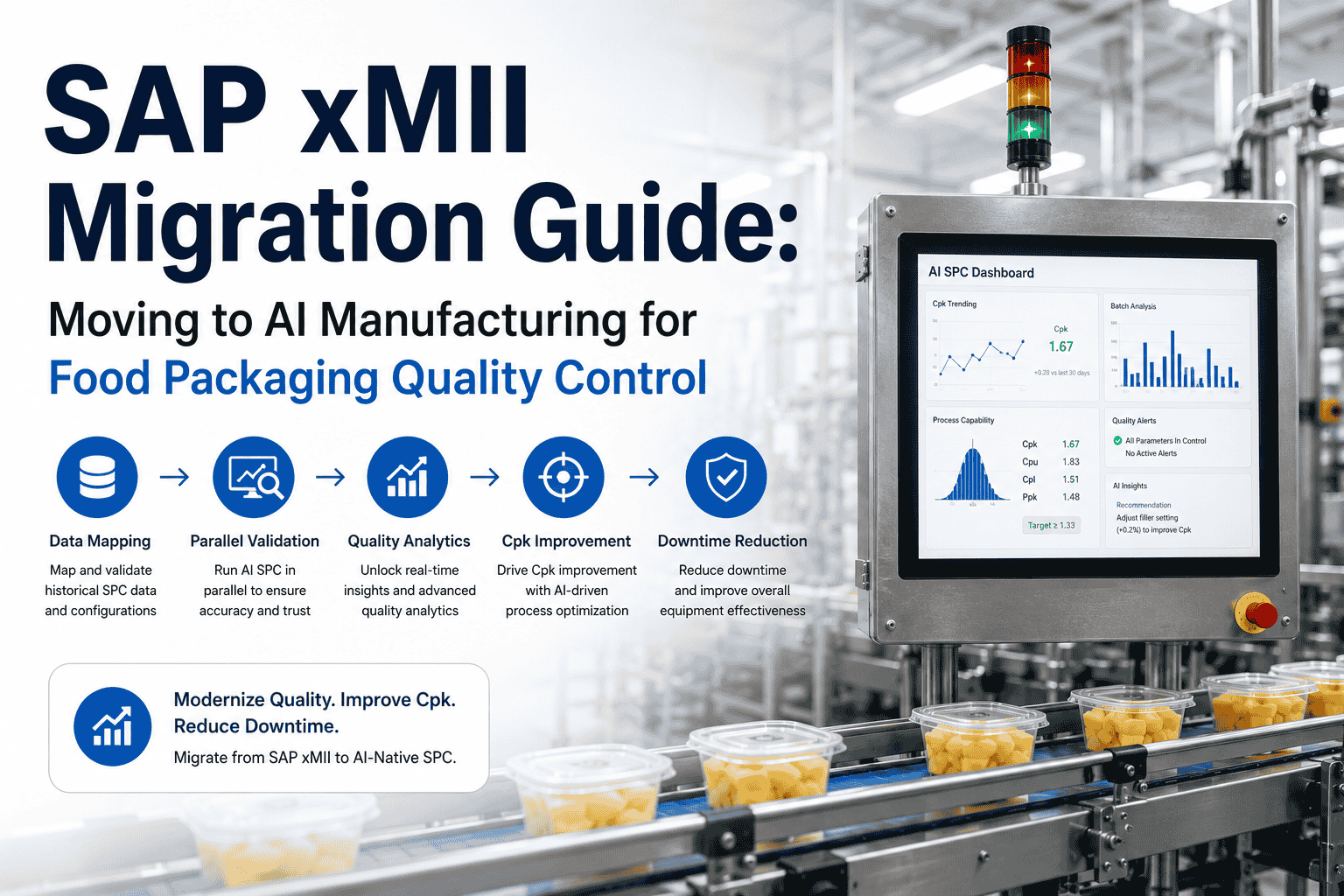
F&B regulations don't live in a single audit binder — they live at specific points along the production line. FSMA 204 traceability lives at receiving and shipping. HACCP critical control points live at cook and pasteurization. HARPC preventive controls live at fill and process. Allergen control and FDA 21 CFR Part 11 electronic records live at packaging. Every stage on the line has its own regulation, its own compliance evidence, and its own audit risk. SAP xMII can show you each of these stages in a report — but the compliance evidence has to be manually assembled, periodic checks have to be scheduled, and audit gaps tend to appear at the stage boundaries. AI-native SPC delivers per-batch continuous compliance evidence across every stage simultaneously — every receiving lot tagged, every CCP forecast, every preventive control monitored, every record Part 11-signed, every shipping unit traceable one-up and one-down within seconds. Continuous compliance instead of periodic compliance. The result for F&B operations: zero gaps between regulatory checkpoints, $10K-$100K+ per Form 483 observation avoided, instant batch genealogy on demand, and audit-readiness as a side effect of normal operation rather than a quarterly fire drill. This guide breaks down the 5 line stages with their regulations, the major frameworks AI-native automates, and the 8-12 week migration roadmap. Book an AI SPC migration workshop for your plant.
Stage 01
FSMA 204
Receiving
Auto lot capture · supplier verification
→
Stage 02
HACCP CCP
Cook / Prep
Real-time CCP forecasting · deviation prevention
→
Stage 03
HARPC PC
Fill / Process
Preventive control monitoring · continuous
→
Stage 04
Allergen + Part 11
Packaging
Cross-contamination + immutable trail
→
Stage 05
FSMA 204 Out
Shipping
1-up / 1-down genealogy · seconds
xMII Reality
Each stage covered in isolation · evidence manually reconstructed at audit time · gaps appear at stage boundaries · quarterly fire drill cadence
Why xMII Compliance Is Periodic, Not Continuous
Legacy xMII was architected when "compliance" meant assembling evidence for the quarterly audit. The 2026 regulatory bar — FSMA 204 traceability, ongoing HARPC preventive controls, real-time HACCP CCP monitoring — has moved past what periodic compliance can deliver. Five structural reasons xMII compliance gaps live in the spaces between scheduled checks.
01
Designed for Sampling, Not Continuous
xMII compliance reports run on scheduled intervals — hourly, shift, daily. Anything between samples is invisible. The 2026 frameworks (FSMA, HARPC) explicitly require ongoing monitoring evidence.
02
Evidence Assembled at Audit Time
xMII compliance packs are built when auditors are scheduled. SQL queries, manual report builders, spreadsheet stitching. The reconstruction process itself introduces version-control and signature-trail gaps.
03
Stage Boundary Gaps
xMII tends to track each stage in its own module. The handoffs between Receiving → Cook → Fill → Package → Ship lose evidence at boundaries. Auditors find the gaps by asking for end-to-end genealogy.
04
Reactive HACCP Monitoring
xMII alarms when CCP limits are breached. By then the deviation has happened. HACCP's spirit is prevention — AI-native CCP forecasting catches drift 1-30 minutes ahead, preventing the violation rather than logging it.
05
FSMA 204 Traceability Strain
FSMA Rule 204 (live since Jan 2026) requires rapid one-up / one-down lot traceability. xMII genealogy reconstruction often takes days. AI-native delivers it in seconds with Part 11-compliant records.
The 5 Line Stages · Deep-Dive on Each Regulation
Each production stage has its own regulatory anchor, its own compliance evidence requirement, and its own AI-native capability. The deep-dive below shows what lives at each stage, what auditors expect to see, and how AI-native SPC delivers that evidence continuously instead of on the schedule xMII was built around.
Stage 01 · FSMA 204
Receiving · Inbound Lot Traceability
FSMA Rule 204 mandates electronic records with rapid retrieval for all Critical Tracking Events on the Food Traceability List. Receiving is where the chain starts. AI-native captures supplier lot, receiving timestamp, condition data, and links it to the batches that will use the lot — all automatically, with Part 11 signatures.
Stage 02 · HACCP CCP
Cook / Prep · Critical Control Points
HACCP demands monitoring, verification, and corrective action records at every CCP — cook temperature/time, pasteurization, cooling. xMII typically logs CCP data and alarms on breaches. AI-native forecasts CCP deviation 1-30 minutes ahead, enabling intervention before the violation rather than documentation after.
Stage 03 · HARPC PC
Fill / Process · Preventive Controls
HARPC (FSMA's Hazard Analysis and Risk-based Preventive Controls) expands beyond HACCP into supply chain, sanitation, and process preventive controls. Each PC requires ongoing monitoring evidence. AI-native runs continuous multivariate monitoring instead of sampled checks — every PC covered every batch.
Stage 04 · Allergen + Part 11
Packaging · Cross-Contamination + Records
Packaging is where allergen labeling, cross-contamination prevention, and FDA 21 CFR Part 11 electronic record integrity converge. AI-native captures every changeover sanitation event, every allergen line clearance, every record signature with tamper-evident time stamps and operator attribution.
Stage 05 · FSMA 204 Out
Shipping · Outbound Traceability
FSMA 204 closes the loop with outbound CTE records — every shipped unit linked back through process and receiving to supplier lot. xMII typically requires day-long reconstruction. AI-native delivers complete one-up / one-down genealogy in seconds, with retailer-compatible export formats and recall-readiness on demand.
Cover Every F&B Regulation Continuously — Not Periodically
iFactory's F&B AI SPC practice deploys continuous regulatory compliance evidence across all 5 line stages — FSMA 204 traceability, HACCP CCP forecasting, HARPC preventive controls, allergen + Part 11 records, and outbound recall-ready genealogy. On existing xMII infrastructure in 8-12 weeks per line.
F&B Regulatory Frameworks · What AI-Native SPC Automates
The five frameworks below cover the bulk of U.S. F&B regulatory exposure. Each one has specific compliance requirements that AI-native SPC automates as a side effect of normal line operation — no separate workflow, no manual evidence reconstruction. The mapping below shows what each framework requires and what AI-native delivers automatically.
Framework
Requires
AI-Native Delivers Automatically
xMII Gap
HACCP
CCP monitoring + verification + corrective action records
Predictive CCP forecasting + auto CAPA
Reactive logging · manual CAPA
HARPC (FSMA)
Hazard analysis + ongoing preventive control monitoring
Continuous multivariate PC monitoring + evidence
Sampling-based checks
FSMA 204
Electronic CTE records + rapid retrieval (one-up / one-down)
Auto-capture + seconds-fast genealogy
Day-long reconstruction
FDA 21 CFR Part 11
Electronic records integrity + audit trail + signatures
Cryptographic signatures + tamper-evident trail
Trail gaps + manual reconciliation
GFSI (BRCGS / SQF / FSSC 22000)
Documented quality system + audit readiness on demand
Live compliance dashboards + one-click pack export
Quarterly evidence assembly
Need a regulatory framework gap analysis for your plant? Book a compliance assessment with our F&B advisory team.
Periodic vs Continuous Compliance · Capability Comparison
The xMII vs AI-native comparison is sharpest on regulatory compliance. Every dimension below shows where periodic compliance breaks down and where continuous compliance changes the operating model. The plants making the transition stop treating audits as quarterly events and start treating compliance as a continuous operational capability.
Dimension
xMII (Periodic)
AI-Native (Continuous)
Compliance Impact
Evidence Cadence
Hourly / shift / daily reports
Per-batch, per-event, continuous
No gaps between samples
CCP Monitoring
Threshold alarms · reactive
1-30 min ahead forecasting
Prevent violations vs document them
FSMA 204 Genealogy
Days to reconstruct
Seconds · one-click retrieval
Recall-readiness on demand
Part 11 Audit Trail
Manual reconciliation
Cryptographic + tamper-evident
No trail integrity questions
Allergen Control
Sanitation logs · paper
Auto changeover capture + verification
Cross-contamination risk surfaced
Compliance Pack Generation
SQL pulls + manual builders
One-click export · always current
Days saved per audit cycle
Operating Posture
Quarterly fire drill
Continuous capability
Audit becomes a normal day
Want a periodic-to-continuous compliance gap diagnostic? Connect with our F&B compliance team for a tailored review.
Migration Path · 4-Phase Roadmap in 8-12 Weeks
The compliance layer deploys on existing xMII infrastructure with on-premise edge AI. Four phases take a plant from periodic xMII compliance to a continuously running per-batch evidence layer across all 5 line stages. Most plants see measurable compliance readiness improvement starting in week 6.
Phase 1
Compliance Inventory
Map each line stage to regulatory framework · identify current xMII coverage gaps · baseline audit readiness · Year 1 risk reduction quantified
Weeks 1-2
→
Phase 2
Edge + Evidence Capture
On-prem AI appliance installed · per-stage evidence capture configured · Part 11 signature layer activated · FSMA 204 genealogy tested
Weeks 2-5
→
Phase 3
Predictive CCP & PC Models
HACCP CCP forecasting and HARPC preventive control monitoring trained · predictive alerts wired to operator workflows
Weeks 5-9
→
Phase 4
Continuous Compliance Live
All 5 stages continuously monitored · compliance dashboards live · mock audit drill executed · xMII retained for transactional layer
Weeks 9-12
Need a tailored 4-phase compliance roadmap for your lines? Book a roadmap planning session with our F&B regulatory team.
Expert Perspective
The F&B compliance teams I work with all describe the same shift after the AI-native transition: regulatory work stops being a separate workflow with its own deadlines and starts being a side effect of normal line operation. Under xMII, compliance is something you do — assemble evidence, build packs, run reports, prepare for audits. Under AI-native, compliance is something the platform produces automatically as a consequence of monitoring the line. Every batch has its complete genealogy because FSMA 204 capture happens on every receiving event without anyone having to remember. Every CCP has its complete record because predictive monitoring runs whether or not anyone is watching. Every Part 11 signature is intact because the cryptographic trail is maintained at the platform layer, not by individual operators remembering to sign things. When auditors arrive, the work is done. There's no preparation week, no late-night SQL pulls, no spreadsheet stitching. The compliance team starts the audit by handing over the pre-built pack and starts the audit on the conversation rather than on the document scramble. That's the real shift. The cost avoidance and the audit-day calm are downstream effects of the architectural choice.
— F&B Regulatory Affairs Best Practice, 2026
5 Stages
Continuously monitored · per batch
$10K-100K+
Per Form 483 observation avoided
Jan 2026
FSMA Rule 204 live · enforcement begins
8-12 wks
Implementation per line
Bottom Line · Continuous Compliance Is the New Audit-Day Calm
F&B regulations have moved past what periodic compliance can deliver. FSMA Rule 204 traceability went live January 2026 with rapid-retrieval expectations xMII reconstruction can't meet. HARPC's ongoing preventive control requirement explicitly rejects sampling-based evidence. HACCP's prevention spirit demands forecasting that reactive alarming can't provide. The 5 line stages — Receiving, Cook/Prep, Fill/Process, Packaging, Shipping — each carry their own regulatory anchor and their own evidence requirement. AI-native SPC delivers continuous per-batch compliance across all five stages simultaneously, with Part 11-compliant signatures, recall-ready genealogy, predictive CCP control, and one-click compliance pack export. Plants making the migration stop treating audits as quarterly fire drills and start treating compliance as a continuous capability. The Form 483 cost avoidance, the supplier scorecard wins, and the audit-day calm are downstream effects of the architectural choice. Keep xMII for the transactional layer. Add the continuous compliance layer on top. Win on every audit, every inspection, every day.
Replace Periodic xMII Compliance With Continuous AI-Native Evidence
iFactory's F&B AI SPC practice deploys continuous regulatory compliance across all 5 line stages in 8-12 weeks — FSMA 204 traceability, HACCP CCP forecasting, HARPC preventive controls, allergen + Part 11 records, outbound recall-ready genealogy. Sovereign on-prem AI keeps recipe IP and audit records inside the plant. Built for zero gaps between checkpoints.
Frequently Asked Questions
What F&B regulations does AI-native SPC cover continuously?
Five major frameworks: HACCP (CCP monitoring + corrective action), HARPC under FSMA (ongoing preventive controls), FSMA Rule 204 (electronic traceability records, one-up / one-down), FDA 21 CFR Part 11 (electronic records integrity + signatures), and GFSI schemes (BRCGS, SQF, FSSC 22000). All five are delivered as a continuous side effect of monitoring the line — not as separate compliance workflows.
What's the difference between periodic and continuous compliance?
Periodic compliance (xMII default) captures evidence at scheduled intervals — hourly, shift, daily. Anything between samples is invisible to auditors and a potential finding. Continuous compliance (AI-native) captures evidence per batch and per event, with no gaps. FSMA 204 and HARPC explicitly require ongoing monitoring that periodic sampling can't satisfy.
How does AI-native SPC support FSMA Rule 204 traceability?
FSMA Rule 204 went live January 2026 and requires electronic Critical Tracking Event records with rapid retrieval for foods on the Traceability List. AI-native captures supplier lot, receiving timestamps, condition data, batch usage, and outbound shipping events automatically with Part 11 signatures. One-up / one-down genealogy retrieves in seconds versus the day-long reconstruction xMII typically requires. Recall-readiness becomes on-demand.
Do I need to replace xMII to get continuous compliance?
No. The AI-native compliance layer deploys on top of existing xMII infrastructure. xMII keeps doing transactional work it does well — work orders, batch records, ERP integration. The AI layer adds continuous compliance evidence capture, predictive CCP control, and per-batch genealogy. This avoids the 12-36 month MES replacement timeline while delivering 2026-grade compliance in 8-12 weeks per line.
How long does the migration to continuous compliance take?
8-12 weeks per line across 4 phases: Compliance Inventory (Wk 1-2, map each stage to framework and identify gaps), Edge + Evidence Capture (Wk 2-5, on-prem AI appliance with Part 11 signature layer), Predictive CCP & PC Models (Wk 5-9, HACCP forecasting and HARPC preventive monitoring trained), Continuous Compliance Live (Wk 9-12, all 5 stages monitored with mock audit drill).
Book a workshop for your plant.