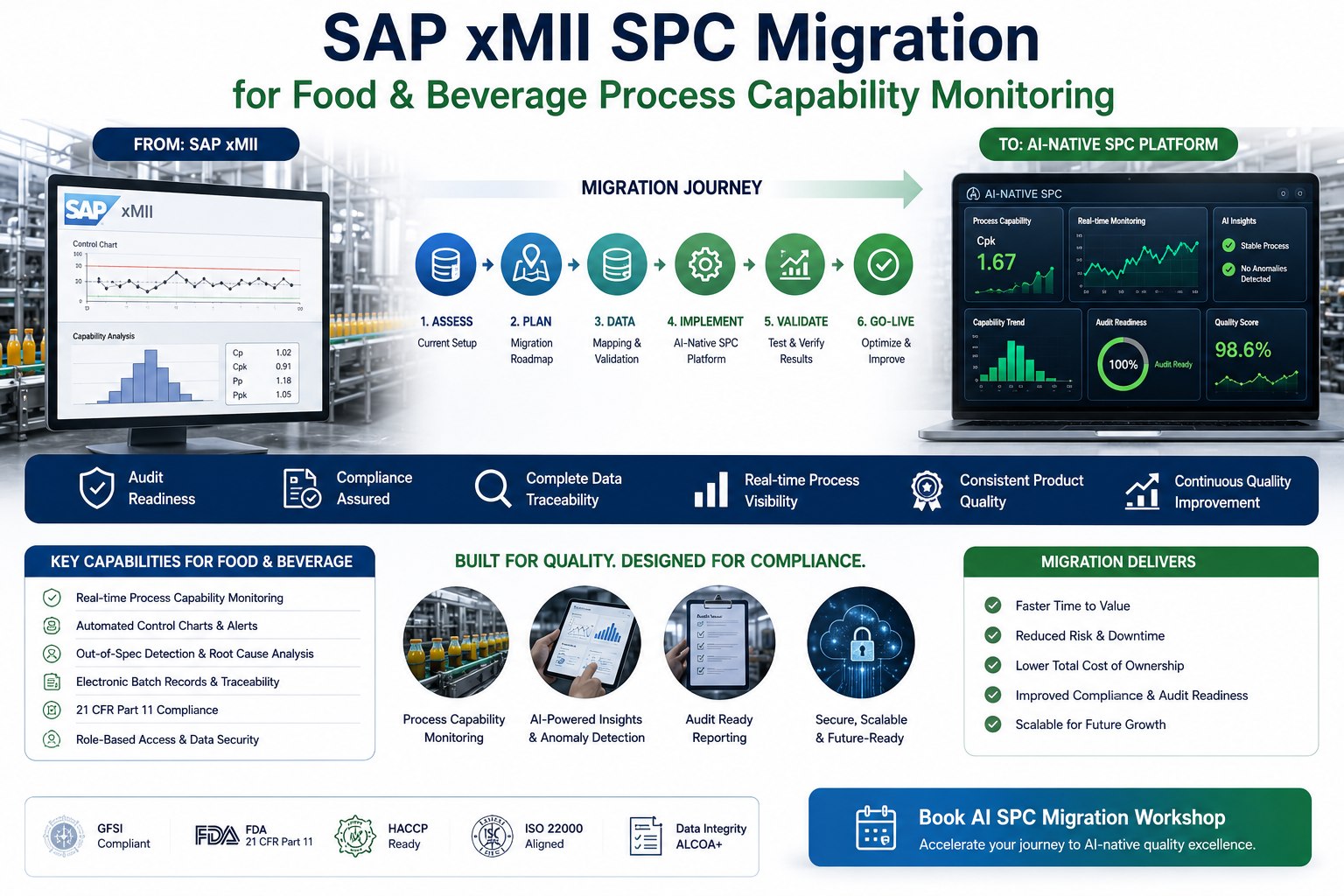
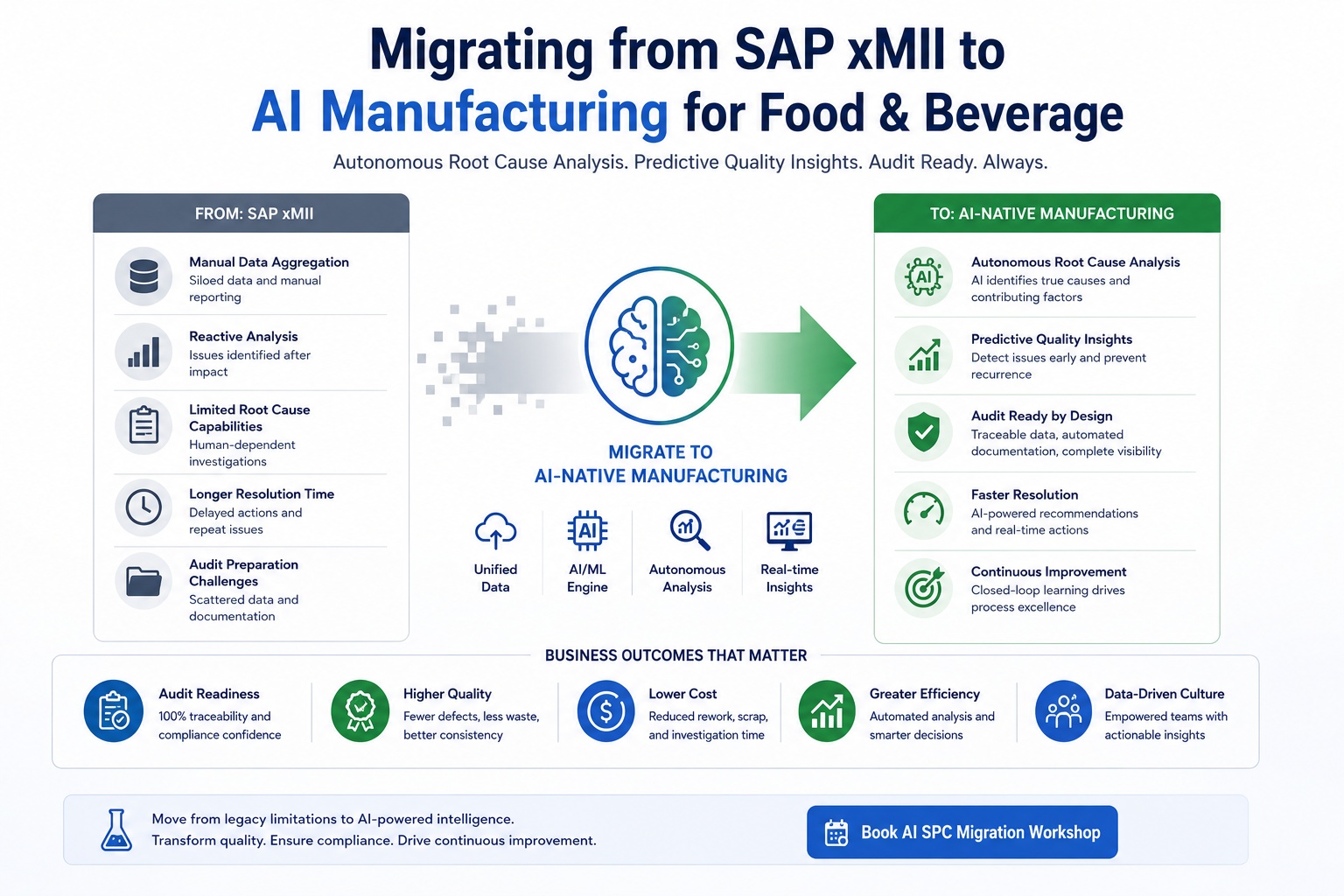
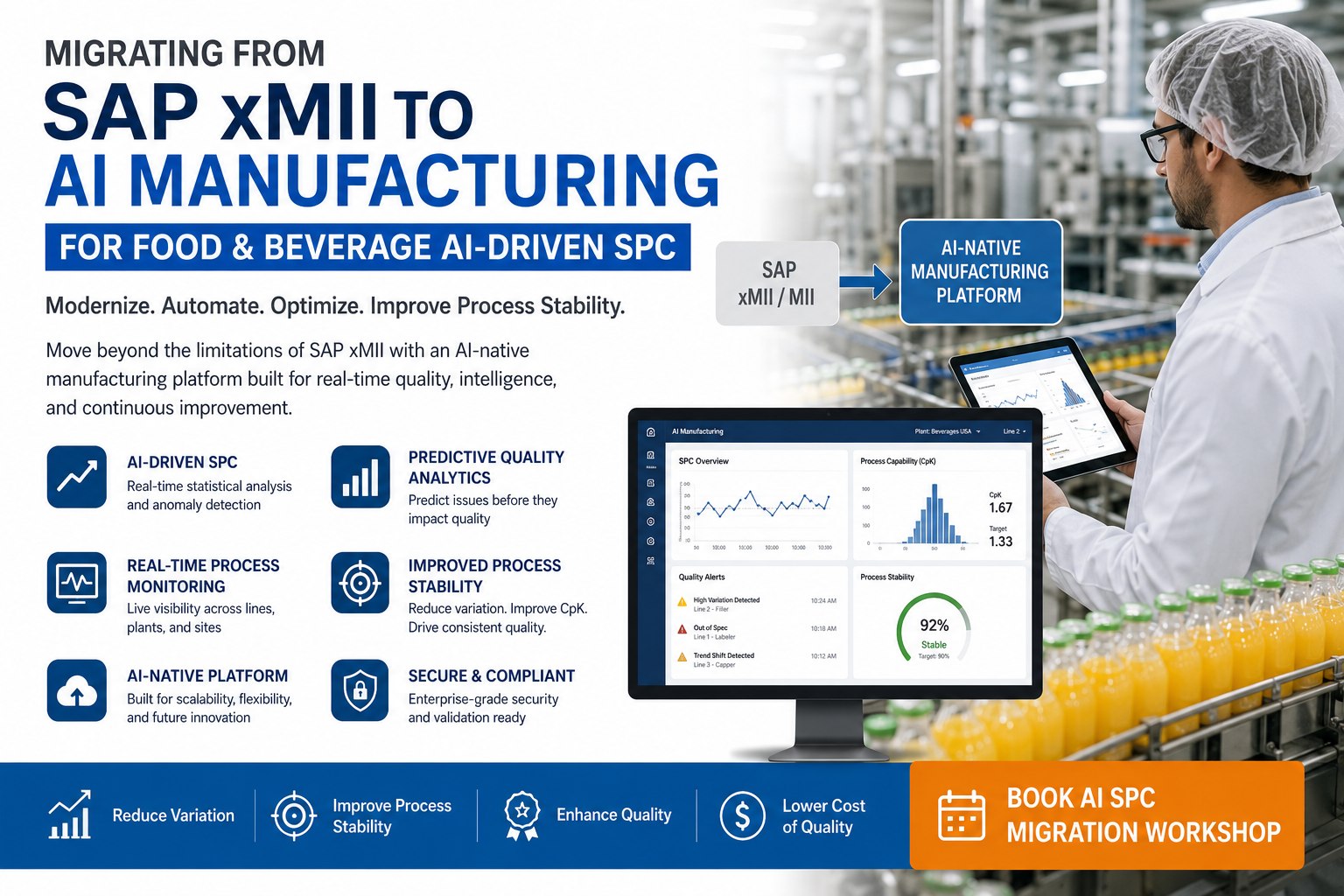
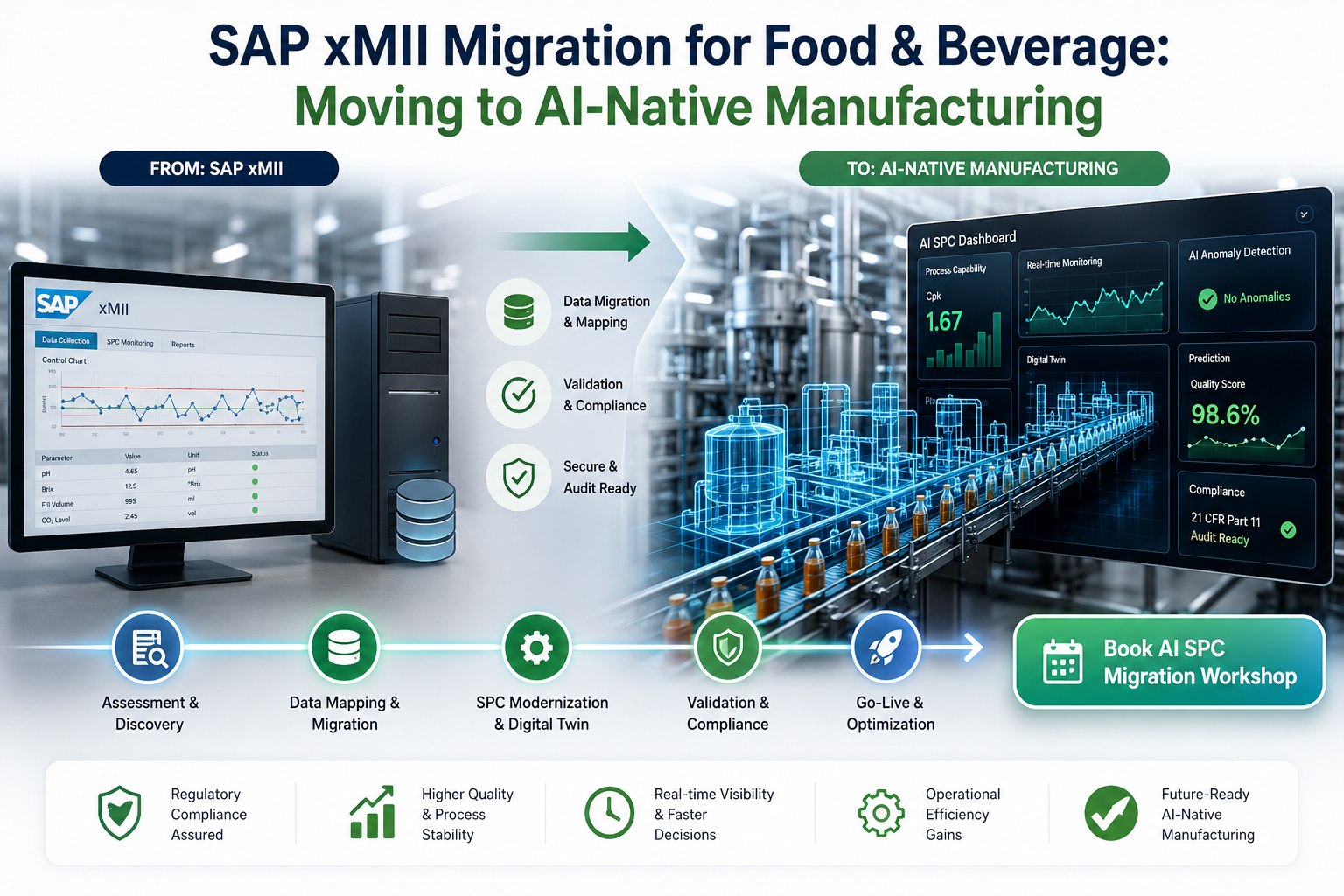
Every F&B regulatory audit — FDA, FSMA, GFSI, BRCGS, SQF — comes down to six questions. The auditor sits in your quality office and asks: show me your control charts. What's your Cpk. Show me the CAPA for this out-of-control event. How were your control limits set. Show me the audit trail for batch X-1234. What's your capability trend year-over-year. Plants running SAP xMII SPC face those questions with scrambling, screenshots, SQL queries, and three-day data pulls. Plants running AI-native SPC answer in 30 seconds with a dashboard that's continuously audit-ready. The cost of failure: $10K-$100K+ per audit finding, Form 483 observations, supplier scorecard slippage, and regulatory follow-up audits that compound the original cost. The migration from xMII SPC to AI-native SPC isn't about better charts — it's about flipping audit-readiness from a quarterly fire drill to a continuous capability. This guide breaks down the 5 audit-readiness pillars, process capability indices auditors actually demand, the xMII-vs-AI-native gap on each audit question, and the 4-phase migration roadmap. Book an AI SPC migration workshop for your plant.
Q1
"Show me your control charts for fill weight over last 90 days"
AI-Native: dashboard pull · 5 sec
Q2
"What's your Cpk for cook temperature this month?"
AI-Native: live index · always current
Q3
"Show me the CAPA for this out-of-control event"
AI-Native: event → action → closure trail
Q4
"How were your control limits set?"
AI-Native: model lineage · timestamped
Q5
"Show me the audit trail for batch X-1234"
AI-Native: full genealogy · one click
Q6
"What's your process capability trend year-over-year?"
AI-Native: longitudinal Cpk · auto-trended
Why F&B Audits Are Getting Harder
The F&B regulatory bar has risen faster than legacy SPC platforms can keep up. Five forces are pushing audit-readiness from a quality-team concern to a board-level risk. Plants still running SAP xMII SPC face each force with platform constraints designed before the modern audit playbook existed.
01
FSMA Rule 204 Traceability
FDA FSMA Final Rule on Food Traceability mandates one-up/one-down electronic records with rapid retrieval. xMII genealogy was never designed for the depth or speed FSMA inspectors now expect.
02
GFSI Audit Frequency Up
GFSI-recognized schemes (BRCGS, SQF, FSSC 22000) have shortened audit cycles and added unannounced visits. Continuous audit-readiness has become a competitive requirement for retailer-facing suppliers.
03
Customer Scorecard Pressure
Major retailers and CPG buyers now run their own supplier scorecards with quality-metric thresholds. A single audit finding can drop scorecard scores enough to lose category position.
04
SAP xMII Support Sunsetting
SAP mainstream support ends Dec 2027. Custom xMII SPC logic accumulated over a decade can't be safely maintained much longer. Audit-readiness during a forced migration is its own risk vector.
05
AI-Native Sets the New Baseline
Auditors who've seen AI-native SPC dashboards in other plants now expect that level of responsiveness everywhere. "We're still running xMII" stops being a sympathetic answer once the comparison exists.
The 5 Pillars of Audit-Ready SPC · Detailed
Audit-ready SPC isn't a feature — it's an architecture. Five pillars determine whether your plant passes audits in calm, daily-readiness mode or scrambles through fire drills every quarter. Each pillar maps to specific auditor expectations; missing one pillar creates an audit finding.
Pillar 01
Continuous Data Capture
Every measurement automatically captured from PLCs, sensors, lab equipment. No manual entry gaps, no missing intervals, no operator transcription errors. Auditors check for completeness — gaps in the data are findings even if values are good.
Pillar 02
Adaptive Control Limits
Limits update with process behavior, product variant, line, and shift. xMII static limits create false alarms (auditors ask "why so many alarms with no action?") or miss real drift. AI-native adapts and documents every limit change.
Pillar 03
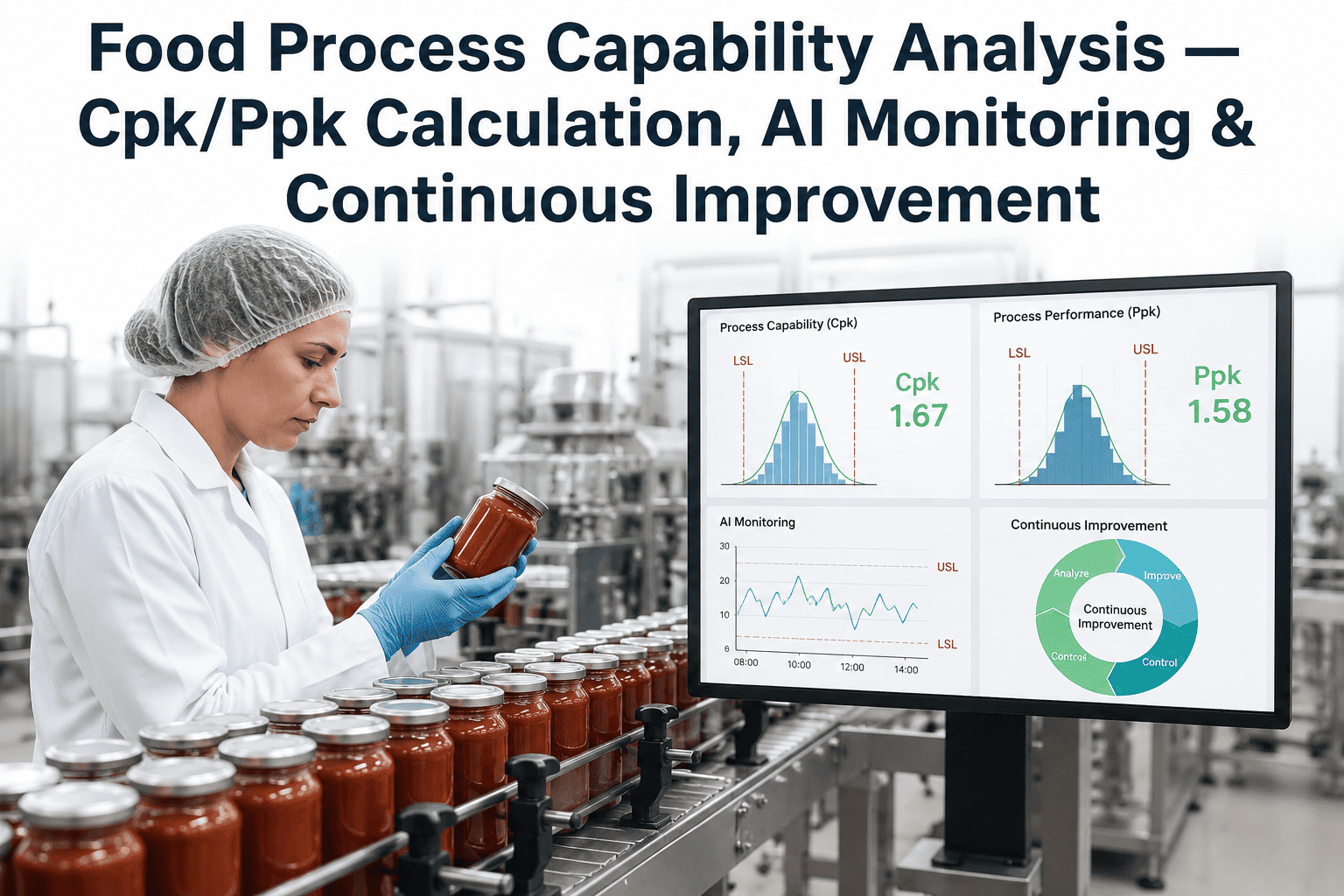
Live Cp / Cpk / Pp / Ppk Indices
Process capability indices continuously calculated and trended. Auditors expect to see current Cpk on demand for every critical parameter. xMII typically generates these on request, not live; AI-native shows them as standing dashboard tiles.
Pillar 04
Immutable Audit Trail
Every event, alarm, corrective action, limit change, operator interaction time-stamped and cryptographically signed. FDA 21 CFR Part 11 explicitly requires this. xMII trails exist but reconstructing batch genealogy across systems often takes days.
Pillar 05
Auto-Generated Compliance Reports
FDA, FSMA, GFSI, BRCGS, and SQF reporting templates generated automatically with current data, on demand. xMII reports require IT scripts and manual report builders; AI-native ships compliance packs with one-click export.
Build Continuous Audit-Readiness Into Your SPC Stack
iFactory's F&B AI SPC practice deploys the 5-pillar audit-ready stack — continuous data capture, adaptive limits, live Cp/Cpk dashboards, immutable Part 11 trails, and auto-generated FDA/FSMA/GFSI compliance packs. Every audit answered in under 30 seconds.
Process Capability Indices · What Auditors Actually Look For
Process capability indices are the universal language F&B auditors speak. Cp, Cpk, Pp, Ppk — every one of them tells a different story about whether your process is in control and capable of meeting specifications. The reference table below shows what each index measures, the benchmark thresholds auditors expect, and what each level means for your audit position.
Index
What It Measures
Threshold
Audit Interpretation
Cp
Process spread vs spec width (potential capability)
> 1.33 capable
Process can fit within spec · centering aside
Cpk
Cp adjusted for off-center process
> 1.33 capable · > 1.67 highly
The metric auditors anchor on most
Pp
Long-term process performance (vs Cp short-term)
Same as Cp
Auditors compare Pp vs Cp for stability
Ppk
Long-term performance adjusted for centering
> 1.33 standard
Compares to Cpk · gap indicates drift
Cpk < 1.0
Process producing out-of-spec output
NOT CAPABLE
Auditor finding · CAPA required
Cpk > 2.0
Six Sigma level performance
BEST-IN-CLASS
Auditor confidence · supplier scorecard win
Need help benchmarking your current Cpk performance? Book a capability assessment with our F&B SPC specialists.
The 6 Audit Questions · xMII vs AI-Native
The six standard audit questions split sharply between the two platforms. xMII can answer them — eventually, with effort, and with risk of inconsistency. AI-native answers them as dashboard queries. The detailed gap analysis below maps each question to typical response times and data sources.
Question 1
"Show me control charts for fill weight over last 90 days"
xMII: SQL query, build chart, validate · ~ 30-90 min
AI-Native: dashboard tile · 5 seconds
Question 2
"What's your Cpk for cook temperature this month?"
xMII: capability report run · ~ 60-120 min
AI-Native: live Cpk tile · always current
Question 3
"Show me the CAPA for this out-of-control event on March 12"
xMII: pull alarm log + paper CAPA file · ~ 2-4 hours
AI-Native: event → action → closure trail · instant
Question 4
"How were your control limits set, and when did they last change?"
xMII: search emails + spreadsheets · ~ 1-3 days
AI-Native: model lineage · every change time-stamped
Question 5
"Show me the complete audit trail for batch X-1234"
xMII: cross-system reconciliation · ~ 1-3 days
AI-Native: one-click batch genealogy · ~ 10 seconds
Question 6
"What's your process capability trend year-over-year?"
xMII: 12 monthly reports manually combined · ~ 4-8 hours
AI-Native: longitudinal Cpk · auto-trended · 5 sec
Want to stress-test your own SPC against these 6 questions? Connect with our audit-readiness advisors for a free diagnostic.
Migration Path · From Audit Fire Drills to Continuous Readiness
The xMII-to-AI-native SPC migration runs faster than full MES replacement because the AI intelligence layer deploys on existing infrastructure. The 4-phase roadmap below typically completes in 6-12 weeks per line, with audit-readiness improvements measurable from week 4.
Phase 1
Baseline & Inventory
Inventory xMII SPC artifacts · map data sources · current Cpk baseline · audit-readiness gap assessment
Weeks 1-2
→
Phase 2
Edge Appliance Install
On-prem AI appliance connects to PLCs, lab systems, MES · data flows verified · sovereignty preserved
Weeks 2-4
→
Phase 3
Parallel Operation
AI-native SPC runs alongside xMII · adaptive limits trained · quality team validates · auditor question dry-runs
Weeks 4-8
→
Phase 4
Cutover & Audit Drill
xMII SPC retired for this line · AI-native is system of record · 6-question dry-run audit drill executed
Weeks 8-12
Need a tailored migration roadmap for your line? Book a migration planning session with our F&B team.
Expert Perspective
The F&B plants that pass audits cleanly in 2026 share one habit: they treat audit-readiness as a daily capability, not a quarterly event. They run the 6-question test on themselves every Monday morning. They know their Cpk for every critical parameter without pulling a report. They can reconstruct any batch genealogy in under a minute. The plants that scramble for audits are the ones still running xMII SPC and treating the audit as the one time per quarter when those questions get asked. The migration to AI-native SPC isn't really about better statistical methods — modern Cpk math is identical to xMII Cpk math. It's about flipping the audit-readiness model from event-driven to always-on. When the auditor walks in at 8AM unannounced, the question isn't whether you can answer the six questions. It's whether you can answer them in 30 seconds without your team holding their breath. The plants that get that right build it into the platform, not into the people scrambling on Sunday night.
— F&B Audit-Readiness Best Practice, 2026
$10K-100K+
Cost per audit finding · F&B average
Cpk > 1.33
Industry-standard capable threshold
6-12 wks
SPC migration timeline per line
Part 11
FDA 21 CFR data integrity standard
Bottom Line · Audit-Ready Every Day, Not Every Quarter
The SAP xMII SPC platform served F&B manufacturers for two decades. The audit playbook has moved on. FSMA Rule 204 traceability, GFSI unannounced visits, customer scorecards, and AI-native expectations have raised the bar past what legacy SPC was designed for. The five pillars of audit-ready SPC — continuous data capture, adaptive limits, live capability indices, immutable Part 11 trails, and auto-generated compliance reports — deliver answers to the six standard audit questions in 30 seconds instead of three days. The migration runs in 6-12 weeks per line, on existing infrastructure, with sovereign on-premise AI that protects recipe IP and audit records. The plants that flip audit-readiness from a quarterly fire drill to a continuous capability stop dreading auditor visits and start using audit performance as a competitive advantage. The cost of not migrating is no longer just technical debt — it's audit findings that compound into scorecard slippage, regulatory follow-ups, and lost category position.
Flip Audit-Readiness From Fire Drill to Continuous Capability
iFactory's F&B AI SPC practice deploys the 5-pillar audit-ready SPC stack in 6-12 weeks per line — continuous data capture, adaptive limits, live Cp/Cpk dashboards, immutable FDA Part 11 trails, and auto-generated FDA/FSMA/GFSI compliance packs. Built so every auditor question gets answered in under 30 seconds.
Frequently Asked Questions
What are the 5 pillars of audit-ready F&B SPC?
Continuous data capture (no manual entry gaps), adaptive control limits (current with process behavior), live Cp/Cpk/Pp/Ppk indices (always-current dashboards), immutable audit trail (FDA 21 CFR Part 11 time-stamped), and auto-generated compliance reports (FDA, FSMA, GFSI, BRCGS, SQF templates). Miss any one and an auditor will find the gap. Together they deliver 30-second answers to every standard audit question.
What process capability index do F&B auditors focus on?
Cpk is the index auditors anchor on most. Industry thresholds: Cpk below 1.0 = not capable (audit finding, CAPA required); Cpk above 1.33 = capable (industry-standard target); Cpk above 1.67 = highly capable; Cpk above 2.0 = Six Sigma level / best-in-class. Auditors also compare Cp vs Cpk (off-center process) and Ppk vs Cpk (drift indicator) to see process stability over time.
How long does xMII SPC to AI-native migration take?
6-12 weeks per line for the AI SPC layer — faster than full MES replacement (12-36 months) because the AI intelligence layer deploys on existing infrastructure. Four phases: Baseline & Inventory (Wk 1-2), Edge Appliance Install (Wk 2-4), Parallel Operation (Wk 4-8), Cutover & Audit Drill (Wk 8-12). Audit-readiness improvements measurable from week 4 forward.
Why does data sovereignty matter for F&B SPC audits?
F&B audit records — Part 11 trails, batch genealogy, recipe parameters, allergen segregation logs — must stay accessible, immutable, and within data residency boundaries. On-premise AI keeps audit records and recipe IP inside the plant where FDA, FSMA, and EU Data Act compliance auditors expect to find them. Cloud-hosted SPC raises data residency questions during audits that on-premise eliminates.
What does a "30-second audit answer" actually look like?
When an auditor asks "show me your control charts for fill weight last 90 days," the SPC dashboard pulls the chart from a standing tile in 5 seconds. "What's your Cpk for cook temperature?" — a live tile showing current Cpk, trended over the last 12 months, always current. "Show me the trail for batch X-1234" — one-click batch genealogy with every event time-stamped per FDA Part 11. No SQL pulls, no spreadsheets, no IT tickets.
Book a migration workshop to see the dashboard live.