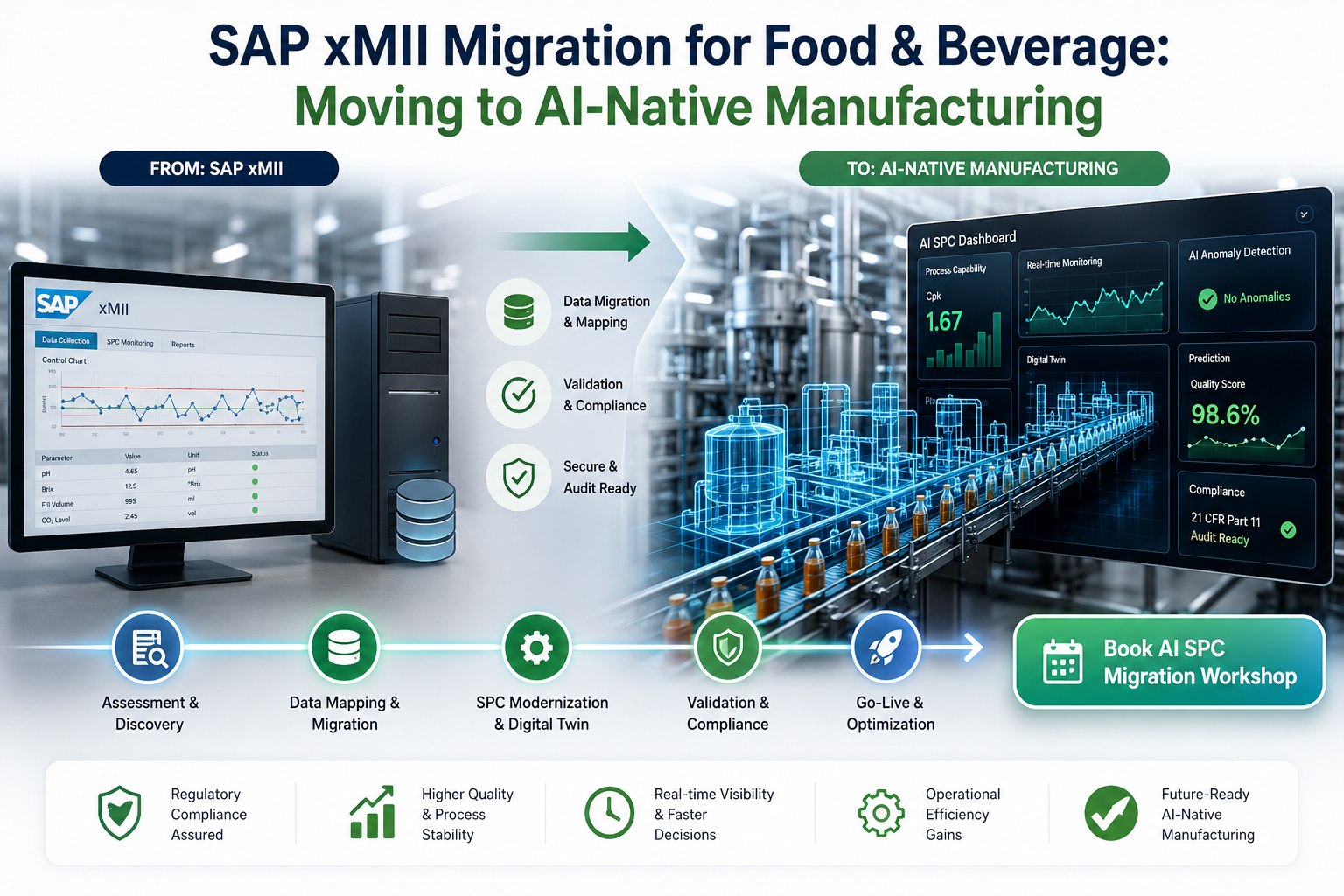
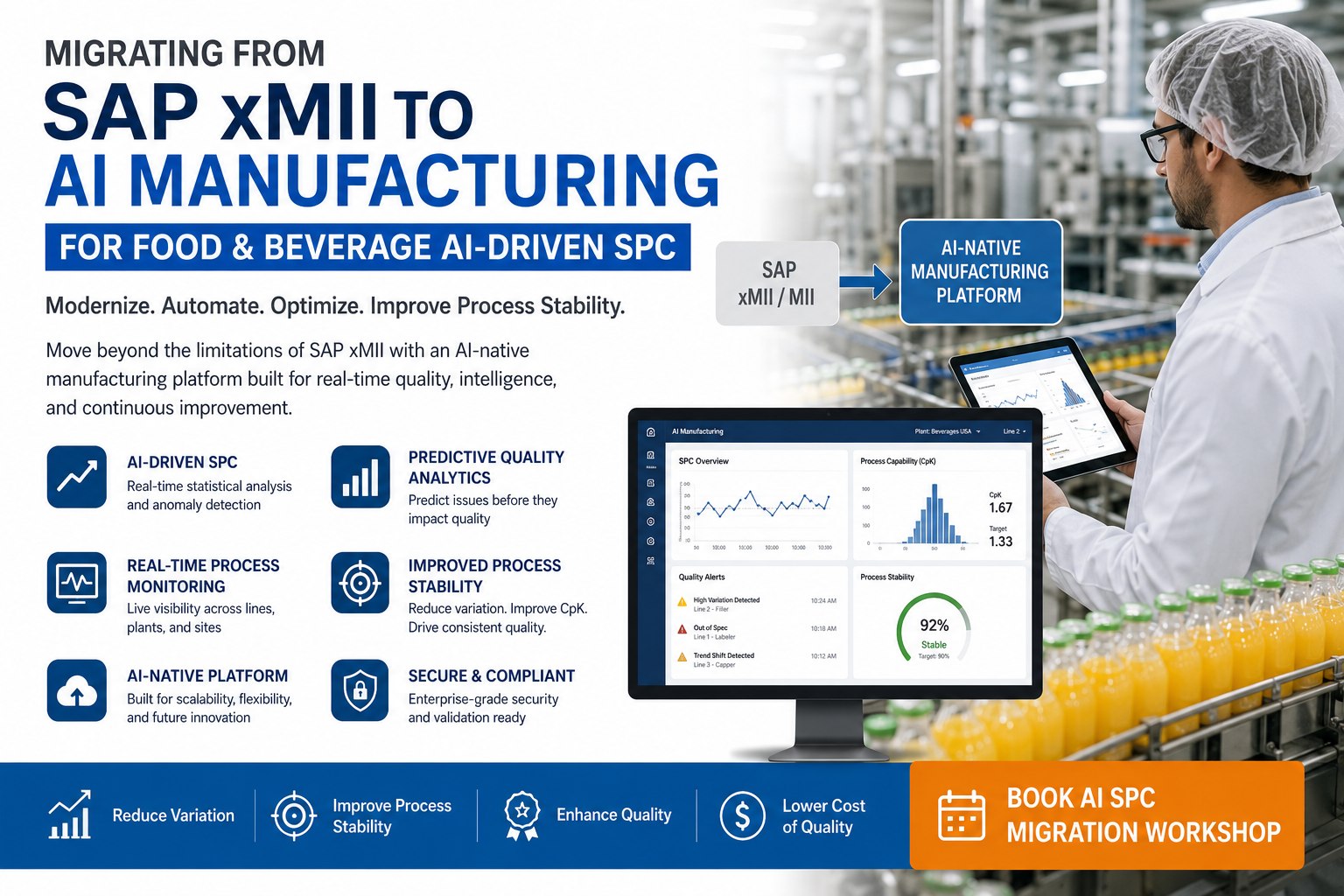
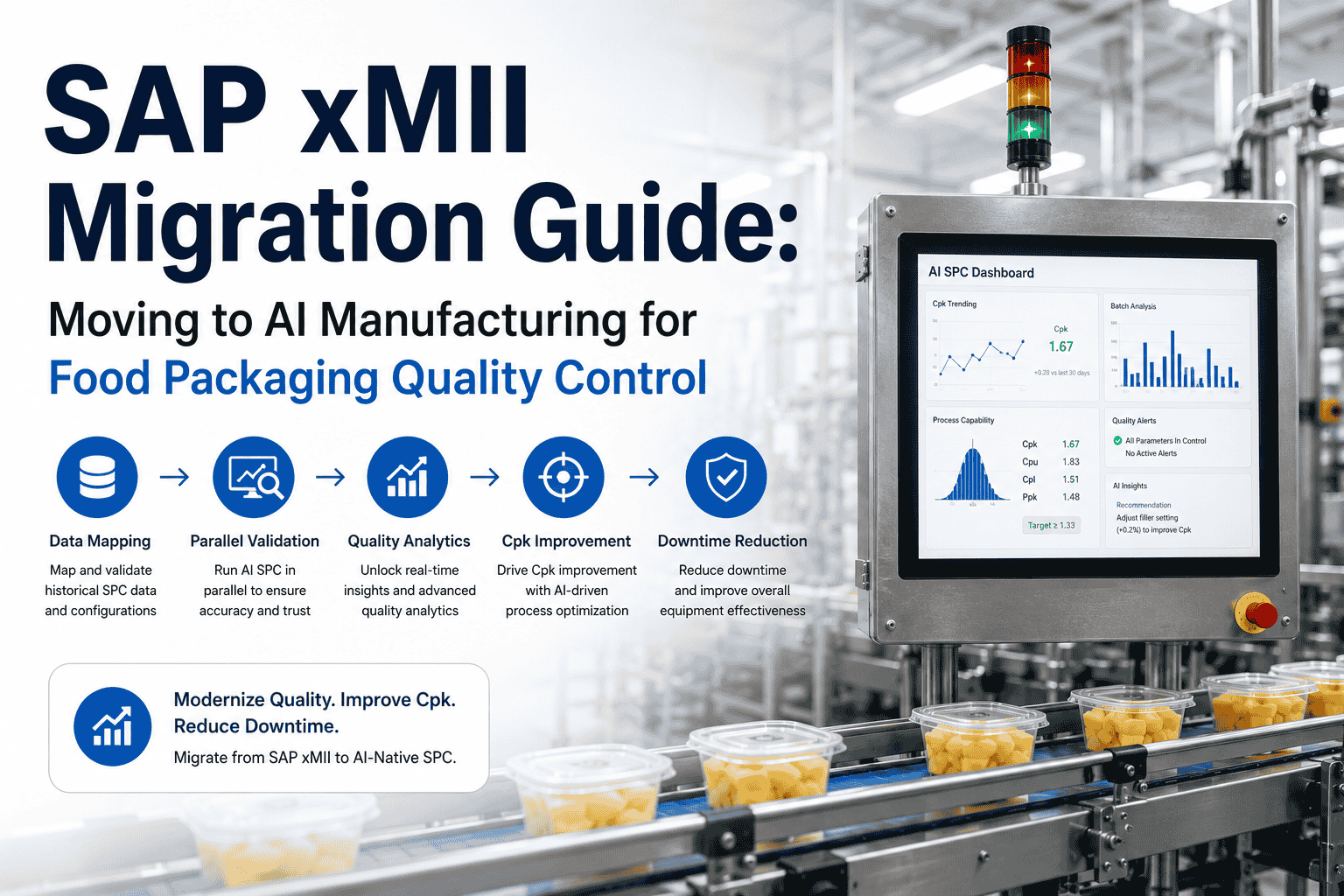
SAP confirmed mainstream support for SAP xMII ends December 31, 2027 — with paid extended support running to roughly 2030. By end of 2024, only 39% of SAP's 35,000 ECC customers had completed S/4HANA migration. The xMII timeline is identical, and consulting rates for SAP specialists are already up 20% with another 30-50% projected by 2027 as the window narrows. For food & beverage manufacturers, this isn't just an IT deadline. xMII often runs the SPC charts, HACCP integration, recipe management, and quality records that regulators (FDA, FSMA, allergen tracking) audit. The smart F&B teams have realized the migration question has two answers, not one: the MES question (SAP DMC, Plex, AVEVA, Proficy) is a 12-36 month decision; the AI intelligence layer (predictive SPC, computer vision, GenAI quality copilots) is independent and can deliver value in 6-12 weeks per line. This guide breaks down the two-track approach, the SPC capability gap, F&B compliance requirements, the migration inventory framework, and the AI-native SPC modernization path. Book an AI SPC migration workshop for your plant.
Current State
SAP xMII
Rule-based SPC
Static control limits
Manual quality records
EOL Dec 2027
Track A
AI Intelligence Layer
6-12 weeks / line
Deploy NOW · predictive SPC · adaptive limits · computer vision · GenAI copilots
Track B
MES Replacement
12-36 months
SAP DMC · Plex · AVEVA · Proficy · F&B-specific platforms · separate timeline
Destination
AI-Native Manufacturing
Predictive SPC
Adaptive HACCP
Vision quality
GenAI copilots
The 2027 Deadline · What's Forcing F&B Migration Now
Five forces are pushing F&B SAP xMII migrations into the 2026-2027 window. Wait beyond Q3 2026 and you're racing rising consultant rates, shrinking partner capacity, and a compressed delivery window. The cost of starting now versus starting late typically differs by 40-60% in migration spend.
01
SAP Mainstream Support EOL Dec 2027
Hard deadline. Extended paid support runs to ~2030 but with no new features, no roadmap, and rising fees. 61% of SAP customers still face this pressure — partner capacity is already constrained.
02
Consulting Rates Up 20%, Climbing 30-50%
SAP specialist rates rose ~20% from 2023-2025. Multiple analysts project another 30-50% increase by 2027 as remaining migrations compress into a shrinking window. Earlier starts cost less.
03
F&B Compliance Stakes Are High
xMII often holds SPC charts, HACCP CCP records, allergen genealogy, and quality release data. FDA, FSMA, and recall traceability all audit these records. Compliance gaps during migration = regulatory exposure.
04
AI-Native Is a Generational Capability Leap
Rule-based SPC catches yesterday's problems. Predictive SPC catches tomorrow's. Adaptive control limits, computer vision for foreign object detection, and GenAI quality copilots aren't xMII features — they're AI-native platform DNA.
05
Two-Track Approach Removes the Trade-Off
F&B teams used to choose: rush the MES decision or wait years for AI benefit. The two-track approach delivers AI intelligence in 6-12 weeks per line while MES selection plays out separately. No trade-off needed.
SAP xMII vs AI-Native Manufacturing · The Capability Gap
The migration from xMII isn't just a technology refresh — it's a generational capability leap. The comparison below shows what changes at every layer, from how SPC limits are set to how operators get answers. Each row represents a capability gap that compounds across thousands of decisions per shift.
Capability
SAP xMII (Legacy)
AI-Native Platform
F&B Impact
SPC Control Limits
Static · manually set
Adaptive · context-aware
Fewer false alarms · catches drift earlier
Quality Detection
Sensor + manual checks
Computer vision + sensor fusion
Foreign objects · fill weight · seal integrity
Operator Guidance
Static SOPs in binder
GenAI Copilot · context-aware answers
Faster troubleshooting · less tribal knowledge
HACCP Monitoring
Threshold breach alerts
Predictive CCP forecasting
Prevent CCP violations vs report them
Recipe Variation
Ingredient + parameter logs
Process simulation + digital twin
Test new recipes virtually before runs
Architecture
NetWeaver · on-prem · monolith
Event-driven · hybrid · API-first
Faster integration · cleaner upgrades
Support & Roadmap
EOL Dec 2027 · no new features
Continuous AI model updates
No more capability ceiling
Close the SAP xMII Capability Gap Before 2027
iFactory's F&B AI SPC migration practice delivers the AI intelligence layer in 6-12 weeks per line — predictive SPC, adaptive HACCP, computer vision quality, and GenAI operator copilots — while your MES decision plays out separately. Don't wait 36 months for AI value.
The Two-Track Migration Approach
The single most important insight for F&B xMII migration in 2026: don't try to answer "what replaces xMII?" with one platform. Treat the AI intelligence question and the MES execution question as separate decisions on separate timelines. The framework below shows what each track owns, why F&B specifically benefits from the split, and how the two tracks converge.
Track A
AI Intelligence Layer
6-12 weeks per line
Deploys on existing xMII infrastructure first, demonstrating value before MES migration completes. Predictive SPC, adaptive HACCP, computer vision quality, GenAI operator copilots. Data sovereign — on-premise appliance keeps F&B recipe IP and allergen records inside the plant.
What this track owns:
Predictive SPC + adaptive control limits
Computer vision for fill / seal / foreign objects
GenAI operator copilots
HACCP CCP forecasting
Recipe variation digital twin
Track B
MES / Execution Replacement
12-36 months
Separate decision on its own timeline. Evaluate SAP DMC, Plex, AVEVA, GE Proficy, or F&B-specific platforms. Handles production execution, ERP integration, work order management, and the ISA-95 Level 3 functions xMII previously delivered.
What this track owns:
Work order dispatch + production execution
ERP integration (B2MML / REST)
Equipment master data + routings
OEE + downtime classification
Compliance records + traceability
Want a two-track migration plan tailored to your F&B operations? Book a migration workshop with our F&B advisory team.
F&B Compliance · HACCP, FDA, Allergens, Recipe IP
Food & beverage compliance requirements shape the migration architecture more than they shape any other vertical. Data sovereignty for recipes, immutable HACCP records, allergen traceability, and FDA-recognized validation aren't features you bolt on later — they're constraints that determine which platform fits and how the AI layer is deployed.
Compliance 01
HACCP & Critical Control Points
Every CCP (cook temperature, pH, time-temperature combinations) needs continuous monitoring and immutable records. AI-native platforms forecast CCP excursions hours in advance instead of just reporting threshold breaches.
Predictive CCP · immutable logs · deviation forecasting
Compliance 02
FDA FSMA & Traceability
FSMA Rule 204 mandates one-up/one-down traceability with electronic records. xMII genealogy records must migrate cleanly — lost lineage data is a recall-readiness gap that regulators will find on audit.
FSMA 204 · one-up/one-down · electronic records
Compliance 03
Allergen Cross-Contamination
Major allergens (Big 9 in US) require validated cleaning between runs and audit-ready segregation records. AI-native platforms model cross-contamination risk in real time across shared lines — beyond static cleaning schedules.
Big 9 allergens · cleaning validation · risk modeling
Compliance 04
Recipe IP & Data Sovereignty
F&B recipes are competitive crown jewels. Cloud-hosted SPC modules raise data residency questions. On-premise AI intelligence layer keeps recipe IP, formulation parameters, and process settings inside the plant.
On-premise AI · recipe IP protection · sovereign data
Need an F&B compliance review for your migration? Connect with our food safety advisors for a tailored compliance map.
Migration Inventory · Rationalize Before You Rebuild
The single most important input before committing to a migration path is an honest inventory of the custom logic your xMII deployment is carrying — BLS transactions, query templates, MDOs, KPIs, SAPUI5 pages. That inventory determines whether your migration is 12 months or 36. The 4-quadrant framework below is what experienced migration teams apply consistently to cut scope by 50-70%.
~40-52%
RETIRE
Logic that's unused, duplicated across plants, or solving problems that no longer exist. Massive plant-by-plant duplication is the norm in multi-site xMII deployments.
Action: kill it · don't rebuild
~28-32%
REPLACE
Standard capabilities (OEE, SPC, downtime classification, production reporting) that ship out-of-the-box in modern AI-native or SAP DM platforms. No custom rebuild needed.
Action: configure native · don't port
~3-8%
KEEP
Transitional bridges that need to keep working during the migration window. Plan their eventual retirement once the new platform reaches full parity.
Action: maintain · plan sunset
Need a rationalized inventory of your xMII deployment? Book an inventory workshop with our migration architects.
Expert Perspective
The F&B manufacturers handling the SAP xMII transition best in 2026 are the ones who recognized early that the "MII replacement" question has two answers, not one. The MES question — what platform handles production execution and ERP integration — is SAP DMC, Plex, AVEVA, Proficy, or a category-specific F&B platform. The AI question — what platform handles adaptive SPC, predictive recommendations, and shop-floor intelligence — is an AI intelligence layer that's deliberately independent of the MES. Treating these as one decision forces compromise on both. Treating them as two separate decisions lets you optimize each on its own timeline. For F&B specifically, the on-premise data sovereignty requirement is the strongest argument for the AI intelligence layer being a separate, plant-resident system rather than a feature of the cloud MES. Food safety records, allergen tracking, and recipe IP have data residency requirements that get cleaner with on-prem AI than with cloud-hosted MES SPC modules. The 2027 deadline forces the MES decision; the AI intelligence layer decision is independent and can deliver value while the MES decision is still being made.
— F&B Manufacturing Architecture Practice, 2026
Dec 2027
SAP xMII mainstream support EOL
39%
SAP customers migrated by end 2024 (Gartner)
50-70%
Scope reduction via inventory rationalization
+11%
First-pass yield improvement · AI SPC layer year 1
Bottom Line · Start Track A Now, Time Track B Right
The SAP xMII migration window for F&B manufacturers is narrowing fast. December 2027 is hard. Consulting capacity is already constrained. Specialist rates climb 30-50% by 2027. The teams that lead this transition aren't the ones rushing a single mega-platform decision — they're the ones running the two-track approach. Track A (the AI intelligence layer) deploys in 6-12 weeks per line and starts delivering predictive SPC, adaptive HACCP, computer vision quality, and GenAI operator copilots while your MES selection plays out on its own 12-36 month timeline. Track B (the MES replacement) gets evaluated properly without compromise. Both converge into AI-native manufacturing — but Track A's value compounds for 24+ months before Track B even completes. For F&B specifically, on-premise AI keeps recipe IP and allergen records inside the plant where compliance auditors expect them. Rationalize the xMII inventory before rebuilding. Start Track A now. Time Track B right. The deadline is a forcing function, not a trap — for the manufacturers that move first.
Run the Two-Track F&B Migration That Beats the 2027 Deadline
iFactory's F&B AI SPC migration practice delivers Track A — predictive SPC, adaptive HACCP, computer vision quality, GenAI copilots — on existing xMII infrastructure in 6-12 weeks per line, while your MES decision plays out separately. On-premise AI keeps recipe IP and allergen records sovereign. Built for the 2027 deadline, designed for the next 10 years.
Frequently Asked Questions
When does SAP xMII support actually end?
December 31, 2027 for mainstream maintenance and support — confirmed by SAP. Extended (paid) support runs to ~2030 with no new features and rising fees. Migration timelines run 12-36 months depending on custom logic volume. SAP specialist rates already up 20% since 2023, with another 30-50% increase projected by 2027 as the window narrows. Start before Q3 2026 to avoid the capacity crunch.
What is the two-track migration approach for F&B?
Track A: AI intelligence layer (predictive SPC, adaptive HACCP, computer vision, GenAI copilots) deploys in 6-12 weeks per line on existing xMII infrastructure. Track B: MES replacement (SAP DMC, Plex, AVEVA, Proficy, F&B-specific platforms) runs separately on its own 12-36 month timeline. Treating these as two decisions, not one, lets you optimize each — and start delivering AI value immediately instead of waiting for MES completion.
How does AI-native SPC differ from SAP xMII SPC?
xMII SPC uses static, manually-set control limits — the same limits regardless of context. AI-native SPC uses adaptive control limits that account for product, line, shift, and historical patterns — fewer false alarms, earlier drift detection. Adds computer vision for fill/seal/foreign objects, predictive HACCP forecasting (prevent vs report), and GenAI operator copilots for SOP guidance. xMII reports yesterday's problems; AI-native catches tomorrow's.
What compliance requirements drive F&B migration architecture?
Four requirements shape every F&B migration: 1) HACCP CCP monitoring (predictive vs reactive), 2) FSMA Rule 204 traceability (one-up/one-down electronic records), 3) Allergen segregation (Big 9 allergens, cleaning validation), 4) Recipe IP data sovereignty (on-premise preferred for recipe formulations and process parameters). Cloud-hosted SPC modules raise data residency questions; on-premise AI intelligence layer keeps F&B IP and audit records inside the plant.
How do I inventory my xMII deployment before migration?
Apply the 4-quadrant framework: RETIRE (~40-52%) — unused, duplicated, obsolete logic. REPLACE (~28-32%) — standard OEE/SPC/reporting that ships out-of-box in modern platforms. TRANSFORM (~17-22%) — genuinely differentiating logic redesigned as clean-core APIs. KEEP (~3-8%) — transitional bridges. Catalog BLS transactions, xMII queries, MDOs, KPIs, SAPUI5 pages. Rationalization typically cuts migration scope by 50-70%.
Book an inventory workshop with our migration architects.