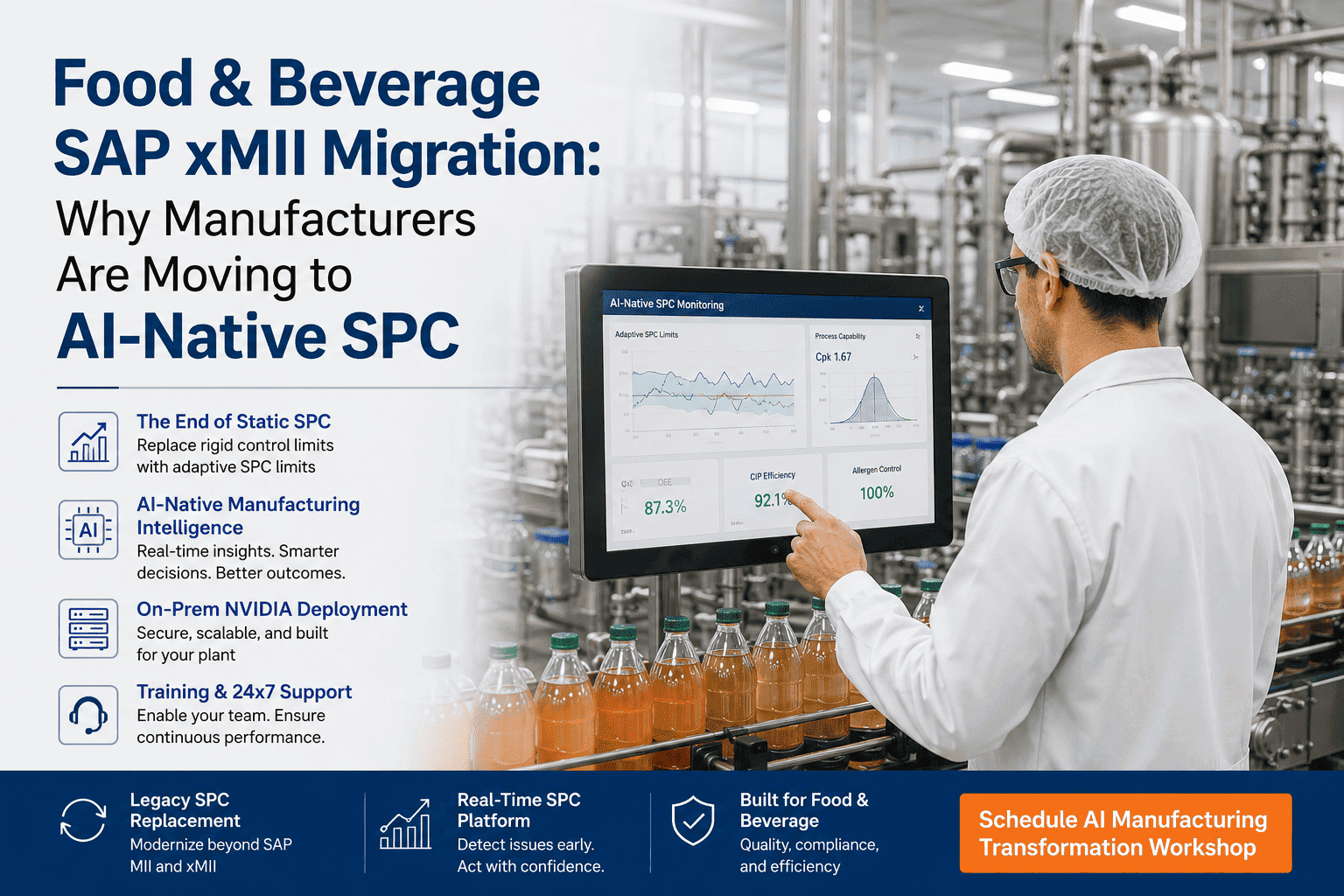
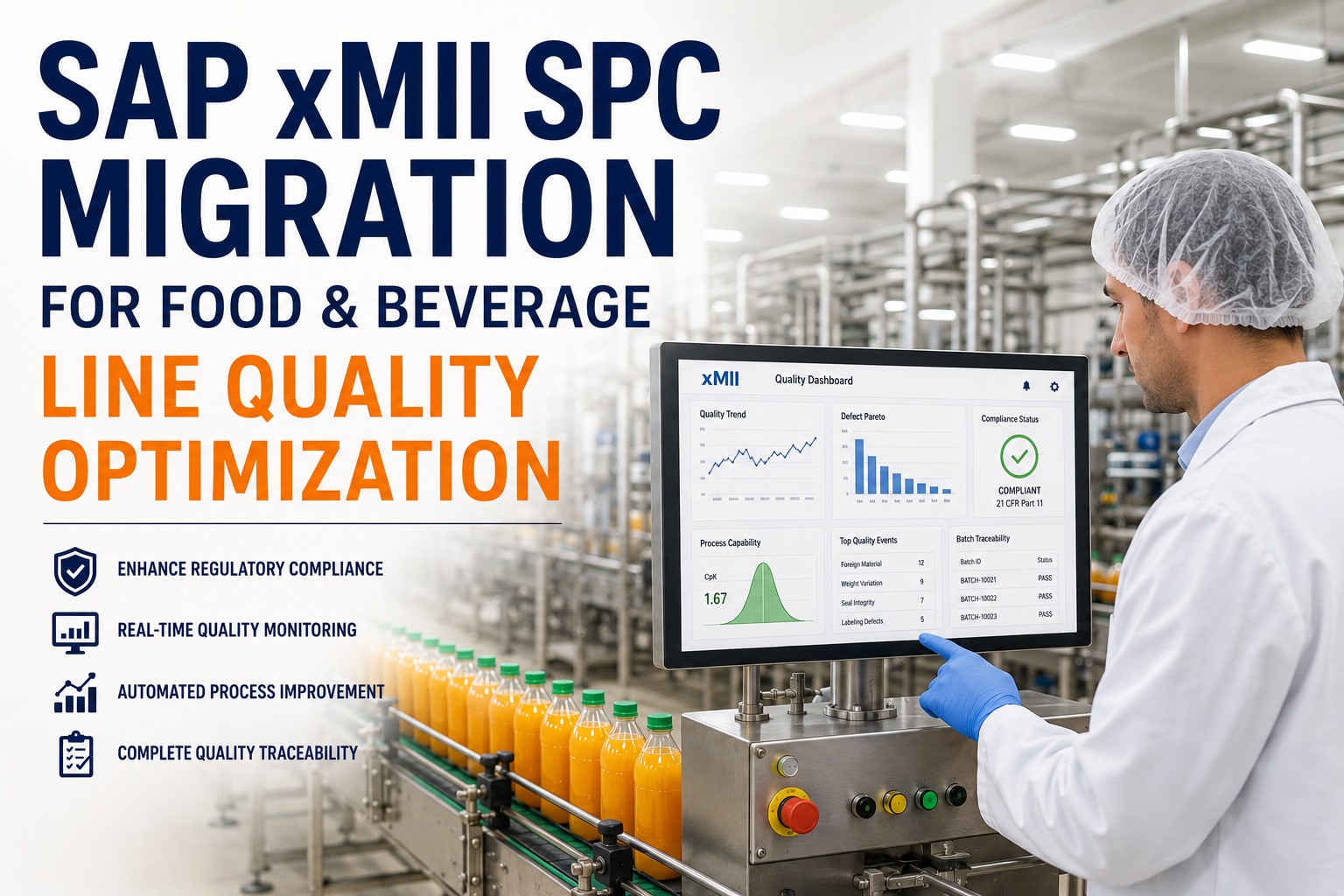
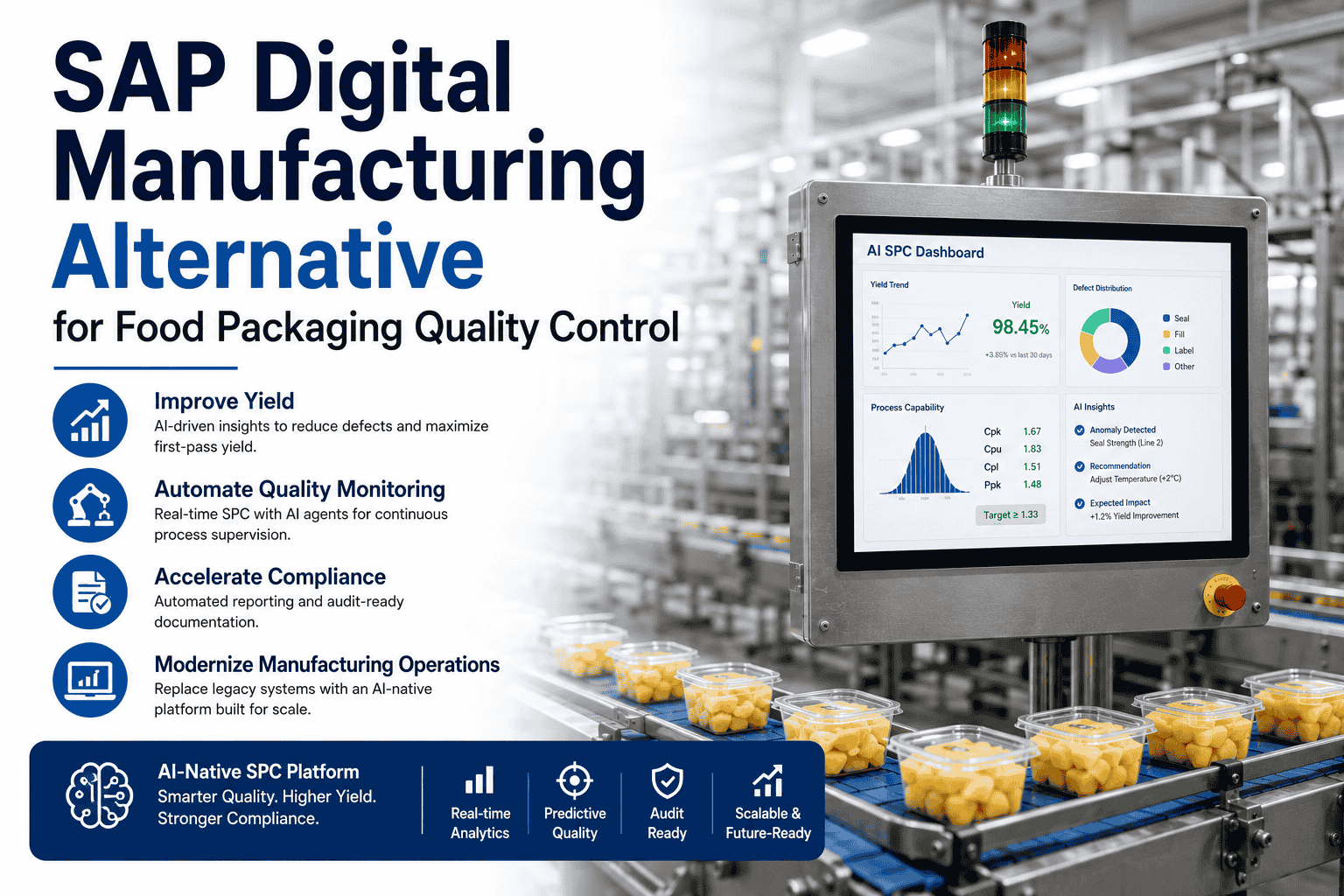
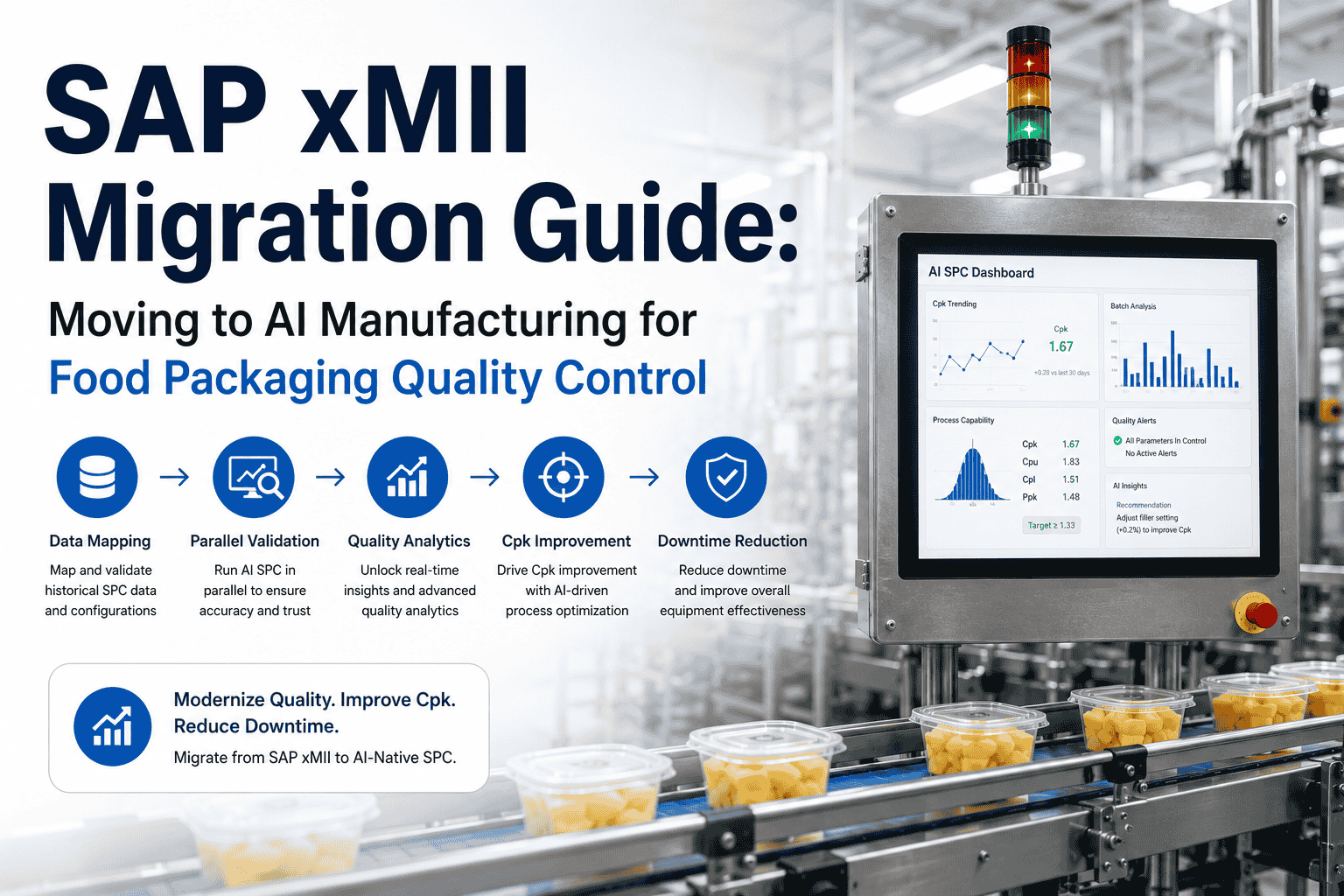
SAP xMII and MII mainstream maintenance ends December 31, 2027 — and the static SPC era ends with it. The control charts that food & beverage supervisors have used for decades were built when quarterly limit recalculation was state of the art. They can’t adapt to seasonal milk variability, allergen changeovers, CIP cycle drift, or the day-to-day variance every shift supervisor knows is real but the legacy SPC system can’t see. AI-native SPC with adaptive limits isn’t a feature upgrade to MII — it’s a paradigm shift. iFactory AI is the on-premise NVIDIA-deployed platform F&B manufacturers are choosing to replace legacy SPC, SAP MII, and xMII with adaptive AI-driven process control. Schedule an AI manufacturing transformation workshop to map your specific migration path before 2027 consulting capacity tightens.
SAP xMII Migration · F&B Supervisors
The End of Static SPC. The Start of Adaptive AI.
SAP MII/xMII mainstream maintenance ends Dec 31, 2027. F&B supervisors face three migration paths — SAP DMC, extended maintenance, or AI-native replacement. iFactory AI delivers adaptive SPC limits, on-prem NVIDIA deployment, training, and 24×7 support on your existing PLC/SCADA stack.
Dec 2027SAP MII/xMII mainstream end-of-life
12–36 motypical migration timeline
30–50%specialist rate increases projected 2026–27
Three Migration Paths
01
SAP Digital Manufacturing Cloud
Cloud-only, re-platform required, 12–36 mo
SAP’s default
02
Extended maintenance to 2030
Premium pricing, no new features, accumulating debt
Defer
03
iFactory AI: On-prem AI-native SPC
Adaptive limits, NVIDIA deployment, 6–12 wk per line
Recommended
Why Static SPC Is Ending — And Why That Matters for Supervisors
Static SPC was state of the art when SAP xMII launched in 2005. Control limits got recalculated quarterly, BLS transactions queried plant data into spreadsheet-style charts, and supervisors interpreted patterns by eye. Twenty years later, the food & beverage manufacturing reality looks different. Allergen changeovers happen weekly. CIP cycles drift between sanitation audits. Incoming milk fat varies 3.4–4.2% by season and farm. Beverage formulations shift across SKUs. Supervisors need control limits that adapt to current conditions, not limits set quarterly that force operators to choose between alarm fatigue (tight limits) or tolerance-eating (loose limits).
Then · Static SPC
Built for stable, single-product lines
Quarterly limit recalculation by quality engineers
BLS transactions and xMII queries pulling SCADA data
Supervisors interpret Western Electric rules by eye
CAPA initiated after out-of-spec event
Limits don’t account for allergen changeovers
→
Now · Adaptive AI-Native SPC
Built for multi-SKU, allergen-aware, CIP-frequent lines
Limits adapt continuously to current conditions
On-prem NVIDIA AI server processes data at the edge
Western Electric & Nelson rules automated 24×7
Preventive intervention before defect occurs
Changeover-aware limits adjust per product
The Three Migration Paths Supervisors Must Evaluate
SAP MII/xMII end-of-life forces a decision that isn’t optional. Mainstream maintenance ends December 31, 2027. After that date, SAP releases no fixes, no security patches, no compliance updates. For regulated F&B environments, an unsupported manufacturing intelligence platform creates active audit risk — not theoretical future risk. Each migration path carries different implications for supervisors managing shift outcomes, operator effectiveness, and quality KPIs.
01
SAP Digital Manufacturing Cloud (DMC)
SAP’s default replacement path
Pro: Native SAP integration with S/4HANA
Pro: SAP-supported migration tooling
Con: Cloud-only — on-prem deployment unavailable
Con: 12–36 month re-platforming effort
Con: Static SPC retained, no adaptive limits
Con: BLS transactions require complete rewrite
Fit: Manufacturers already cloud-first, accepting same SPC paradigm
02
Extended Maintenance to 2030
Defer the migration decision
Pro: No immediate migration cost
Pro: Existing customizations continue running
Con: Premium maintenance pricing
Con: No new features, no roadmap investment
Con: Audit risk in regulated F&B environments
Con: 30–50% specialist rate increases through 2026–27
Fit: Manufacturers with active SAP roadmap discussions or M&A pending
03
iFactory AI: AI-Native Replacement
Modern best-of-breed AI manufacturing intelligence
Pro: Adaptive SPC limits replace static charting
Pro: On-prem NVIDIA deployment (data sovereignty)
Pro: 6–12 week per-line deployment, not 12–36 mo
Pro: Layers on existing PLC/SCADA, no rip-and-replace
Pro: Integrates with S/4HANA via standard APIs
Pro: Training & 24×7 support included
Fit: F&B manufacturers wanting modern SPC, on-prem control, and fast deployment
Need help mapping these three paths against your specific MII/xMII implementation? Schedule a transformation workshop — 90 minutes with your supervisor team produces a documented migration recommendation.
What Changes for F&B Supervisors with AI-Native SPC
The transition from static MII-based SPC to adaptive AI-native SPC changes the supervisor’s daily reality in five concrete ways. The shift report becomes richer because pattern detection runs continuously instead of at quarterly chart reviews. Operator effectiveness becomes measurable because alert quality and response patterns get tracked. Allergen and CIP changeovers stop being SPC blind spots. The escalation path to plant management becomes data-driven instead of intuition-driven. And the time supervisors spend interpreting charts gets redirected toward operator coaching and quality improvement.
Before: Manual chart review at start-of-shift, supervisor interprets patterns by eye, written log of perceived issues
After: AI-generated shift digest with patterns detected, recommendations made by operators, and open issues for next shift
Change 02
Operator Coaching
Before: Coaching based on observed performance, supervisor judgment, retrospective complaint reviews
After: Coaching grounded in alert response patterns, recommendation acceptance rates, and operator-specific learning opportunities
Change 03
Allergen Changeovers
Before: Static SPC limits don’t adjust for allergen changeovers, supervisors monitor manually for cross-contact risk
After: Adaptive limits adjust per product run, allergen-aware AI flags cross-contact risk before changeover completion
Change 04
CIP Verification
Before: CIP cycle pass/fail status, ATP swab results, post-event re-clean decisions
After: Predictive CIP pass probability, condition-based cycle optimization, re-clean prevention recommendations
Change 05
Plant Manager Escalation
Before: Verbal escalations, supervisor intuition, retrospective root cause investigation
After: Documented pattern history, probability-weighted risk scoring, intervention windows quantified with specific recommendations
Map the Supervisor Workflow Transition
A transformation workshop walks through your current supervisor workflow with MII/xMII and produces a documented transition plan to AI-native SPC. Includes shift report templates, operator coaching frameworks, and CIP verification protocols tuned to your specific F&B production environment.
iFactory AI vs SAP DMC vs Extended Maintenance — Side-by-Side
Strategic comparison decisions need a defensible documentation trail. The comparison below covers the dimensions F&B supervisors and their plant managers evaluate when choosing migration path: deployment model, SPC paradigm, integration scope, timeline, support model, and audit posture. iFactory AI’s strongest differentiation is the combination of on-premise NVIDIA deployment with adaptive AI-native SPC — neither SAP DMC nor extended maintenance offers that combination.
← Swipe to see all columns →
The iFactory AI Platform — What Supervisors Get on Day 1
iFactory AI deploys as an on-premise NVIDIA appliance that connects to your existing PLC and SCADA infrastructure via standard OPC-UA, Modbus, and MQTT protocols. No PLC code changes. No SCADA reconfiguration. Within 6–12 weeks per line, supervisors transition from static MII charts to adaptive AI-native SPC running on-prem with full data sovereignty. The platform comes with training, 24×7 support, and integration assistance for your specific F&B production environment.
01
Adaptive SPC Limits
Control limits learn current conditions continuously. Per-product, per-shift, per-line adaptation. Western Electric and Nelson rules automated across every chart, every second. Eliminates the quarterly limit recalculation overhead from MII.
02
On-Prem NVIDIA Deployment
Pre-configured NVIDIA AI server installed in plant network. Data stays on-premise, addressing food safety and IP sovereignty requirements. Standard OPC-UA, Modbus, MQTT connectivity to existing automation. No cloud dependency for core SPC operation.
03
CIP & Allergen Intelligence
Condition-based CIP cycle optimization. ATP-pass probability prediction. Allergen-aware adaptive limits adjust per product changeover. Cross-contact risk flagged before next batch begins. Integrated with downstream batch quality SPC.
04
Supervisor Workflow Tools
Shift digest with pattern history, operator coaching dashboards with alert response analytics, escalation packages for plant manager review, and changeover-aware monitoring. Designed for the supervisor role, not adapted from operator screens.
05
S/4HANA & ERP Integration
Standard API integration with S/4HANA, ECC, and major MES platforms. Quality records flow into existing QMS (SAP QM, ETQ, Rockwell PharmaSuite). FSMA 21 CFR 117 Subpart C preventive control documentation generated automatically.
06
Training & 24×7 Support
Operator training, supervisor workflow training, and engineering-level training included. 24×7 support during deployment and operation. Quarterly platform tuning reviews. Continuous learning models adapt to your production patterns automatically.
Migration Timeline — From MII/xMII to AI-Native SPC
The migration from MII/xMII to iFactory AI runs per-line, not big-bang. Most F&B manufacturers start with one critical line (typically a high-volume product or regulatory-sensitive batch) and expand once supervisors and operators validate the new SPC paradigm. The 6–12 week per-line timeline contrasts sharply with the 12–36 month timeline for SAP DMC migration — making it possible to complete a multi-line F&B plant migration well before the 2027 MII end-of-life deadline.
Phase 01
Workshop & Path Selection
Transformation workshop with supervisor & plant manager teams
Current MII/xMII implementation audited for migration scope
Migration path documented (DMC vs maintenance vs iFactory AI)
Pilot line selected based on impact and complexity
Phase 02
Pilot Deployment (6–12 wk)
NVIDIA appliance installed in plant network
PLC/SCADA tag mapping — no code changes
Shadow mode: AI runs alongside existing MII charts
Supervisor & operator training delivered
Phase 03
Multi-Line Rollout
Pilot line success criteria validated
Remaining lines onboarded in 6–12 wk waves
S/4HANA and QMS integration completed
Static MII charts decommissioned per line as AI replaces
Phase 04
MII/xMII Sunset
All production lines on iFactory AI
MII/xMII formally retired before 2027 deadline
Historical MII data archived per retention policy
Continuous platform tuning & quarterly reviews
Expert Perspective
"The hardest part of the SAP xMII migration decision for F&B manufacturers isn’t the technical comparison — it’s recognizing that the SPC paradigm itself is changing. Manufacturers who treat this as a like-for-like replacement (MII to DMC, both with static SPC) are upgrading the platform but keeping the limitations. The plants getting real value from migration are the ones who recognize that adaptive AI-native SPC is fundamentally different from static SPC, and design the migration to capture that paradigm shift. Supervisors feel the difference within the first two weeks of operator transition. The alert quality is better, the false alarms drop, the missed drift gets caught, and operator coaching becomes data-grounded instead of intuition-driven. The 2027 deadline forces a decision either way — the question is whether to use the migration window to modernize or just re-platform the same paradigm. For F&B specifically, the regulatory environment is shifting toward preventive controls under FSMA 21 CFR 117 Subpart C, and adaptive AI-native SPC aligns with that direction in a way static SPC fundamentally can’t."
— F&B Manufacturing Modernization Practice, 2026 industry perspective
Dec 2027
SAP MII/xMII mainstream maintenance ends
6–12 wk
iFactory AI per-line deployment
39%
SAP ECC customers had migrated by end 2024 (Gartner)
Schedule Your AI Manufacturing Transformation Workshop
90 minutes with your supervisor and plant manager team produces a documented migration path: DMC vs extended maintenance vs iFactory AI mapped to your specific MII/xMII implementation. You leave with a per-line transition plan, pilot recommendation, and timeline aligned to your 2027 deadline. No engagement commitment required to participate.
Frequently Asked Questions
Is SAP xMII really being discontinued, or is this just a roadmap concern?
It’s a confirmed product lifecycle decision with published dates, not a roadmap concern. Mainstream maintenance for SAP MII and SAP ME ends December 31, 2027, with extended maintenance available through approximately 2030 at premium pricing. After mainstream end-of-life, SAP releases no new fixes, security patches, or compliance updates. For F&B manufacturers in regulated environments, an unsupported manufacturing intelligence platform creates active audit findings — not theoretical future risk. SAP’s migration message is clear: move to Digital Manufacturing Cloud (DMC). The same 2027 deadline also affects SAP PCo (the connectivity layer), BLS transactions, and xMII queries — the entire NetWeaver-based stack is sunsetting together.
Why would we choose iFactory AI over SAP DMC for migration?
Three primary reasons. First, deployment model: iFactory AI runs on-premise on NVIDIA appliances, addressing F&B data sovereignty requirements that cloud-only SAP DMC can’t meet. Many F&B manufacturers have IP and food safety policies that limit production data leaving the plant network. Second, SPC paradigm: iFactory AI delivers adaptive AI-native SPC with automated Western Electric and Nelson rule detection. SAP DMC retains the static SPC paradigm of MII, just on a different platform. Third, timeline: iFactory AI deploys per-line in 6–12 weeks, allowing a phased plant rollout. SAP DMC migration typically runs 12–36 months and requires re-platforming. For F&B manufacturers wanting modern SPC, on-prem control, and faster deployment — iFactory AI is the better fit. For manufacturers already cloud-first and comfortable with static SPC, SAP DMC remains a valid path.
What happens to our existing S/4HANA integration if we replace xMII with iFactory AI?
S/4HANA integration continues through standard APIs. iFactory AI provides connectors to S/4HANA, ECC, and major MES platforms (SAP, Rockwell, Wonderware/AVEVA, Honeywell). Quality records flow into existing QMS (SAP QM, ETQ, Rockwell PharmaSuite, MasterControl). Production execution data flows back to S/4HANA for cost rollup and inventory management. The integration approach uses modern REST APIs and standard ERP connectors rather than the legacy BLS/xMII Query stack — which means the integration is forward-compatible with S/4HANA upgrades after 2027 (when MII-based integrations become break points). For specific custom BLS transactions or xMII queries currently in production, the workshop includes a per-transaction migration assessment.
Our supervisors are familiar with MII charts. How disruptive is the transition?
The transition runs in shadow mode for 4–8 weeks per line, where AI-native SPC runs alongside existing MII charts. Supervisors continue using MII charts during this phase while observing AI-native pattern detection in parallel. Most supervisors transition to AI-native primary view within the first 30 days of shadow mode because the alert quality is observably better — fewer false alarms, more catches of drift that MII missed, recommendations that are actionable rather than cryptic. Training includes supervisor-specific workflow walkthroughs (shift digest, operator coaching, escalation packages) and is delivered as part of the deployment. The disruption is far smaller than typical MII upgrades because no PLC code changes, no SCADA reconfiguration, no operator HMI replacement is required.
Why is on-premise NVIDIA deployment important for F&B?
Three reasons specific to F&B. First, food safety data sovereignty: many F&B manufacturers have policies that limit production data leaving the plant network, particularly for allergen records, CIP verification, and PMO compliance documentation. On-prem deployment satisfies these policies without exception handling. Second, edge AI performance: adaptive SPC requires real-time inference on streaming process data — latency from cloud round-trips degrades the detection window operators need to intervene. On-prem NVIDIA processing eliminates the latency. Third, audit posture: regulatory inspections (FDA, USDA, FSMA) can require demonstrating where SPC data is processed and stored. On-prem deployment with documented data flow simplifies audit responses compared to cloud-hosted SPC where data crosses jurisdictional boundaries.
When should F&B manufacturers start the migration planning?
Now — mid-2026 is the latest reasonable start for a multi-line F&B plant. Three reasons. First, capacity tightening: SAP migration specialist rates have already risen 20% since 2023 and are projected to rise another 30–50% through 2026–27 as the remaining work compresses into a shrinking window. Plants starting late will pay premium consulting rates. Second, deployment time: per-line iFactory AI deployments run 6–12 weeks each. A typical F&B plant with 4–8 production lines needs 6–18 months for full migration with phased rollout. Starting in mid-2026 puts completion before the 2027 deadline. Starting in 2027 doesn’t. Third, audit risk: after December 31, 2027, running MII/xMII creates active audit findings in regulated F&B environments. Manufacturers want to be off MII before that deadline, not in the middle of migration.